
The prospect of humanoid robots integrating into our daily lives is transitioning from science fiction to a tangible technological frontier. Unlike their specialized counterparts confined to factories or specific tasks, humanoid robots promise a unique attribute: cross-scenario versatility. Their anthropomorphic form and bipedal locomotion are designed for seamless operation within environments built for humans, using tools made for human hands. This fundamental characteristic suggests a future of deep, collaborative integration, potentially fostering a human-machine symbiotic society. In such a society, legal governance cannot remain tethered to isolated, pre-defined scenarios. It must evolve into a more general, principled architecture that anticipates the novel challenges posed by entities that move, perceive, and interact like us, yet are fundamentally different in their cognitive and moral foundations. This article, from my perspective as a scholar examining this intersection, argues that the legal governance of the humanoid robot must be distinguished from that of robots in a general sense, precisely due to its cross-scenario application and the consequent centrality of two capabilities: situational awareness and emotion recognition. Building on this premise, I will design a basic legal governance framework aimed at balancing technological innovation with societal risk, establishing clear responsibility allocation, and ultimately forming rational incentives for the development of a safe and productive symbiotic future.
The journey towards the humanoid robot is as much an engineering challenge as it is a philosophical one. For millennia, humans have imagined artificial beings in our own image. Today, the focus is on replicating not consciousness, but the external morphology and behavior that allow for通用 operation in a human-centric world. The technical realization hinges on solving complex problems in bipedal locomotion, dexterous manipulation, and environmental interaction. Dynamically stable walking, for instance, is often achieved through control based on the Zero Moment Point (ZMP) criterion. The condition for dynamic stability can be expressed as the ZMP remaining within the support polygon defined by the feet:
$$ \text{ZMP} = (x_{zmp}, y_{zmp}) \in \text{Support Polygon} $$
where $x_{zmp}$ and $y_{zmp}$ are calculated from the robot’s total momentum. Similarly, achieving human-like dexterity in a robotic hand involves solving for joint torques ($\tau$) that enable both firm grasping and sensitive haptic exploration, often modeled through grasp quality metrics and contact force optimization.
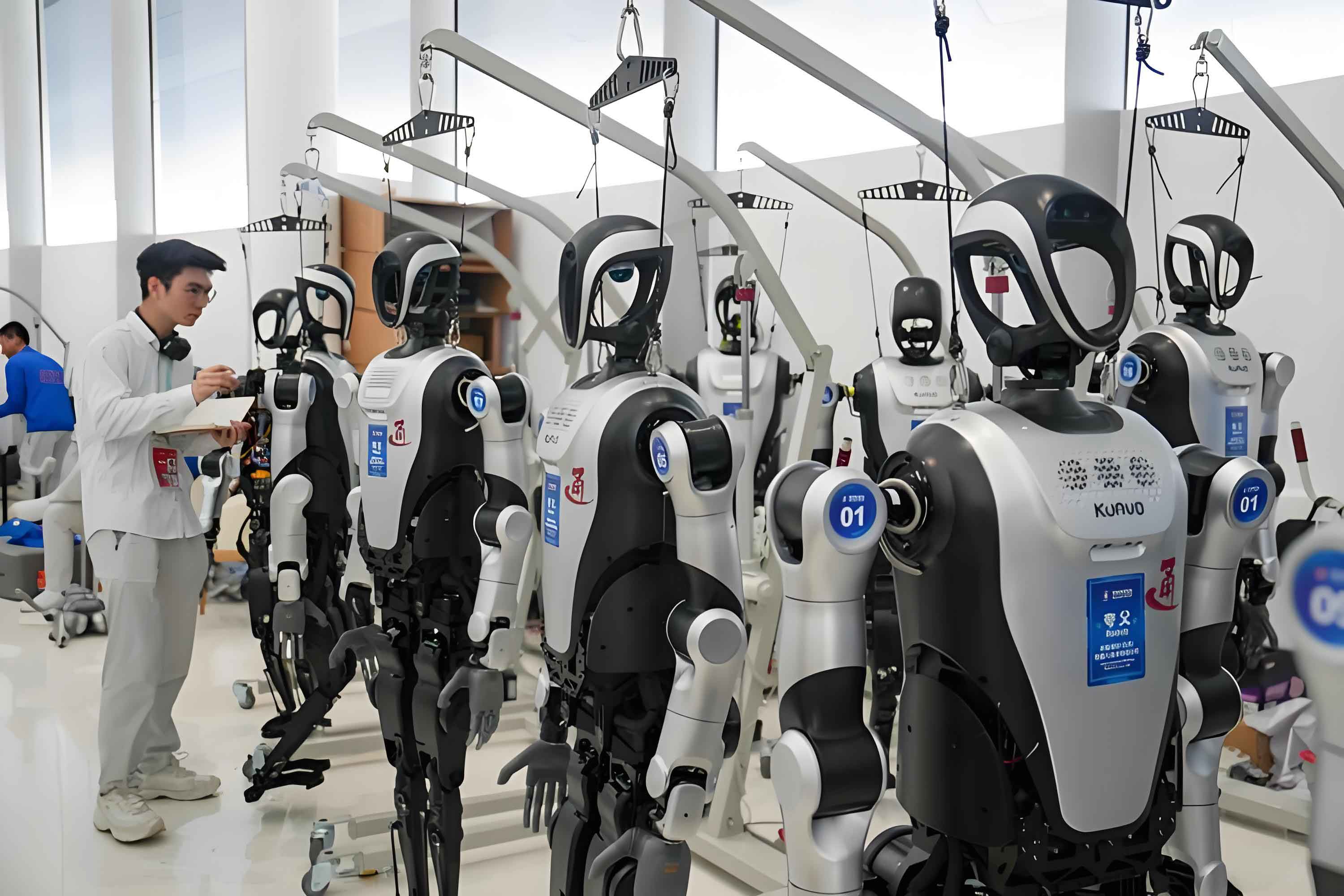
However, the true differentiator of the advanced humanoid robot is its perceptual and cognitive interface. To collaborate, it must move beyond pre-programmed paths and develop sophisticated situational awareness—the perception of environmental elements, comprehension of their meaning, and projection of their status in the near future. This relies on a sensor fusion model, integrating data from visual, auditory, and tactile sensors ($S_v, S_a, S_t$) into a coherent world model $M_t$ at time $t$:
$$ M_t = F(S_v(t), S_a(t), S_t(t), M_{t-1}, \Theta) $$
where $F$ is the fusion and estimation function, and $\Theta$ represents learned parameters. Concurrently, interaction requires emotion recognition, often implemented through affective computing models that classify emotional states $E$ from multimodal signals like facial expressions $F_e$, voice prosody $V_p$, and language $L$:
$$ P(E | F_e, V_p, L) = \frac{P(F_e, V_p, L | E) P(E)}{P(F_e, V_p, L)} $$
This Bayesian formulation underscores that the robot’s understanding is probabilistic and learned, not intrinsically experiential. This gap between human intuitive understanding and machine learned inference lies at the heart of its unique legal challenges.
Why, then, pursue the complex path of the humanoid robot when wheeled or single-arm robots suffice for many tasks? The argument extends beyond economics. While adapting environments for specialized robots has a cost, the primary value of the humanoid robot is its通用性 as a multi-task collaborator. It serves as a universal physical interface to the human world. This is not about replacing humans in niche applications but about creating a flexible partner capable of operating across the vast, unstructured spectrum of human activity. Its indispensability emerges not from excelling in one domain, but from being moderately competent in many, thereby enabling widespread integration. The following table contrasts key attributes:
| Feature | Specialized/Non-Humanoid Robot | General-Purpose Humanoid Robot |
|---|---|---|
| Morphology | Optimized for task (e.g., arm, wheeled base) | Anthropomorphic (bipedal, two arms, head) |
| Environment | Often structured or adapted | Built for humans, unstructured |
| Tool Use | Custom end-effectors | Can use standard human tools |
| Primary Legal Focus | Product liability, workplace safety | Cross-contextual torts, social interaction liability |
| Key Governance Challenge | Scenario-specific regulation | General framework for open-ended interaction |
When the humanoid robot becomes a commonplace collaborator, legal questions shift from the particular to the general. The core issues are no longer just about a robotic arm causing harm in a fenced cell or a delivery drone crashing. They concern an entity that shares our sidewalks, our homes, and our workspaces, interacting dynamically. From my analysis, two dimensions crystallize the unique legal character of the humanoid robot: the comprehensiveness of its cross-scenario human interaction, and its relative deficiencies in situational awareness and emotion recognition compared to human expectations.
First, consider situational awareness. Human perception and reaction are influenced by experience, intuition, and physiological state. The humanoid robot‘s awareness is a product of sensor data and algorithmic models. While it may process data faster and without fatigue, it lacks human-like intuition for novel or ambiguous situations. In tort law, the standard of care is often tied to the “reasonable person’s” ability to perceive risk and take cost-effective precautions. If a humanoid robot fails to detect a hazard a human would have seen, is the failure one of product design, user training, or environmental design? The legal benchmark for a robot’s “reasonable” perception cannot be identical to a human’s if its perceptual capabilities are fundamentally different. The calculus of negligence, where liability arises if the cost of prevention $B$ is less than the probability of harm $P$ multiplied by the loss $L$ ($B < P \times L$), becomes complex when $B$ is not a simple human action but a question of sensor acuity, algorithm training, and contextual understanding.
Second, and perhaps more subtle, is the issue of emotion recognition and social signaling. Human cooperation is laden with nuance, irony, sarcasm, and unspoken norms. A humanoid robot relying on probabilistic affective computing models may profoundly misinterpret social cues. An innocuous data-gathering question may be perceived as a privacy invasion; a programmed attempt at humor may be received as profound insensitivity. Because the humanoid robot looks and acts somewhat like a human, people will attribute to it a social agency and expect adherence to social norms. Violations of these expectations, even without physical harm, can lead to claims of dignitary torts, intentional infliction of emotional distress, or harassment. The robot’s inability to fully comprehend the social meaning of its actions creates a persistent risk of micro-conflicts and significant emotional harm.
Therefore, the legal governance architecture for the humanoid robot must be forward-looking and incentive-aligning. It should encourage innovation while managing the distinct risks stemming from its perceptual and social shortcomings. I propose a framework centered on dynamic responsibility allocation and risk prevention, moving away from pure producer-centric liability toward a more nuanced model that accounts for use context and user influence.
The framework rests on several pillars. Primarily, given the humanoid robot‘s通用性 and its learning capacity through interaction, the legal focus should shift significantly toward the user or deployer, rather than solely the manufacturer. The user, through continual interaction and task assignment, effectively “trains” the robot’s behavior in specific social and physical contexts. Thus, the user is often the “least-cost avoider” for many interaction-based risks.
This leads to a context-dependent liability matrix. For physical damage caused by a humanoid robot, the standard of care and liability should vary based on the environment:
| Operational Environment | Robot’s Expected Capability | Proposed Liability Rule for User/Deployer | Rationale |
|---|---|---|---|
| Unstructured “Non-Smart” Environment (e.g., general public sidewalk, home) | Limited situational awareness; operates with significant perceptual gap vs. humans. | Fault-Based Liability. User must exercise due care congruent with the robot’s known limitations. | Prevents stifling deployment while holding users accountable for reckless use. The “reasonable robot” standard is lower than the “reasonable person” standard here. |
| Structured “Smart” Environment (e.g., sensor-equipped warehouse, assisted-living facility) | Enhanced awareness via environmental sensors (IoT, beacons). Capability approaches or exceeds human perception in that domain. | Presumed-Fault (or Strict) Liability. User/deployer is liable unless they prove all reasonable precautions, including environmental safeguards, were taken. | The enabled high capability justifies a higher duty of care. Incentivizes investment in smart infrastructure for safety. |
Manufacturers have a crucial role in enabling this framework. They must clearly classify and label their humanoid robot products for intended environments (e.g., “For use only in smart industrial environments”). A “regulatory sandbox” approach is vital for testing and certifying these capabilities during development. If a manufacturer mislabels a robot or sells one unfit for its claimed operational context, they should face direct liability. Mandatory insurance schemes, similar to automotive insurance, should be established, with premiums tiered according to the operational environment classification, creating a financial risk pool for accidents.
For non-physical, social, or dignitary harms arising from a humanoid robot‘s poor emotion recognition or norm violations, the liability analysis differs. The key variable becomes the degree of social “training” or anthropomorphization encouraged by the user. The proposed rule can be summarized as:
Let $U$ be the user’s action set, where $U_{\text{tool}}$ denotes use as a mere tool (no social training), and $U_{\text{social}}$ denotes active socialization/personification of the robot. Let $H$ be a dignitary harm suffered by a third party $T$.
$$ \text{Liability}(User) =
\begin{cases}
0, & \text{if } U = U_{\text{tool}} \\
1, & \text{if } U = U_{\text{social}} \text{ and } H \text{ occurs, unless User proves exhaustive supervision}
\end{cases} $$
In essence, if a user deploys a humanoid robot purely as an intelligent appliance, they are not liable for its social faux pas, as no social agency is implied. However, if the user trains, programs, or presents the robot as a social companion or interface (e.g., a care robot for the elderly, a receptionist), they assume a responsibility akin to that of a guardian or owner of an animal with known propensities. They are liable for harms caused by the robot’s social interactions unless they can demonstrate having implemented all possible supervisory measures to prevent normative violations. This creates an incentive to either limit social programming or invest heavily in robust social intelligence training and monitoring.
In conclusion, the advent of the humanoid robot signifies more than a technical milestone; it heralds a new phase in human-machine cohabitation requiring a reimagined legal infrastructure. Governance cannot be an afterthought. It must be architected proactively, acknowledging that the humanoid robot is defined by its cross-scenario通用性 and characterized by its unique gaps in situational awareness and emotion recognition. The framework I propose moves beyond simple product liability toward a more distributed model of responsibility. It ties legal obligations and liability to the context of use (smart vs. non-smart environments) and the nature of the human-robot relationship (tool vs. social agent), enforced through clear manufacturer classifications, insurance mechanisms, and user duties. This approach seeks to balance a crucial equation: protecting human safety and dignity while fostering the innovation that will allow humanoid robot technology to mature and ultimately deliver on its promise of a truly collaborative, symbiotic society. The goal of law here is not to prevent the journey, but to ensure it is undertaken with a clear map and shared rules for the road ahead.