
As I reflect on the journey of AI human robots, it is clear that we stand at the precipice of a transformative era. These machines, designed to emulate human form and intelligence, are not merely tools but partners in reshaping our world. My exploration begins with the fundamental question: why focus on humanoid structures? The answer lies in their inherent adaptability to human environments. Unlike specialized robots, AI human robots can navigate stairs, use standard tools like hammers and scissors, and interact through facial expressions, voice, and body language. This mimicry reduces psychological barriers, fostering trust and natural interaction. For instance, in a laboratory setting, an AI human robot can accurately describe its surroundings, pick up objects, and engage in fluid dialogue, demonstrating advanced scene understanding and语音识别 capabilities. This is just the beginning; the potential spans from manufacturing to healthcare, driven by innovations in artificial intelligence, computer vision, and sensor technologies.
The historical context of AI human robots dates back to ancient legends, such as the tales of skilled artisans creating human-like automatons. Today, we have progressed from early prototypes like WABOT-1 to modern systems such as Tesla’s Optimus. This evolution underscores a critical insight: the human form is a universal key. By replicating our bipedal stance and dexterous hands, AI human robots achieve unparalleled versatility. They can perform complex tasks like writing, painting, and assembling components, all while integrating into existing infrastructures without costly modifications. As I delve deeper, it becomes evident that the synergy of AI and robotics is accelerating this progress. For example, the integration of machine learning algorithms allows these robots to learn from interactions, improving their decision-making over time. Consider the following formula representing a basic reinforcement learning model used in AI human robots:
$$ Q(s,a) \leftarrow Q(s,a) + \alpha \left[ r + \gamma \max_{a’} Q(s’,a’) – Q(s,a) \right] $$
Here, \( Q(s,a) \) denotes the expected reward for taking action \( a \) in state \( s \), with \( \alpha \) as the learning rate, \( r \) the immediate reward, and \( \gamma \) the discount factor. Such models enable AI human robots to adapt to dynamic environments, a cornerstone of their intelligence.
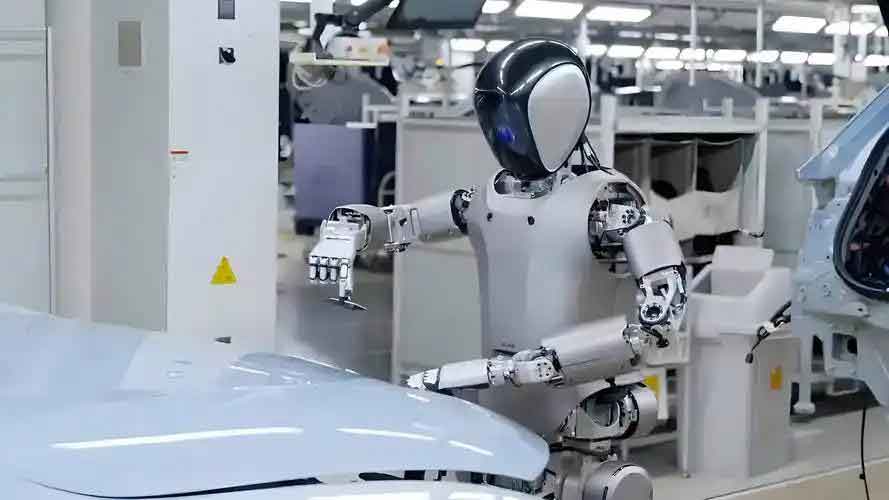
In terms of market dynamics, the growth trajectory for AI human robots is staggering. Projections indicate a compound annual growth rate of nearly 94% from 2025 to 2035, potentially reaching a market size of $154 billion by 2035. This boom is fueled by global trends like aging populations and declining birth rates, which heighten the demand for automated labor and companionship. As I analyze these trends, it is clear that AI human robots are poised to become ubiquitous in sectors ranging from industrial automation to personal care. The table below summarizes key application areas and their potential impact:
| Application Domain | Key Tasks | Expected Impact |
|---|---|---|
| Manufacturing | Welding, assembly, quality inspection | Increased efficiency and precision |
| Healthcare | Surgery assistance, rehabilitation, patient monitoring | Enhanced accuracy and personalized care |
| Logistics | Autonomous navigation, picking, packaging | Optimized supply chains |
| Education | Personalized tutoring, interactive learning | Improved accessibility and engagement |
| Emergency Response | Search and rescue in hazardous environments | Reduced human risk |
Policy support plays a pivotal role in this evolution. Governments worldwide are fostering innovation through funding, tax incentives, and international collaborations. For instance, initiatives like the National Robotics Initiative in the U.S. and similar strategies in Japan emphasize cross-sector partnerships to advance core technologies. In my assessment, such policies are crucial for overcoming technical hurdles and standardizing safety protocols. The integration of AI human robots into society requires robust frameworks to address ethical concerns, such as privacy and accountability. Moreover, the cost of development remains a significant barrier. Research and manufacturing involve high expenses for components like servos, sensors, and controllers. However, economies of scale and advancements in materials science promise to reduce these costs over time. The following formula illustrates a cost optimization model for producing AI human robots:
$$ C_{\text{total}} = \sum_{i=1}^{n} (C_{\text{material},i} + C_{\text{labor},i}) \times e^{-\lambda t} $$
Where \( C_{\text{total}} \) is the total cost, \( n \) is the number of units, \( C_{\text{material},i} \) and \( C_{\text{labor},i} \) are material and labor costs per unit, and \( \lambda \) represents the learning rate coefficient over time \( t \). This model highlights how iterative production can lead to affordability.
Technological advancements in AI human robots are accelerating at an unprecedented pace. The convergence of computer vision, natural language processing, and affective computing enables these machines to interpret and respond to human emotions. For example, by analyzing facial expressions and vocal tones, an AI human robot can simulate empathy, strengthening user bonds. In my experience, this emotional intelligence is powered by deep learning architectures. Consider a convolutional neural network (CNN) used for emotion recognition:
$$ \mathbf{y} = f(\mathbf{W} * \mathbf{x} + \mathbf{b}) $$
Here, \( \mathbf{x} \) is the input image data, \( \mathbf{W} \) represents the weight matrix, \( \mathbf{b} \) the bias vector, and \( f \) the activation function. Such models allow AI human robots to decode subtle cues, making interactions more intuitive. Additionally, motion control relies on sophisticated algorithms for balance and coordination. The dynamics of a bipedal AI human robot can be modeled using the Lagrangian formulation:
$$ L = T – U $$
Where \( T \) is the kinetic energy and \( U \) the potential energy of the system. By minimizing the action integral \( S = \int L \, dt \), we derive equations of motion that ensure stable gait patterns. These mathematical foundations are essential for real-world applications, such as navigating uneven terrain or manipulating objects with precision.
The competitive landscape for AI human robots is shaped by regional strengths. In some regions, complete supply chains and manufacturing capabilities provide a solid foundation for mass production. A robust demand for automation, coupled with rapid innovation in AI and IoT, fuels this growth. For instance, the deployment of AI human robots in scenarios like automotive assembly lines demonstrates their practical utility. They can perform repetitive tasks with high accuracy, reducing errors and enhancing productivity. The table below compares different technological components critical to AI human robot development:
| Technology Component | Description | Current Challenges |
|---|---|---|
| Computer Vision | Enables object recognition and scene analysis | Real-time processing in dynamic environments |
| Natural Language Processing | Facilitates human-robot communication | Understanding context and sarcasm |
| Sensor Fusion | Integrates data from multiple sensors | Noise reduction and data alignment |
| Actuation Systems | Controls limb movements and gestures | Achieving human-like fluidity |
Looking ahead, the future of AI human robots hinges on addressing four core challenges: safety, intelligence, cost, and regulation. From my perspective, safety is paramount; robots must operate reliably without causing harm. This involves rigorous testing and fail-safe mechanisms. Intelligence, on the other hand, requires continuous learning. AI human robots should evolve through experience, much like humans. Reinforcement learning, as mentioned earlier, is key here. Cost reduction will come from innovations in modular design and open-source platforms. Finally, ethical guidelines must be established to govern deployment, ensuring transparency and fairness. The potential of AI human robots to revolutionize industries is immense, but it demands collaborative efforts across academia, industry, and government.
In conclusion, as I envision the path forward, AI human robots represent a paradigm shift in how we interact with technology. Their ability to blend into human ecosystems, coupled with advancing AI, positions them as catalysts for societal transformation. Whether in factories, hospitals, or homes, these machines will augment our capabilities, addressing global challenges like labor shortages and healthcare access. The journey of AI human robots is one of continuous innovation, and I am optimistic that with sustained effort, we will unlock their full potential, creating a future where humans and robots coexist synergistically.