
The advent of advanced humanoid robots marks a pivotal moment in the evolution of Human-Computer Interaction (HCI). As a quintessential embodiment of embodied AI, the humanoid robot transcends its predecessors by integrating a human-like form with sophisticated cognitive and behavioral capabilities. This convergence is reshaping the very fabric of interaction, moving beyond utilitarian command-response loops toward nuanced, context-aware partnerships. This article analyzes the transformative impact of humanoid robots on HCI paradigms, scrutinizes the multifaceted technical risks emerging from their core technologies, and proposes a framework for their responsible integration into society.
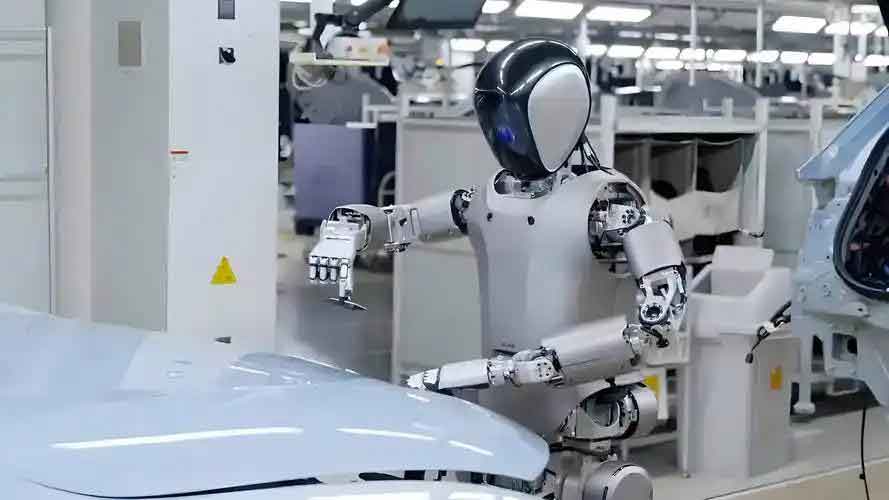
The transition from disembodied to embodied interaction represents the first fundamental shift. Traditional interfaces act as barriers, but the humanoid robot‘s physical presence enables a direct, co-present engagement. The body becomes the primary interface, facilitating a bidirectional flow of information and affect with minimal transmission loss. This creates a new morphology of interaction where human, machine, and environment achieve perceptual resonance. The following table contrasts the traditional and humanoid robot-mediated paradigms:
| Dimension of Interaction | Traditional HCI Paradigm | Humanoid Robot-Mediated Paradigm |
|---|---|---|
| Bodily Engagement | Disembodied; screen/device as mediator. | Embodied; physical co-presence as mediator. |
| Informational Flow | Uni-/bi-directional through an interface. | Multi-directional and ambient through shared physical space. |
| Affective Cue Transmission | Limited, often symbolic (emojis, avatars). | Rich, utilizing multimodal signals (gesture, tone, gaze). |
| Environmental Integration | User bridges digital and physical worlds. | Robot actively perceives and acts within a shared physical world. |
This embodiment is mathematically modeled through a sensorimotor integration function, where the robot’s action $A_t$ at time $t$ is a function of its multimodal perception $P_t$, internal state $S_t$, and a goal-oriented policy $\pi$:
$$A_t = \pi(P_t(Visual, Auditory, Haptic, Proprioceptive), S_t, Goal)$$
The second dimension involves the reconfiguration of relational dynamics. The humanoid robot moves from a “subordinate” tool to a “collaborative” agent. This is enabled by affective computing models that allow for real-time inference of human emotional states and contextual adaptation. The robot’s response $R$ is no longer a simple function of command $C$, but of inferred user state $U_{state}$ and contextual parameters $\theta$:
$$R = f(C, U_{state}(Emotion, Intent, History), \theta(Context, Ethics))$$
This relational shift is critical. The humanoid robot gains a degree of operational autonomy, allowing it to evaluate the safety and ethical implications of instructions. This capacity for bidirectional value negotiation fundamentally alters the power dynamic, fostering a nascent form of partnership.
Thirdly, the humanoid robot enables radical scenario mobility. Interaction is liberated from fixed terminals (desktops, smartphones) and extends fluidly across domestic, industrial, educational, and healthcare settings. This transforms social contexts from one-dimensional (human-human) or two-dimensional (human-screen) interactions to multi-dimensional ecosystems of human-robot-human exchange, creating richer value connections.
However, the technological bedrock enabling these advances—large AI models, algorithmic libraries, and advanced actuators—introduces profound and systemic risks that threaten the very benefits they promise.
Technical Risks Inherent in Humanoid Robot Systems
The operationalization of a humanoid robot relies on a tripartite architecture often metaphorically described as a “brain,” “cerebellum,” and “limbs.” Each component harbors specific vulnerabilities.
| Risk Category | Key Technology Involved | Primary Manifestation | Potential Impact |
|---|---|---|---|
| Data Privacy Erosion | AI Large Language Models (LLMs) / Multimodal Models (“Brain”) | Granular, perpetual data harvesting; scope creep beyond informed consent. | Comprehensive user profiling; catastrophic data breach from system failure. |
| Algorithmic Bias & Identity Discrimination | Motion & Behavior Algorithm Libraries (“Cerebellum”) | User classification and tiered service based on interaction patterns. | Reinforcement of social biases; creation of new digital divides; indirect discrimination. |
| Adaptive Rigidity & Misalignment | Data-Driven Actuators & Control Systems (“Limbs”) | Inability to handle dynamic environments or nuanced personal needs. | Uncanny or unsafe physical interactions; degraded user experience and trust. |
1. The Illusion of Intimacy and the Reality of Surveillance
The “brain” of a humanoid robot, powered by generative AI models, thrives on data. The quest for natural interaction drives the collection of extraordinarily granular data—linguistic nuances, micro-expressions, gait patterns, and behavioral trajectories. This creates an unparalleled intimacy but also an omnipresent surveillance apparatus. The principle of data minimization is violated as data scope continuously expands. The embodied context further complicates consent; mere interaction can be construed as implicit permission for pervasive data gathering. A system failure or breach in this data-saturated entity could lead to a holistic exposure of a user’s private life. The risk function $Risk_{privacy}$ can be conceptualized as proportional to the data granularity $G$, storage scale $SS$, and inversely proportional to consent clarity $CC$ and system security $Sec$:
$$Risk_{privacy} \propto \frac{G \cdot SS}{CC \cdot Sec}$$
2. The Bias Embedded in Motion
The “cerebellum,” or the algorithmic core governing coordination and behavior, relies on libraries built from vast datasets. To optimize resource allocation, a humanoid robot may classify users, for instance, into tiers: High-Frequency Interaction Users, Standard Users, and Low-Frequency Priority Users. While framed as efficiency, this logic entrenches algorithmic bias. If training data is unrepresentative or if classification correlates with sensitive attributes (e.g., socioeconomic status inferred from behavior), the system perpetuates and automates discrimination. The service disparity $\Delta S$ between user groups $i$ and $j$ becomes a function of biased algorithmic sorting $B_{sort}$ and unbalanced training data $U_{data}$:
$$\Delta S_{ij} = f(B_{sort}(U_{data}, Feature\ Vector), Policy)$$
This creates a feedback loop where underserved groups receive inferior interaction, widening the human-robot interaction divide.
3. The Inflexibility of Embodied Action
Finally, the “limbs”—the actuators and drive systems—face the challenge of adaptive rigidity. They are programmed with high-quality data but must also operate using noisy, real-world sensor data. This mismatch often results in jerky, unnatural, or unsafe movements. The driver’s reliance on fixed control algorithms limits its capacity for context-aware adaptation. It cannot gracefully handle unexpected environmental changes or decipher subtle, personalized user cues. The adaptability gap $G_{adapt}$ widens with environmental dynamism $E_{dyn}$ and the uniqueness of user need $N_{unique}$, challenging the actuator’s fixed response repertoire $R_{fixed}$:
$$G_{adapt} = E_{dyn} \cdot N_{unique} – \alpha(R_{fixed})$$
Where $\alpha$ is a learning coefficient. A low $\alpha$ leads to mechanical, misaligned, and potentially hazardous interactions, eroding trust.
Strategies for Mitigating Risk and Fostering Symbiosis
Addressing these risks requires a multi-layered approach focused on ontological reframing, trust engineering, and technical robustness.
| Strategic Goal | Core Method | Practical Implementation |
|---|---|---|
| Create an Autonomous Co-World | Ontological Shift & User Empowerment | Recognize humanoid robots as legitimate actors; shift design power to users for collaborative interaction pattern creation. |
| Establish Sustained Trust | Multi-Stakeholder Governance & Algorithmic Transparency | Implement layered model governance; involve independent third-party auditors; design for fairness, not just efficiency. |
| Guide High-Quality Interaction | Metabolic Data Architecture & Evidence-Based Data Curation | Fuse multimodal, heterogeneous data for adaptive training; employ a closed-loop evidence-based data ecosystem for quality assurance. |
1. Cultivating a Co-World of Human-Robot Autonomy
The first step is an ontological shift: to view the humanoid robot not merely as a tool, but as a novel existential entity within our shared physical world. Its moral patiency stems from its capacity for perception, interpretation, and responsive action. This recognition forms the basis for a “co-world” where humans and humanoid robots coexist under a framework of mutually beneficial consensus. Practically, this requires a radical transfer of agency from manufacturer to user communities. Users should be empowered to co-create interaction protocols, ensuring the technology aligns with diverse human values and social contexts, embodying a truly human-centric computing vision.
2. Engineering for Sustained Relational Trust
Trust is not a one-time achievement but a continuously maintained state. A layered governance model is essential. For foundation models, rigorous attention to data provenance and fairness is required. For application-level services, dynamic safety and privacy standards must evolve alongside the technology. Crucially, a multi-stakeholder approach involving designers, third-party certifiers (acting as “platform guardians” or “safety officers”), and user advocates is needed to audit algorithms for bias, ensure accountability, and share risk. The trust function $T(t)$ over time must be actively sustained through performance $P$, safety $S_f$, and transparency $T_r$:
$$T(t+1) = T(t) + \beta(P, S_f, T_r) – \gamma(Incidents, Opacity)$$
where $\beta$ and $\gamma$ are positive and negative trust coefficients, respectively.
3. Pioneering High-Quality, Adaptive Interaction
Overcoming actuator rigidity demands a “metabolic” data architecture. The driver system must consume and adapt to a continuous stream of multimodal, heterogeneous data—blending noisy real-world data, adversarial training samples, and high-fidelity simulation data. Integrating tactile and flexible sensors will provide crucial feedback loops. Furthermore, an evidence-based data ecology is paramount. Data must be rigorously curated through a closed-loop cycle of production, synthesis, evaluation, and application. This ensures only high-quality, representative data fuels the humanoid robot‘s learning. The data quality score $Q_d$ for training can be modeled as:
$$Q_d = \frac{\sum_{i=1}^{n} w_i \cdot I_i(Representativeness, Fidelity, Fairness)}{\sum_{i=1}^{n} w_i} \cdot \Lambda(Audit\ Trail)$$
where $I_i$ are data quality indicators with weights $w_i$, and $\Lambda$ is a function verifying the evidence-based curation process. This fosters an adaptive, stable, and responsive system capable of true co-evolution with its human partners and environment.
In conclusion, the integration of humanoid robots into society presents a profound dualism: unparalleled opportunities for partnership alongside significant technical and ethical perils. The risks of privacy erosion, algorithmic discrimination, and adaptive failure are inherent to the current technological paradigm. Proactive mitigation requires more than technical fixes; it demands a fundamental rethinking of our relationship with these entities—from one of mastery to one of negotiated symbiosis. By constructing a co-world based on recognized autonomy, engineering for sustained trust through multi-stakeholder governance, and guiding interaction quality via metabolic data systems, we can steer the development of humanoid robots toward a healthy, equitable, and truly collaborative future. The journey ahead necessitates continuous vigilance, interdisciplinary collaboration, and a steadfast commitment to prioritizing human flourishing within the emerging human-robot ecosystem.