
As I reflect on the recent global half-marathon for humanoid robots, it’s clear that this event symbolizes both the progress and the profound challenges in our field. The marathon saw participation from numerous teams, with the winning humanoid robot completing the 21.0975-kilometer course in 2 hours, 40 minutes, and 42 seconds. While such feats capture public imagination, they also underscore the technical hurdles we face in making humanoid robots viable for widespread use. The race revealed issues with reliability, durability, and thermal management—key factors that must be addressed before humanoid robots can transition from novelty to necessity. In my view, the direction for humanoid robots is undoubtedly correct, but the journey toward large-scale application is long, requiring continuous technological advancement and clearer definition of use cases.
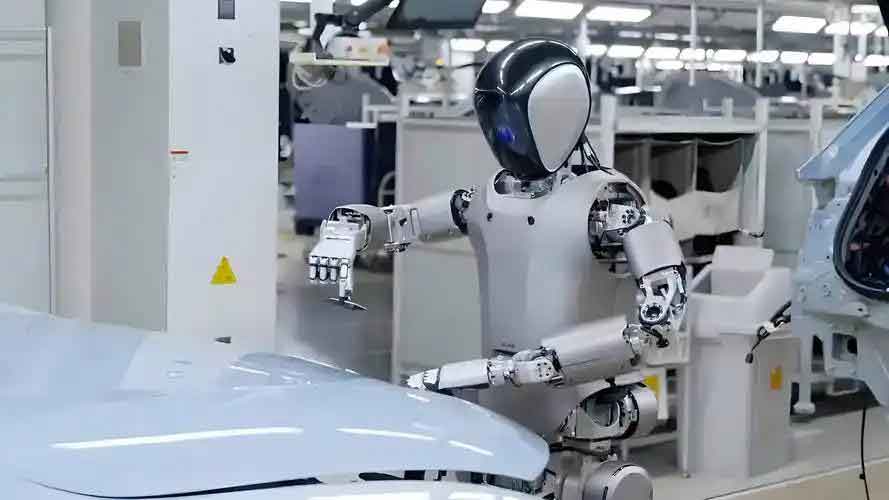
The development of humanoid robots is fraught with uncertainty, much like any cutting-edge technology. A robust R&D system must manage this uncertainty effectively. I believe this hinges on several principles: talent, process efficiency, demand-driven innovation, and a balanced portfolio. Superior talent reduces uncertainty by fostering breakthrough ideas, while an efficient system accelerates iteration. Demand traction—solving real user pain points—guides research toward practical outcomes. Finally, a mix of short-, medium-, and long-term projects mitigates risk. For humanoid robots, this means pursuing incremental improvements alongside moonshot ambitions.
To quantify the technical challenges, consider the following table summarizing key performance metrics for humanoid robots in dynamic environments like marathons:
| Metric | Description | Current Average | Target for Commercialization |
|---|---|---|---|
| Energy Efficiency | Power consumption per kilometer | 500 Wh/km | 100 Wh/km |
| Locomotion Stability | Fall rate during continuous operation | 0.5 falls/hour | 0.01 falls/hour |
| Thermal Management | Maximum operating temperature | 80°C | 40°C |
| Computational Load | Processing power for real-time control | 50 TFLOPS | 10 TFLOPS |
| Cost of Components | Average price per actuator | $5,000 | $500 |
These metrics highlight the gap between current capabilities and what’s needed for affordable, reliable humanoid robots. The marathon, for instance, exposed thermal issues—many robots overheated, leading to failures. This can be modeled using a heat dissipation formula: $$ \frac{dT}{dt} = \frac{P_{\text{gen}} – P_{\text{diss}}}{C} $$ where \( T \) is temperature, \( t \) is time, \( P_{\text{gen}} \) is power generated by motors, \( P_{\text{diss}} \) is power dissipated, and \( C \) is thermal capacity. Optimizing this equation is critical for endurance tasks.
Our approach to advancing humanoid robot technology follows a three-pronged strategy, which I call “walking on three legs.” This balances immediate gains with long-term bets, ensuring we don’t put all our eggs in one basket. The table below outlines this framework:
| Leg | Focus Area | Time Horizon | Key Activities | Expected Outcomes |
|---|---|---|---|---|
| 1. Core Components | Actuators, controllers, sensors | Short-term (2-3 years) | R&D, testing, supply chain development | Mass production of reliable parts |
| 2. Appliance Robotization | Integrating robotics into existing products | Medium-term (1-2 years) | Embedding AI modules, scenario-based design | Enhanced functionality in home/industrial settings |
| 3. Full Humanoid Development | General-purpose humanoid robots | Long-term (5+ years) | Exploration of human-like capabilities, AI training | Versatile robots for diverse applications |
The first leg—core components—is akin to selling picks and shovels during a gold rush. By developing high-performance motors, encoders, and control systems, we aim to supply the broader humanoid robot ecosystem. This reduces dependency on external vendors and accelerates innovation. For example, actuator efficiency can be expressed as: $$ \eta = \frac{P_{\text{out}}}{P_{\text{in}}} \times 100\% $$ where \( \eta \) is efficiency, \( P_{\text{out}} \) is mechanical power output, and \( P_{\text{in}} \) is electrical power input. Pushing \( \eta \) above 90% is a key target.
The second leg, appliance robotization, leverages our deep expertise in domestic and industrial environments. By adding intelligent modules to conventional devices, we create “robotized” versions that perform autonomous tasks—like fetching items or adjusting settings. This builds a foundation of data and user feedback, informing more advanced humanoid robot designs. Consider a simple model for task success rate: $$ S = \frac{N_{\text{success}}}{N_{\text{attempts}}} = f(C, E, A) $$ where \( S \) is success rate, \( C \) is computational power, \( E \) is environmental complexity, and \( A \) is algorithm sophistication. Improving \( S \) requires iterative testing in real-world scenarios.
The third leg, full humanoid robot development, is the most ambitious. It involves creating machines that can navigate unstructured environments, manipulate objects, and interact naturally. The challenges here are immense, from bipedal locomotion to contextual understanding. We use a layered architecture, as shown in this formula for overall system capability: $$ C_{\text{total}} = \sum_{i=1}^{n} w_i \cdot C_i $$ where \( C_{\text{total}} \) is total capability, \( w_i \) are weights for subsystems (e.g., perception, planning, control), and \( C_i \) are individual subsystem capacities. Balancing these weights is an ongoing optimization problem.
Managing R&D for humanoid robots requires both horizontal integration and vertical打通. Horizontal integration means breaking down silos across teams to collaborate on common technologies. For instance, we form cross-functional squads to brainstorm appliance robotization ideas, then rapidly prototype them. Vertical打通 involves aligning market needs with technical development and manufacturing. This ensures that research translates swiftly into products. A simplified workflow efficiency equation is: $$ E_{\text{workflow}} = \frac{T_{\text{idea-to-market}}}{\text{Resource Investment}} $$ where lower \( T \) indicates faster iteration. By streamlining processes, we aim to minimize \( T \) while maximizing output.
Recently, we’ve embraced a “simplify to grow” philosophy. This means focusing on fewer, high-impact projects, flattening organizational hierarchies, and leveraging AI tools to automate routine tasks. The goal is to reduce friction in innovation. For humanoid robots, this translates to prioritizing core algorithms over peripheral features. A focus metric is innovation density: $$ ID = \frac{\text{Number of Patents or Breakthroughs}}{\text{R&D Spending}} $$ Increasing \( ID \) signals more efficient use of resources.
Our team culture rejects mere “grinding” in favor of thoughtful innovation. I’ve learned from younger colleagues—through a reverse mentoring program—that work-life balance is crucial for creativity. They’ve taught me to “be yourself,” fostering an environment where diverse perspectives thrive. This is vital for humanoid robot development, as breakthrough ideas often come from interdisciplinary碰撞. For example, insights from biology can inspire more efficient gait algorithms, modeled as: $$ G(t) = A \sin(\omega t + \phi) + B \cos(2\omega t + \psi) $$ where \( G(t) \) represents joint angles over time, and parameters are tuned via machine learning.
Looking ahead, the commercialization timeline for humanoid robots remains uncertain. Some predict ubiquity within five years; others see decades of refinement. Based on our three-legged strategy, I believe scalable applications will emerge gradually, starting with niche industrial uses before expanding to homes. Key enablers include cost reduction, energy efficiency gains, and AI advances. The following table projects adoption phases:
| Phase | Time Frame | Primary Applications | Technological Prerequisites |
|---|---|---|---|
| Pilot Deployment | Next 2-4 years | Factory inspection, logistics handling | Improved sensors, basic autonomy |
| Selective Adoption | 5-10 years | Healthcare assistance, public services | Advanced AI, safety certification |
| Mass Market | 10+ years | Household chores, educational companions | Affordable pricing, human-like interaction |
The humanoid robot marathon serves as a microcosm of this journey. While it showcased endurance limits, it also spurred healthy competition and knowledge sharing. If such events continue, I expect performance to improve exponentially, driven by better materials, control algorithms, and energy systems. The progress can be modeled with a learning curve: $$ P(t) = P_0 \cdot e^{kt} $$ where \( P(t) \) is performance at time \( t \), \( P_0 \) is initial performance, and \( k \) is the learning rate. For humanoid robots, \( k \) is accelerating due to collaborative open-source efforts.
In conclusion, the path to humanoid robot commercialization is not a sprint but a marathon itself. It demands patience, strategic investment, and a willingness to learn from failures. By walking on three legs—core components, appliance robotization, and full humanoid development—we can navigate uncertainties and steadily advance the field. The ultimate goal is to create humanoid robots that are not just technological marvels but practical tools enhancing human productivity and well-being. As we refine our R&D systems and foster inclusive cultures, I’m optimistic that humanoid robots will eventually become integral to our daily lives, transforming industries and homes alike.