
As we witness the profound digital transformation sweeping across the global manufacturing sector, I observe that the integration of advanced technologies is fundamentally reshaping production paradigms. In this context, the humanoid robot emerges as a quintessential fusion of artificial intelligence and mechanical engineering, poised to revolutionize industrial operations. The journey from smart equipment to smart factories is accelerating, and the humanoid robot stands at the forefront, offering unprecedented capabilities to enhance efficiency, flexibility, and intelligence on the shop floor.
The manufacturing industry, the backbone of national economies, is undergoing a seismic shift driven by digitalization. This transformation is not merely about adopting new tools; it is a comprehensive re-engineering of processes, systems, and workforce interactions to achieve sustainable growth and competitive advantage. Artificial intelligence serves as the powerful engine for this change, and the humanoid robot provides AI with a physical embodiment, allowing intelligent algorithms to interact directly with the physical world. From automotive assembly to electronics manufacturing, the application scenarios for humanoid robot solutions are rapidly expanding, promising to tackle tasks that are repetitive, hazardous, or require high precision.
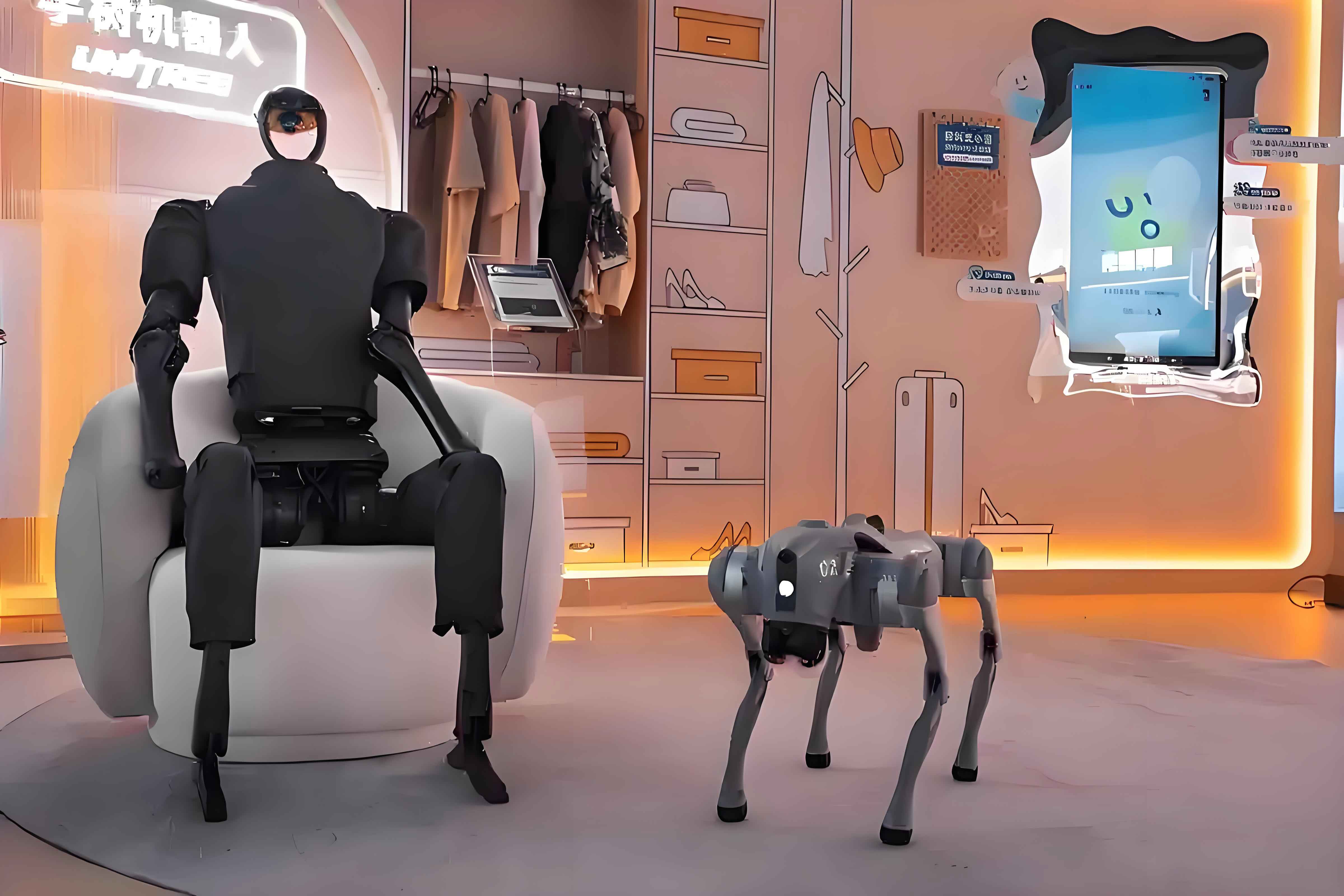
We have seen remarkable breakthroughs in the core technologies enabling modern humanoid robot platforms. These advancements are critical for their transition from laboratory prototypes to viable industrial partners. The progress can be categorized into several key domains, as summarized in the table below, which encapsulates the evolution from 2021 to the present.
| Technology Domain | Specific Breakthrough | Quantitative Improvement / Capability | Underlying Principle / Formula |
|---|---|---|---|
| Locomotion & Motion Control | Enhanced Terrain Adaptation and Dynamic Movement | Running speed increased from 6 km/h to 12 km/h; Ability to climb 134 consecutive outdoor stairs. | Motion stability is often analyzed using the Linear Inverted Pendulum Model (LIPM): $$ \ddot{x} = \frac{g}{z_c} (x – p) $$ where \(x\) is the center of mass position, \(z_c\) is constant height, \(g\) is gravity, and \(p\) is the foot placement point. |
| Intelligent Control (“Brain & Cerebellum”) | Advanced Decision-Making and Precise Motion Execution | Transition from model-based to learning-based control; Improved multi-sensor data fusion for environmental perception. | The control policy \(\pi\) in reinforcement learning for a humanoid robot can be expressed as: $$ \pi^* = \arg\max_\pi \mathbb{E}_{\tau \sim \pi} \left[ \sum_{t=0}^{T} \gamma^t R(s_t, a_t) \right] $$ where \(\tau\) is a trajectory, \(R\) is the reward, and \(\gamma\) is the discount factor. |
| Energy Management & Endurance | High-Density Batteries and Fast-Charging Systems | Operational endurance reaching 6+ hours; Energy consumption reduced by over 80% compared to previous generations. | The energy density \(\rho_E\) of a battery is crucial: $$ \rho_E = \frac{E}{m} $$ where \(E\) is the stored energy and \(m\) is the mass. Fast-charging involves managing heat dissipation governed by: $$ P_{loss} = I^2 R_{int} $$ where \(I\) is charging current and \(R_{int}\) is internal resistance. |
| Human-Robot Interaction (HRI) | Natural Language Processing and Safe Collaborative Operation | Accurate understanding of multi-turn dialogues; Force feedback systems enabling safe physical collaboration. | The probability of correctly interpreting a command can be modeled via sequence-to-sequence models: $$ P(y|x) = \prod_{t=1}^{T_y} P(y_t | y_{<t}, $$="" \(\theta\)="" \(x\)="" \(y\)="" \theta)="" action="" and="" are="" command,="" input="" is="" model="" parameters. |
These technological leaps are not isolated; they synergistically empower the humanoid robot to meet the specific and growing demands of digital transformation in manufacturing. The core drivers for adopting a humanoid robot within factories are multifaceted. Primarily, there is an urgent need to boost productivity in the face of labor shortages and the demand for high-mix, low-volume production. A humanoid robot, when integrated with Manufacturing Execution Systems (MES), can perform complex assembly sequences with superhuman consistency. For instance, in precision assembly, the repeatability error \(\sigma_r\) of a humanoid robot manipulator can be less than 0.03 mm, significantly outperforming human capabilities over extended periods. The overall impact on production cycle time \(T_{cycle}\) can be modeled as: $$ T_{cycle}^{new} = T_{cycle}^{old} \times (1 – \eta_{HR}) $$ where \(\eta_{HR}\) is the efficiency improvement factor, often ranging from 0.3 to 0.5 for tasks suitable for a humanoid robot.
Secondly, cost reduction is a perpetual goal. The humanoid robot presents a compelling economic case by substituting human labor in ergonomically challenging or hazardous roles and optimizing resource use. The total cost of ownership \(C_{TCO}\) for a humanoid robot system over \(N\) years can be compared against manual labor costs: $$ C_{TCO} = C_{cap} + \sum_{n=1}^{N} \frac{C_{op}(n) + C_{main}(n)}{(1 + r)^n} $$ Here, \(C_{cap}\) is capital expenditure, \(C_{op}\) is operational cost (energy, software), \(C_{main}\) is maintenance, and \(r\) is the discount rate. Studies indicate that \(C_{TCO}\) for a humanoid robot solution can lead to an 18-25% reduction in comprehensive production costs, with a payback period \(\tau_{payback}\) often between 2 to 3 years, satisfying the condition: $$ \sum_{n=1}^{\tau_{payback}} \Delta \text{Savings}(n) \geq C_{cap} $$
Furthermore, the intrinsic flexibility of the humanoid robot is a game-changer. Unlike traditional fixed-base industrial robots that require extensive reprogramming and re-tooling for product changeovers, a humanoid robot can adapt through software updates and learning new motion primitives. This adaptability \(A\) can be quantified by the time \(t_{adapt}\) required to reconfigure for a new task versus the task’s duration \(t_{task}\): $$ A = 1 – \frac{t_{adapt}}{t_{adapt} + t_{task}} $$ For a humanoid robot operating in a high-mix environment, \(A\) approaches 1, indicating minimal downtime for changeover.
The technical superiority of the humanoid robot over conventional automation becomes evident when we perform a comparative analysis. Traditional industrial robots excel in structured, high-volume settings but lack the generality and mobility needed for dynamic workshops. The humanoid robot, with its anthropomorphic design, bridges this gap. Let us formalize some of these advantages.
| Aspect | Traditional Industrial Robot (e.g., SCARA, Articulated Arm) | Humanoid Robot | Implication for Digital Manufacturing |
|---|---|---|---|
| Morphology & Mobility | Fixed or limited mobility (e.g., on rails). Dedicated end-effectors. | Bipedal/mobile, human-like limbs with high degree-of-freedom (DoF). Generalized end-effectors (hands). | The humanoid robot can navigate unstructured spaces and use existing human tools, reducing infrastructure modification costs. The workspace \(W\) is virtually unlimited: \(W_{HR} \approx \mathbb{R}^3\). |
| Perception & Intelligence | Pre-programmed trajectories. Limited situational awareness. | Multi-modal sensing (vision, LiDAR, force/torque). Real-time decision-making via AI models. | Enables autonomous quality inspection. Defect detection accuracy \(Acc_{det}\) can be modeled: $$ Acc_{det} = \frac{TP+TN}{TP+TN+FP+FN} $$ where TP, TN, FP, FN are true/false positives/negatives. For a humanoid robot with advanced vision, \(Acc_{det} > 0.995\). |
| Human-Robot Collaboration | Typically operates in caged environments for safety. Minimal direct interaction. | Designed for safe, close-proximity collaboration. Natural language and gesture interfaces. | Facilitates hybrid teams. The collaborative efficiency \(CE\) of a human-humanoid robot team can be: $$ CE = \alpha \cdot P_{human} + (1-\alpha) \cdot P_{robot} $$ where \(P\) denotes performance on subtasks and \(\alpha\) is the optimal task allocation factor. |
| Reconfigurability | High cost and time for task/line reconfiguration. Changeover time \(t_c\) can be days. | Rapid re-tasking via software. Changeover time \(t_c\) can be hours or minutes. | Essential for flexible manufacturing systems (FMS). Overall Equipment Effectiveness (OEE) improves as Availability increases: $$ OEE = Availability \times Performance \times Quality $$ The humanoid robot boosts Availability by reducing \(t_c\). |
From my perspective, the intelligent perception and decision-making core of a modern humanoid robot is its most transformative feature. The “brain” of the humanoid robot processes streams of sensor data \(S(t) = \{s_1(t), s_2(t), …, s_n(t)\}\) to build a world model \(M\). This model informs action selection \(a_t\) at time \(t\) from the policy \(\pi\): $$ a_t = \pi(M(S(t)), \theta_\pi) $$ Simultaneously, the “cerebellum” or low-level controller ensures dynamic stability. For a walking humanoid robot, the Zero Moment Point (ZMP) criterion must be satisfied within the support polygon \(SP\): $$ ZMP(t) = \left( \frac{\sum_i m_i (z_i \ddot{x}_i – x_i (\ddot{z}_i + g))}{\sum_i m_i (\ddot{z}_i + g)}, \frac{\sum_i m_i (z_i \ddot{y}_i – y_i (\ddot{z}_i + g))}{\sum_i m_i (\ddot{z}_i + g)} \right) \in SP $$ where \(m_i\) and \((x_i, y_i, z_i)\) are the mass and coordinates of link \(i\). This complex control is now achievable in real-time, allowing the humanoid robot to operate in cluttered, human-centric environments.
The energy autonomy of a humanoid robot is another critical area of progress. To sustain prolonged operation, the power management system must balance actuator power \(P_{act}\), computation power \(P_{comp}\), and sensor power \(P_{sens}\). The total power draw \(P_{total}\) is: $$ P_{total}(t) = P_{act}(t) + P_{comp} + P_{sens} $$ The operational time \(T_{op}\) given a battery capacity \(C_{bat}\) (in Wh) is: $$ T_{op} = \frac{C_{bat}}{\overline{P_{total}}} $$ where \(\overline{P_{total}}\) is the average power. With solid-state batteries increasing \(C_{bat}\) and efficient actuators reducing \(P_{act}\), the humanoid robot can now work full shifts, aligning with manufacturing cycles. Furthermore, fast-charging technology aims to minimize the downtime \(T_{charge}\). If charging power \(P_{charge}\) is sufficiently high, \(T_{charge}\) can be approximated by: $$ T_{charge} \approx \frac{C_{bat} \cdot (SOC_{target} – SOC_{current})}{P_{charge}} $$ where \(SOC\) is the State of Charge.
However, the path to ubiquitous deployment of the humanoid robot in manufacturing is not without significant challenges. From a technical standpoint, the integration complexity is high. Ensuring seamless communication between the humanoid robot and legacy manufacturing IT systems (ERP, PLM) requires robust middleware and APIs. The reliability \(R_{sys}\) of such an integrated system over time \(t\) is a product of individual component reliabilities: $$ R_{sys}(t) = \prod_{i=1}^{k} R_i(t) $$ where \(R_i(t)\) could be the reliability of the humanoid robot hardware, the network, the AI model, etc. Any weak link drastically reduces \(R_{sys}(t)\).
Economically, the upfront capital cost \(C_{cap}\) for a sophisticated humanoid robot remains a barrier for small and medium-sized enterprises (SMEs). The cost structure includes expensive components like high-torque density actuators, multi-core AI processors, and advanced sensors. A simplified cost model for a humanoid robot unit might be: $$ C_{cap} = C_{mech} + C_{elec} + C_{compute} + C_{software} + C_{integration} $$ While economies of scale are expected to drive \(C_{cap}\) down, the current investment is substantial.
From a social and operational perspective, workforce adaptation is crucial. The humanoid robot is not meant to wholly replace human workers but to augment them, taking over dull, dirty, and dangerous tasks. This necessitates reskilling programs. The success of integration can be measured by the synergy metric \(S\) between human workers \(H\) and humanoid robot \(R\): $$ S(H, R) = \frac{O(H \cup R)}{O(H) + O(R)} $$ where \(O\) represents the output of a system. Effective collaboration yields \(S > 1\), indicating super-additive performance.
Looking ahead, the future for the humanoid robot in manufacturing is extraordinarily promising. We are moving towards a paradigm where the humanoid robot will act as a versatile, mobile, and intelligent production agent. I envision the emergence of “cognitive factories” where fleets of humanoid robot units collaborate with each other and with humans, dynamically reconfiguring production lines based on real-time orders and supply chain data. The concept of the “digital twin” will be deeply intertwined with the humanoid robot, allowing for simulation, optimization, and remote operation of physical robots through their virtual counterparts. The control commands for the physical humanoid robot could be derived from the digital twin’s simulation environment, minimizing real-world trial-and-error.
In conclusion, the humanoid robot represents a monumental leap in our quest to fully digitize and smarten the manufacturing sector. Its unique combination of form, intelligence, and adaptability addresses core challenges of modern production: variability, complexity, and the need for resilience. While hurdles in cost, integration, and standardization remain, the trajectory is clear. Continued advancements in AI, materials science, and battery technology will further unlock the potential of the humanoid robot. As these platforms become more capable and affordable, I am confident that the humanoid robot will transition from a novel demonstrator to a foundational pillar of the smart factory, driving productivity, fostering innovation, and shaping the future of work in manufacturing. The journey of the humanoid robot is just beginning, and its impact will be profound and far-reaching.