
The 2025 World Robot Conference kicked off on August 8th at the Beijing Beiren Yichuang International Convention and Exhibition Center, centered on the theme “Making Robots Smarter, Embodied Intelligence More Intelligent.” This year’s event showcased a plethora of new products, innovative robotic applications, and cutting-edge scenarios. Throughout the conference, forums, exhibitions, competitions, and related activities were held, drawing significant attention from industry leaders and enthusiasts alike.
According to the event organizers, compared to last year, this edition featured a richer array of新品, with over 50整机 enterprises participating and support from 28 international institutions. A total of more than 200 companies exhibited over 1,500 products, including those from prominent firms like Ubtech, Yushu Technology, and Qinglang Intelligent, with nearly 100 new products making their debut—almost double the number from the previous year. The exhibition floor was bustling with crowds, reflecting the rapidly heating up robot market. Statistics from market research firm Frost & Sullivan indicate that, measured by sales revenue, China’s intelligent service robot market grew from RMB 19.3 billion in 2018 to RMB 51.6 billion in 2022, achieving a compound annual growth rate of 27.9%.
Humanoid robots, in particular, have accelerated their development pace. Leading humanoid robot manufacturer Tesla has clearly outlined a mass-production timeline for its Optimus robot. During an earnings call earlier this year, Tesla raised its 2025 mass-production expectations for the Optimus humanoid robot to up to 10,000 units, further boosting previous forecasts. Simultaneously, an increasing number of tech giants have announced their entry into the humanoid robot field. Companies like NVIDIA, Microsoft, and Google have released foundational models and platforms aimed at shortening the development cycle for humanoid robots. In response, J.P. Morgan optimistically estimates that, driven by market dynamics and global demographic and labor trends, the potential market size for humanoid robots could reach approximately 5 billion units.
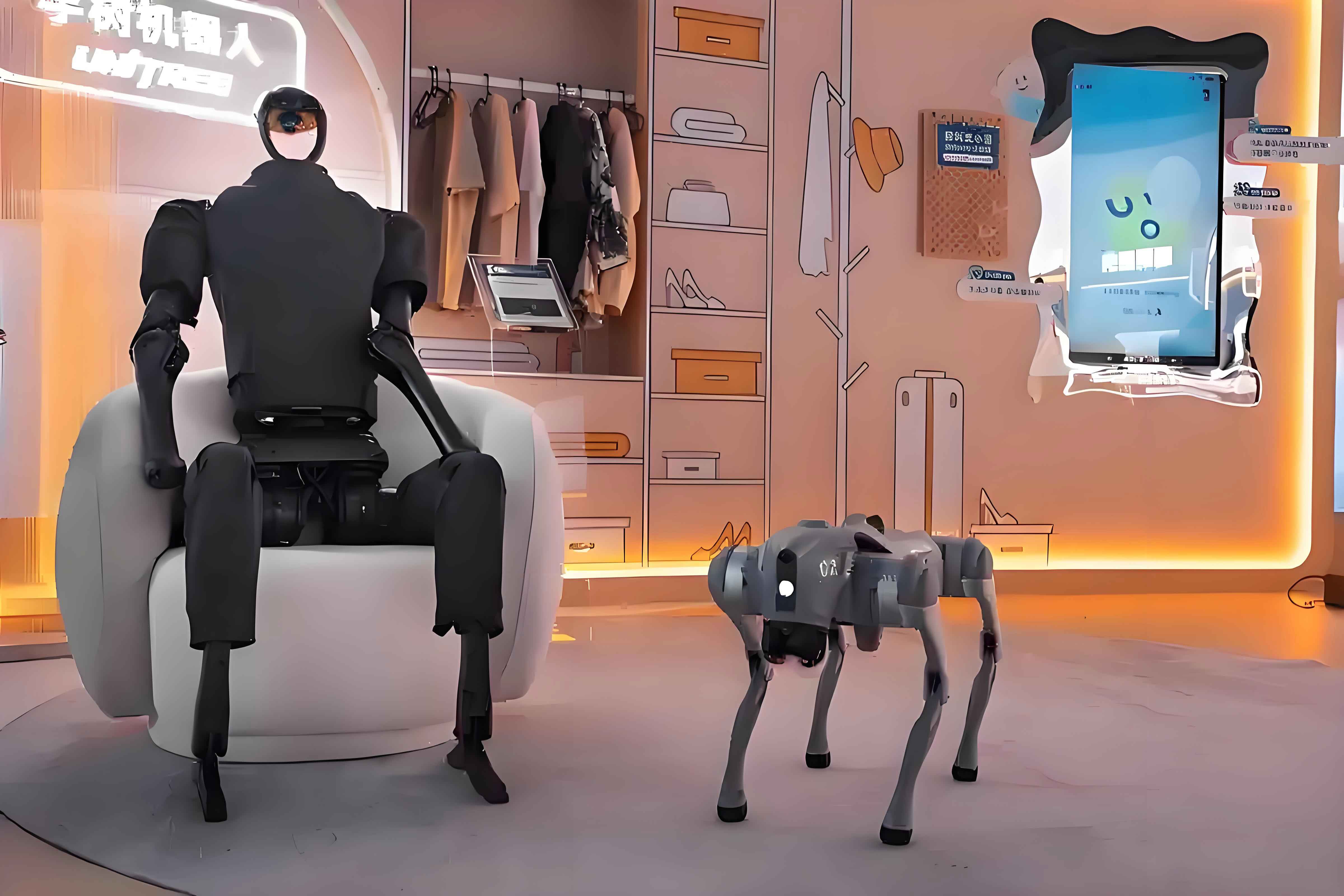
The deep integration of artificial intelligence (AI) with robotics was a prominent highlight at the conference. Numerous enterprises demonstrated outcomes where AI is deeply embedded into robotic systems, particularly showcasing cases of robots being integrated into diverse scenarios. These achievements signal that intelligent manufacturing and service-oriented robots have entered a phase of advanced intelligence.
At the iFlytek booth, the company displayed how its AI is deeply integrated with robotic manufacturers, enabling robots to comprehend natural language and improving human-robot interaction. Based on a large model “robot brain” platform, iFlytek combined capabilities in speech recognition, speech synthesis, and language translation. By incorporating multimodal noise reduction technologies and leveraging lip recognition and visual identification, it addressed issues of voice recognition interference in multi-person interactive environments.
Higher-level and more complex tasks are now being handled by robots at the event. Zhifang, founded in 2023, demonstrated the practical abilities of its AlphaBot series humanoid robots in handling multiple tasks and application scenarios, including logistics sorting, beverage preparation, and drum playing. Compared to conceptual displays, these real-world operations carry greater technical weight. A representative from the Zhifang booth explained that the AlphaBot2 humanoid robot can be used in industrial manufacturing, home companionship, and medical care scenarios. Its humanoid mechanical arm can bear a load of up to 10 kilograms per arm, with over 34 degrees of freedom overall, allowing it to plan actions based on conversational commands, smoothly picking up cups, operating drink machines, adding ice, and handing beverages to users.
If the deep integration of AI provides humanoid robots with a brain for intelligent leaps, enabling them to “think,” then the rise of edge intelligence allows them to react in real-time. With the maturation of AI chips and edge computing platforms, humanoid robots have gained the ability to think offline and adapt online.
Thus, it comes as no surprise that AI chip giant NVIDIA made an appearance at this World Robot Conference. NVIDIA’s founder and CEO, Jensen Huang, has stated that the next wave of AI is robotics, with one of the most exciting developments being humanoid robots. To build the next generation of humanoid robots, NVIDIA recently released multiple software and hardware products, including NIM microservices and frameworks for robot simulation and learning, the general humanoid robot foundation model GROOTN1, and the JetsonThor platform suitable for humanoid robots. Exhibiting robot manufacturer Yinhe Tongyuan showcased a embodied large model robot named Galbot, which is equipped with NVIDIA’s JetsonThor chip.
On-site, multiple humanoid robots were seen collaborating. Leading humanoid robot company Ubtech demonstrated the coordination of humanoid robots, unmanned logistics vehicles, and production lines, showcasing the potential of general robots in multi-task industrial scenarios. A Ubtech现场负责人 explained that, utilizing the scheduling and task allocation management of群体智能技术 “Group Brain Network 2.0,” different models of humanoid robots collaborated in sorting and搬运 tasks, completing material storage, transportation, and sorting operations. This ensured both individual autonomous decision-making capabilities and group collaboration, enhancing overall operational efficiency.
群体智能技术 is regarded by Ubtech as a key technology for the industrial application of humanoid robots and is being vigorously tested and promoted externally. The Ubtech现场负责人 noted that dozens of humanoid robots applying “群体智能” technology are already undergoing coordinated training at ZEEKR’s 5G smart factory. Through data accumulation and model training from multi-robot collaborative training, product and technology iteration and upgrading are accelerated.
At the August 8th exhibition, humanoid robots undoubtedly served as the core attraction. Last year, most humanoid robots at the conference remained in static states—standing still, sitting, or suspended. Even during demonstrations, these humanoid robots could only walk a few meters on the ground or perform simple tasks like gesturing and voice dialogue, offering little surprise.
This year, however, that perception was completely overturned. On-site, humanoid robots not only walked and conversed but also engaged in complex actions such as martial arts and soccer. Demonstrations by some popular manufacturers featured confrontational and entertaining elements, rapidly heating up the booth areas, with crowds so dense that passage was nearly impossible.
Among them, Yushu Robot set up a robot fighting ring in the exhibition area, where humanoid robots performed combat displays, creating the most lively atmosphere at the event. The humanoid robot from Beijing Accelerated Evolution Technology played soccer in the exhibition area, navigating obstacles and completing actions like dribbling and shooting, also attracting large crowds of on-site spectators.
Despite the exciting robot demonstrations and technological advancements witnessed on-site, observers could still sense that humanoid robots are not yet “smart” enough. Commercial application of these humanoid robots will require more time.
When discussing the落地 of humanoid robots, Jiang Lei, Chief Scientist at the National-Local Joint Humanoid Robot Innovation Center, summarized the challenges as “one high and five difficulties”: high barriers to entry, difficulties in software algorithms, challenges in software-hardware decoupling, obstacles in knowledge accumulation, hurdles in talent aggregation, and complexities in safe application.
The consensus within the industry is that technological maturity remains insufficient. Taking the simple task of having a humanoid robot “pour water” as an example, it involves technologies such as positioning, natural language understanding, external perception, and mechanical arm control. Therefore, humanoid robots are still in the early stages, whether in terms of commercial scenario落地, functionality, or model training, with the industry primarily focusing on preliminary applications.
Regarding the progress of its humanoid robot commercial落地, the aforementioned Ubtech现场负责人 stated that Ubtech’s industrial humanoid robots have completed the first phase of training in automotive factories. Significant improvements have been made in joint stability, overall structural reliability, battery life, software system stability, positioning and navigation, and motion control core technologies. This has addressed challenges in algorithm and software system stability for humanoid robots in industrial settings, enabling the robots to quickly adapt to a series of more complex tasks such as sorting and vehicle assembly.
Price is another practical obstacle to the commercial落地 of humanoid robots. On July 25th, Yushu Technology released its third humanoid robot, the “UnitreeR1 Smart Partner,” with a starting price of RMB 39,900, supporting development customization. Weighing approximately 25 kilograms, it integrates voice and image multimodal large models. This pricing is significantly lower compared to previous humanoid robots that were only available in the enterprise market and essentially unavailable to consumers, yet it remains relatively expensive for consumer expectations.
On the issue of humanoid robot pricing, Zhao Weichen, Vice President of Accelerated Evolution Company, noted that consumers hope to see robot prices “driven down” to the level of household appliances for humanoid robots to achieve mass adoption. However, this requires collective efforts from the entire industry chain, upstream and downstream.
In summary, the 2025 World Robot Conference highlighted significant strides in the evolution of humanoid robots, driven by AI integration and technological innovations. The event showcased how humanoid robots are becoming more capable in complex tasks, from industrial applications to entertainment displays. However, challenges such as high costs, software complexities, and safety concerns persist, indicating that widespread commercial adoption of humanoid robots is still on the horizon. As companies continue to refine their technologies and collaborate across the ecosystem, the potential for humanoid robots to transform various sectors remains immense, with optimistic market projections underscoring their future role in global labor and daily life.
The demonstrations of humanoid robots at the conference, including those from Yushu Technology and Accelerated Evolution, illustrated the growing versatility of these machines. For instance, the humanoid robot from Yushu engaged in dynamic fighting performances, while Accelerated Evolution’s model displayed soccer skills, both capturing public imagination and highlighting progress in mobility and interaction. Despite these advances, the underlying issues of “one high and five difficulties” remind stakeholders that humanoid robot development is a marathon, not a sprint. Industry leaders like Ubtech and NVIDIA are pushing boundaries with群体智能 and edge computing, but real-world testing in environments like smart factories is crucial for iterative improvement.
Looking ahead, the trajectory for humanoid robots appears promising, with Tesla’s production plans and investments from tech giants fueling innovation. Yet, as pricing and technical hurdles are addressed, the focus will shift to ensuring that humanoid robots can seamlessly integrate into diverse settings, from homes to hazardous workplaces. The 2025 World Robot Conference served as a vivid snapshot of this journey, emphasizing both the excitement and the realities of creating truly intelligent humanoid robots that can one day become commonplace companions and workers.