
As an enthusiast deeply embedded in the robotics industry, I have observed a fascinating surge in innovation across various domains, from agile legged machines to precision medical systems. In recent months, several pivotal developments have captured my attention, underscoring a broader trend toward more capable, efficient, and accessible robotic solutions. Among these, advancements in the realm of the robot dog stand out particularly, showcasing remarkable progress in mobility, endurance, and modularity. This article delves into these trends from my personal perspective, weaving together technical insights, comparative analyses, and future implications, with a special emphasis on the evolving capabilities of the modern robot dog.
The robot dog, once a novelty, has rapidly evolved into a sophisticated platform for research, inspection, and even companionship. A prime example is the latest generation of a compact, intelligent quadruped recently unveiled by a robotics company based in Hangzhou. This new model, which I will refer to as an advanced robot dog, represents a significant leap forward, thanks to breakthroughs in proprietary joint technology, control systems, and algorithms. From my analysis, the heart of any robot dog lies in its actuator modules—the core power units that dictate motion performance. This new iteration employs an integrated design featuring high-precision absolute encoders and lightweight housing, coupled with custom high-torque joint drives. The result is a system with exceptional torque density, response bandwidth, and reverse drive efficiency, which directly translates to enhanced stability, reduced power consumption, and improved load-bearing capacity. Specifically, the sustained walking load has increased by 40%, reaching 7.5 kg, while motion endurance has nearly doubled, allowing for continuous operation of up to 90 minutes and a range of 5 km. Such metrics highlight how the robot dog is transitioning from a demonstrative gadget to a practical tool for real-world applications.
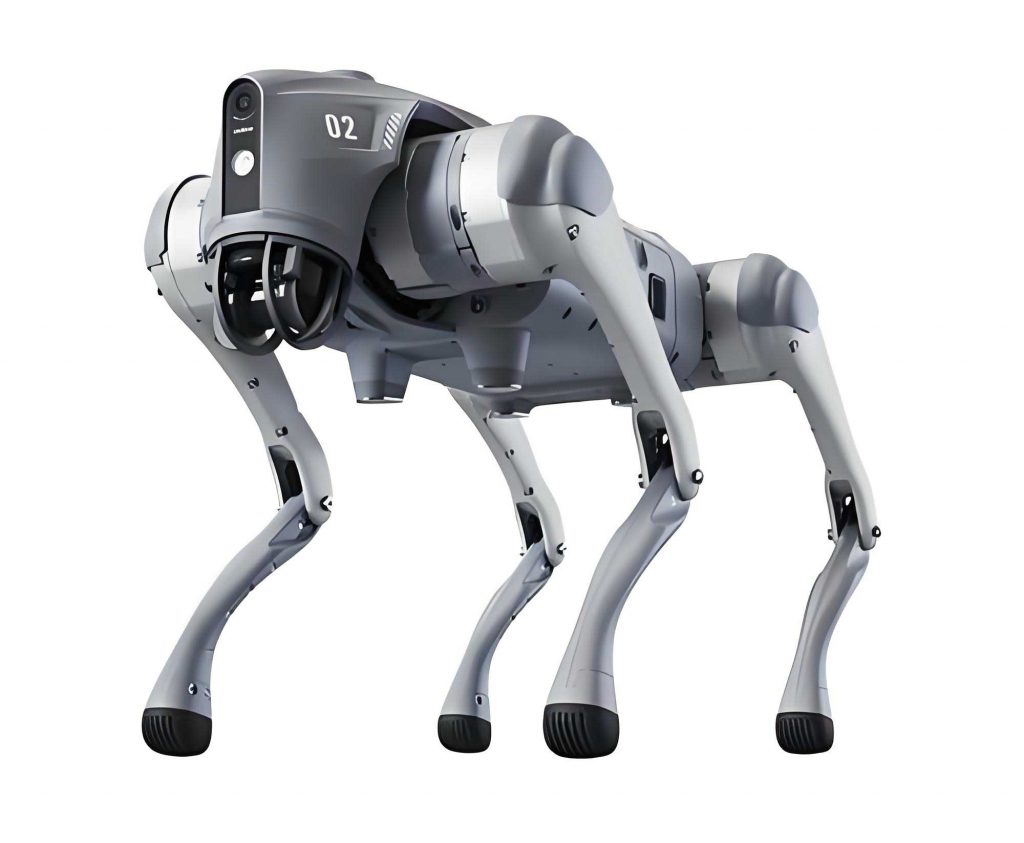
To better appreciate these improvements, let’s consider the underlying mechanics. The dynamics of a robot dog can be modeled using equations of motion. For instance, the torque $\tau$ required at a joint can be expressed as:
$$ \tau = I \alpha + b \omega + mgL \sin(\theta) $$
where $I$ is the moment of inertia, $\alpha$ is angular acceleration, $b$ is damping coefficient, $\omega$ is angular velocity, $m$ is mass, $g$ is gravitational acceleration, $L$ is lever arm length, and $\theta$ is joint angle. The latest robot dog optimizes these parameters through advanced materials and control algorithms, minimizing $\tau$ for given movements and thus boosting efficiency. Moreover, the integration of high-feedback encoders enhances precision, allowing for smoother gaits. The robot dog’s enhanced performance can be summarized in Table 1, comparing key attributes across hypothetical generations.
| Feature | Previous Generation | Current Advanced Robot Dog | Improvement |
|---|---|---|---|
| Maximum Load Capacity | 5.4 kg | 7.5 kg | +40% |
| Continuous Motion Time | 45 minutes | 90 minutes | +100% |
| Operational Range | 2.5 km | 5 km | +100% |
| Joint Response Bandwidth | 50 Hz | 80 Hz (estimated) | +60% |
| Power Consumption | High | Reduced by 20% (estimated) | Significant |
Beyond raw power, the modern robot dog excels in modularity and intelligence. This model features an open modular architecture with interfaces for RTK modules, 5G connectivity, AI hosts, edge processors, and various sensors. It offers software development kits (SDKs) and APIs for advanced perception capabilities, enabling deep customization in areas like autonomous navigation, obstacle avoidance and detour, visual localization, and environmental mapping. For example, when equipped with LiDAR and depth cameras, the robot dog can perform real-time SLAM (Simultaneous Localization and Mapping), described by:
$$ p(x_t | z_{1:t}, u_{1:t}) = \eta \cdot p(z_t | x_t) \int p(x_t | x_{t-1}, u_t) p(x_{t-1} | z_{1:t-1}, u_{1:t-1}) dx_{t-1} $$
where $x_t$ is the state at time $t$, $z_t$ are observations, $u_t$ are controls, and $\eta$ is a normalization factor. This allows the robot dog to operate autonomously in complex terrains, making it invaluable for tasks like search and rescue or infrastructure inspection. From my experience, the flexibility of such platforms is key to their adoption; a robot dog that can be tailored with plug-and-play components lowers barriers for developers and researchers.
In parallel to the robot dog’s evolution, I have been closely following strides in medical robotics, which share underlying principles in control and precision. Recently, a domestically developed orthopedic surgical robot system received regulatory approval for hip joint applications, marking it as a pioneering integrated solution for knee and hip procedures. This system, which I’ll refer to as a multifunctional surgical robot, exemplifies how robotics is transforming healthcare. Its design allows for tooltip interchangeability to switch between knee and hip surgeries, backed by clinical trials involving 166 cases that validated its efficacy and safety. The robot assists surgeons in achieving more accurate implant placement while enhancing procedural safety through features like automatic bone milling alignment, boundary protection, and postoperative assessment.
The control algorithms in such surgical robots often involve inverse kinematics and trajectory planning. For a robotic arm positioning a tool, the relationship between joint angles $\vec{\theta}$ and end-effector pose $\vec{p}$ can be given by:
$$ \vec{p} = f(\vec{\theta}) $$
where $f$ is the forward kinematics function. The inverse problem, solved in real-time, ensures precise movements. Compared to a robot dog, which navigates dynamic environments, surgical robots prioritize sub-millimeter accuracy in constrained spaces. However, both rely on robust sensing and feedback loops. Table 2 contrasts the key aspects of these robotic systems, highlighting their diverse applications.
| Aspect | Robot Dog | Surgical Robot |
|---|---|---|
| Primary Function | Mobile locomotion, inspection, autonomy | Precision surgical assistance, implant alignment |
| Key Technologies | High-torque joints, LiDAR, SLAM, modular APIs | Navigation software, force feedback, imaging integration |
| Performance Metrics | Load capacity (7.5 kg), endurance (90 min), range (5 km) | Accuracy (<1 mm), procedure time reduction, safety margins |
| Development Focus | Agility, endurance, environmental interaction | Precision, sterility, clinical validation |
| Typical Use Cases | Disaster response, security, research | Joint replacement, spinal surgery, trauma care |
Another intriguing development comes from a U.S.-based surgical robotics firm, which completed an FDA clinical study for a miniature robotic-assisted surgery platform designed for intestinal resection. This system, noted for its compact size and space-saving design, can be set up in minutes without the need for large, suspended equipment, streamlining preoperative preparations. While distinct from a robot dog in purpose, it echoes the trend toward miniaturization and portability seen in legged robots. The dynamics of such systems can be modeled using reduced-order models for efficiency, such as:
$$ M(q)\ddot{q} + C(q, \dot{q})\dot{q} + G(q) = \tau $$
where $M$ is the mass matrix, $C$ accounts for Coriolis forces, $G$ is gravity vector, $q$ are generalized coordinates, and $\tau$ is applied torque. In both cases, optimizing these equations leads to lighter, more responsive systems.
Reflecting on these advancements, I believe the robot dog serves as a bellwether for broader robotic trends. Its progress in joint technology—where torque density and efficiency are paramount—directly informs other domains. For instance, the high-torque modules in a robot dog could inspire similar actuators in surgical robots for finer manipulation. Moreover, the perception capabilities of a robot dog, enabled by LiDAR and cameras, parallel the imaging needs in medical robotics for anatomical mapping. From my vantage point, the cross-pollination of ideas between these fields is accelerating innovation.
To quantify the impact, consider the economic and operational benefits. A robot dog deployed for industrial inspection can reduce human risk in hazardous environments. Its endurance and load capacity allow it to carry sensors for prolonged periods, collecting data that can be analyzed via machine learning models. The energy efficiency gains, represented by reduced power consumption, lower operational costs and extend mission times. These factors contribute to a total cost of ownership (TCO) model, which can be approximated as:
$$ \text{TCO} = C_{\text{acquisition}} + \sum_{t=1}^{T} \frac{C_{\text{operation}, t} + C_{\text{maintenance}, t}}{(1 + r)^t} $$
where $C$ denotes costs, $T$ is lifespan, and $r$ is discount rate. For a robot dog, improvements in durability and efficiency directly reduce $C_{\text{operation}}$ and $C_{\text{maintenance}}$, enhancing ROI.
In the surgical realm, robots improve patient outcomes through precision. The accuracy of implant placement, for example, can be modeled using statistical error minimization. If $\epsilon$ represents placement error, the goal is to minimize $\mathbb{E}[\epsilon^2]$ through robotic guidance. Clinical studies have shown that such systems can reduce outliers, leading to faster recovery and lower revision rates. This aligns with the broader push toward personalized medicine, where robotics enables tailored interventions.
Looking ahead, I anticipate several converging trends. First, the robot dog will continue to gain autonomy through better AI integration, perhaps using reinforcement learning for adaptive gait control. The reward function in such learning might be:
$$ R(s, a) = -\alpha \cdot \text{energy} – \beta \cdot \text{deviation} + \gamma \cdot \text{progress} $$
where $s$ is state, $a$ is action, and $\alpha, \beta, \gamma$ are weights. Second, modularity will foster ecosystems where third-party developers create specialized payloads for robot dogs, from thermal cameras for firefighting to samplers for environmental monitoring. Third, surgical robots will become more interoperable with imaging systems, enabling real-time intraoperative updates. Both robot dogs and surgical robots may leverage 5G for low-latency remote operation, expanding their reach to underserved areas.
In conclusion, the robotics landscape is vibrant and multifaceted. The advancements in robot dog technology—with its leaps in joint performance, endurance, and modular intelligence—exemplify the rapid pace of innovation. When viewed alongside breakthroughs in surgical robotics, such as integrated orthopedic systems and miniaturized platforms, a common thread emerges: the pursuit of greater capability, efficiency, and accessibility. As someone passionate about this field, I am excited to see how these technologies will evolve and intertwine, shaping industries and improving lives. The robot dog, in particular, stands as a testament to how far legged robotics has come, and it promises to be a cornerstone of future robotic deployments. Through continued research and development, driven by collaborative efforts across domains, we can expect even more remarkable achievements in the years to come.