
Observing the trajectory of the global robotics industry, one cannot ignore the formidable and accelerating presence of China robot entities. For years, the narrative surrounding China’s industrial automation ambitions has been filtered through external analyses and market reports. From my vantage point within this dynamic ecosystem, the story is more nuanced than simple tales of lagging components or market catch-up. It is a complex interplay of historical timing, strategic patience, and a race against a rapidly closing window of opportunity defined by dual transformations—within manufacturing itself and within the very definition of a robot.
The journey of robotics research in this region began with aspirations far removed from the factory floor. In an era of inexpensive labor, the economic imperative for automation in mass manufacturing was virtually non-existent. Pioneering researchers, therefore, channeled their intellect toward frontier applications in ocean exploration and aerospace, laying a crucial foundation in control theory and systems integration. This early focus meant that when the global wave of industrial automation began to crest, the local development of manufacturing-focused China robot platforms was not a primary national industrial priority. The market was deemed not yet ready, a perspective solidified by feedback from major manufacturers who saw cheap labor as a permanent fixture. This divergence in initial focus created a temporal gap between global robot adoption and domestic industrial robot development.
The turning point arrived with the new millennium, symbolized by the establishment of the first dedicated industrial robot enterprise. This was not merely a company launch; it was a statement of intent. It marked the conscious decision to build a national China robot capability, moving from purely scientific research and specialized applications into the competitive arena of industrial manufacturing. The subsequent years have validated this decision explosively. The nation has surged to become the world’s largest consumer of industrial robots, a demand driven by an irreversible macroeconomic shift: soaring labor costs and the pressing need for manufacturing upgrades. Yet, this booming consumption has not translated into domestic market dominance. The competitive landscape remains fiercely contested by established international giants.
| Metric | International Leaders (Combined) | Domestic China Robot Industry (Representative) | Implication |
|---|---|---|---|
| Market Share in Domestic Sales (2013) | ~54% (Top 4 Firms) | Single-digit percentage | High consumption does not equal production leadership. |
| Annual Revenue Scale (Circa 2013) | Tens of Billions USD | Hundreds of Millions USD | Significant disparity in financial muscle and global scale. |
| Industry Maturity & Consolidation | Highly consolidated, decades of refinement. | Fragmented, ~420+ enterprises in ecosystem. | Domestic industry is in a growth & shake-out phase. |
| Primary Historical Driver | Early automation demand in auto industry. | Recent labor cost inflation & policy push for upgrade. | Different starting points and market pressure timelines. |
A common and oft-cited diagnosis for this competitive gap points directly at the reliance on imported core components, such as precision reducers and high-performance servo systems. It is an undeniable fact that many China robot assemblers depend on this global supply chain. However, I contend that this framing is misleading as a root-cause analysis. In a globally integrated economy, specialization is the norm, not the exception. No leading robotics nation produces every single sub-component in-house. The logic that domestic production of all parts is a prerequisite for success is flawed; if domestic components achieve cost-performance parity, they become available to global competitors as well, neutralizing any exclusive advantage.
The real source of competitive advantage lies not in the isolated performance of parts, but in the holistic integration and innovation of the system. The ultimate competitiveness of a China robot is synthesized from superior design philosophy, deep application-specific technology, and accumulated brand trust. This synthesis takes time and iterative refinement in real-world applications. Consider the timelines of the industry leaders: they spent decades evolving from their core competencies in numerical control or welding systems before becoming robotics powerhouses. Their journey involved patient capital, continuous R&D, and gradual market expansion. The China robot industry is compressing this learning curve at an unprecedented rate, but fundamental laws of engineering maturation and brand building still apply.
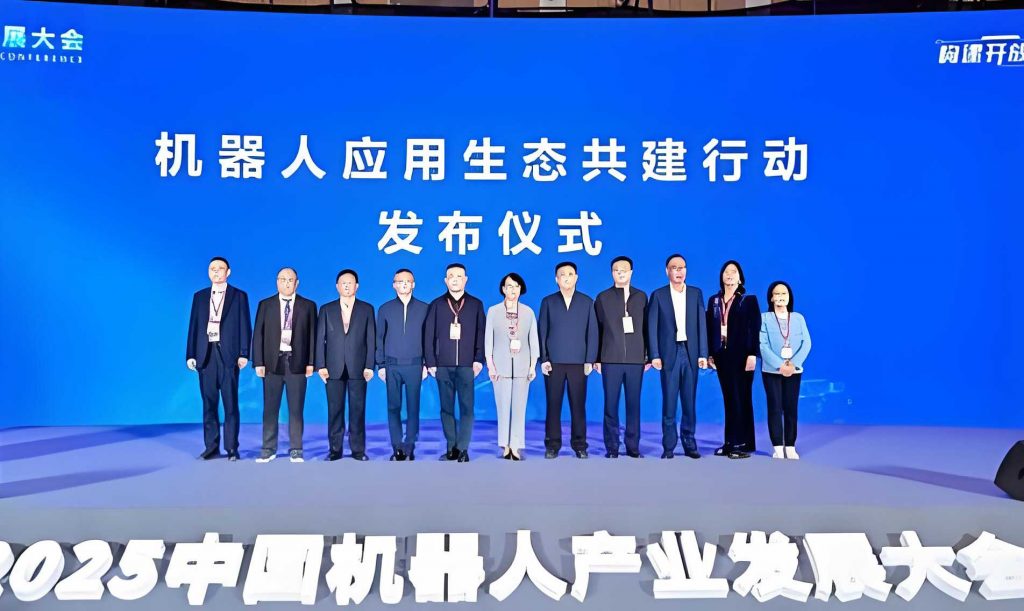
The scale of the challenge is mirrored in the scale of the opportunity. The robot density in manufacturing here remains a fraction of that in leading automated nations. The potential demand, if the country aims to approximate the manufacturing efficiency of South Korea or Germany, is staggering, numbering in the millions of units. This is a volume that existing global capacity cannot swiftly meet, creating a massive vacuum. This vacuum is the primary strategic opportunity for the China robot sector. The demand is not just for replacement but for creation of new automated capacity. The growth trajectory can be modeled as a classic adoption S-curve, currently in its steep ascent phase:
$$ R_t = R_0 \cdot (1 + g)^t + M \cdot \frac{1}{1 + e^{-k(t-t_0)}} $$
Where \( R_t \) is the total robot stock at time \( t \), \( R_0 \) is the initial base, \( g \) is a steady growth rate, \( M \) is the total addressable market potential, \( k \) is the adoption speed constant, and \( t_0 \) is the inflection point year. Current indicators suggest \( k \) is large and positive, signaling rapid uptake.
The economic driver is brutally clear. The unit cost of robots has halved over the past decade, while manufacturing wages have more than doubled. The crossover point where automation becomes unequivocally cheaper than human labor for an expanding set of tasks has been reached and passed. This can be expressed as a simple cost-benefit threshold:
$$ C_{robot}(t) = I_r / L + O_r < C_{human}(t) = W_h \cdot H \cdot (1 + \alpha)^t $$
Here, \( C_{robot} \) is the annualized cost (Initial investment \( I_r \) over lifespan \( L \) plus annual operation cost \( O_r \)), and \( C_{human} \) is the annual labor cost (Wage \( W_h \) times hours \( H \) compounded by annual wage inflation \( \alpha \)). For many sectors, this inequality now holds true.
This brings us to the critical concept of the “window of opportunity.” Experts consistently cite a period of 8 to 10 years as decisive. This window is defined by two concurrent and transformative shifts:
- Manufacturing Paradigm Shift: The urgent, large-scale transition from labor-intensive to technology-intensive production across all of Chinese industry.
- Robotic Intelligence Shift: The global transition from traditional, dumb “repeatable” robots (Generation 1) to感知 and intelligent robots (Generations 2 & 3).
| Generation | Core Capability | Market Penetration (Global) | Opportunity for China Robot |
|---|---|---|---|
| Gen 1: Teach-Playback | Rigid, precise repetition of programmed paths. | ~90% (Mature, dominated by incumbents) | Cost competition; challenging to displace established trust. |
| Gen 2:感知 & Adaptive | Vision, force sensing for limited task adaptation. | <10% (Growing rapidly) | Racing on same starting line; opportunity for innovation. |
| Gen 3: Autonomous | Context-aware, decision-making in unstructured environments. | Niche (R&D/Experimental) | True frontier; no incumbent lock-in. Pure R&D competition. |
The second shift is particularly liberating for the China robot ecosystem. In the realm of下一代 intelligent robotics, the global community is, in many aspects, starting anew. The decades of accumulated advantage in perfecting Gen 1 mechanics are less decisive. The competition shifts to algorithms, artificial intelligence, sensor fusion, and human-robot collaboration—fields where local research talent and vast datasets from the world’s most complex manufacturing environment can be leveraged. This is where the China robot industry can transition from being a follower to a co-creator of the future.
However, to seize this dual-window opportunity, the domestic industry must overcome its fundamental weakness: fragmentation and lack of scale. Having hundreds of companies is a sign of vitality, but also of dispersion of resources. Robotics is a “three-high” industry: high technology, high talent, and high capital intensity. Building an international-grade China robot champion requires massive, sustained investment in R&D, global marketing, and application engineering. The consolidation seen in Japan’s history—where dozens of players coalesced into a few giants—is a likely and necessary path. The role of capital markets and strategic policy is to accelerate this natural consolidation, fostering the emergence of 2-3 comprehensive leaders with the scale to compete globally.
The path forward is clear, yet fraught with urgency. The time is not for incremental improvement alone, but for bold, integrated strategy. The formula for success for a world-class China robot enterprise is multi-variable:
$$ S = \int_{t=0}^{T} \left( \beta I_{R\&D}(t) + \gamma K_{talent}(t) + \delta A_{app}(t) \right) \cdot e^{\lambda M(t)} \, dt $$
In this conceptual integral, the ultimate Strength \( S \) of an enterprise by the window deadline \( T \) depends on the cumulative flow of investment in R&D (\( I_{R\&D} \)), talent capital (\( K_{talent} \)), and application experience (\( A_{app} \)), each weighted by coefficients \( \beta, \gamma, \delta \). Critically, all are amplified exponentially by the scale of the accessible market \( M(t) \), with \( \lambda \) as a scaling factor. The massive domestic market \( M(t) \) is the unique multiplier for the China robot sector.
Therefore, the imperative is twofold. For enterprises: aggressively integrate, specialize, or consolidate to achieve scale and deepen technological moats, particularly in smart systems. For the ecosystem: create conditions that allow capital and talent to coalesce around potential champions, while simultaneously fostering a dense innovation network in感知, AI, and next-generation human-robot interfaces.
In conclusion, the narrative of China robot is at an inflection point more significant than its origin story. The constraints are less about sourcing parts and more about synthesizing time, market access, and intelligence into a cohesive competitive force. The window of 8-10 years is the time available to complete this synthesis before the global industry’s next hierarchy solidifies. The race is not just to capture a share of the current market, but to define and lead in the market of tomorrow—the market of intelligent, collaborative automation. Missing this window would mean accepting a prolonged role in the lower tiers of the global value chain. Seizing it could redefine the global automation landscape for decades to come.