
As a pioneer in the field of robotics, we have witnessed an extraordinary evolution from simple automated machines to sophisticated humanoid robots that mirror human capabilities. The journey began over a century ago with the conceptualization of robots in science fiction, but it is in recent decades that advancements in sensors, actuators, and AI modeling have accelerated this transformation. In our work, we focus on pushing the boundaries of what is possible, developing robots that not only perform tasks but also interact seamlessly with humans. This article delves into our experiences, innovations, and the technical intricacies behind humanoid robots, which represent the future of robotics. We will explore key milestones, performance metrics, and the underlying mathematics that drive these machines, all from our first-hand perspective.
The foundation of our efforts lies in the development of legged robots, starting with quadrupedal designs that paved the way for more complex humanoid robots. Initially, our research centered on creating agile, electric-driven robots that could navigate diverse terrains. For instance, our early prototypes, such as the XDog, demonstrated the potential of high-mobility robots without relying on traditional gear reducers. This approach allowed us to reduce costs and enhance performance, setting the stage for later innovations. The core principle driving our work is the belief that humanoid robots will eventually integrate into daily life, performing tasks ranging from industrial labor to personal assistance. To illustrate the progression, consider the following table summarizing the evolution of our key robot models, highlighting their speed, payload, and applications:
| Robot Model | Max Speed (m/s) | Payload Capacity (kg) | Primary Application |
|---|---|---|---|
| XDog | 2.5 | 5 | Research and Education |
| Laikago | 3.0 | 10 | General Purpose Mobility |
| AlienGo | 3.5 | 20 | Industrial Inspection |
| Go1 | 4.7 | 5 | Consumer Entertainment |
| B1 | 4.0 | 80 | Firefighting and Rescue |
| B2 | 6.0 | 100 | Power Station巡检 |
| H1 (Humanoid) | 1.5 | 15 | General Humanoid Tasks |
In the early stages, our focus was on optimizing the dynamics of legged robots using electric actuators. The motion of these robots can be described by the Lagrangian dynamics equation, which governs the system’s behavior. For a robot with multiple degrees of freedom, the equation is given by:
$$ \frac{d}{dt} \left( \frac{\partial L}{\partial \dot{q}} \right) – \frac{\partial L}{\partial q} = \tau $$
where \( L \) is the Lagrangian (kinetic energy minus potential energy), \( q \) represents the generalized coordinates, \( \dot{q} \) is the velocity, and \( \tau \) denotes the generalized forces. This formula allowed us to simulate and control robot movements, ensuring stability and efficiency. For example, in the Go1 model, we achieved a top speed of 4.7 m/s by minimizing energy loss through direct drive mechanisms. The pursuit of such performance is crucial for humanoid robots, as they require similar principles to mimic human gait and balance.
As we transitioned to humanoid robots, the challenges multiplied. Humanoid robots must not only move efficiently but also perceive and interact with their environment. Our H1 model, for instance, incorporates advanced sensors and AI algorithms to navigate complex scenarios. The perception system uses a combination of LiDAR and cameras, with the data processed through neural networks. The effectiveness of this system can be quantified by the signal-to-noise ratio (SNR), defined as:
$$ \text{SNR} = \frac{P_{\text{signal}}}{P_{\text{noise}}} $$
where \( P_{\text{signal}} \) is the power of the desired signal and \( P_{\text{noise}} \) is the power of background noise. In H1, we achieved a 200% improvement in perception range, enabling better obstacle avoidance and human interaction. This is vital for humanoid robots to operate safely in dynamic environments, such as crowded streets or industrial sites.
Our applications span both consumer and industrial domains. In consumer settings, humanoid robots like H1 are designed for tasks such as fetching items or providing companionship. For industrial use, robots like B2 excel in hazardous environments, such as electrical substations, where they perform inspections without human intervention. The economic impact of humanoid robots is substantial; according to industry projections, the market for professional service robots could reach $170 billion by 2030. This growth is driven by the versatility of humanoid robots, which can adapt to various roles. Below is a table comparing the key performance metrics of our humanoid robot H1 with earlier quadruped models, emphasizing the advancements in humanoid robotics:
| Feature | Quadruped Robots (e.g., Go1) | Humanoid Robots (e.g., H1) |
|---|---|---|
| Degrees of Freedom | 12 | 9 (per leg) and 4 (per arm) |
| Top Speed (m/s) | 4.7 | 1.5 |
| Payload (kg) | 5 | 15 |
| Primary Use Case | Entertainment and Light Tasks | Complex Human-like Operations |
| Autonomy Level | Partial (with human guidance) | High (full self-balancing and decision-making) |
The development of humanoid robots involves intricate control systems. One key aspect is the zero-moment point (ZMP) criterion, used to ensure dynamic stability during walking. The ZMP is defined as the point on the ground where the net moment of the inertial forces and gravity forces is zero. Mathematically, it can be expressed as:
$$ x_{\text{ZMP}} = \frac{\sum m_i (g z_i – \ddot{z}_i x_i) – \sum I_i \dot{\omega}_i}{\sum m_i (g – \ddot{z}_i)} $$
where \( m_i \) is the mass of segment i, \( g \) is gravity, \( z_i \) is the height, \( \ddot{z}_i \) is the vertical acceleration, \( x_i \) is the horizontal position, \( I_i \) is the moment of inertia, and \( \dot{\omega}_i \) is the angular acceleration. For H1, we implemented this in real-time control, allowing it to recover from disturbances like pushes or uneven surfaces. This resilience is a hallmark of advanced humanoid robots, making them suitable for real-world applications.
In terms of energy efficiency, we have optimized our robots using the specific resistance metric, which compares the power consumption to the weight and speed. It is given by:
$$ \eta = \frac{P}{mgv} $$
where \( P \) is the power input, \( m \) is the mass, \( g \) is gravity, and \( v \) is the velocity. For H1, we achieved a value of 0.8, indicating high efficiency compared to earlier models. This is critical for extending battery life and enabling longer operational times in humanoid robots deployed in field applications.
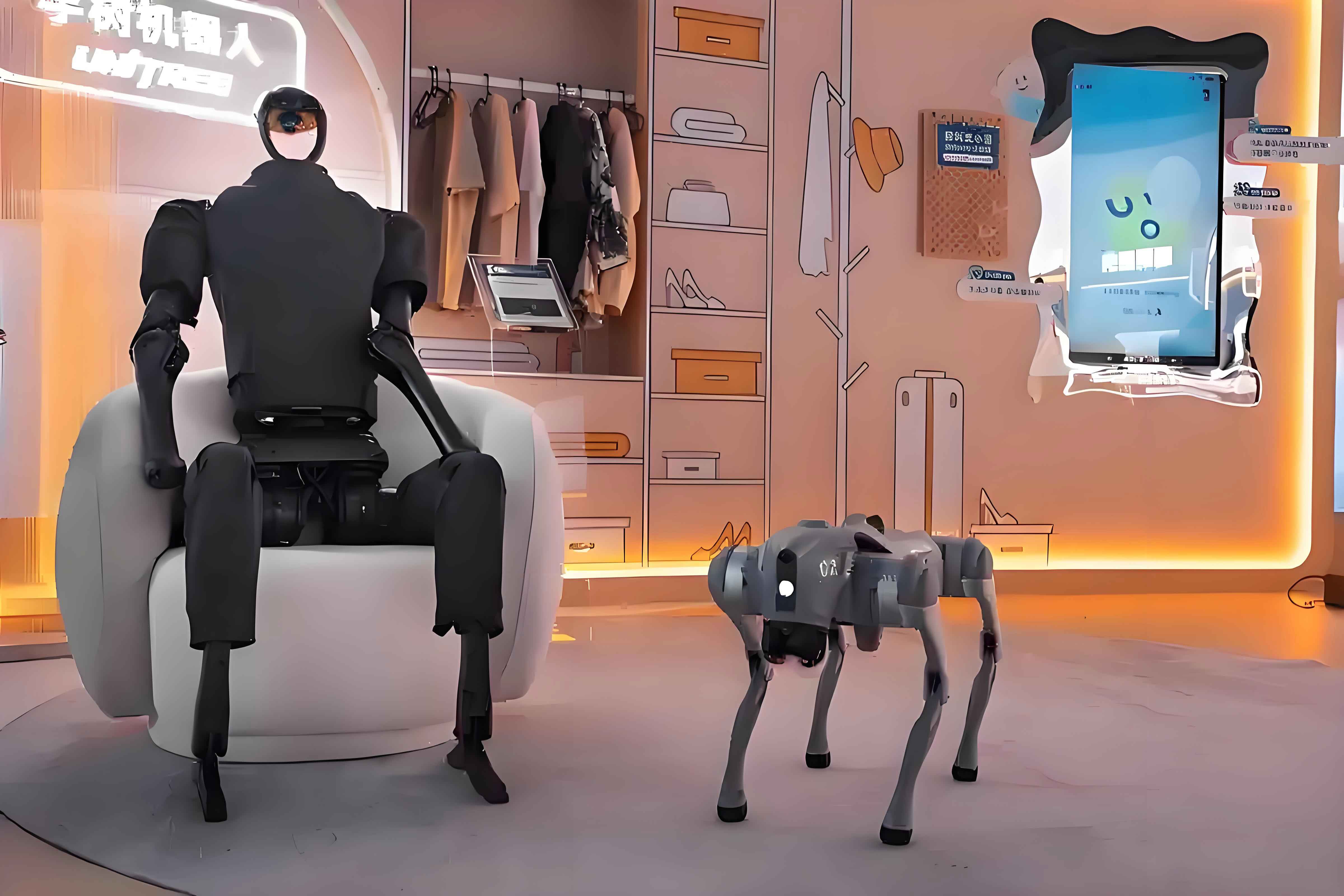
Looking ahead, the integration of humanoid robots into society faces challenges such as cost and supply chain maturity. Currently, most components, from motors to sensors, are developed in-house due to the lack of standardized suppliers. This self-reliance requires significant investment in R&D, but it also drives innovation. For instance, our H1 humanoid robot uses custom-designed actuators that provide high torque-to-weight ratios, essential for mimicking human movements. The potential of humanoid robots is limitless; they could revolutionize healthcare, education, and disaster response by performing tasks that are dangerous or repetitive for humans.
In conclusion, our journey in robotics has been marked by continuous iteration and a focus on humanoid robots as the ultimate goal. From quadrupedal machines to bipedal humanoid robots, each step has brought us closer to creating entities that can coexist with humans. The mathematics and engineering behind these advancements—from dynamics equations to perception algorithms—underscore the complexity and promise of this field. As we refine our technologies, humanoid robots will become more accessible, transforming how we live and work. The future is bright for humanoid robots, and we are excited to be at the forefront of this revolution.