
In recent years, as artificial intelligence technology accelerates its iteration, humanoid robots have gradually become a key direction for the transformation and upgrading of the manufacturing industry. From my observation, under policy support and guidance, the humanoid robot industry in China is rapidly achieving large-scale development, with application scenarios becoming increasingly rich. Related products are deeply integrated into the real economy, and humanoid robots are expected to become a significant new engine for economic growth. This article delves into the current state, challenges, and future prospects of the humanoid robot ecosystem, with a focus on China’s positioning in the global landscape.
The global market for humanoid robots is evolving swiftly. Countries like Japan, South Korea, the United States, and Germany have developed rapidly in this field. Japanese companies such as Honda, Toyota, Seiko, Epson, and Sony are in leading positions; South Korean firms like Samsung and Hyundai Motor are well-known; in the U.S., humanoid robot technology R&D is primarily concentrated in universities and companies like Boston Dynamics and Tesla, which possess high technical capabilities and innovation; German companies such as Siemens and Kuka also enjoy a strong reputation. Compared to these nations, China’s humanoid robot industry started later, but with the support of AI technology, it has made remarkable progress. According to the “2021 Global Artificial Intelligence Innovation Index Report” by the Chinese Institute of Science and Technology Information, China’s AI innovation level has entered the world’s first tier, generally reaching international advanced standards. Currently, China’s humanoid robot industry based on AI technology is steadily advancing, having launched multiple humanoid robot products, gradually narrowing the gap with developed countries.
To illustrate the competitive landscape in innovation, consider the patent applications for humanoid robot technologies. As of June 2023, China leads in cumulative patent applications, but Japan holds more effective invention patents. The following table summarizes the top 10 countries by patent counts:
| Rank | Applicant Country | Cumulative Patent Applications (units) | Effective Invention Patents (units) |
|---|---|---|---|
| 1 | China | 6618 | 1699 |
| 2 | Japan | 6058 | 1743 |
| 3 | South Korea | 1279 | 674 |
| 4 | France | 766 | 245 |
| 5 | United States | 685 | 358 |
| 6 | Germany | 135 | 60 |
| 7 | United Kingdom | 66 | 14 |
| 8 | Canada | 39 | 6 |
| 9 | Italy | 33 | 12 |
| 10 | India | 29 | 6 |
From this data, it is evident that China and Japan are frontrunners in humanoid robot innovation. The growth in patent activity can be modeled using the compound annual growth rate (CAGR). For instance, from 2014 to 2023, China’s public patent applications for humanoid robots had a CAGR of 19.3%, while authorized patents had a CAGR of 22.9%. The CAGR formula is expressed as:
$$ CAGR = \left( \frac{V_f}{V_i} \right)^{\frac{1}{n}} – 1 $$
where \( V_f \) is the final value, \( V_i \) is the initial value, and \( n \) is the number of years. This rapid growth underscores the dynamism in humanoid robot R&D.
Looking at the technological evolution, humanoid robots will progress through three stages:仿人机器人 (human-like robots), 类人机器人 (anthropomorphic robots), and 真人机器人 (true human robots). Currently, only some human-like robots have achieved commercialization, while anthropomorphic robots are still in the R&D phase. This indicates substantial growth potential in the domestic humanoid robot market. According to the International Federation of Robotics, from 2021 to 2030, the global humanoid robot market size is projected to have a CAGR as high as 71%. Meanwhile, data from the China Electronics Society suggests that by 2030, China’s humanoid robot market size could reach approximately ¥8700 billion. This growth can be represented by an exponential function:
$$ M(t) = M_0 \cdot e^{rt} $$
where \( M(t) \) is the market size at time \( t \), \( M_0 \) is the initial market size, \( r \) is the growth rate, and \( e \) is Euler’s number. For humanoid robots, such models help forecast future trends.
The humanoid robot industry chain consists of upstream core components, midstream whole-machine R&D, manufacturing, system integration, and downstream applications. The entire chain involves thousands or even tens of thousands of components and system software. In China, the upstream component industry chain has begun to show advantages in some areas. Key components include reducers, sensors, motors, and lead screws, whose technological capabilities directly determine the performance and cost of humanoid robots. Let’s break down the upstream sectors:
Precision Reducers: These act as human joints, connecting power sources and actuators. The global reducer market is dominated by harmonic reducers from companies like Japan’s Harmonica, but Chinese players such as绿的谐波, 来福谐波, and 同川科技 are catching up. In precision planetary reducers, Japanese and German firms lead, with Chinese companies like科峰智能 holding a 5.4% global share in 2022. A comparison of reducer performance can be summarized in a table:
| Component Type | Leading Global Companies | Key Chinese Companies | Performance Gap |
|---|---|---|---|
| Harmonic Reducer | Harmonica (Japan) | 绿的谐波, 来福谐波 | Close in ratio, torque, efficiency; lag in lifespan |
| Planetary Reducer | Newbo (Japan), Neugart (Japan) | 科峰智能 (Hubei) | Market share around 5.4% globally |
Servo Motors: These are core components for motion control. Foreign leaders include Infineon (Germany), Siemens (Germany), ABB (Switzerland), and Panasonic (Japan), holding over 70% of the global market. Chinese companies like汇川技术 (Shenzhen) and鸣志电器 (Shanghai) are representative, with鸣志电器 consistently exceeding 10% global market share, ranking fourth worldwide. The torque equation for servo motors in humanoid robots can be expressed as:
$$ \tau = J \alpha + B \omega + \tau_{load} $$
where \( \tau \) is torque, \( J \) is moment of inertia, \( \alpha \) is angular acceleration, \( B \) is damping coefficient, \( \omega \) is angular velocity, and \( \tau_{load} \) is load torque. This highlights the complexity in controlling humanoid robot movements.
Sensors: These are critical perception components in humanoid robots, including torque sensors, tactile sensors, and inertial sensors. Currently, overseas companies like ATI (U.S.) dominate the six-axis torque sensor market, while Chinese producers such as安培龙 (Shenzhen) and宇立仪器 (Nanning) are in early stages due to technical barriers. Tactile sensor markets are also led by欧美 and Japanese firms, with Chinese companies like汉威科技 (Zhengzhou) focusing on mid-to-low-end applications. The sensitivity of a sensor can be modeled as:
$$ S = \frac{\Delta V}{\Delta P} $$
where \( S \) is sensitivity, \( \Delta V \) is output change, and \( \Delta P \) is input change. Improving \( S \) is vital for humanoid robot perception.
Machine Vision: This involves using machines to replace human eyes for measurement and judgment. China accounts for 57.71% of global patent applications in machine vision, leading as the top technology source, followed by Japan (18.14%), the U.S. (13.87%), and South Korea (3.87%). In 2024, China’s machine vision market size was ¥20.717 billion, with a five-year CAGR of 21.80%. However, the global market is still foreign-dominated, with Japan’s Keyence and the U.S.’s Cognex as dual leaders, holding 48% and 6% market shares in 2023, respectively. The resolution in machine vision for humanoid robots can be given by:
$$ R = \frac{1}{2 \cdot \text{MTF}} $$
where \( R \) is resolution and MTF is modulation transfer function. Advancements here enhance humanoid robot capabilities.
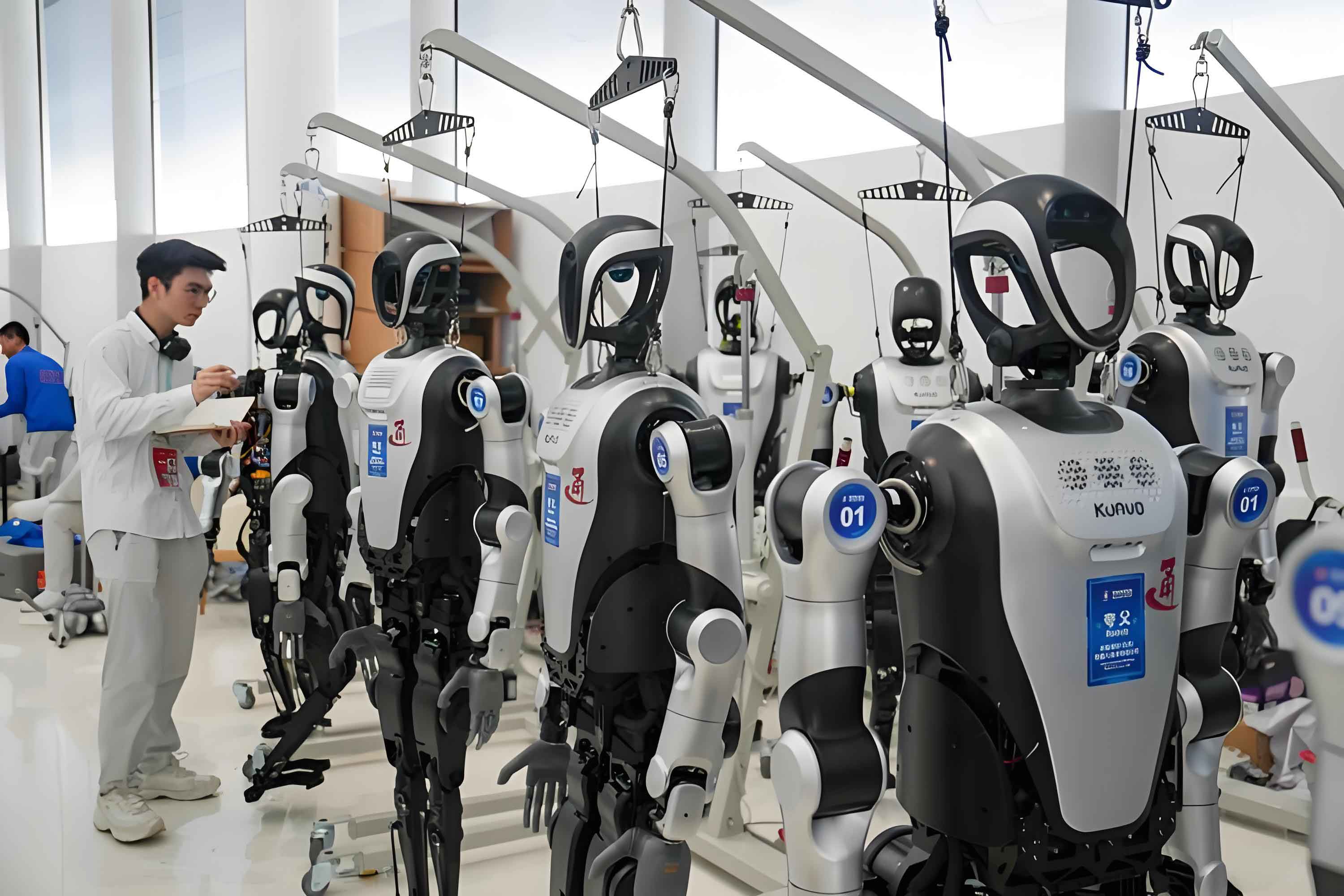
The midstream industry chain for humanoid robots is still in the exploration phase, with key technologies requiring breakthroughs. This includes本体设计 (body design), manufacturing, software, and system integration. In China, it is in the early industrial development stage, facing challenges like weak technical foundations, high manufacturing costs, large computing power demands, and validation in general scenarios. Embodied intelligence is the ultimate direction for humanoid robots, and large models are essential for embodied intelligent robots. However, there are pain points in planning and decision-making algorithms. With the success of ChatGPT commercialization, large models have proven their value in AI. In the future, large models are expected to reshape embodied intelligence scenes through high-tech supply. The development of midstream humanoid robot产业链 depends on the maturity of domestic large model technology, which will evolve through stages: short-term with large language models (LLMs), medium-term (1–3 years) with vision-language models (VLMs), and long-term (2–5 years) with vision-language-action models (VLAs). This progression can be represented as:
$$ \text{Embodied Intelligence} = f(\text{LLM}, \text{VLM}, \text{VLA}) $$
where \( f \) denotes a function integrating multiple modalities. For humanoid robots, achieving this integration is crucial for autonomy.
The downstream industry chain for humanoid robots has broad development prospects with rich potential application scenarios. Terminal applications focus on industrial manufacturing, warehousing and logistics, commercial services, household services, scientific research, security patrols, special services, healthcare, and entertainment. From the application plans and market layouts of various manufacturers in 2023, humanoid robots in China are expected to first land in structured scenarios in commercial service fields in the short to medium term; in the medium to long term, breakthroughs may occur in industrial manufacturing, logistics, public safety, and emergency rescue, such as automotive assembly, 3C post-assembly and inspection, logistics handling and sorting, and emergency rescue in hazardous scenes; in the long term, they will provide services in household scenarios, demanding higher generality, safety, and intelligence from humanoid robots. The market penetration rate \( P \) can be estimated as:
$$ P = \frac{N_{\text{robots}}}{N_{\text{potential sites}}} \times 100\% $$
where \( N_{\text{robots}} \) is the number of deployed humanoid robots and \( N_{\text{potential sites}} \) is the total potential application sites.
Regarding financial performance, listed companies in China’s humanoid robot sector generally show good results, with an average gross profit margin of 36% in Q1 2025. Upstream component markets are relatively mature, with Chinese local enterprises achieving breakthroughs in market penetration, and several listed companies holding important positions with good revenue growth and profitability. However, midstream and downstream companies, affected by R&D costs and market scale, have some firms with low net profit margins, facing significant financial pressure. This can be analyzed using profitability ratios:
$$ \text{Gross Margin} = \frac{\text{Revenue} – \text{Cost of Goods Sold}}{\text{Revenue}} \times 100\% $$
$$ \text{Net Margin} = \frac{\text{Net Income}}{\text{Revenue}} \times 100\% $$
For humanoid robot companies, improving net margins is key to sustainability.
The investment and financing landscape for humanoid robots reveals vast demand for多元化投融资. Since 2022, China’s humanoid robot field has seen 25 financing deals involving nearly ¥4.4 billion. Characteristics include活跃的早期阶段投融资 (active early-stage investments), with seed/angel rounds and Series A融资 comprising over 50%;龙头企业主导投融资市场 (leading enterprises dominating), as tech giants like Alibaba and Meituan enter through R&D or investments; and投融资参与主体日趋多元化 (diversifying participants), with government funds and commercial banks joining. In May 2024, Shanghai established a national-local共建 humanoid robot innovation center and plans to set up an industry fund exceeding ¥10 billion. In terms of robot industry development, Shanghai’s Pudong District has a relatively complete layout, with 4 out of 12 humanoid robots released domestically in 2023 produced there, and a robot industry scale over ¥20 billion. For regions like Sichuan, the Mianyang Robot Intelligent Manufacturing Industrial Park is a聚集区 for humanoid robot development, having attracted over 50 robot-related enterprises through innovative financing such as “invest first, equity later.” The future value of an investment in humanoid robots can be modeled with the net present value (NPV):
$$ NPV = \sum_{t=0}^{T} \frac{C_t}{(1 + r)^t} $$
where \( C_t \) is cash flow at time \( t \), \( r \) is discount rate, and \( T \) is investment horizon. Positive NPV encourages funding for humanoid robot ventures.
Commercial bank support for humanoid robots needs improvement. Traditional bank products and financing models are based on corporate经营情况 and asset quality, but the characteristics of the humanoid robot industry make it difficult for traditional loans to meet funding needs. First, enterprise assets are often intangible like R&D成果, with no authoritative valuation system for patents or products. Second, the industry培育期 is long, possibly lasting from a decade to几十年 from startup to profitability and IPO, while traditional bank credit products typically have terms under five years, mismatching financing needs. Third, the humanoid robot industry is still in the early commercialization stage, with uncertain business models and potentially lower-than-expected future profits, affecting bank credit assessments. To address this, I recommend innovating financial service models based on industry traits, developing richer sci-tech financial products for tech-based SMEs, strengthening投贷联动 financial support, and supporting local专项产业基金 setups.
In conclusion, the humanoid robot industry is poised for transformative growth globally, with China emerging as a key player. The产业链 is taking shape, with strengths in upstream components and vast downstream applications, but midstream challenges remain. Policy support, technological innovation, and optimized financial systems will be crucial. As embodied intelligence advances, humanoid robots will increasingly integrate into various sectors, driving economic growth. The journey ahead involves continuous R&D, collaboration, and adaptation to unlock the full potential of humanoid robots.
To summarize key metrics, here is a table on market projections for humanoid robots:
| Metric | Global (2021-2030) | China (by 2030) |
|---|---|---|
| Market Size CAGR | 71% | N/A |
| Market Size Value | N/A | ¥8700 billion |
| Patent CAGR (2014-2023, China) | N/A | 19.3% (applications), 22.9% (authorizations) |
The evolution of humanoid robot technology can be expressed through a phase transition model:
$$ \text{Technology Readiness Level (TRL)} = g(t, I) $$
where \( t \) is time and \( I \) is investment. Higher TRL enables more advanced humanoid robots. As we move forward, fostering innovation ecosystems and international cooperation will be vital for the humanoid robot revolution.