
As a researcher deeply immersed in the field of robotics, I have witnessed a remarkable transformation in how humanoid robots are reshaping logistics, manufacturing, and warehousing. The integration of advanced sensors, artificial intelligence, and mechanical dexterity has propelled these machines from conceptual novelties to indispensable tools. In this article, I will explore the key advancements and applications of humanoid robots, drawing from recent technological breakthroughs. The term ‘humanoid robot’ will be frequently highlighted to emphasize their growing prevalence. To structure the discussion, I will employ tables and mathematical formulations to summarize capabilities and performance metrics.
The evolution of the humanoid robot is driven by the need for flexibility and autonomy in complex environments. Traditional industrial robots often lack the adaptability required for dynamic tasks, but modern humanoid robots, with their anthropomorphic design, can navigate human-centric spaces and perform a variety of operations. One significant application is in pharmaceutical logistics, where precision and care are paramount. A humanoid robot designed for this sector typically features a height around 1.7 meters and a weight of approximately 65 kilograms, with numerous degrees of freedom enabling lifelike movements. Such a humanoid robot is equipped with binocular vision, 3D radar, and microphone arrays for 360° perception, allowing it to handle delicate items like medicine boxes without damage.
Through end-to-end reinforcement learning, this humanoid robot can optimize entire workflows, such as grasping, code-reading, and placing. The process can be modeled using reinforcement learning frameworks. For instance, the reward function $$ R(s, a) = \alpha \cdot \text{Accuracy} + \beta \cdot \text{Efficiency} – \gamma \cdot \text{Damage} $$ where \( \alpha, \beta, \gamma \) are weights, and the state \( s \) includes sensor inputs. The robot adapts grip force to prevent product damage, achieves code-reading accuracy up to 99.9%, and executes gentle placement actions to avoid stacking. This autonomy enhances the precision and flexibility of pharmaceutical sorting, showcasing the potential of the humanoid robot in sensitive industries.
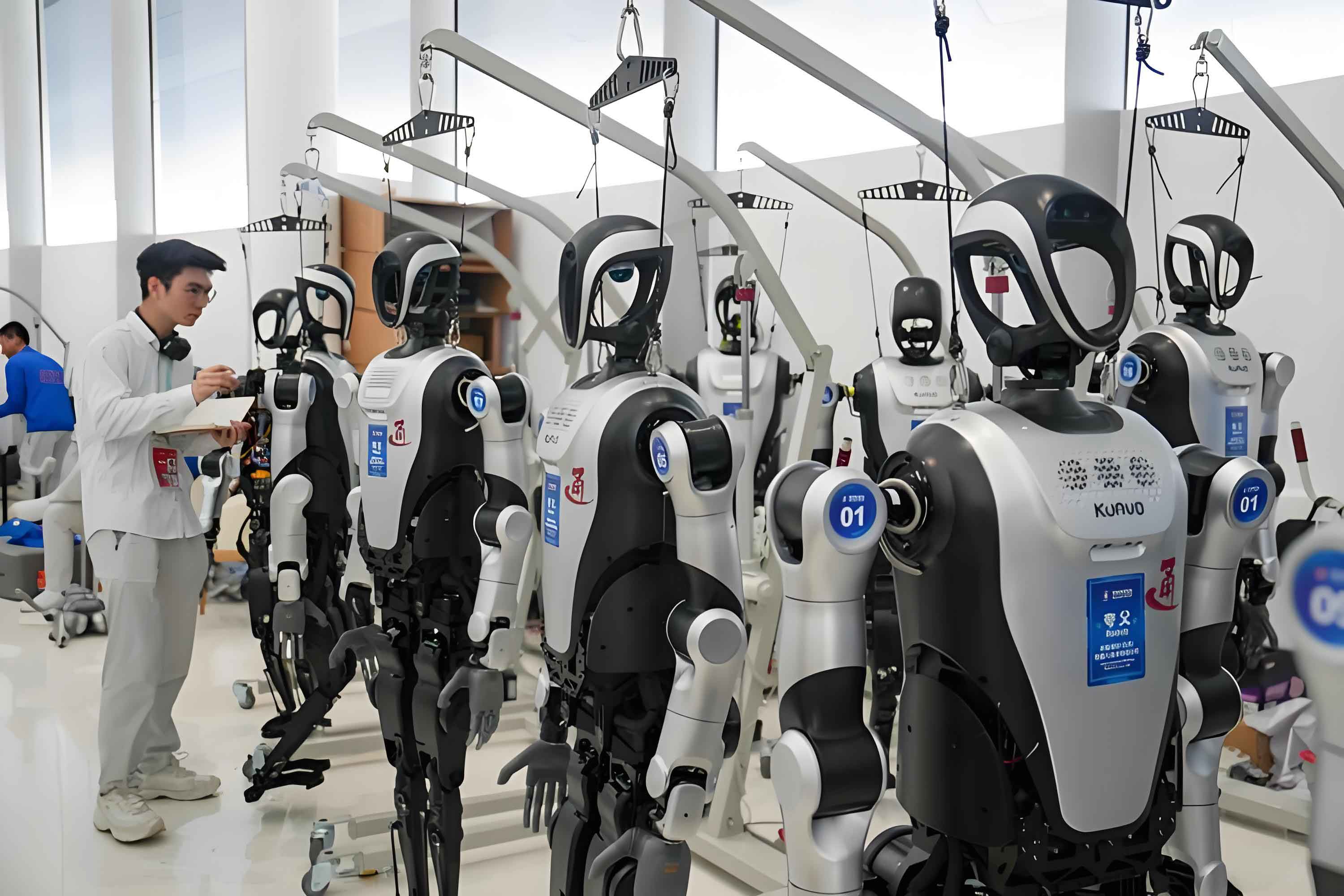
Another innovative category is the composite humanoid robot, which combines collaborative robotic arms with autonomous mobile robot (AMR) platforms. This fusion grants the humanoid robot both mobility and manipulation capabilities, making it ideal for bridging discrete workstations and breaking production silos. By leveraging the AMR’s autonomous navigation and the robotic arm’s precision, such a humanoid robot can perform multi-task coordination in settings like electronics manufacturing, automotive assembly, and e-commerce warehouses. The key advantage lies in its integrated controller, which consolidates robot control, AMR control, vision control, and safety control into a single unit. This all-in-one design, developed with proprietary hardware and software, improves cost-effectiveness and operational efficiency. The motion planning for such a humanoid robot can be described by the equation $$ \tau = J^T F + M(q)\ddot{q} + C(q, \dot{q})\dot{q} $$ where \( \tau \) is the joint torque, \( J \) is the Jacobian matrix, \( F \) is the external force, \( M \) is the inertia matrix, \( q \) is the joint position, and \( C \) represents Coriolis forces. This ensures smooth and accurate movements during mobile operations.
To compare the specifications of different humanoid robot types, the following table summarizes their core parameters:
| Humanoid Robot Type | Height Range (mm) | Weight (kg) | Degrees of Freedom | Arm Payload (kg) | Maximum Speed (m/s) | Key Features |
|---|---|---|---|---|---|---|
| Pharmaceutical-Focused Humanoid Robot | ~1710 | ~65 | 55 | 20 | 4 | 360° perception, reinforcement learning, gentle handling |
| Composite Humanoid Robot (AMR + Arm) | N/A (modular) | Varies | Typically 6-7 per arm | Up to 12 | 1.5 (mobile base) | Integrated controller, autonomous navigation, multi-task coordination |
| Wheel-Leg Hybrid Humanoid Robot | Adjustable (500-2600) | ~30 (payload capacity) | Multiple for limbs and wheels | 30 | 2 | Wheel-leg mobility, load platform with lift, 360° turning |
| Embodied Intelligent Humanoid Robot | ~1800 (estimated) | N/A | High for bionic arms | 30 | 2 (with wheeled base) | Advanced vision, bimanual manipulation, adaptive lifting |
The wheel-leg hybrid humanoid robot represents a fusion of wheeled and legged locomotion, offering versatility in material handling. This humanoid robot supports payloads up to 30 kilograms and is suitable for tasks like transport, picking, palletizing, and inventory counting. In sorting operations, it accurately identifies items and moves them to designated locations. For warehouse management, the humanoid robot can independently map and update its environment, enabling autonomous decision-making for obstacle avoidance and route selection. This allows it to tackle advanced tasks like inventory auditing and shelf management in complex settings. The mobility dynamics can be expressed as $$ v = \frac{d}{t} $$ where \( v \) is velocity, \( d \) is distance, and \( t \) is time, but for adaptive navigation, more complex models like $$ \min_{path} \int_{0}^{T} (w_1 \cdot \text{energy} + w_2 \cdot \text{time}) \, dt $$ are used, optimizing for efficiency and safety.
Moreover, the embodied intelligent humanoid robot introduces innovations across five key dimensions. It features advanced visual cameras and multi-modal models for instant object recognition—what I call “seeing at a glance.” With bionic arm architectures, it develops core picking skills, allowing independent or synchronized operation of both arms. The humanoid robot incorporates intelligent lifting systems with height adjustments from 550 to 870 millimeters, enabling ultra-human-like actions such as 360° omnidirectional turning and bending for pick-and-place. Its high-dynamic adaptive wheeled chassis achieves speeds up to 2 meters per second. The core payload platform coordinates with the mobile base via a precision lifting mechanism. This humanoid robot exemplifies how embodied intelligence enhances adaptability in unstructured environments.
To delve deeper into the performance metrics, consider the efficiency gains from using a humanoid robot in logistics. The throughput \( \Theta \) can be calculated as $$ \Theta = \frac{N}{T} $$ where \( N \) is the number of items handled and \( T \) is the total time. For a humanoid robot with autonomous optimization, \( T \) decreases due to reduced error rates and faster cycle times. For example, if the code-reading accuracy is 99.9%, the error probability \( P_e \) is 0.001, leading to fewer reworks. The overall system efficiency \( \eta \) can be modeled as $$ \eta = \frac{\text{Useful output}}{\text{Total input}} = \frac{\sum \text{successful tasks}}{\sum \text{attempted tasks}} \times 100\% $$ In practice, a humanoid robot can achieve \( \eta > 95\% \) in controlled settings, with further improvements through machine learning.
The control systems in these humanoid robots are pivotal. The integrated multi-controller approach consolidates various functions, reducing latency and enhancing reliability. For a humanoid robot, the control law might be given by $$ u = K_p e + K_i \int e \, dt + K_d \frac{de}{dt} $$ where \( u \) is the control signal, \( e \) is the error, and \( K_p, K_i, K_d \) are PID gains. This ensures precise movement and stability. Additionally, the perception systems of a humanoid robot, such as binocular vision, rely on triangulation principles $$ d = \frac{f \cdot B}{x_l – x_r} $$ where \( d \) is depth, \( f \) is focal length, \( B \) is baseline distance, and \( x_l, x_r \) are pixel disparities. This enables accurate 3D sensing for navigation and manipulation.
In terms of applications, the humanoid robot is revolutionizing sectors beyond logistics. In manufacturing, the composite humanoid robot facilitates just-in-time production by moving parts between stations. In healthcare, similar platforms could assist in sterile environments. The wheel-leg hybrid humanoid robot excels in warehouses with uneven surfaces, combining the speed of wheels with the stability of legs. The embodied intelligent humanoid robot, with its bimanual dexterity, is suited for tasks requiring human-like finesse, such as assembling delicate components. Each iteration of the humanoid robot brings us closer to seamless human-robot collaboration.
To summarize the technological trends, the table below highlights the key advancements across different humanoid robot generations:
| Generation | Era | Key Technologies | Typical Payload (kg) | Autonomy Level | Primary Use Cases |
|---|---|---|---|---|---|
| First-Generation Humanoid Robot | 2000s | Basic servos, pre-programmed motions | 5-10 | Low (scripted tasks) | Research, simple demonstrations |
| Second-Generation Humanoid Robot | 2010s | Enhanced sensors, SLAM, collaborative arms | 10-20 | Medium (environmental adaptation) | Factory automation, logistics assist |
| Third-Generation Humanoid Robot | 2020s onward | AI integration, reinforcement learning, bionic design | 20-30+ | High (full autonomy with learning) | Pharmaceuticals, complex warehousing, multi-domain tasks |
The future of the humanoid robot looks promising, with ongoing research into energy efficiency, cognitive abilities, and social interaction. As these machines become more affordable and capable, their adoption will accelerate. The humanoid robot is not just a tool but a partner in advancing industrial productivity. In conclusion, the advancements in perception, mobility, and intelligence are making the humanoid robot a cornerstone of modern automation. By leveraging formulas for optimization and tables for comparison, we can better appreciate the engineering marvels behind each humanoid robot. I am excited to see how the next wave of innovation will further elevate the role of the humanoid robot in our daily lives and industries.