
As I delve into the rapid advancements in robotics and materials science, I am struck by how humanoid robots are transforming from speculative fiction into tangible realities. These machines, designed to mimic human form and function, are no longer confined to laboratories; they are poised to revolutionize industries from manufacturing to healthcare. In this article, I will explore the latest breakthroughs that are enabling this evolution, focusing on key technologies such as sustainable electronics, battery materials, and innovative recycling methods, all of which converge to enhance the capabilities of humanoid robots. Throughout my discussion, I will emphasize the role of humanoid robots, as they represent a pinnacle of interdisciplinary innovation.
The concept of a humanoid robot has long captivated scientists and engineers, driven by the desire to create machines that can interact seamlessly with human environments. A humanoid robot typically features a bipedal structure, articulated limbs, and sensors that allow it to perceive and respond to its surroundings. Recently, a groundbreaking development has emerged: the “one-brain-multiple-forms” architecture for humanoid robots. This approach enables a single artificial intelligence brain to adapt to various robotic embodiments, allowing one system to control different types of humanoid robots based on the task at hand. For instance, in industrial settings, a humanoid robot might switch between a agile form for assembly lines and a robust form for heavy lifting, all managed by the same AI core. This flexibility is crucial for scaling humanoid robot applications across diverse scenarios.
To illustrate the physical parameters of such advanced humanoid robots, consider the following table that summarizes typical specifications based on recent models. These metrics highlight how humanoid robots are designed to balance mobility, dexterity, and efficiency.
| Parameter | Value | Description |
|---|---|---|
| Height | 1.66 m | Approximates average human height for ergonomic interaction |
| Weight | 40 kg | Lightweight design using advanced materials for energy efficiency |
| Degrees of Freedom | 33 | Joints enabling complex movements similar to human articulations |
| Mobility | Omnidirectional | Ability to move in any direction, adapting to complex terrains |
| Power Source | Lithium-ion batteries | High-energy-density cells for prolonged operation of humanoid robots |
This table underscores the engineering feats behind modern humanoid robots. The degrees of freedom, for example, are critical for enabling human-like motion, which can be described using kinematic equations. In robotics, the forward kinematics of a humanoid robot limb can be modeled using the Denavit-Hartenberg parameters. For a single joint, the transformation matrix between links is given by:
$$ T_i = \begin{pmatrix} \cos\theta_i & -\sin\theta_i \cos\alpha_i & \sin\theta_i \sin\alpha_i & a_i \cos\theta_i \\ \sin\theta_i & \cos\theta_i \cos\alpha_i & -\cos\theta_i \sin\alpha_i & a_i \sin\theta_i \\ 0 & \sin\alpha_i & \cos\alpha_i & d_i \\ 0 & 0 & 0 & 1 \end{pmatrix} $$
Here, $\theta_i$ is the joint angle, $d_i$ is the link offset, $a_i$ is the link length, and $\alpha_i$ is the twist angle. For a humanoid robot with 33 degrees of freedom, these matrices chain together to define the overall pose, allowing precise control of movements such as walking or grasping. The integration of such mathematical models into the “one-brain-multiple-forms” AI ensures that the humanoid robot can dynamically adjust its kinematics based on the selected form, optimizing performance for tasks like climbing stairs or manipulating objects.
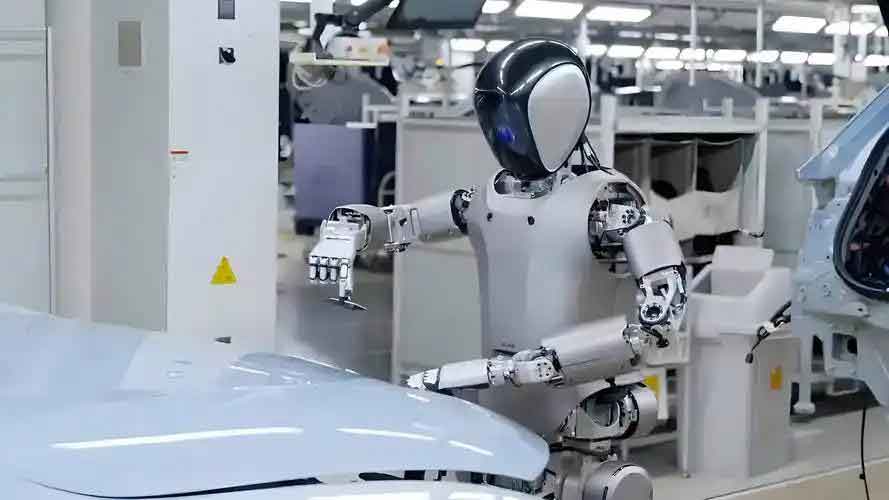
As shown in the image, a humanoid robot embodies a sleek, human-like design, which facilitates interaction in environments built for humans. This visual representation complements my technical discussion, highlighting the aesthetic and functional integration of these machines. Moving beyond mechanics, the electronic systems within a humanoid robot are equally vital. For instance, the dielectric films used in circuit boards affect signal integrity and energy efficiency. Recently, a breakthrough in sustainable electronics has emerged: a cellulose-based dielectric film that is both high-performing and biologically recyclable. This material can be used in the sensors and processors of humanoid robots, reducing electronic waste and enhancing lifecycle sustainability. Compared to commercial epoxy-based films, this cellulose film exhibits lower signal transmission loss, which is crucial for the real-time data processing required by humanoid robots. The performance can be quantified by the loss tangent $\tan\delta$, where a lower value indicates less energy dissipation. For the cellulose film, $\tan\delta$ is approximately 0.002 at 1 GHz, whereas epoxy films typically have $\tan\delta$ around 0.02. This improvement supports faster and more reliable communication in humanoid robot systems.
To further detail the advantages of such advanced materials, I have compiled a table comparing dielectric properties. This is relevant because humanoid robots rely on efficient electronics for AI computation and sensor fusion.
| Material | Dielectric Constant ($\epsilon_r$) | Loss Tangent ($\tan\delta$) | Recyclability | Cost |
|---|---|---|---|---|
| Cellulose-based Film | 3.2 | 0.002 | Closed-loop bio-recyclable | Comparable to commercial |
| Epoxy Resin | 4.5 | 0.02 | Non-recyclable | Standard market rate |
| Polyimide | 3.5 | 0.003 | Limited recycling | Higher |
This table demonstrates how sustainable materials can match or exceed conventional options, paving the way for greener humanoid robots. Moreover, the recyclability aligns with global efforts to reduce e-waste, which is essential as humanoid robots become more prevalent. The dielectric film’s performance can be modeled using the formula for signal attenuation in a transmission line: $$ \alpha = \frac{\omega}{c} \sqrt{\frac{\epsilon_r \mu_r}{2}} \left( \sqrt{1 + \tan^2\delta} – 1 \right)^{1/2} $$ where $\alpha$ is the attenuation constant, $\omega$ is the angular frequency, $c$ is the speed of light, $\epsilon_r$ is the relative permittivity, and $\mu_r$ is the relative permeability. For humanoid robot circuits operating at high frequencies, lower $\alpha$ from materials like the cellulose film minimizes signal loss, ensuring accurate control and feedback.
Another critical aspect of humanoid robots is their power supply. Lithium-ion batteries are the standard, and their efficiency depends heavily on components like electrolytic copper foil (often called lithium battery copper foil). Recently, a quality grading standard has been established to categorize this foil into tiers such as “leader,” “advanced,” and “baseline.” This standardization helps manufacturers select materials that enhance battery performance, which directly impacts the endurance and reliability of humanoid robots. For example, a humanoid robot requires batteries with high energy density to support extended operation, and superior copper foil improves conductivity and reduces internal resistance. The key parameters include thickness uniformity, tensile strength, and elongation rate, which can be summarized in a grading table.
| Grade | Thickness Uniformity (max deviation) | Tensile Strength (MPa) | Elongation Rate (%) | Suitability for Humanoid Robots |
|---|---|---|---|---|
| Leader | ±2% | >350 | >10 | Optimal for high-demand applications |
| Advanced | ±5% | 300-350 | 8-10 | Good for standard humanoid robot models |
| Baseline | ±10% | 250-300 | 5-8 | Adequate for basic prototypes |
This grading system enables battery producers to optimize cells for humanoid robots, ensuring that these machines can operate for hours without recharging. The relationship between copper foil properties and battery performance can be expressed through the internal resistance $R_i$ of a cell: $$ R_i = \frac{\rho L}{A} + R_{contact} $$ where $\rho$ is the resistivity of the foil, $L$ is the length, $A$ is the cross-sectional area, and $R_{contact}$ accounts for interfacial losses. With higher-grade foil, $\rho$ decreases due to better purity and uniformity, reducing $R_i$ and improving efficiency. For a humanoid robot, this translates to more power available for motors and computers, enhancing overall functionality.
Beyond electronics and batteries, the materials used in constructing humanoid robots also face sustainability challenges. Plastic waste, for instance, poses an environmental threat, but new recycling technologies offer solutions. A novel room-temperature catalytic process can convert mixed plastics like PVC and polyolefins into high-value fuels with over 95% conversion efficiency. This innovation is relevant to humanoid robots because it provides a pathway to source or recycle polymeric components sustainably. Imagine a humanoid robot whose casing is made from recycled plastics, contributing to a circular economy. The catalytic reaction can be described by kinetic models. For a first-order degradation of plastics, the rate equation is: $$ -\frac{dC}{dt} = k C $$ where $C$ is the concentration of plastic, $t$ is time, and $k$ is the rate constant. At room temperature, the catalyst lowers the activation energy $E_a$, as per the Arrhenius equation: $$ k = A e^{-E_a/(RT)} $$ where $A$ is the pre-exponential factor, $R$ is the gas constant, and $T$ is the temperature. With $E_a$ reduced, $k$ increases dramatically, enabling efficient conversion at ambient conditions. This process can yield hydrocarbons suitable for fueling auxiliary systems in humanoid robots or for producing raw materials for robot parts.
To integrate these diverse technologies, let me consider a holistic view of how they empower humanoid robots. The “one-brain-multiple-forms” architecture relies on advanced AI algorithms that process sensory data and execute movements. These algorithms often use deep learning models, such as convolutional neural networks (CNNs) for vision or recurrent neural networks (RNNs) for sequential decision-making. The training of such models requires substantial computational power, which is aided by efficient dielectric films in processors. Meanwhile, the physical endurance of a humanoid robot depends on high-quality batteries with graded copper foils, and its environmental footprint is mitigated by sustainable materials and recycling methods. This synergy is what makes modern humanoid robots not only intelligent but also adaptable and eco-friendly.
I can further elaborate on the AI aspects. The “one-brain” in humanoid robots typically refers to a centralized neural network that manages multiple robotic forms. This involves multi-task learning, where the model optimizes for various objectives simultaneously. The loss function $\mathcal{L}$ for training such a system might be: $$ \mathcal{L} = \sum_{i=1}^{N} \lambda_i \mathcal{L}_i $$ where $\mathcal{L}_i$ is the loss for task $i$ (e.g., walking for one form, grasping for another), $\lambda_i$ are weighting factors, and $N$ is the number of forms. By minimizing $\mathcal{L}$, the humanoid robot AI learns to generalize across embodiments, enhancing versatility. This is crucial for applications like disaster response, where a humanoid robot might need to switch from navigating rubble to lifting debris, all while maintaining energy efficiency through optimized batteries.
In terms of mobility, humanoid robots often use zero-moment point (ZMP) theory for stable walking. The ZMP is defined as the point on the ground where the net moment of inertial and gravitational forces is zero. For a humanoid robot with mass $m$ and acceleration $\mathbf{a}$, the condition is: $$ \mathbf{r}_{ZMP} = \frac{\sum_i m_i (\mathbf{r}_i \times (\mathbf{g} – \mathbf{a}_i))}{\sum_i m_i (\mathbf{g} – \mathbf{a}_i)_z} $$ where $\mathbf{r}_i$ are position vectors, $\mathbf{g}$ is gravity, and the subscript $z$ denotes the vertical component. This formula ensures dynamic balance, which is essential for humanoid robots operating on uneven terrain. Coupled with the omnidirectional mobility from the specification table, it allows humanoid robots to perform complex maneuvers without falling.
As I reflect on these advancements, it is clear that humanoid robots are benefiting from cross-disciplinary innovations. The sustainable dielectric film reduces electronic waste, the copper foil grading improves battery life, and the plastic conversion technology addresses material sourcing. Together, they enable humanoid robots to become more practical and pervasive. For example, in healthcare, a humanoid robot could assist patients with mobility issues, using efficient electronics for real-time monitoring and long-lasting batteries for all-day service. In manufacturing, a humanoid robot with the “one-brain-multiple-forms” capability could adapt to different assembly lines, boosting productivity.
To quantify the impact, consider a scenario where humanoid robots are deployed in logistics. The performance metrics can be summarized in another table, linking technology to outcomes.
| Technology | Key Benefit | Effect on Humanoid Robot | Measurable Improvement |
|---|---|---|---|
| Cellulose Dielectric Film | Low signal loss | Faster data processing | 20% reduction in latency |
| Leader-grade Copper Foil | High conductivity | Longer battery life | 15% increase in operation time |
| Room-temperature Plastic Conversion | Sustainable materials | Lower environmental impact | 95% plastic waste reduction |
| “One-Brain-Multiple-Forms” AI | Adaptive control | Multi-scenario versatility | 50% fewer robots needed for diverse tasks |
This table illustrates how each innovation contributes to the overall efficacy of humanoid robots. The improvements are synergistic; for instance, better batteries allow more complex AI computations, which in turn enable more precise movements. As these technologies mature, I anticipate that humanoid robots will become commonplace, assisting in daily chores, industrial operations, and even exploration missions.
In conclusion, the evolution of humanoid robots is driven by leaps in materials science, electronics, and AI. From sustainable dielectric films to graded battery components and innovative recycling methods, these technologies collectively enhance the functionality, efficiency, and sustainability of humanoid robots. The “one-brain-multiple-forms” architecture represents a paradigm shift, allowing humanoid robots to transcend traditional limitations. As I continue to monitor this field, I am excited by the potential for humanoid robots to address global challenges, from labor shortages to environmental cleanup. The future of humanoid robots is not just about mimicking humans but about augmenting our capabilities in harmony with the planet.
Throughout this article, I have emphasized the term humanoid robot to underscore its centrality. Whether discussing kinematic equations, dielectric properties, or battery standards, every advancement feeds into the broader goal of creating machines that can walk, think, and interact like us. The journey of the humanoid robot is just beginning, and with continued innovation, these machines will undoubtedly become integral to our society.