
As I observe the rapid advancements in robotics, I am convinced that we are on the cusp of a transformative era for humanoid robots. The vision of a general-purpose humanoid robot, capable of seamlessly integrating into diverse environments through simple voice or text commands, has long been a driving force for researchers and developers. This ambition stems from the inherent advantages of humanoid robots: their rapid deployment without needing specialized configurations and their low usage barriers. However, the path to true generality is fraught with challenges, primarily due to the limitations of current technology in handling the randomness and complexity of the real physical world. My exploration into this field reveals that bridging the gap between aspiration and reality requires innovative approaches to data, model training, and system integration.
The core challenge lies in the “brain” of the humanoid robot—its ability to perceive, understand, and act. Traditional methods often result in robots that operate well only in constrained settings with specific objects and predefined actions. This severely limits their adaptability. I have seen that a key bottleneck is the scarcity of high-quality, diverse training data. Without it, achieving robust generalization—where a humanoid robot can handle unseen objects, varying lighting conditions, and dynamic environments—remains elusive. This data scarcity directly impacts the commercial scalability of humanoid robots. To illustrate the current landscape, I can summarize different data collection paradigms in a comparative table.
| Data Collection Method | Description | Limitations for Humanoid Robot Generalization | Typical Success Rate Drop When Conditions Change |
|---|---|---|---|
| Human Demonstration via VR | Workers repeat fixed actions (e.g., placing batteries) while wearing VR gear to record motion data. | Only suitable for specific, repetitive tasks; fails with new objects or environments. | Significant decrease (e.g., below 50% for novel objects). |
| Master-Slave Arm Teleoperation | Using robotic arms to mimic human actions for tasks like cooking in a controlled kitchen setup. | Limited to environments with similar layouts; changes in object placement or room geometry cause failures. | Sharp decline (e.g., over 60% reduction for altered kitchen heights). |
| Internet Video Dataset Training | Leveraging large-scale public video datasets (e.g., millions of clips) for generative model training. | Data lacks physical interaction diversity and scale for precise robotic manipulation; sim-to-real gap persists. | Moderate to high, depending on task complexity and environmental variance. |
| Simulation-Based Data Generation | Creating virtual physical environments to generate synthetic interaction data at high speed. | Requires accurate modeling of physics and rendering; may need refinement with real-world data. | Minimal when combined with real-world fine-tuning, maintaining above 90% in many cases. |
From my perspective, simulation technology offers a promising solution. By constructing digital twins of real-world environments, we can generate vast amounts of training data efficiently. In simulation, a humanoid robot can practice thousands of interactions per second, drastically reducing data acquisition costs and accelerating model iteration. This approach addresses the fundamental issue of data scarcity for humanoid robots. The efficiency gain can be modeled mathematically. Let the data generation rate in simulation be denoted by \( R_s \), and in the real world by \( R_r \). Typically, \( R_s \gg R_r \). For a training task requiring \( N \) data samples, the time saved using simulation is:
$$ \Delta T = N \left( \frac{1}{R_r} – \frac{1}{R_s} \right) $$
Where \( \Delta T \) represents the time reduction. With \( R_s \) potentially exceeding 10,000 samples per second, this allows for rapid prototyping and learning. My work involves leveraging such simulations to train end-to-end embodied multi-modal large models. These models serve as the “brain” for humanoid robots, enabling them to understand visual and linguistic inputs and output appropriate actions. A critical breakthrough has been achieving high generalization across seven key dimensions, which I term the “Gold Standards for Humanoid Robot Generalization.” These standards ensure that a humanoid robot can operate reliably in unpredictable real-world conditions.
| Generalization Gold Standard | Description | Impact on Humanoid Robot Performance |
|---|---|---|
| Illumination Generalization | Ability to function under varying lighting conditions (e.g., bright, dim, or mixed light). | Prevents failures in environments like dark rooms or sunlit areas, crucial for 24/7 operation. |
| Background Generalization | Robustness to different backgrounds and cluttered scenes. | Ensures the humanoid robot can focus on objects regardless of visual noise, essential for retail or warehouses. |
| Planar Position Generalization | Capability to handle objects placed at random locations on a plane (e.g., a table). | Enables flexible task execution without pre-programmed coordinates, vital for dynamic settings. |
| Spatial Height Generalization | Adaptation to objects at different heights or shelves. | Allows the humanoid robot to reach items on high or low surfaces, expanding its workspace. |
| Closed-Loop Capability | Ability to adjust actions based on real-time feedback (e.g., correcting a grasp). | Improves success rates by allowing mid-course corrections, mimicking human dexterity. |
| Dynamic Interference Generalization | Resilience to moving obstacles or changes during operation. | Ensures safety and continuity in human-shared spaces like hospitals or factories. |
| Object Category Generalization | Skill in manipulating unseen object types, including transparent, reflective, or deformable items. | Critical for general-purpose applications, as the humanoid robot encounters novel items daily. |
Implementing these standards requires a robust model architecture. I utilize a Vision-Language-Action (VLA) model, which integrates visual perception, language understanding, and motion planning. The model can be represented as a function \( f \) that maps inputs to actions:
$$ \mathbf{a} = f(\mathbf{I}, \mathbf{L}; \theta) $$
where \( \mathbf{I} \) is the visual input (e.g., camera images), \( \mathbf{L} \) is the language command (e.g., “pick up the bottle”), \( \theta \) represents the model parameters learned through simulation and real data, and \( \mathbf{a} \) is the output action sequence for the humanoid robot. The training objective minimizes a loss function \( \mathcal{L} \) that combines task success and efficiency:
$$ \mathcal{L} = \lambda_1 \mathcal{L}_{\text{success}} + \lambda_2 \mathcal{L}_{\text{efficiency}} + \lambda_3 \mathcal{L}_{\text{generalization}} $$
Here, \( \lambda_i \) are weighting coefficients, and \( \mathcal{L}_{\text{generalization}} \) enforces the gold standards via adversarial or multi-environment training. With this framework, my humanoid robot has achieved success rates above 95% in grasping randomly stacked, unseen objects—including challenging ones like transparent glasses or shiny packages. This is a significant leap toward practicality for humanoid robots.
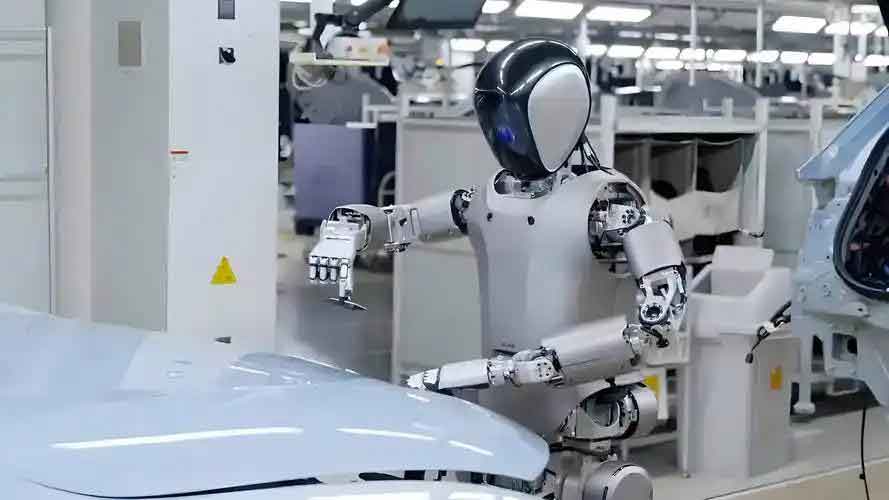
The real-world validation of these advancements is where the potential of humanoid robots truly shines. I have deployed humanoid robots in various exhibition and commercial settings to test their mettle. For instance, at a major tech conference, a humanoid robot equipped with a wheeled base for enhanced mobility operated continuously for 6-8 hours, serving hundreds of visitors. It autonomously learned the exhibition layout in a short time, without any pre-loaded database, demonstrating its ability to adapt on the fly. Visitors often challenged it with tasks like picking up unlabeled transparent water bottles, and it succeeded consistently. While some observers noted the deliberate slow speed for safety during demos, the actual operational speed is 3-4 times faster, making it viable for real tasks. This showcases how humanoid robots can handle unstructured interactions.
Beyond exhibitions, humanoid robots are making inroads into commercial scenarios. In a pharmacy retail setup, a humanoid robot performed continuous tasks like restocking, inventory counting, and item retrieval over several days. It handled over a thousand items, demonstrating reliability in a semi-structured environment. This progress is fueled by iterative improvements—both in hardware and software. Initially, we used off-the-shelf dexterous hands, but now we have developed a proprietary lightweight, multi-functional hand that enhances manipulation capabilities. The synergy between a trained “brain” (the VLA model) and an agile “little brain” for motion execution allows the humanoid robot to master increasingly complex skills, such as opening drawers, folding clothes, or sorting goods.
The path to mass production for humanoid robots is now clearer. I believe that the technology has reached an inflection point where end-to-end model capabilities can be transferred effectively to humanoid platforms. The next five years will likely see humanoid robots deployed in thousands of units across commercial and industrial settings, such as retail, logistics, and healthcare. Within a decade, they could enter household environments. My analysis of market trends indicates a surge in investment, with billions raised for humanoid robot ventures, reflecting strong confidence in their future. To quantify the growth, consider the cost dynamics: as production scales, the cost per humanoid robot decreases exponentially due to economies of scale and learning curves. This can be approximated by:
$$ C(n) = C_0 \cdot n^{-\beta} $$
where \( C(n) \) is the cost after producing \( n \) units, \( C_0 \) is the initial cost, and \( \beta \) is the learning coefficient (typically between 0.1 and 0.3 for advanced manufacturing). For humanoid robots, once production hits thousands, costs could drop significantly, accelerating adoption. The following table outlines potential application timelines and key performance metrics for humanoid robots in various sectors.
| Application Sector | Expected Timeframe for Scale (Years) | Key Tasks for Humanoid Robot | Target Success Rate | Estimated Units Deployed (by 2030) |
|---|---|---|---|---|
| Retail & Pharmacy | 0-2 | Item picking, restocking, customer assistance | >98% | 5,000-10,000 |
| Logistics & Warehousing | 2-4 | Sorting, packing, loading/unloading | >95% | 20,000-50,000 |
| Healthcare & Eldercare | 4-6 | Fetching objects, monitoring, basic support | >99% (safety-critical) | 2,000-5,000 |
| Manufacturing & Industrial | 3-5 | Assembly, quality inspection, machine tending | >97% | 10,000-30,000 |
| Household & Service | 8-10 | Cleaning, organizing, companionship | >90% | 1,000-5,000 (initial niche) |
To sustain this trajectory, continuous innovation in data generation and model training is essential. I employ a hybrid approach that combines simulation data with real-world fine-tuning. The simulation environment generates diverse scenarios, including rare edge cases, while real-world data from pilot deployments provides grounding. The overall training efficacy \( E \) can be modeled as a function of synthetic data \( D_s \) and real data \( D_r \):
$$ E = \alpha \log(1 + |D_s|) + (1 – \alpha) \log(1 + |D_r|) $$
where \( \alpha \) is a mixing parameter optimized for the humanoid robot’s task. Typically, \( \alpha \) ranges from 0.7 to 0.9, emphasizing simulation due to its scalability. This strategy enables weekly iterations on humanoid robot performance, incorporating feedback from field applications. As humanoid robots are deployed more deeply, they generate valuable real-world data, creating a virtuous cycle of improvement.
Looking ahead, the integration of humanoid robots into society will require addressing safety, ethics, and interoperability standards. From my vantage point, the focus should be on developing robust failure-recovery mechanisms and human-robot collaboration protocols. The ultimate goal is a humanoid robot that not only performs tasks but also learns and adapts autonomously. This hinges on advances in foundational models tailored for embodiment. I envision a future where humanoid robots, powered by ever-improving AI, become ubiquitous partners in work and daily life. The journey has just begun, but with each breakthrough in generalization, cost reduction, and real-world validation, we move closer to making the vision of a truly general-purpose humanoid robot a reality.