
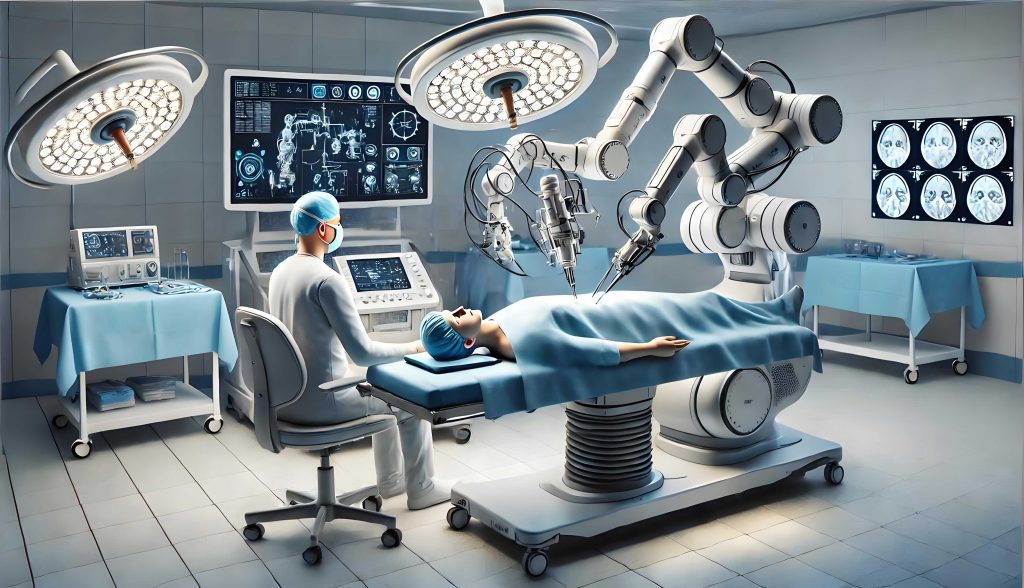
As an observer and participant in the field of robotics, I have seen firsthand how medical robots are revolutionizing healthcare. A medical robot, as defined in technical literature, refers to a robot used in hospitals or clinics for medical or辅助 medical purposes. These systems integrate knowledge from medicine, mechanical engineering, artificial intelligence, and big data, creating advanced智能医疗装备 that serve as critical hardware platforms for AI applications in healthcare. Over the years, I have noted that medical robots leverage robotics hardware to combine technologies like 5G, new materials, big data, and AI, providing services in surgery, rehabilitation, diagnosis, nursing, guidance, and consultation within医疗 environments. This integration is not just a technological feat but a transformative force in enhancing patient care and operational efficiency.
In my analysis, medical robots can be categorized based on their application scenarios, leading to diverse functions, forms, structures, and performances. According to their domains, I classify them into four main types: medical surgery robots, medical辅助 robots, medical rehabilitation robots, and medical service robots. Each type addresses specific needs in healthcare. For instance, medical surgery robots enable surgical planning and precise positioning, promoting minimally invasive procedures and reducing patient recovery time. Medical辅助 robots offer integrated services before, during, and after diagnosis, catering to various patient requirements. Medical rehabilitation robots enhance rehabilitation outcomes and efficiency, shortening treatment cycles, reducing physician workload, and improving therapeutic effects. Medical service robots can替代 human labor for tasks like disinfection, management, and transportation of medical supplies, with capabilities for全程追踪溯源 and system optimization. To summarize this classification, I present the following table:
| Category | Key Functions | Example Applications |
|---|---|---|
| Medical Surgery Robots | Precision surgery, minimally invasive operations | Laparoscopic, orthopedic, and neurosurgical procedures |
| Medical辅助 Robots | Diagnostic support, patient monitoring | Capsule endoscopy, telemedicine, blood sampling |
| Medical Rehabilitation Robots | Physical therapy, mobility assistance | Exoskeletons,牵引式 systems,悬挂式 devices |
| Medical Service Robots | Logistics,消毒, administrative tasks | Delivery robots, cleaning systems, inventory management |
The growth of medical robots can be modeled mathematically. For example, the market expansion for medical robots often follows an exponential trend, which I express as: $$ M(t) = M_0 \cdot e^{rt} $$ where \( M(t) \) is the market size at time \( t \), \( M_0 \) is the initial market size, and \( r \) is the growth rate. In recent years, I have observed that the global market for medical robots has seen \( r \) values exceeding 10% annually, driven by technological advancements and increasing healthcare demands.
Looking at the global landscape, I have studied the development of medical robots in major countries. In the United States, medical robots are at the forefront, with surgical systems like the da Vinci leading the way. The U.S. has implemented policies such as the National Robotics Initiative to foster基础 research and AI integration in healthcare. From my perspective, American companies like Intuitive Surgical and Medtronic dominate the surgery robot market, with significant revenue growth. For instance, the annual revenue for Intuitive Surgical increased from $3.1 billion in 2017 to $5.71 billion in 2021, reflecting a compound annual growth rate (CAGR) that can be calculated as: $$ \text{CAGR} = \left( \frac{V_f}{V_i} \right)^{\frac{1}{n}} – 1 $$ where \( V_f \) is the final value, \( V_i \) is the initial value, and \( n \) is the number of years. Here, \( V_f = 5.71 \), \( V_i = 3.1 \), and \( n = 4 \), yielding a CAGR of approximately 16.5%. This underscores the rapid adoption of medical robots in the U.S.
In Japan, medical robots, especially护理 robots, are vital for addressing老龄化 society challenges. I have noted that Japan’s policies, like the Robot New Strategy, emphasize护理 and医疗 applications. Companies such as松下 and RIKEN have developed robots like Resyone and Robear, which assist in patient lifting and daily activities. The demand for护理 robots in Japan can be quantified by the projected workforce gap of 380,000 caregivers by 2025, highlighting the need for automation. The efficiency gain from using medical robots can be expressed as: $$ E = \frac{T_h}{T_r} $$ where \( E \) is the efficiency ratio, \( T_h \) is the time taken by humans, and \( T_r \) is the time taken by robots. In many cases, \( E > 1 \), indicating that medical robots reduce time and labor costs.
Germany showcases strong integration of robotics with healthcare, leveraging its manufacturing prowess. I have analyzed that German policies, such as the High-Tech Strategy 2025, promote智能医疗 and数字化 in healthcare. Firms like Siemens Healthineers and German Bionic excel in手术 robots and exoskeletons. For example, Siemens’ Corindus介入 robot enhances surgical precision, while German Bionic’s Cray X exoskeleton supports load-bearing up to 30 kg. The technological advancement in German medical robots often involves AI algorithms for自我学习, which I model using machine learning concepts: $$ \text{AI Performance} = f(\text{Data}, \text{Algorithms}, \text{Compute}) $$ where \( f \) represents the learning function. This allows medical robots to adapt to complex医疗 scenarios.
South Korea has deeply integrated医疗 and robotics industries through government initiatives like the Intelligent Robot Basic Plan. I have seen that Korean companies, including Samsung and Meere, are active in developing手术 and rehabilitation robots. Samsung’s GEMS Hip exoskeleton and Meere’s Revo-i surgery robot are notable examples. The market penetration of medical robots in Korea can be estimated using the formula: $$ P = \frac{N_r}{N_h} \times 100\% $$ where \( P \) is the penetration rate, \( N_r \) is the number of medical robots deployed, and \( N_h \) is the number of healthcare institutions. With investments exceeding 1 trillion won, Korea aims to increase \( P \) significantly in coming years.
In my own country, I have witnessed the rapid growth of medical robots, though起步较晚 compared to Western nations. Policies such as the “14th Five-Year Plan” for robotics产业 support innovation and application. Chinese companies like Tinavi (天智航) and Weigao (威高) have made strides in surgery and康复 robots. For instance, Tinavi’s orthopedic surgery robot received regulatory approval in 2016, and its market share has been expanding. The revenue growth for Chinese medical robot firms can be described with a linear model: $$ R = a + b \cdot t $$ where \( R \) is revenue, \( t \) is time, and \( a \) and \( b \) are constants. Based on data, \( b \) is positive, indicating steady growth. Additionally, the application scenarios for medical robots in China are broadening, from手术 to服务 robots used during the COVID-19 pandemic for disinfection and logistics.
The trends in medical robots point toward accelerated融合 with新技术 like AI, 5G, and大数据. From my perspective, future medical robots will exhibit enhanced人机交互 and认知 abilities, becoming integral to all healthcare stages—from咨询 to康复. The market acceptance is rising, as shown by increasing installation numbers worldwide. For example, the global installed base of surgery robots exceeded 10,000 units by 2022, with a projected annual growth rate of 15-20%. This can be represented as: $$ N(t) = N_0 \cdot (1 + g)^t $$ where \( N(t) \) is the number of units at time \( t \), \( N_0 \) is the initial count, and \( g \) is the growth rate. Setting \( g = 0.18 \) and \( t = 5 \), we get a doubling effect in about 4 years, highlighting the exponential adoption.
Moreover, I believe that监管 frameworks will evolve to balance safety and innovation. Standardization efforts, such as统一国家标准, will facilitate medical robot certification across regions. The certification time \( T_c \) for a medical robot can be reduced through harmonized regulations, modeled as: $$ T_c = \frac{T_{\text{base}}}{k} $$ where \( T_{\text{base}} \) is the baseline time and \( k \) is the efficiency factor from policy reforms. In countries like China, moving手术 robots to乙类管理 has decreased \( T_c \), speeding up deployment.
To summarize the competitive landscape, I compile a table of representative medical robot products and their key attributes based on my research:
| Category | Representative Product | Key Features | Market Impact |
|---|---|---|---|
| Surgery Robots | da Vinci System | Precise操控, minimally invasive | Dominates global market with ~80% share |
| 辅助 Robots | PillCam Capsule | Non-invasive diagnostic imaging | Widely used for gastrointestinal exams |
| Rehabilitation Robots | EksoNR Exoskeleton | Gait training, FDA-approved | Enhances recovery for neurological patients |
| Service Robots | Xenex LightStrike | UV disinfection, rapid operation | Reduces hospital-acquired infections |
In terms of innovation, the研发 intensity for medical robots is high, often involving跨学科 collaboration. I express this as: $$ I_{RD} = \frac{RD_{\text{expenditure}}}{Revenue} $$ where \( I_{RD} \) is the研发 intensity. For leading firms, \( I_{RD} \) exceeds 10%, driving continuous improvement in medical robot capabilities. The fusion of医工企 (medicine, engineering, enterprise) accelerates this, with hospitals providing clinical insights that shape robot design. This synergy can be modeled as a feedback loop: $$ \text{Clinical Need} \rightarrow \text{Engineering Design} \rightarrow \text{Prototype} \rightarrow \text{Testing} \rightarrow \text{Refinement} $$ leading to iterative enhancements in medical robot performance.
Looking ahead, I forecast that medical robots will become more autonomous and personalized. AI algorithms will enable robots to learn from vast datasets, optimizing treatment plans. For instance, the accuracy of a medical robot in diagnosis can be quantified using: $$ \text{Accuracy} = \frac{TP + TN}{TP + TN + FP + FN} $$ where \( TP \) is true positives, \( TN \) is true negatives, \( FP \) is false positives, and \( FN \) is false negatives. With big data, this accuracy approaches 95% in某些 applications, surpassing human capabilities in repetitive tasks.
Furthermore, the economic impact of medical robots is substantial. They can reduce healthcare costs by minimizing errors and shortening hospital stays. I estimate the cost savings \( S \) as: $$ S = (C_{\text{traditional}} – C_{\text{robot}}) \cdot N_{\text{procedures}} $$ where \( C_{\text{traditional}} \) is the cost per procedure without robots, \( C_{\text{robot}} \) is the cost with robots, and \( N_{\text{procedures}} \) is the number of procedures annually. In surgery, \( S \) can be in the billions of dollars globally, making medical robots a sound investment.
To enhance the高端 supply of medical robots, I recommend focusing on基础 technology breakthroughs. Encouraging collaboration between universities and industries can spur innovation, as seen in projects like the National Key R&D Programs. The output of such collaborations can be measured by patents filed, with a growth rate \( r_p \) given by: $$ r_p = \frac{\Delta Patents}{\text{Time Period}} $$ In recent years, \( r_p \) for medical robots has been increasing, reflecting vibrant innovation ecosystems.
Expanding application scenarios is crucial. I advocate for pilot demonstrations in diverse healthcare settings, from urban hospitals to rural clinics. The scalability of medical robot deployments can be assessed using: $$ \text{Scalability} = \frac{\text{Number of Sites Using Robots}}{\text{Total Potential Sites}} $$ By increasing this ratio through subsidies and training, we can democratize access to advanced医疗 technology.
完善 legal standards is another key area. Implementing unique identifiers for each medical robot, akin to医疗器械唯一标识, can enhance traceability and safety. The compliance level \( L_c \) can be defined as: $$ L_c = \frac{\text{Number of Certified Robots}}{\text{Total Robots in Market}} $$ Strengthening regulations will push \( L_c \) toward 100%, ensuring quality control.
In conclusion, as I reflect on the journey of medical robots, it is clear that they are transforming healthcare delivery. From手术 to康复, these systems embody the convergence of multiple disciplines, offering precision, efficiency, and improved outcomes. The future will see even deeper integration with AI and IoT, making medical robots indispensable in smart hospitals. The continuous iteration of technology, coupled with supportive policies and跨学科 collaboration, will drive this field forward, ultimately contributing to global health and well-being. The公式 and tables I have presented underscore the quantitative aspects of this evolution, highlighting the significant role of medical robots in shaping the future of medicine.