
The world beneath our feet is one of profound opportunity and equally profound hazard. As we push the boundaries of civilization deeper—constructing tunnels for transit, excavating mines for resources, and maintaining sprawling subterranean infrastructure—the challenges of operating in these confined, unstable, and often perilous environments become paramount. Traditional methods, relying heavily on human presence for inspection, data collection, and monitoring, are fraught with risk. It is in this context that I have witnessed and contributed to the emergence of a transformative tool: the autonomous robot dog. This agile, resilient platform is not merely a piece of equipment; it is a paradigm shift in how we perceive and interact with the subsurface realm. My work in field robotics for geotechnical engineering has convinced me that these legged robotic systems are redefining safety, efficiency, and data fidelity in underground operations.
The subsurface environment presents a unique constellation of constraints that severely challenge conventional wheeled or tracked robots and human workers alike. The primary challenges can be summarized as follows:
| Challenge | Description | Impact on Operations |
|---|---|---|
| Unstructured Terrain | Rubble, steep inclines, mud, standing water, and irregular surfaces left by excavation or blasting. | Compromises mobility for wheeled systems; high risk of slips, trips, and falls for humans. |
| Confined Spaces & Complex Geometry | Narrow tunnels, low ceilings, sharp turns, and complex multi-level workings. | Limits the size and maneuverability of large robotic platforms; requires high agility. |
| Hazardous Atmospheric Conditions | Potential for toxic gases (e.g., CO, NOx, H2S), low oxygen, explosive dust, and poor visibility due to particulates. | Requires extensive personal protective equipment (PPE) for humans and can incapacitate or damage sensitive electronics. |
| Residual Physical Hazards | Unexploded ordnance (UXO) after blasting, unstable rock faces prone to collapse, and exposed reinforcement or machinery. | Creates life-threatening situations for inspection personnel, often halting operations for safety checks. |
| Communication Blackouts | Radio signals are heavily attenuated by rock and soil, making reliable, long-range wireless communication nearly impossible. | Renders real-time remote teleoperation difficult and limits data retrieval, pushing autonomy to the forefront. |
The robot dog, with its bio-inspired quadrupedal design, is engineered from the ground up to navigate this hostile checklist. Its core advantage lies in dynamic stability and adaptability. The articulated legs provide discrete footholds, allowing the robot dog to traverse gaps, climb over debris, and maintain balance on surfaces that would immobilize a tracked vehicle. A fundamental aspect of its locomotion can be described by inverse kinematics, determining the joint angles required for each leg to place its foot at a desired location. For a single leg, this calculation is crucial:
$$
\begin{bmatrix}
x_f \\
y_f \\
z_f
\end{bmatrix}
=
\begin{bmatrix}
L_1 \cos(\theta_1) + L_2 \cos(\theta_1+\theta_2) + L_3 \cos(\theta_1+\theta_2+\theta_3) \\
L_1 \sin(\theta_1) + L_2 \sin(\theta_1+\theta_2) + L_3 \sin(\theta_1+\theta_2+\theta_3) \\
0 \quad \text{(for planar simplification)}
\end{bmatrix}
$$
Where $L_1, L_2, L_3$ are the lengths of the leg segments (hip, thigh, calf) and $\theta_1, \theta_2, \theta_3$ are the corresponding joint angles. The robot dog’s onboard computer solves these equations in real-time for all four legs, synchronized with a gait pattern algorithm (e.g., trot, crawl, amble) to generate stable motion. This mechanical intelligence is the first layer of its suitability for underground work. Furthermore, advanced models incorporate terrain compliance and impedance control, allowing the robot dog to sense ground contact forces and adjust leg stiffness softly or rigidly as needed, preventing destructive impacts and absorbing shocks. This can be modeled as:
$$
\tau = J^T (F_{desired}) + D(\dot{q}) + G(q)
$$
Here, $\tau$ is the vector of joint torques, $J^T$ is the transpose of the leg’s Jacobian matrix mapping joint space to Cartesian space, $F_{desired}$ is the desired force at the foot, $D(\dot{q})$ represents damping forces, and $G(q)$ compensates for gravity. This level of control allows the robot dog to “feel” its way across uncertain ground.
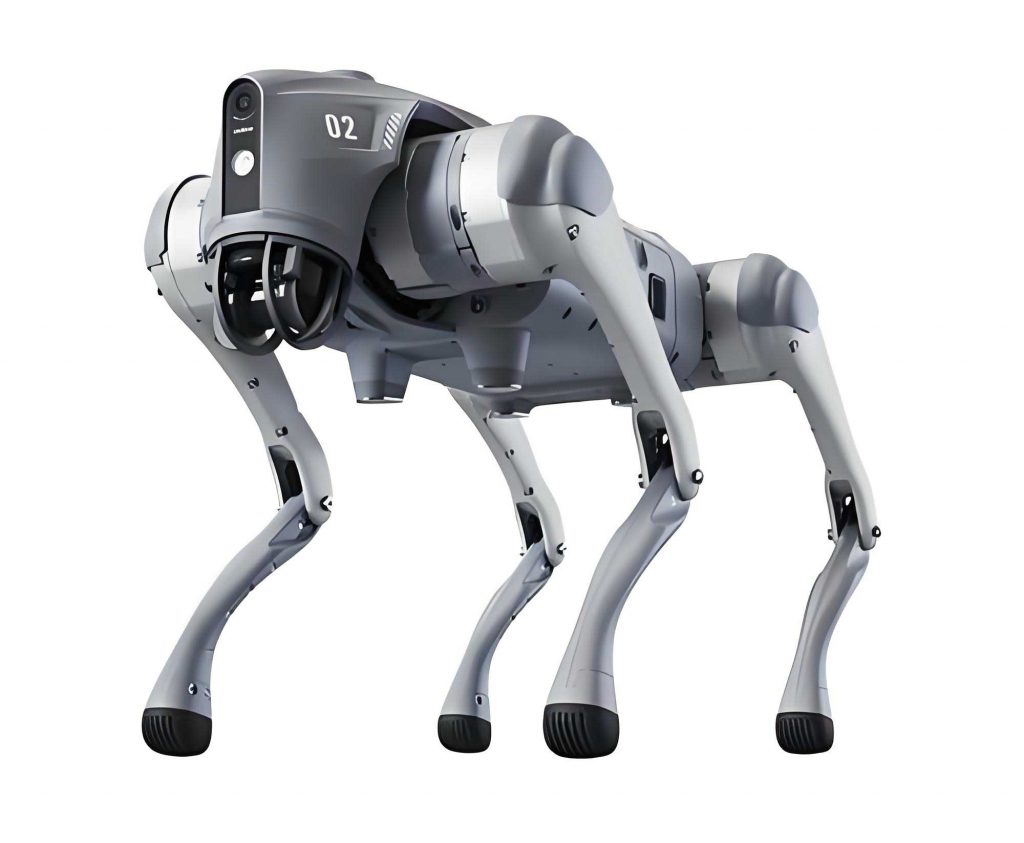
The true transformative power of the modern robot dog, however, lies in its role as a mobile sensor fusion platform. Its back is not just a cargo area; it is a standardized interface for a modular payload of perception and analysis tools. In my deployments, we have equipped robot dogs with diverse sensor suites tailored to specific mission profiles. The following table outlines a comprehensive sensor package and its purpose:
| Sensor Module | Data Output | Primary Application Underground |
|---|---|---|
| 3D LiDAR | High-density point cloud | As-built surveying, volume calculation, change detection (e.g., convergence monitoring), and creation of digital twins for the tunnel. |
| Pan-Tilt-Zoom (PTZ) RGB Camera | High-resolution imagery & video | Visual inspection for cracks, spalling, bolt integrity, water ingress, and general condition assessment. |
| Thermal Imaging Camera | Temperature gradient maps | Detecting water leaks behind linings, locating hotspots on electrical or mechanical equipment, and identifying thermal anomalies in rock masses. |
| Multi-Gas Sensor Array | Concentrations of O2, CH4, CO, H2S, NOx | Atmospheric profiling for worker safety, early warning of explosive or toxic gas buildup. |
| Methane Laser Spectrometer | Precise, stand-off CH4 concentration | Targeted gas detection from a safe distance, crucial in coal mines or gassy tunnels. |
| Geophone Array / Microphone | Seismic/acoustic vibrations | Monitoring for microseismic activity, listening for sounds of stress in rock or leaking fluids. |
The fusion of data from these sensors, localized precisely via the robot dog’s onboard Simultaneous Localization and Mapping (SLAM) algorithm, creates a rich, georeferenced dataset that was previously impossible or prohibitively dangerous to obtain. For instance, a single autonomous patrol by a robot dog can generate a co-registered dataset containing a millimeter-accurate 3D model, a visual and thermal overlay highlighting defects, and a spatial map of atmospheric gas concentrations. This comprehensive profile is invaluable for predictive maintenance and risk assessment.
The application spectrum for a robot dog in subsurface engineering is vast. Let me detail several key use cases based on practical field experience.
Post-Blast Inspection and Hazard Assessment: This is arguably the most dangerous routine task in tunneling and mining. After a controlled explosion, the heading face is unstable, littered with debris, and may contain misfired explosives or be filled with noxious fumes. Sending a human inspector in immediately is a high-risk procedure that often causes project delays. Here, the robot dog excels. We program it to autonomously navigate to predefined GPS-denied coordinates (using its prior SLAM map) after the all-clear is given for mechanical entry. As it proceeds, its gas sensors continuously log air quality. Upon reaching the face, it performs a systematic scan: LiDAR for rockfall and muck pile profile, visual and thermal cameras to scan for “hot” unexploded blasting caps, and acoustic sensors to listen for tell-tale sounds. It then returns autonomously, delivering a conclusive safety report before any human enters. The mission success probability $P_{success}$ for such a hazardous inspection can be modeled as a function of the robot dog’s reliability:
$$
P_{success} = R_{base} \cdot R_{comm} \cdot R_{nav} \cdot \prod_{i=1}^{n} R_{sensor_i}
$$
where $R_{base}$ is the basic mechanical/electrical reliability, $R_{comm}$ is the probability of maintaining a data link (even if intermittent), $R_{nav}$ is the reliability of the navigation stack, and $R_{sensor_i}$ is the reliability of each critical sensor. The robot dog’s design aims to maximize each $R$ term, making $P_{success}$ acceptably high for this critical task.
Routine Surveying and Quality Control: During construction, verifying dimensions, shotcrete thickness, and lining placement is essential. A robot dog can be deployed daily or weekly to patrol the entire tunnel drive. Using its LiDAR and cameras, it generates progressive as-built models. By comparing point clouds from different dates, we can compute convergence rates or detect deformations with sub-centimeter accuracy using algorithms like the Iterative Closest Point (ICP). The deviation $\Delta$ between two scans, $P$ and $Q$, is minimized:
$$
\min_{R, t} \sum_{i=1}^{N} || (R \cdot p_i + t) – q_i ||^2
$$
where $R$ is the rotation matrix and $t$ the translation vector that best align the point sets. This quantitative analysis, provided autonomously by the robot dog, is far superior to manual measurements.
Equipment and Infrastructure Monitoring: Underground facilities house critical equipment: pumps, fans, transformers, and conveyor belts. A robot dog can be scheduled for periodic inspection rounds, using thermal imaging to check motor temperatures and visual inspection to look for oil leaks, corrosion, or loose components. It can also read analog gauges via optical character recognition (OCR). This shift from periodic human rounds to continuous or frequent robotic data collection enables a transition from preventative to predictive maintenance.
Despite their impressive capabilities, current-generation robot dogs are not a panacea. Their deployment underground is tempered by significant limitations, which define the frontiers of our research and development.
| Limitation | Technical Description | Current Mitigation & Research Direction |
|---|---|---|
| Communication Range | Radio waves (Wi-Fi, 4/5G) are attenuated exponentially with distance in tunnels: $P_r = P_t \cdot G_t \cdot G_r \cdot (\lambda / (4\pi d))^n \cdot L_{material}$, where $n > 2$ (often 3-4) in tunnels due to waveguide and rough wall effects. | Use of mesh networks with drop nodes, opportunistic “sneakernet” data download when the robot returns, and development of robust autonomy to operate long periods without a link. |
| Payload Capacity | Commercial platforms are typically limited to 10-20 kg. This restricts sensor options (e.g., heavy geophysical sensors like ground-penetrating radar) and battery quantity. | Careful sensor miniaturization, optimized mechanical design to increase strength-to-weight ratio, and mission-specific payload swaps. Research into more powerful actuators and composite materials. |
| Operational Endurance | Battery life limits mission duration to 1-3 hours under active sensing and locomotion load, dictated by energy density: $E_{mission} = P_{avg} \cdot t_{mission}$. | Deployment of autonomous docking stations for wireless recharging, exploration of hybrid power systems (fuel cell + battery), and software optimization for energy-efficient gaits and “sleep” modes. |
| Environmental Hardening | Dust, humidity, and water ingress can damage sensors and joints. High levels of particulate matter can blind LiDAR and cameras. | IP-rated enclosures, pressurized compartments, air-blowing systems for lenses, and algorithmic filtration of sensor noise (e.g., dust in point clouds). |
| Navigation in Featureless or Dynamic Environments | Long, repetitive tunnels or areas undergoing active excavation (changing scenery) challenge visual-inertial SLAM, leading to drift or failure. | Fusion with wheel odometry, use of ultra-wideband (UWB) anchor systems for localization, and deployment of artificial fiducial markers in key areas. |
The path forward involves addressing these limitations holistically. A simple scaling law suggests that increasing size can solve payload and battery issues: mass and structural strength scale with volume ($\propto L^3$), while power for locomotion scales approximately with mass. However, agility and the ability to navigate tight spaces degrade. The optimization problem is multi-variable. Future robot dog generations will likely be part of heterogeneous teams: smaller, agile scouts and larger, carrier-style robot dogs that act as mobile power and communication hubs, following the scouts and extending their operational range. This symbiotic relationship can be formalized. Consider a scout robot dog $S$ and a carrier robot dog $C$. The total system endurance $T_{system}$ when $C$ can recharge $S$ is greater than the sum of their independent missions:
$$
T_{system} = T_C^{ind} + \min\left(T_S^{ind}, \frac{E_C^{transfer}}{\eta \cdot P_S}\right)
$$
where $E_C^{transfer}$ is the energy the carrier can wirelessly transfer, $\eta$ is the transfer efficiency, and $P_S$ is the scout’s power draw. This teaming concept directly tackles the endurance and communication challenges.
Furthermore, the integration of the robot dog with novel subsurface sensing modalities is a thrilling frontier. For example, imagine a robot dog equipped with a miniaturized, non-invasive subsurface imaging tool. While the referenced magnetic resonance sounding method requires specific coil configurations not directly mountable on a small robot dog, the principle of mobile, close-proximity geophysical surveying is sound. A robot dog could deploy small electrode arrays for electrical resistivity tomography (ERT) or precisely position micro-seismic sensors around a region of interest, providing a mobile platform for high-resolution, targeted underground imaging without the need for extensive cabling and human field work.
In conclusion, the advent of the autonomous robot dog marks a seminal moment in subsurface engineering. From my perspective in the field, it is more than a tool; it is a partner that assumes the most significant risks, performs tedious tasks with unwavering consistency, and delivers a quality and density of data that fundamentally improves our understanding of the underground environment. The robot dog enhances human safety not by replacing the skilled engineer, but by liberating them from the most dangerous and mundane tasks, allowing human expertise to focus on analysis, decision-making, and innovation. The limitations we face today—in communication, endurance, and payload—are not dead ends, but rather the precise coordinates for our next phase of research and development. As we refine these platforms, making them more robust, more intelligent, and more integrated into the operational workflow, the robot dog will undoubtedly become as indispensable underground as the hard hat and the surveyor’s total station are today. It is the vanguard of a new, safer, and more intelligent era of building and exploring the world beneath us.