
The strain wave gear, also commonly referred to as a harmonic drive, represents a paradigm shift in precision power transmission technology. Characterized by its unique operating principle that relies on the controlled elastic deformation of a metallic component, this mechanism offers an unparalleled combination of high reduction ratios, compactness, and positional accuracy within a single stage. Its invention was catalyzed by the demanding requirements of aerospace and defense applications, where performance-to-weight ratio and reliability are paramount. Over the decades, the technology has matured significantly, finding its way from specialized military and space systems into a vast array of civilian and industrial domains, most notably in robotics and precision automation. This article provides a detailed, first-person examination of the strain wave gear, delving into its fundamental operating principles, historical evolution, comparative performance metrics, diverse applications, and the critical research frontiers that will define its future.
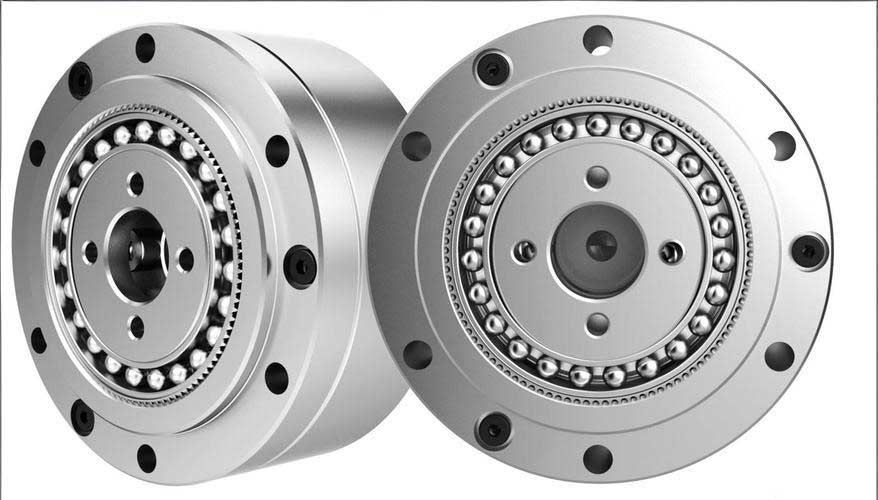
The core functionality of a strain wave gear system is deceptively simple yet mechanically elegant. It operates based on the principle of controlled elastic meshing between three primary components: a rigid Circular Spline (CS), a flexible Flexspline (FS), and a Wave Generator (WG). The Flexspline is a thin-walled, cup- or short-sleeve-shaped cylindrical gear that is slightly smaller in diameter than the rigid Circular Spline, which features internal teeth. The Wave Generator, typically an elliptical bearing assembly, is inserted into the Flexspline, causing it to deform into an elliptical shape. This deformation forces the teeth of the Flexspline to engage with the teeth of the Circular Spline at two diametrically opposite regions along the major axis of the ellipse.
The key to the high reduction ratio lies in the difference in the number of teeth between the two splines. The Flexspline typically has two fewer teeth (or a small, even difference) than the Circular Spline. When the Wave Generator rotates, the elliptical deformation pattern rotates with it. However, due to the tooth engagement, the Flexspline itself rotates relative to the Circular Spline in the opposite direction, but at a drastically reduced speed. The fundamental kinematic relationship, or reduction ratio \( i \), for the common configuration where the Circular Spline is fixed, the Wave Generator is the input, and the Flexspline is the output, is given by:
$$ i = -\frac{N_f}{N_c – N_f} $$
where \( N_c \) is the number of teeth on the Circular Spline and \( N_f \) is the number of teeth on the Flexspline. The negative sign indicates the reversal in rotation direction. For a typical setup where \( N_c = 202 \) and \( N_f = 200 \), the reduction ratio \( i = -100 \). This elegant principle allows for single-stage reduction ratios commonly ranging from 50:1 to over 300:1.
The historical trajectory of the strain wave gear is intrinsically linked to the Cold War space race. The technology was pioneered in the late 1950s in the United States, driven by the need for compact, reliable, and high-ratio actuators for missile guidance systems, satellite antenna pointing mechanisms, and spacecraft control surfaces. Major aerospace corporations and research institutions, such as USM Corporation, NASA’s Lewis Research Center, and Bell Aerospace, invested heavily in its development. Shortly thereafter, the Soviet Union initiated its own comprehensive research programs, with institutions like the Bauman Moscow State Technical University making significant contributions to the theoretical understanding of stress distributions and new gear profiles. Japan’s entry into the field in the 1970s, through companies like Harmonic Drive Systems Inc., was marked by a focus on commercialization, standardization, and mass production, which subsequently made strain wave gear technology accessible to a broader industrial market.
The introduction of strain wave gear technology to other parts of the world followed a similar pattern of initial technology transfer followed by local R&D. In Europe, nations like Germany, Switzerland, and the UK developed their own expertise, often focusing on ultra-high-precision applications for machine tools and scientific instruments. The global dissemination of knowledge has led to a mature, yet still evolving, technological landscape where different regions have developed particular strengths, from theoretical modeling and new materials to advanced manufacturing techniques for miniaturized components.
Mechanical Characteristics and Performance Analysis
The distinctive operating principle of the strain wave gear bestows upon it a set of remarkable advantages and some inherent challenges. A comparative summary is presented in the table below:
| Advantages | Disadvantages & Challenges |
|---|---|
|
|
The high load capacity can be quantitatively appreciated by considering the number of teeth in simultaneous contact. For a gear with \( N_f \) teeth and a typical engagement arc of 180 degrees, the number of tooth pairs in contact \( Z_c \) is approximately:
$$ Z_c \approx \frac{N_f}{2} $$
This large \( Z_c \) distributes the transmitted torque \( T \) across many teeth, reducing the load per tooth pair and contributing to smooth operation. The stress state within the Flexspline is complex, combining bending stresses from the elliptical deformation, membrane stresses from torque transmission, and contact stresses at the tooth interface. A simplified view of the maximum bending stress \( \sigma_b \) in the cylindrical wall of a cup-type Flexspline can be related to the radial deflection \( w_0 \) imposed by the Wave Generator:
$$ \sigma_b \propto E \cdot \frac{t \cdot w_0}{R^2} $$
where \( E \) is the Young’s modulus of the Flexspline material, \( t \) is its wall thickness, and \( R \) is its nominal radius. This equation highlights why material selection (high fatigue strength, like maraging steel or advanced alloys) and precise control of geometry are critical for the durability of a strain wave gear.
Application Spectrum: From Aerospace to Consumer Devices
The unique advantages of the strain wave gear have led to its pervasive adoption across a remarkably broad spectrum of industries. Its role is often mission-critical, serving as the precise muscle behind motion control systems.
- Aerospace & Defense: This remains a premier application area. Strain wave gears are used in satellite solar array drives, antenna pointing systems, missile fin actuators, radar pedestals, and drone gimbal systems. Their ability to provide high torque in a vacuum-compatible, lightweight package is unparalleled.
- Industrial Robotics: Over 60% of all strain wave gears produced are used in robotic joint actuators. They provide the compact, high-torque, zero-backlash rotation essential for the precision, dexterity, and payload capacity of articulated robot arms, particularly in the critical first three axes.
- Machine Tools & Semiconductor Manufacturing: High-precision rotary tables, CNC indexers, and wafer handling robots utilize strain wave gears for their exceptional angular accuracy and stiffness, enabling micron-level precision in machining and positioning.
- Medical & Laboratory Equipment: Surgical robots, MRI patient positioning systems, and automated laboratory analyzers benefit from the smooth, precise, and compact motion provided by strain wave gear reducers.
- Optical & Instrumentation Systems: Telescope mounts, pan-tilt-zoom (PTZ) camera systems, and laser steering mechanisms rely on their precision and minimal backlash.
Global Technological Landscape and Performance Gaps
While the strain wave gear is a globally recognized technology, significant disparities exist in the performance and sophistication of commercially available products. A primary differentiator lies in the design and manufacturing of the Flexspline. Internationally, the trend for high-performance applications has decisively shifted towards the short-sleeve (or “pancake”) Flexspline. This design minimizes axial length, drastically reducing the system’s moment of inertia and overall volume while maintaining or even increasing torque capacity through optimized stress distribution and material science.
In contrast, many manufacturers still predominantly produce the traditional cup-type Flexspline, which has a significantly longer axial profile. This leads to a larger, heavier assembly with a higher moment of inertia. The performance gap is quantified in the following comparison table, which contrasts key parameters for similarly rated strain wave gear reducers (Ratio 100:1, Input Speed 1500 RPM) from international leaders versus domestic producers using conventional designs:
| Parameter | International (Short-Sleeve Design) | Conventional (Cup-Type Design) |
|---|---|---|
| Outer Diameter (mm) | 70, 85, 110, 135, 170 | 70, 85, 110, 135, 170 |
| Axial Length (mm) | ~14, ~17, ~22, ~27, ~33 | ~50, ~55, ~70, ~95, ~110 |
| Rated Output Torque (Nm) | 57, 110, 233, 398, 686 | 33, 55, 132, 265, 495 |
The data reveals a stark contrast: for the same outer diameter, the short-sleeve strain wave gear reducer can be 60-70% shorter in length while delivering 40-100% more output torque. Furthermore, international high-precision models often achieve positional accuracy and backlash values below 1 arc-minute, whereas standard models may exhibit backlash of 3 arc-minutes or more. This gap stems from differences in gear tooth profile optimization (e.g., S-shaped or double-arc profiles vs. simple involute), manufacturing precision (grinding vs. hobbing), material heat treatment processes, and advanced modeling of system dynamics and load distribution.
Future Trajectories and Critical Research Challenges
The evolution of the strain wave gear is being driven by the relentless demand for higher performance in robotics, aerospace, and micro-mechatronic systems. The overarching trends are clear: miniaturization, higher power density, enhanced precision, and improved reliability. Realizing these goals requires focused research to overcome several persistent technical hurdles:
- Advanced Flexspline Design & Materials: The shift to short-sleeve designs intensifies stress concentrations. Research into topology optimization of the Flexspline geometry, including stress-relief features and optimized tooth root profiles, is crucial. Concurrently, the development and application of next-generation materials—such as high-strength titanium alloys, metal matrix composites, or advanced carbon fiber composites for hybrid Flexsplines—offer pathways to higher torque-to-weight ratios and improved fatigue life.
- High-Fidelity Modeling and Simulation: Accurately predicting the complex non-linear behavior of the strain wave gear, including the dynamic interaction between elastic deformation, tooth contact, and system vibrations, requires advanced multi-physics simulation tools. Integrating finite element analysis (FEA) for stress and system dynamics with multi-body simulation (MBS) for kinematics is essential for virtual prototyping and performance optimization.
- Ultra-Precision Manufacturing for Miniaturization: As strain wave gears move towards sub-miniature scales (modules < 0.1), manufacturing the Flexspline, Circular Spline, and Wave Generator with micron-level accuracy becomes a formidable challenge. Innovations in micro-machining, laser processing, and additive manufacturing (3D printing) for high-strength metals need to be explored and adapted.
- Thermal Management and Efficiency Optimization: For high-speed, high-torque applications, losses in the Wave Generator bearing and gear meshing generate heat. Research into low-friction bearing designs, advanced lubricants for extreme environments, and integrated cooling strategies is necessary to push operational boundaries.
- Integrated Mechatronic Design: The future lies in seamlessly integrating the strain wave gear reducer with high-performance torque motors and feedback sensors into a single, compact “Smart Actuator” module. This requires co-design of the mechanical transmission, electromagnetic motor, and control electronics to maximize system-level performance.
In conclusion, the strain wave gear stands as a testament to innovative mechanical engineering, transforming a simple principle of elastic deformation into a cornerstone technology for precision motion control. From its origins in mid-20th-century aerospace projects to its current status as the enabling technology for modern robotics and automation, its journey has been one of continuous refinement. The ongoing research into materials, design optimization, and manufacturing precision is not merely an academic exercise; it is the key to unlocking new capabilities in micro-satellites, dexterous surgical robots, agile manufacturing systems, and the next generation of intelligent machines. The strain wave gear, in its relentless pursuit of smaller size, greater strength, and finer accuracy, will undoubtedly remain at the forefront of advanced drive technology for decades to come.