
As an engineer focused on practical solutions in mechanical maintenance and assembly, I have consistently encountered a fundamental challenge: the disassembly and fastening of large-diameter, high-strength threaded connections in heavy machinery, such as that found in shipbuilding, energy, and heavy industrial sectors. In these applications, the required tightening or loosening torque can be enormous, often exceeding the capability of standard manual wrenches or even the physical strength of multiple operators. While the international market offers various powered solutions like hydraulic wrenches and pneumatic impact wrenches, these systems often come with significant drawbacks. Hydraulic systems are complex, requiring pumps, hoses, and reservoirs, making them bulky and potentially messy. Pneumatic wrenches, though powerful, generate severe vibration and noise and are tethered to a compressed air supply, limiting their portability and ease of use. Furthermore, the high cost of these premium tools places them out of reach for many workshops and maintenance teams.
This recurring problem led me to explore alternative mechanical amplification principles. My investigation settled on the remarkable capabilities of strain wave gear transmission, also commonly known as harmonic drive. The inherent characteristics of strain wave gear systems—simplicity, few moving parts, compact size, exceptionally high single-stage reduction ratios, high torque capacity, and smooth, quiet operation—presented a compelling case for integration into a manual tool. The core proposition is elegant: by incorporating a strain wave gear mechanism as the primary force amplifier within a wrench, an operator can input a relatively small manual torque and receive a massively amplified output torque, all within a compact, self-contained, and purely mechanical package. This article details my design, analysis, and rationale for this novel strain wave gear amplified torque wrench.
The Limitations of Conventional Torque Amplification Tools
Before delving into the proposed solution, it is critical to understand the landscape of existing torque tools. The table below summarizes the key characteristics of common high-torque solutions.
| Tool Type | Amplification Principle | Advantages | Disadvantages |
|---|---|---|---|
| Long Handle / Cheater Bar | Lever Arm Extension | Extremely simple, zero cost. | Requires enormous physical space, unsafe due to high bending moments on fastener, imprecise. |
| Torque Multiplier (Geared) | Planetary Gear Train | Purely mechanical, portable, good amplification (typically 5:1 to 150:1). | Can be bulky and heavy for very high ratios, efficiency losses in multi-stage designs. |
| Hydraulic Torque Wrench | Hydraulic Pressure & Piston | Extremely high, controllable torque; precise. | Complex system (pump, hoses, wrench), expensive, heavy, requires maintenance of hydraulic fluid. |
| Pneumatic Impact Wrench | Compressed Air & Rotary Hammer | Very high speed, good for run-down. | Poor torque accuracy, loud, requires large air compressor, high vibration. |
The ideal tool for many maintenance scenarios would combine the portability and simplicity of a manual torque multiplier with the extremely high amplification ratio typically associated with powered systems. This is the performance gap the strain wave gear aims to bridge.
Fundamentals of Strain Wave Gear Transmission
The operational principle of the strain wave gear is unique and forms the cornerstone of this wrench design. Unlike conventional gears that rely on rigid body rotation, a strain wave gear utilizes controlled elastic deformation of a flexible component. The system comprises three primary elements:
- Wave Generator (WG): This is the input element. It is typically an elliptical cam or a bearing assembly with an elliptical raceway. Its function is to create a controlled, rotating wave of deflection.
- Flexspline (FS): This is a thin-walled, flexible cylindrical gear with external teeth. It is mounted over the wave generator. The elliptical shape of the generator forces the Flexspline to deform into a corresponding elliptical shape.
- Circular Spline (CS): This is a rigid, internal-toothed ring gear. It has a slightly different number of teeth than the Flexspline (typically 2 more). It meshes with the Flexspline at two diametrically opposite regions along the major axis of the ellipse.
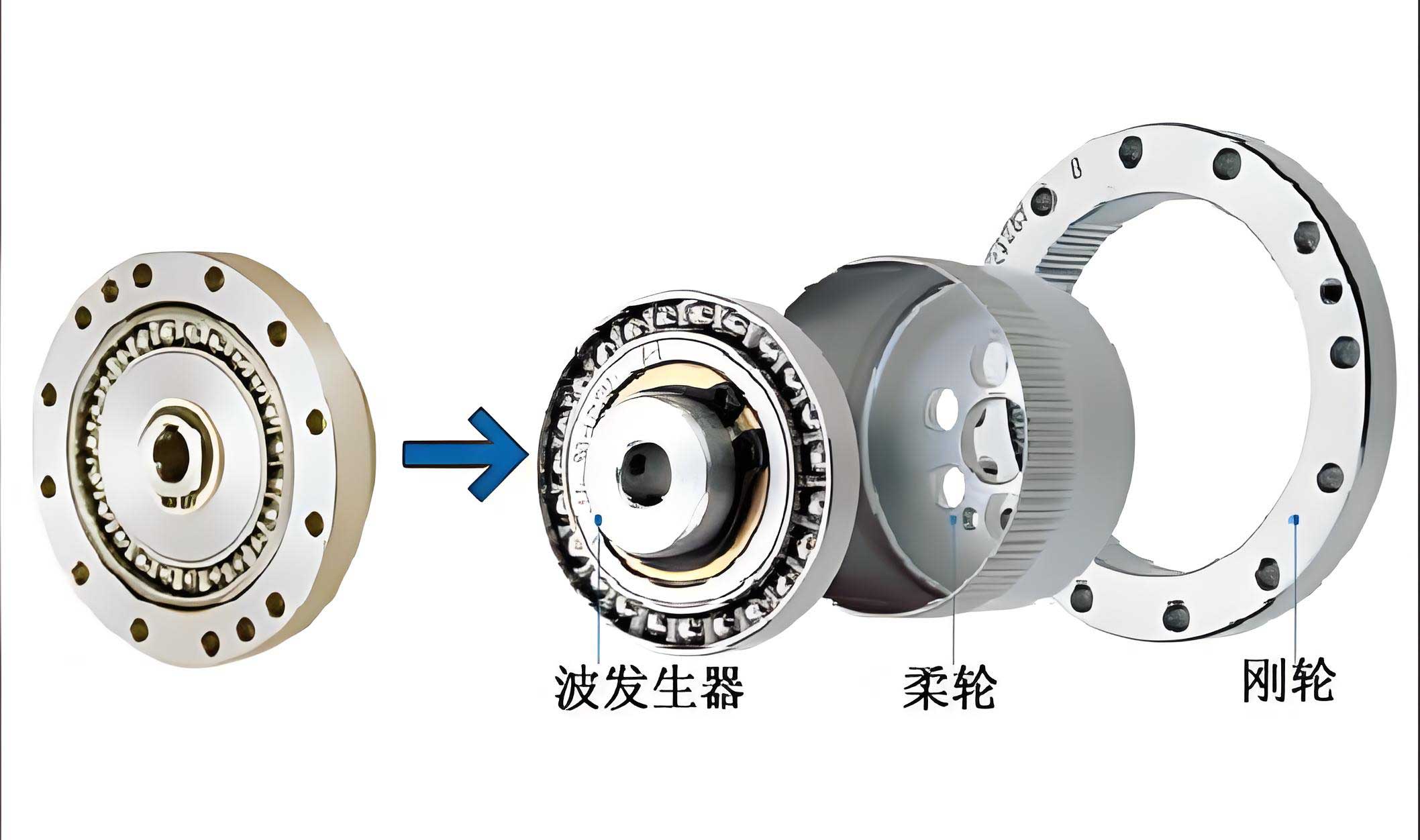
The fundamental kinematic relationship is defined by the difference in tooth count. If \( N_{CS} \) is the number of teeth on the Circular Spline and \( N_{FS} \) is the number of teeth on the Flexspline, the gear reduction ratio \( i \) when the Wave Generator is the input and the Flexspline is the output (with Circular Spline fixed) is given by:
$$ i = -\frac{N_{FS}}{N_{CS} – N_{FS}} $$
For the common configuration where \( N_{CS} – N_{FS} = 2 \), the ratio simplifies to \( i = -\frac{N_{FS}}{2} \). The negative sign indicates a reversal of rotation direction between input and output. Single-stage strain wave gear ratios from 50:1 to over 300:1 are standard. Crucially, this high reduction is achieved in a single, coaxial stage, resulting in an incredibly compact package. The simultaneous engagement of approximately 30% of the teeth across the major axis distributes the load, leading to high torque capacity, low backlash, and smooth motion with high efficiency, often above 80% even for high ratios.
System Design of the Strain Wave Gear Amplified Torque Wrench
The proposed wrench translates the principles of strain wave gear transmission into a practical, handheld tool. The design prioritizes robustness, usability, and maximizing the torque amplification effect.
1. Overall Structural Configuration
The cross-sectional layout of the wrench reveals an integrated strain wave gear assembly. From the working end to the handle, the key components are:
- Output Socket: The front-most component, featuring a standard hexagonal or square drive to interface with socket adapters. This socket is rigidly connected to the Flexspline.
- Wave Generator (Input): Directly behind the socket, this component has a non-circular (elliptical) outer profile. It is connected to the central input shaft/handle connection rod.
- Flexspline: A thin-walled cup-shaped gear that fits over the Wave Generator, separated by a set of ball bearings that facilitate the smooth elliptical deformation. Its external teeth are in constant mesh with the Circular Spline.
- Circular Spline Housing: This serves a dual purpose. It is the rigid outer housing of the wrench body, and its internal bore is machined with gear teeth to function as the fixed Circular Spline.
- Connection Rod/Input Shaft: This links the manual handle to the Wave Generator, transferring the operator’s input torque.
- Handle: A standard reaction arm or a T-handle providing the input lever.
In this configuration, the operation is as follows: The operator applies force to the handle, which tries to rotate the Wave Generator. The Circular Spline (the wrench housing) is held stationary by the operator’s other hand or reacts against an adjacent structure. Because the Circular Spline is fixed, the rotation of the Wave Generator causes the Flexspline to rotate slowly in the opposite direction, according to the high reduction ratio. Since the Flexspline is connected to the output socket, this slow rotation produces a massively amplified output torque on the fastener.
2. Modular Socket System and Universal Joint Handle
To ensure versatility, the wrench features a modular socket interface. A set of hardened steel adapters with standard square drives (e.g., 1/2″, 3/4″, 1″) allows the use of any conventional socket. For specific, high-frequency applications, dedicated custom sockets with a series of hexagonal broaches in descending size can be manufactured, enabling one socket to fit a range of bolt sizes common to a particular machine.
Recognizing that access is often limited, the design incorporates a detachable universal joint between the main wrench body and the handle. This U-joint allows the handle to be angled relative to the fastener axis, enabling operation in recessed or obstructed locations where a straight pull is impossible. The U-joint is engineered for high torsional strength to prevent failure under high input loads.
3. Integrated Torque Control and Indication System
While the primary function is amplification, precision tightening often requires a specific target torque. A mechanical torque control module can be integrated into the input shaft. This module typically consists of a calibrated spring collar and a release mechanism. The operator presets the desired input torque (which corresponds to a known, amplified output torque). When this preset value is reached during tightening, the mechanism disengages with an audible “click” and a slight sudden movement, signaling to stop applying force. For more advanced applications, a microcontroller-based system with a torque sensor, LCD display, and audible/visual alerts could be embedded, creating a “smart” amplified torque wrench.
4. Material Selection and Manufacturing Specifications
The durability and performance of the wrench hinge on appropriate material choices and heat treatment for its core strain wave gear components. The following table details the recommended specifications:
| Component | Primary Material | Key Heat Treatment / Process | Target Properties / Justification |
|---|---|---|---|
| Wrench Housing / Circular Spline | 42CrMo4 (AISI 4140) or similar alloy steel | Quenched and Tempered | High strength and toughness to absorb reaction forces and provide a rigid gear mesh interface. Hardness ~45-50 HRC. |
| Wave Generator | High-Carbon Chrome Bearing Steel (e.g., SUJ2 / AISI 52100) | Through-hardening or Case Hardening | High wear resistance and contact fatigue strength to withstand the rolling contact with the Flexspline and bearings. |
| Flexspline (Critical Component) | Case-Hardening Steel (e.g., 20CrNiMo / SAE 8620) | Carburizing or Nitriding | A hard, wear-resistant tooth surface (58-62 HRC) over a tough, ductile core to withstand millions of cyclic elastic deformations without fatigue failure. |
| Connection Rod & Handle | Medium Carbon Steel (e.g., AISI 1045) | Quenched and Tempered | Good torsional strength and toughness to transmit input torque reliably. |
The manufacturing of the Flexspline demands particular attention. The gear teeth are typically hobbed or shaped before the final heat treatment. Processes like carburizing must be carefully controlled to achieve the desired case depth without inducing excessive distortion. For cup-style Flexsplines, the thin-walled diaphragm section must have a flawless surface finish to avoid stress risers that could initiate fatigue cracks.
Working Principle and Torque Amplification Analysis
The core function of the wrench is torque amplification via speed reduction. The principle is derived from the conservation of power (neglecting losses for initial explanation). The mechanical power \( P \) transmitted is the product of torque \( T \) and angular velocity \( \omega \):
$$ P = T \cdot \omega $$
For an ideal system, input power equals output power: \( P_{in} = P_{out} \). Therefore:
$$ T_{in} \cdot \omega_{in} = T_{out} \cdot \omega_{out} $$
Rearranging, we get the fundamental torque amplification relationship:
$$ T_{out} = T_{in} \cdot \left( \frac{\omega_{in}}{\omega_{out}} \right) = T_{in} \cdot i $$
where \( i \) is the gear reduction ratio (\( \omega_{in} / \omega_{out} \)). In the strain wave gear wrench, with the Circular Spline fixed and the Wave Generator as input, the gear ratio \( i_{WG-FS} \) is given by the formula mentioned earlier:
$$ i = \frac{N_{FS}}{N_{CS} – N_{FS}} $$
Thus, the output torque at the socket (Flexspline) is:
$$ T_{socket} = T_{handle} \cdot i $$
Example Calculation: Assume a strain wave gear with \( N_{CS} = 202 \) and \( N_{FS} = 200 \). The reduction ratio is \( i = 200 / (202 – 200) = 100:1 \). If an operator applies a force of 250 N (approx. 56 lbf) at the end of a 0.4-meter handle, the input torque is:
$$ T_{handle} = Force \times Lever Arm = 250 \, \text{N} \times 0.4 \, \text{m} = 100 \, \text{N·m} $$
The theoretical output torque would be:
$$ T_{socket} = 100 \, \text{N·m} \times 100 = 10,000 \, \text{N·m} $$
This is a substantial torque, capable of loosening or tightening very large fasteners. Accounting for mechanical efficiency \( \eta \) (typically 0.75 to 0.85 for a strain wave gear), the actual output is:
$$ T_{socket\_actual} = T_{handle} \cdot i \cdot \eta = 100 \cdot 100 \cdot 0.8 = 8,000 \, \text{N·m} $$
This calculation clearly demonstrates the transformative potential of integrating a strain wave gear into a manual tool.
Performance Characteristics and Comparative Advantages
The strain wave gear amplified torque wrench exhibits a set of distinct advantages that position it uniquely in the market:
- Extremely High Amplification in a Single Stage: The most significant advantage is the ability to achieve amplification ratios of 50:1 to 150:1 or more in a single, integrated stage. This far exceeds what is practical with conventional planetary torque multipliers of similar size and weight.
- Superior Compactness and Power Density: The coaxial design of the strain wave gear results in a very compact tool profile. The wrench head is typically no larger in diameter than a standard impact socket adapter for the same torque rating, making it ideal for confined spaces.
- Quiet, Smooth, and Controllable Operation: Unlike impact tools, this wrench applies torque in a smooth, continuous manner. This is crucial for precision tightening, preventing thread damage, and allowing for accurate joint pre-loading. The operation is virtually silent.
- High Mechanical Efficiency: Despite the elastic deformation involved, well-designed strain wave gear systems maintain good efficiency, ensuring that a high percentage of the operator’s input work is translated to useful output torque.
- No External Power Source: As a purely mechanical tool, it requires no hoses, cables, batteries, or compressors. It is always ready for use, offering ultimate portability and reliability in field conditions.
- Cost-Effectiveness and Lifecycle Value: While the precision components (Flexspline, Wave Generator) require sophisticated manufacturing, the overall system lacks the expensive subsystems of hydraulic or pneumatic tools (pumps, motors, valves). This translates to a lower purchase price and significantly reduced maintenance costs over its service life.
Durability Analysis and Lifecycle Considerations
The primary life-limiting component of the wrench is the Flexspline. Its operational life is governed by high-cycle fatigue due to the repeated elastic bending with each revolution of the Wave Generator. The stress state in the Flexspline is complex, combining bending stresses at the tooth root, membrane stresses in the diaphragm, and hoop stresses in the cylindrical wall. Finite Element Analysis (FEA) simulations are essential in the design phase to optimize geometry, minimize stress concentrations, and predict fatigue life.
Critical areas identified through simulation include:
- Tooth Root Fillet: The region of maximum bending stress during meshing.
- Diaphragm Transition: Where the flexible cylindrical section meets the thicker output flange or socket connection. This is a classic location for stress concentration.
The fatigue life \( N_f \) can be estimated using modified Goodman or Gerber criteria based on the alternating stress \( \sigma_a \) and mean stress \( \sigma_m \) from FEA, and the material’s endurance limit \( \sigma_e’ \). A simplified check involves ensuring the safety factor \( n_f \) is adequate:
$$ n_f = \frac{\sigma_e’}{\sigma_a} > [n] $$
where \( [n] \) is the required design factor of safety (often 2 or higher for critical components). With proper material selection (e.g., high-quality vacuum-degassed steel), precise manufacturing, and optimized heat treatment, a Flexspline can be designed for a service life exceeding 10,000 operating cycles, which is more than sufficient for a manual maintenance tool used on large, infrequently disassembled connections.
Application Scenarios and Future Potential
The application scope for this strain wave gear wrench is vast, targeting any industry where high torque is needed but space, power, or budget constraints limit traditional options.
- Marine and Offshore: Ideal for engine mount bolts, propeller shaft couplings, and deck machinery fasteners on vessels and oil platforms.
- Wind Energy: Perfect for tower flange bolts and gearbox connections within the nacelle, where space is constrained and bringing hydraulic power units aloft is logistically challenging.
- Heavy Construction and Mining: For dismantling large excavator, crusher, and conveyor components in the field.
- Rail Transportation: For wheel set bolts, coupler assemblies, and bogie frame fasteners.
- Power Generation: Maintenance of turbines, generators, and large valve assemblies.
- General Heavy Industry: Any facility maintaining presses, rolling mills, or large pumps.
Future development paths could explore:
- Ultra-Compact Designs: Using advanced materials like maraging steel or titanium for the Flexspline to allow even thinner walls and smaller overall package sizes.
- Hybrid Electromechanical Versions: Integrating a small, high-speed electric motor to drive the Wave Generator, creating a cordless ultra-high-torque tool that maintains the compactness of the strain wave gear.
- Advanced Smart Features: Embedding wireless torque and angle sensors with Bluetooth connectivity for data logging and quality assurance, directly integrated into the wrench assembly.
Conclusion
The integration of strain wave gear technology into a manual torque wrench presents a paradigm shift for high-torque fastener applications. This design successfully addresses the key shortcomings of existing powered and manual tools by offering unparalleled torque amplification in a compact, quiet, self-contained, and cost-effective package. The purely mechanical nature ensures reliability and ease of use in the most demanding environments. By harnessing the unique kinematics of the strain wave gear—specifically its ability to provide exceptionally high reduction ratios in a single stage—this tool empowers a single operator to generate output torques that were previously the exclusive domain of large, expensive hydraulic systems. The strain wave gear amplified torque wrench is not merely an incremental improvement but a fundamentally new class of tool that promises to enhance efficiency, safety, and capability in maintenance operations across a wide spectrum of heavy industries.