
The recent convergence of three major technological domains—low-altitude aviation, intelligent connected vehicles (ICVs), and advanced robotics—marks a pivotal moment in industrial evolution. From my perspective as an observer and analyst of these fields, the inaugural conference on synergistic development, held with the theme “Intelligently Connecting Sky, Ground, and Earth, Co-building a New Ecosystem,” was not merely a meeting but a foundational event. It established a critical platform for discussing the deep integration of these industries, with the humanoid robot emerging as a central, unifying agent. This article delves into the multi-faceted collaboration between these sectors, analyzing the shared technological foundations, supply chain synergies, and the transformative applications that define this new frontier. The core thesis is that the fusion of these domains, particularly through the embodiment of intelligence in humanoid robot platforms, is accelerating the development of new quality productive forces and reshaping the very structure of modern industry.
The conference’s central premise was that innovation is no longer siloed. Breakthroughs in one field now directly catalyze advances in others. This is most evident in the shared technological pillars: artificial intelligence (AI) and machine learning (ML) for perception and decision-making; advanced sensor fusion (LiDAR, radar, vision); high-performance, low-power computing platforms; and sophisticated actuation and control systems. A humanoid robot serves as a quintessential testbed and beneficiary for all these technologies. Its need for bipedal locomotion in complex environments mirrors the navigation challenges for ground vehicles and aerial drones. Its requirement for dexterous manipulation and human interaction drives advances in AI that are equally applicable to autonomous vehicle passenger management or drone-based delivery handling.
The following table summarizes the core technological interdependencies and their primary challenges:
| Technological Domain | Key Requirements (Low-Altitude Aircraft) | Key Requirements (Intelligent Connected Vehicle) | Key Requirements (Humanoid Robot) | Common Research Challenge |
|---|---|---|---|---|
| Perception & AI | 3D airspace mapping, dynamic obstacle avoidance, weather recognition. | 360° scene understanding, V2X communication parsing, intent prediction. | Egocentric scene understanding, human gesture/ speech recognition, affordance detection. | Developing robust, multi-modal AI models that generalize across vastly different operational domains and sensor suites. |
| Control Systems | Flight stability, path following, swarm coordination. | Vehicle dynamics control, platooning, cooperative maneuver execution. | Whole-body balance control, compliant manipulation, bipedal gait generation. | Creating verifiably safe and adaptive control algorithms for systems with high degrees of freedom operating in unstructured environments. |
| Power & Propulsion | High energy-density batteries, efficient electric thrust. | Fast charging, battery longevity, regenerative braking. | High-torque density actuators, energy-efficient locomotion. | Achieving breakthroughs in solid-state or next-gen battery technology to solve the universal constraint of energy density and weight. |
| Connectivity | Low-latency command & control (C2), air-to-ground networks. | Ultra-reliable low-latency communication (URLLC), cellular V2X. | High-bandwidth sensor data streaming, cloud-brain coordination. | Building resilient, secure, and ubiquitous communication networks (e.g., 5G-Advanced/6G) that support massive machine-type communication and critical tasks. |
This technological convergence can be mathematically framed as an optimization problem for system capability. Let us define a generalized performance metric \( P \) for an autonomous system (be it aerial, terrestrial, or a humanoid robot) as a function of its key attributes:
$$ P = f(A, R, C, E) $$
Where:
- \( A \) represents Autonomy (perception, planning, decision-making capability).
- \( R \) represents Robustness (to environmental disturbances, system failures).
- \( C \) represents Cost (unit economics, total cost of ownership).
- \( E \) represents Energy Efficiency (work performed per unit of energy consumed).
The goal of synergistic innovation is to maximize \( P \) under real-world constraints by leveraging shared advancements. For instance, an AI model developed for a car’s pedestrian detection (\( A_{car} \)) can be adapted and refined for a humanoid robot‘s object recognition (\( A_{robot} \)), accelerating development and reducing cost (\( C \)) for both. Similarly, lightweight composite materials developed for aircraft frames improve the energy efficiency (\( E \)) of both electric vehicles and the structural skeleton of a humanoid robot.
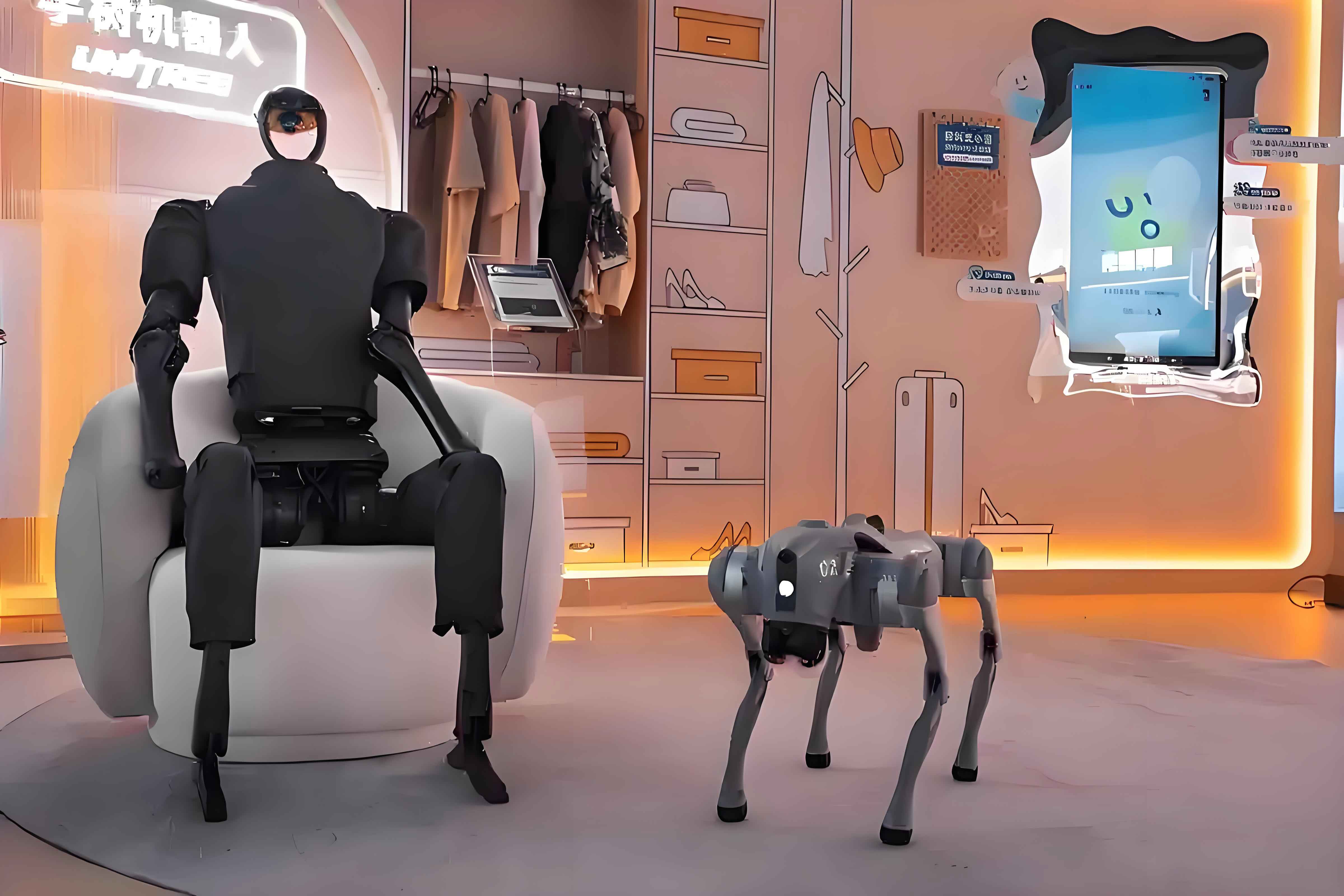
The visual representation above underscores the physical embodiment of this convergence. The image, while not from the conference, conceptually aligns with the theme, showing advanced robotic forms capable of interacting with human environments. This interaction is the cornerstone of cross-domain application scenarios. Consider logistics: an autonomous electric truck (ICV) arrives at a distribution center, where a swarm of drones (low-altitude aircraft) unloads packages from its roof hatches, and a team of humanoid robots sorts and moves them inside for last-meter delivery. The efficiency equation for such a fully automated logistics chain highlights the synergy:
$$ \text{Total System Throughput} = \sum_{i=1}^{n} (V_i \cdot \eta_i) \cdot \min( L_{drone}, L_{robot}, L_{sort} ) $$
Here, \( V_i \) is the velocity of the i-th vehicle type, \( \eta_i \) is its operational efficiency, and \( L_{drone}, L_{robot}, L_{sort} \) represent the limiting throughput factors for the drone offload, humanoid robot handling, and sorting systems, respectively. The system’s overall performance is bottlenecked by the slowest interoperable component, driving integrated design and standardization.
Beyond logistics, the fusion enables revolutionary scenarios in emergency response, infrastructure inspection, and smart manufacturing. A humanoid robot, deployed from an air vehicle, can enter a disaster zone to perform complex rescue tasks, using manipulators designed with automotive-grade durability. It can then be transported by a self-driving vehicle to another site. The shared supply chain is critical here. Components like high-resolution cameras, inertial measurement units (IMUs), microprocessors, and precision gears become commoditized across all three industries, leading to economies of scale and reduced costs. A simplified model for the cost evolution of a critical component, such as a LiDAR sensor, driven by cross-industry demand is:
$$ C(t) = C_0 \cdot e^{-k \cdot D_{total}(t)} $$
$$ D_{total}(t) = D_{auto}(t) + D_{aero}(t) + D_{robot}(t) $$
Where \( C(t) \) is the cost at time \( t \), \( C_0 \) is the initial cost, \( k \) is a learning/scale constant, and \( D_{total}(t) \) is the aggregate demand from the automotive, aerospace (low-altitude), and humanoid robot sectors. The rapid growth in \( D_{robot}(t) \) acts as a significant new multiplier, accelerating the cost reduction curve for all.
The collaborative frameworks initiated at the conference—joint research projects, shared resource platforms, and the drafting of industry white papers—are essential to formalize this synergy. These initiatives aim to create standards for communication protocols between machines, safety certification frameworks for human-robot interaction, and data-sharing agreements to train more robust AI models. The “Ten Initiatives for Collaborative Innovation” emerging from the event serve as a manifesto, calling for unified efforts in policy-making, talent cultivation, and open innovation. The talent aspect is paramount. The parallel annual conference focused on automotive talent, with its theme “Clarifying the Trend, Creating Change, Gathering Talent to Break the Volume,” directly addresses this. The industry needs a new breed of engineers and scientists: mechatronic generalists who understand the principles of aerodynamics, vehicle dynamics, and bipedal locomotion, alongside AI specialists capable of reasoning across physical domains.
However, the path to seamless integration is fraught with technical and regulatory hurdles. The table below outlines primary challenges and potential collaborative solutions:
| Challenge Category | Specific Hurdle | Potential Synergistic Solution |
|---|---|---|
| Safety & Certification | Establishing fail-safe standards for humanoid robots operating near people, cars, and aircraft. | Adapting automotive functional safety (ISO 26262) and aviation DO-178C standards into a new, unified risk-assessment framework for mobile intelligent systems. |
| Interoperability | Lack of common communication languages and physical interfaces between systems from different vendors/domains. | Developing open-source middleware (akin to ROS but for cross-domain swarms) and standardized physical docking/power transfer interfaces through industry consortia. |
| Public Acceptance & Ethics | Fear of job displacement, privacy concerns with pervasive sensing, and ethical decision-making in AI. | Joint public engagement campaigns, transparent “explainable AI” development shared across sectors, and collaborative studies on the socioeconomic impact to guide responsible policy. |
| Compute Architecture | Balancing the need for massive onboard processing with weight and power constraints, especially for humanoid robots and aircraft. | Co-developing hybrid edge-cloud computing architectures and low-power, neuromorphic chips where research from lightweight drone AI directly benefits robot and vehicle AI. |
The investment model is also evolving. Traditional vertical-focused venture capital is giving way to “convergence funds” that specifically target technologies applicable across these boundaries. The value proposition for a new actuator company is no longer just “for robots” but “for robots, automotive active suspension, and aircraft control surfaces.” This broadens the total addressable market and de-risks investment. The net present value (NPV) calculation for such a cross-cutting technology startup becomes more attractive:
$$ \text{NPV} = \sum_{t=1}^{T} \frac{CF_{auto}(t) + CF_{aero}(t) + CF_{robot}(t)}{(1 + r)^t} – I_0 $$
where \( CF_{domain}(t) \) represents the projected cash flow from each application domain, \( r \) is the discount rate, \( T \) is the horizon, and \( I_0 \) is the initial investment. The diversification across sectors reduces the volatility in projected cash flows.
In conclusion, the synergistic development of low-altitude aircraft, intelligent connected vehicles, and humanoid robots is not a speculative vision but an ongoing industrial reality. The conference served as a powerful catalyst, aligning stakeholders around a common roadmap. The humanoid robot, in particular, stands as both a beneficiary and a driver of this convergence. Its development pulls forward AI, sensing, and actuation technologies that elevate the capabilities of all three fields. The release of joint research agendas, the establishment of shared platforms, and the collective advocacy embodied in the Ten Initiatives provide the necessary scaffolding for sustained collaboration. This tri-domain fusion, built on shared technology, supply chains, and talent, represents a profound shift towards a more integrated, intelligent, and automated physical world. It is a definitive step in cultivating new quality productive forces, where the whole of the combined innovation ecosystem is vastly greater than the sum of its previously isolated parts. The future being built is one where machines of the land, air, and human form factor will collaborate seamlessly, and the foundational work for that future is happening now.