
As we stand at the cusp of a technological revolution, the logistics industry is poised to undergo a profound transformation driven by the advent of humanoid robots. In recent years, the rapid development of artificial intelligence, particularly general-purpose large models, has significantly reduced the difficulty of researching and developing humanoid robots. This breakthrough, coupled with supportive government policies such as China’s inclusion of humanoid robot development in its 14th Five-Year Plan, has created a golden opportunity for their integration into key sectors like logistics. From my perspective as an observer and participant in this field, I believe that humanoid robots are not merely an incremental improvement but a disruptive force that will redefine how we handle warehousing, sorting, and last-mile delivery. This article explores the imminent changes, the vast opportunities, and the strategic pathways for the logistics industry to harness the power of humanoid robots.
The current landscape of logistics robotics is dominated by specialized machines such as Automated Guided Vehicles (AGVs), Autonomous Mobile Robots (AMRs), palletizing robots, and vision-based sorting robots. While these have automated many tasks, they suffer from inherent limitations due to their non-humanoid design. For instance, AGVs and AMRs typically rely on wheels or tracks, which restrict their mobility in environments with stairs or uneven terrain. This creates a critical gap in two key areas: first, the inability to carry goods up and down stairs during delivery, often referred to as the “last hundred meters” challenge in multi-story residential buildings; and second, the difficulty in handling irregularly shaped items or placing them on varied shelf heights in warehouses, especially in forward-deployment scenarios like fresh food hubs. The following table summarizes the limitations of conventional robots compared to the potential of humanoid robots:
| Robot Type | Primary Function | Key Limitations | Humanoid Robot Advantage |
|---|---|---|---|
| AGV/AMR | Horizontal transport in warehouses | Cannot navigate stairs; limited to flat surfaces | Bipedal locomotion allows stair climbing and complex terrain navigation |
| Sorting Robot | Fixed-line item sorting | Fixed range; struggles with irregular items and multi-level shelving | Articulated arms and mobility enable flexible picking and placement across shelves |
| Delivery Robot | Short-range parcel delivery | Often confined to ground-level, contactless drop-offs | Can perform door-to-door delivery, including indoor navigation and handover |
These shortcomings highlight the need for a more versatile solution, which is where the humanoid robot comes into play. By mimicking human form and movement, a humanoid robot can overcome these barriers. Its bipedal structure allows it to traverse stairs, its articulated arms enable dexterous manipulation of diverse objects, and its integrated sensors facilitate real-time interaction with the environment. This versatility is crucial for addressing the growing demands of modern logistics.
The transformative impact of humanoid robots on logistics can be encapsulated in solving two persistent problems: the “last mile” and the “last hundred meters.” In the last mile, efficiency in sorting and handling at forward-deployment warehouses is paramount. With the surge in e-commerce and fresh food delivery, warehouses must process a high volume of irregular items like vegetables, seafood, and non-standard packages. Traditional automation struggles here, but a humanoid robot, equipped with advanced vision systems and flexible grippers, can identify, sort, and place items on shelves of varying heights. For example, Amazon’s testing of the Digit humanoid robot for unloading trucks and moving boxes exemplifies this application. In the last hundred meters, the challenge is delivering goods directly to consumers’ doorsteps, especially in urban areas with multi-story buildings without elevators. Humanoid robots can carry packages upstairs, ring doorbells, and even interact with recipients for secure handover, ensuring true “door-to-door” service. This capability not only enhances customer satisfaction but also supports non-contact delivery, which has become increasingly important for health and safety reasons.
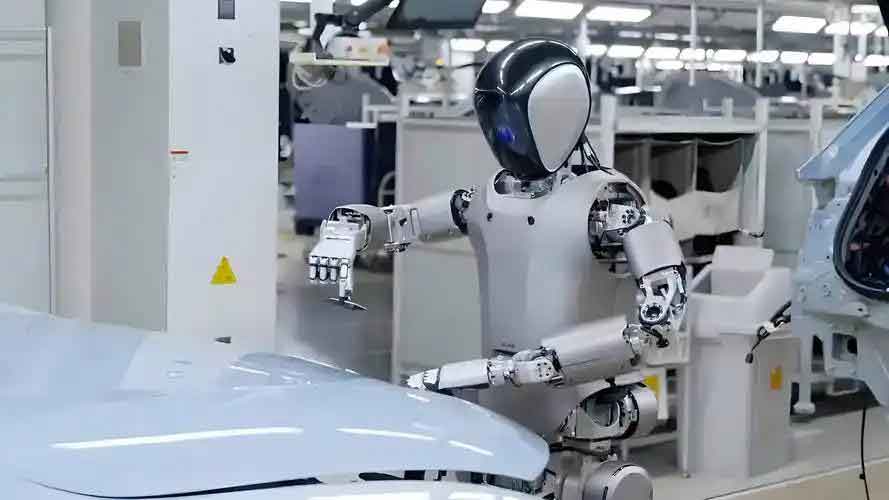
The adoption of humanoid robots is further propelled by macro-trends. Logistics demand is skyrocketing; for instance, China’s courier business volume exceeded 120 billion parcels in 2023, reflecting a massive and growing market. However, this growth comes with volatility—monthly fluctuations can exceed 50% due to events like “Double 11,” making workforce management challenging. Simultaneously, demographic shifts such as population aging and declining birth rates are leading to a labor shortage, increasing reliance on automation. The need for non-contact solutions, accelerated by health concerns, also favors robotic deployment. The convergence of these factors creates a perfect storm for humanoid robot integration. To quantify the demand, consider that China alone has over 230,000 courier service outlets; if each deploys just one humanoid robot, the immediate market is 230,000 units. Globally, with millions of delivery and warehouse workers, the potential scale is in the tens of millions. This growth can be modeled using a compound annual growth rate (CAGR) formula: $$ N(t) = N_0 \times (1 + r)^t $$ where \( N(t) \) is the number of humanoid robots at time \( t \), \( N_0 \) is the initial deployment, and \( r \) is the growth rate. Optimistic projections suggest \( r \) could approach 94% in the early phases, indicating explosive expansion.
Cost optimization is a central driver for adopting humanoid robots in logistics. Historically, the high cost of developing and controlling humanoid robots hindered their commercialization. However, AI advancements, especially large language models (LLMs), have drastically reduced these costs by enabling more efficient perception, decision-making, and control. For example, LLMs allow humanoid robots to learn from multi-sensor data (e.g., 3D cameras, LiDAR, tactile feedback) without extensive manual programming, slashing development time and expenses. The operational cost per hour for a humanoid robot is becoming competitive with human labor. Let’s analyze this with a cost-benefit equation: $$ C_{robot} = \frac{I}{L \cdot H} + M $$ where \( C_{robot} \) is the hourly operating cost, \( I \) is the initial investment (purchase price), \( L \) is the lifespan in years, \( H \) is annual operating hours, and \( M \) is hourly maintenance and software costs. For Amazon’s Digit, estimates suggest \( C_{robot} \) could drop to $2–3 per hour at scale, compared to human wages that often exceed $4 per hour even in lower-cost regions. In China, warehouse workers earn around 22–28 RMB per hour (approximately $3–4), making robots economically viable. Moreover, humanoid robots can work continuously without breaks, reducing effective cost per task. For delivery, the math is even starker: if a humanoid robot like Tesla’s Optimus is mass-produced at $25,000, its two-year cost might undercut a human courier’s salary, potentially saving logistics firms billions annually. The table below illustrates a cost comparison:
| Cost Factor | Human Worker (Example) | Humanoid Robot (Projected at Scale) |
|---|---|---|
| Hourly Wage/Salary | $4–16 (varies by region) | $2–3 (including software) |
| Annual Hours | ~2,000 (with breaks) | ~8,760 (continuous operation) |
| Benefits/Overhead | Additional 20–30% | Minimal (mainly electricity) |
| Total Annual Cost | $10,000–$40,000+ | $5,000–$10,000 |
Beyond direct cost savings, humanoid robots enhance efficiency in ways that translate to higher profitability. In forward-deployment warehouses, faster sorting and replenishment cycles increase inventory turnover, reducing holding costs. This can be expressed using the inventory turnover ratio formula: $$ \text{Turnover} = \frac{\text{Cost of Goods Sold}}{\text{Average Inventory}} $$ By accelerating processes with humanoid robots, turnover rises, lowering per-unit costs. Additionally, real-time delivery capabilities minimize spoilage for perishables, cutting losses that often plague fresh food logistics.
For the logistics industry to fully capitalize on humanoid robots, a collaborative development path is essential. First, synergy between robot developers and logistics firms is crucial. Humanoid robots require extensive real-world data for training their AI models—data that logistics companies can provide from operational scenarios involving sorting, navigation, and interaction. In return, robots must be customized to fit logistics environments, such as adapting gripper designs for standard package sizes or optimizing movement algorithms for warehouse layouts. This co-innovation cycle will accelerate iteration and adoption. Second, data sharing across the ecosystem is vital. Logistics companies should anonymize and pool sensor data from humanoid robot deployments to create robust training datasets, fostering faster learning and improvement. Third, a tripartite “industry-university-research” partnership can bridge gaps. Academic institutions offer cutting-edge research in robotics and AI, while companies provide funding, market insights, and testing grounds. Joint projects can tackle technical hurdles, such as improving energy efficiency or developing fail-safe mechanisms, and help educate the next generation of robotics engineers. Finally, integrating humanoid robots into government big data systems can amplify their value. These robots, equipped with sensors, can collect real-time information on traffic, infrastructure conditions, or community events, acting as “smart grid” nodes for urban management. Logistics firms could then monetize aggregated data through exchanges, creating new revenue streams.
Looking ahead, the trajectory for humanoid robots in logistics is exceedingly bright. As technology matures and costs decline, we will see widespread deployment across sorting centers, delivery networks, and even retail backrooms. The humanoid robot will evolve from a novelty to a cornerstone of logistics infrastructure, enabling unprecedented levels of automation and service quality. However, challenges remain, such as ensuring safety in human-robot interactions, addressing ethical concerns about job displacement, and standardizing protocols for interoperability. The industry must proactively engage with policymakers, workers, and the public to navigate these issues. In conclusion, the rise of the humanoid robot represents a pivotal moment for logistics—a chance to overcome historical limitations, reduce costs, and meet the demands of a digital, fast-paced world. By embracing collaborative innovation and strategic partnerships, the logistics sector can ride this wave of change to new heights of efficiency and innovation.
To further illustrate the technical aspects, consider the control optimization for a humanoid robot in a warehouse. The robot’s motion can be modeled using dynamics equations. For instance, the balance during lifting can be described by: $$ \tau = J^T F + M(q)\ddot{q} + C(q, \dot{q}) $$ where \( \tau \) is the joint torque, \( J \) is the Jacobian matrix, \( F \) is the external force, \( M \) is the mass matrix, \( q \) is the joint angle, and \( C \) represents Coriolis and centrifugal forces. Such models help in programming efficient movements. Additionally, the learning process for sorting tasks can be framed as a reinforcement learning problem: $$ \max_{\pi} \mathbb{E} \left[ \sum_{t=0}^{T} \gamma^t R(s_t, a_t) \right] $$ where \( \pi \) is the policy, \( \gamma \) is the discount factor, and \( R \) is the reward for successful item placement. These mathematical foundations underscore the sophistication behind humanoid robot operations.
In summary, the integration of humanoid robots into logistics is not a matter of if, but when. The convergence of AI, market needs, and economic pressures creates an irreversible trend. For logistics companies, the imperative is clear: invest in understanding and adopting humanoid robot technology, foster partnerships, and prepare for a future where human and machine collaboration defines success. The journey has just begun, and the opportunities are as vast as the global logistics network itself.