
The global automotive industry is undergoing a profound transformation, marked by intensifying competition and a relentless drive towards intelligent and digital upgrades. In this context, the emergence of the humanoid robot as a potential agent within the factory walls is generating significant discussion. As a technology with inherent general-purpose potential, its entry into the highly automated realm of car manufacturing promises not merely incremental improvements but a fundamental rethinking of production paradigms. This analysis synthesizes key industry perspectives to explore the unique value proposition, feasible application paths, persistent technical bottlenecks, and the evolutionary roadmap for humanoid robot integration in automotive plants.
The core argument for deploying humanoid robots in this sector lies not in replacing existing, highly efficient dedicated automation—like welding or painting robots—but in addressing the pervasive “last meter” or “corner case” automation gaps. Traditional industrial automation excels in structured, repetitive tasks but struggles with variability. The unique value of the humanoid robot is therefore tripartite:
- Task Adaptability & Ultimate Flexibility: Its anthropomorphic form and high degree-of-freedom (DoF) design allow it to perform a wide range of non-standardized, flexible tasks. This makes it ideal for final assembly operations involving delicate wiring harness routing, interior trim installation, or part handling where objects and sequences frequently change, especially with high-mix production.
- Environmental Compatibility & Seamless Integration: A humanoid robot is designed to natively operate in environments built for humans. It can navigate standard factory aisles, use existing tools, and work within established workstations without requiring massive, costly retrofits to the factory layout or infrastructure. This dramatically lowers the barrier for automating legacy facilities.
- Enhanced Human-Robot Collaboration (HRC) & Safety: The human-like form factor can make interactions more intuitive and acceptable for human workers. Coupled with advanced sensing and AI, humanoid robots can safely collaborate in shared spaces, taking over tedious, ergonomically challenging, or hazardous tasks (e.g., initial equipment inspection in confined spaces), thereby augmenting the human workforce.
The economic rationale is often framed by a simple comparison of the Total Cost of Ownership (TCO) for a humanoid robot versus the annual fully-loaded cost of a human worker for a specific task. A basic feasibility formula considers the payback period $ T $:
$$ T = \frac{C_{robot}}{(L_{human} – O_{robot}) \cdot H_{annual}} $$
Where:
$ C_{robot} $ is the capital cost of the humanoid robot system,
$ L_{human} $ is the annual labor cost (wages, benefits, etc.),
$ O_{robot} $ is the annual operating cost of the robot (maintenance, energy),
$ H_{annual} $ is the annual operating hours.
Early analyses suggest that for suitable repetitive tasks, a payback period ($ T $) of 12-18 months may be achievable, making initial pilots economically justifiable. The potential for 24/7 operation further enhances the long-term value proposition.
Prioritized Application Scenarios: From Simple Mobility to Complex Manipulation
The path to scalable, economical adoption of humanoid robots will follow a “feet and eyes first, hands next, brain last” progression. This prioritizes scenarios with lower technical risk and clearer immediate return on investment (ROI). The following table summarizes the analysis of key candidate scenarios:
| Application Scenario | Primary Tasks | Technical Feasibility (Current) | Business & Economic Rationale | Scalability Potential |
|---|---|---|---|---|
| Intra-factory Logistics & Kitting | Moving parts/boxes, line-side delivery, empty container return, pallet depalletizing. | High. Environment is semi-structured (fixed routes, racks). Tasks are repetitive (pick/place, carry). SLAM and navigation in such environments are relatively mature. | High labor cost area with clear replacement value. Enables Just-in-Time (JIT) delivery, reduces line-side inventory, minimizes production stoppages. | Very High. Logistics solutions (robot + fleet management software) are highly replicable across different plants, workshops, and even industries. |
| Equipment Inspection & Monitoring | Patrolling predefined routes, using cameras/thermal sensors to check equipment status, reading gauges, identifying anomalies (unusual sounds, heat spots). | Moderate to High. Mobile sensing and data fusion are tractable. The challenge lies in robust anomaly detection with limited fault samples. | Prevents costly unplanned downtime. Replaces skilled technicians, offering high-value substitution. Enables predictive maintenance. | High. Inspection algorithms and knowledge bases can be incrementally trained and deployed across similar equipment types. |
| Vehicle Quality Inspection | Conducting visual checks for surface defects, measuring gaps and flushness (面差), verifying part presence and correct installation. | Moderate. Highly dependent on advanced vision sensors (3D, laser) and robust defect-detection AI, which can struggle with reflective surfaces and scarce defect data. | Ensures 100% objective, consistent inspection, eliminating human variability. Reduces quality escape costs and potential recall risks. | Moderate. Core vision framework is reusable, but new vehicle models or defect types require model fine-tuning with new data. |
| Precision Assembly & Fastening | Torque-controlled bolt tightening, precision placement of components like hinges, application of sealant. | Moderate. Requires high-precision force/position hybrid control and whole-body coordination to manage reaction forces during tightening. | Critical for safety and quality traceability. Eliminates human error in high-stakes fastening operations. | |
| Flexible Component Assembly (e.g., Wiring Harnesses) | Routing, plugging, and securing flexible cables and wiring harnesses through complex paths. | Low (Current State). The “holy grail” challenge. Requires advanced dexterous manipulation, real-time tactile feedback, and complex long-horizon task planning to handle non-rigid, deformable objects. | Replaces the most skilled and hard-to-train labor. Represents the final frontier for full automation, with immense strategic value once solved. |
Industry pilots are already underway, validating these scenarios. For instance, a leading Chinese automaker has successfully deployed humanoid robots for automated return of empty material boxes in its final assembly warehouse. Another electric vehicle pioneer is testing humanoid robots for interior quality checks and appearance inspection, integrating them directly with the manufacturing execution system (MES).
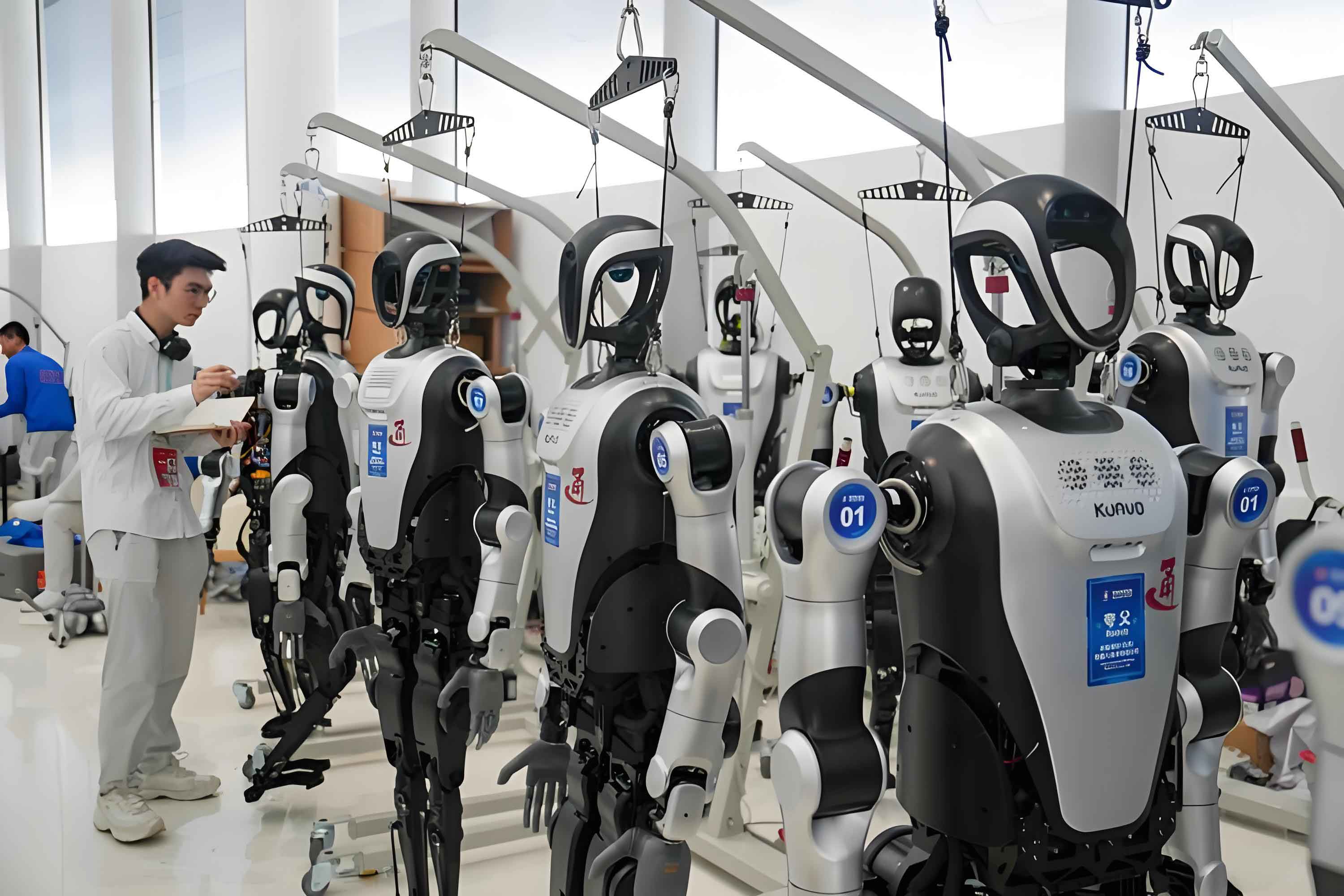
The image above conceptually represents a humanoid robot engaged in a detailed quality inspection task, highlighting the convergence of mobility, perception, and precision required in such applications.
Core Technical Bottlenecks: The Path to Industrial-Grade Reliability
Transitioning from laboratory demonstrations and controlled pilots to reliable, high-uptime industrial assets is the paramount challenge. The hurdles can be categorized into three interdependent domains: Cognition, Mobility, and Manipulation.
| Bottleneck Domain | Core Challenges | Technical Breakthrough Directions | Key Performance Indicator (KPI) Target |
|---|---|---|---|
| 1. Cognition & AI (The “Brain”) |
|
|
Task success rate $ S_{task} $ in unseen or edge-case scenarios: $ S_{task} > 99.5\% $. |
| 2. Mobility (The “Feet & Balance”) |
|
|
Mean Time Between Failures (MTBF): $ MTBF > 8000 $ hours. Navigation success rate in dynamic environments: $ >99.9\% $. |
| 3. Manipulation (The “Hands & Arms”) |
|
|
Grasp success rate for novel, complex-shaped parts: $ >99\% $. Force control accuracy: $ < \pm 1N $. |
The overall system reliability can be modeled as a series system of these domains: $$ R_{system}(t) = R_{cognition}(t) \times R_{mobility}(t) \times R_{manipulation}(t) $$ where $ R_{*}(t) $ represents the reliability function of each subsystem over time $ t $. Achieving a high $ R_{system} $ requires simultaneous advancement across all fronts.
Evolutionary Roadmap and Ecosystem Considerations
The integration of humanoid robots into automotive manufacturing will be a phased, iterative process, driven by cumulative technological progress and validated use cases.
| Phase | Timeline | Characteristics & Goals | Expected Penetration & Key Enablers |
|---|---|---|---|
| Pilot & Exploration | Present ~ 2027 | Proof-of-Concept (PoC) projects in selected, low-risk areas (logistics, basic inspection). Focus on validating technical feasibility, identifying engineering hurdles, and establishing initial business cases. | Penetration < 1%. Key enablers: Early adopter OEMs/Robot makers, custom integration solutions. |
| Scaled Application | ~2028 – 2030 | Technology reliability improves, costs begin to decline. Application expands to quality inspection, precision fastening. Humanoid robot requirements start influencing new factory design and product design-for-assembly. | Logistics/Inspection: 10-30% penetration in suitable areas. Assembly: <5% penetration. Key enablers: Standardized interfaces, modular “skill” packages, improved component supply chains. |
| Mainstream Adoption | 2030+ | Cost, reliability, and flexibility surpass traditional automation/human labor for a broad range of tasks. Breakthroughs in dexterous manipulation (e.g., wire harnessing). Becomes a standard component of greenfield smart factories. | Penetration >50% in suitable workstations. Key enablers: Full technology stack maturity, vibrant ecosystem of developers and integrators, “robot-as-a-service” business models. |
This evolution will be supported by a maturing ecosystem stratified into layers: a Data & Hardware Layer (sensors, actuators), a Platform & Model Layer (robot OS, AI training platforms, specialized skill models), and an Integration & Application Layer (system integrators deploying tailored solutions). Success will depend on open collaboration across this ecosystem.
It is also worth noting that the humanoid robot form factor, while highly promising for its generality, is part of a broader spectrum of “embodied AI” solutions. Some companies are exploring “wheeled + dual-arm” configurations as a more immediately stable and efficient alternative for many factory tasks. Others continue to advance quadruped robots for specialized mobile inspection roles. The optimal morphology may vary by specific application, but the humanoid robot remains the archetype for maximum task generality in human-centric environments.
In conclusion, the journey of the humanoid robot into the automotive industry is not a simple story of substitution, but one of transformation. It represents the pursuit of the “ultimate flexible automation unit,” capable of bridging the final gaps in the digital-physical loop, adapting to dynamic production needs, and enabling a fundamental shift from rigid, dedicated automation to adaptive, autonomous manufacturing systems. While significant technical and economic hurdles remain, the concerted exploration by automotive and robotics leaders signals a clear belief in its transformative potential. The factory of the future will likely be one where humanoid robots work alongside humans and traditional machines, not as replacements, but as a new class of intelligent agents that redefine what is possible in manufacturing.