
The year 2025 is widely regarded as the inaugural year for the mass production of humanoid robots. A critical issue at the forefront of industry and public discourse is how to further achieve large-scale commercial deployment of humanoid robots. This topic was the central focus of a recent investment forum held in Guangzhou, co-hosted by the Shanghai Securities News and the Guangdong Robot Association, with collaboration from Haozhi Electromechanical and GF Fund. The event brought together industry experts to delve into the theme “Domestic Opportunities for Core Components of Robots,” facilitating in-depth exchanges on the progress of localizing core components for humanoid robots and the pathway to their widespread commercial adoption. Participants explored trends in core technologies across the robotics industry chain and identified forward-looking development opportunities.
Forum attendees unanimously agreed that the industry for humanoid robots is currently in a critical phase of transition from technological breakthrough to mass production. The key to achieving mass production lies in addressing the challenges of cost and reliability through the localization and scaling of core components. In terms of application, the short-term strategy should focus on validation within industrial settings, while the long-term vision necessitates ecological collaboration and technological iteration to gradually penetrate household scenarios, ultimately enabling humanoid robots to become a common feature in ordinary homes.
- Breakthrough: Localization of Core Components
Against the backdrop of the accelerating deployment of humanoid robots, related core components are witnessing significant opportunities for domestic production. According to Tang Xiuqing, Chairman of Haozhi Electromechanical, the company has achieved independent research and development of core components for humanoid robots, including reducers, low-voltage drives, torque sensors, and encoders. They have completed related patent applications, with core indicators reaching industry-leading levels. Specifically, the transmission accuracy of their harmonic reducer products has nearly doubled compared to mainstream international products, while vibration amplitude has been reduced by over 30% compared to foreign counterparts.
Over the past 11 years, Haozhi Electromechanical has consistently invested in research and development within the field of robotic core components. “The company’s reducer products began to gradually increase in volume in the second half of this year, and we anticipate even greater breakthroughs next year,” Tang Xiuqing stated. The journey from a laboratory prototype to a mass-produced item is fraught with hurdles that R&D teams must overcome. “Initially, we focused on achieving technological breakthroughs. After succeeding, we contemplated how to surpass existing standards. Once we achieved superiority, we shifted our focus to ensuring performance stability and advancing mass production. Each stage presents its own formidable challenge, but we tackle them one by one,” Tang candidly shared. He noted that even after a technological breakthrough, factors like material consistency and assembly processes can still cause fluctuations in product yield, requiring repeated iterative optimization to resolve.
Furthermore, hardware solutions from downstream original equipment manufacturers are not yet finalized, and customer requirements vary significantly. This highly customized development model further constrains mass production efficiency. Chen Xianyong, Vice President of Flexiv Robotics, emphasized that the localization of core robotic components is an inevitable trend in industrial development and a key focus for Flexiv. The company has adopted a model of “in-house R&D coupled with domestic supply chain collaboration” to achieve technological breakthroughs in critical parts such as reducers, force control sensors, and motors. Currently, the localization rate of components for their entire robot system has reached 90%.
Flexiv Robotics has also chosen to leverage external expertise. According to Chen Xianyong, addressing the high demands for precision and stability in complex scenarios like 3C electronic precision assembly and automotive manufacturing, the company has engaged in customized development with domestic suppliers. Through iterative validation in real-world scenarios, they have tackled pain points such as insufficient accuracy and short lifespan. In the view of Sun Zhiqiang, Chairman of Reisong Technology, component enterprises and whole-machine manufacturers, along with downstream scenario companies, should form an ecosystem characterized by “specialized division of labor and collaborative攻坚.” On one hand, component companies should concentrate on core technologies and avoid diverting resources by venturing into whole-machine manufacturing. On the other hand, whole-machine manufacturers need to deeply collaborate with component suppliers. For instance, when Reisong cooperates with domestic sensor manufacturers, it opens its machine vision algorithm data to suppliers, assisting them in optimizing the dynamic response performance of the sensors.
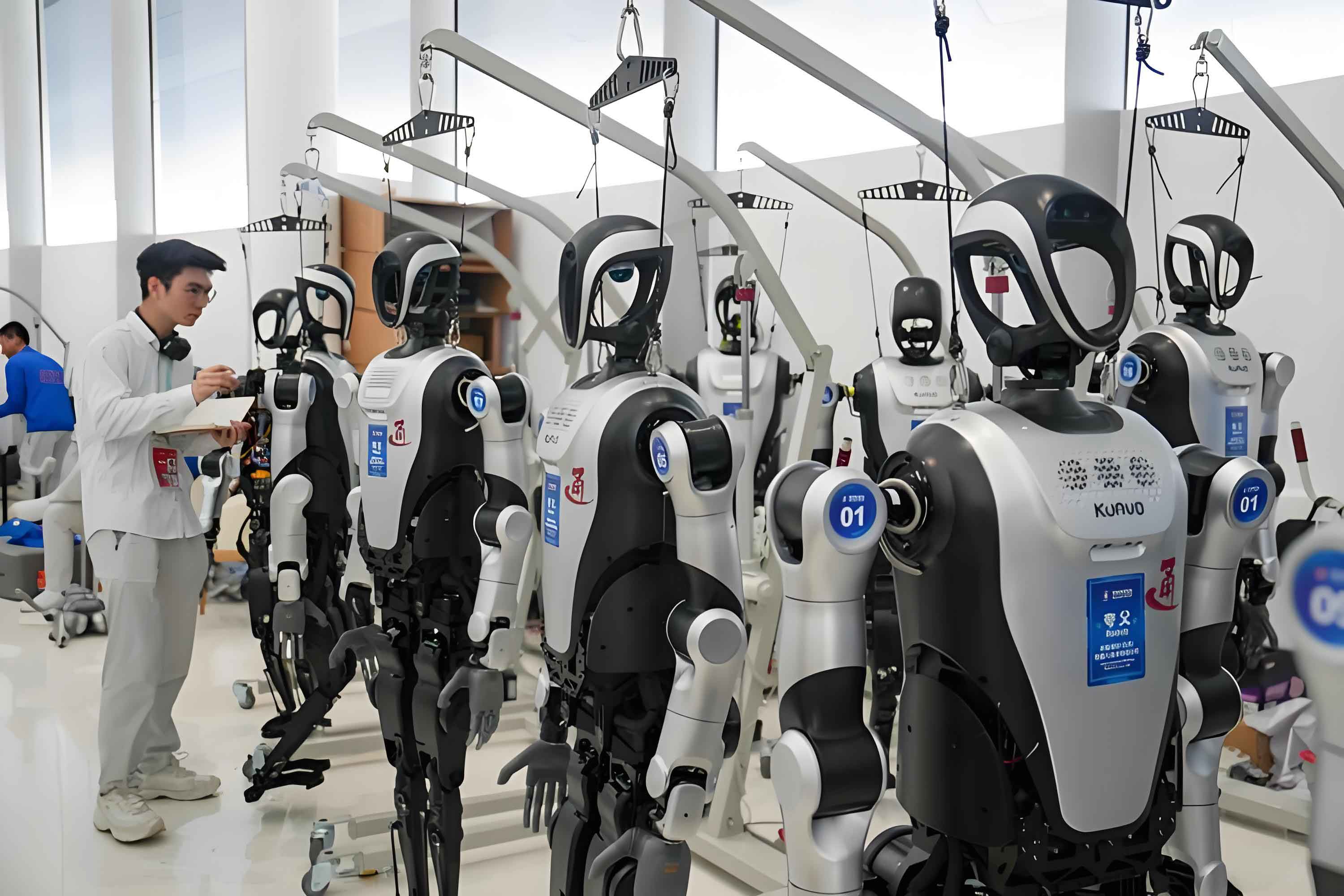
The progress in core components is pivotal for the advancement of humanoid robots. As companies like Haozhi and Flexiv demonstrate, domestic capabilities are maturing, reducing reliance on international suppliers and fostering a more resilient supply chain for humanoid robots. The iterative process of refining these components ensures that future generations of humanoid robots will exhibit enhanced performance, durability, and cost-effectiveness, which are essential for broad market acceptance of humanoid robots.
- Cost: The Key to Scaling
In the journey towards mass production of humanoid robots, cost is a focal point for all stakeholders. Ren Yutong, Executive President of the Guangdong Robot Association, revealed that in the current cost structure of a single humanoid robot, the motion system accounts for the highest proportion, ranging from 40% to 50%. This primarily includes motors, reducers, joint modules, and related elements. Within this, the motor system constitutes approximately 25% of the total machine cost, while the reducer system accounts for about 10%.
To illustrate the cost distribution more clearly, the following table summarizes the key cost components of a typical humanoid robot based on current industry estimates:
| Component Category | Approximate Cost Percentage (%) |
|---|---|
| Motion System (Total) | 40 – 50 |
| – Motor System | ~25 |
| – Reducer System | ~10 |
| Other Systems (e.g., Sensing, Computing, Structure) | 50 – 60 |
“Depending on customization requirements such as functional complexity and load capacity, the price of our adaptive robots ranges from several hundred thousand to several million yuan,” Chen Xianyong informed. He added that the company’s products are still in the early stages of development. Once subsequent products are deployed in batches globally, costs will be further optimized, and product prices will become more competitive. The potential for cost reduction through scale is significant for the future of humanoid robots.
The furniture manufacturing sector represents a typical application scenario for future humanoid robots. Li Maohong, Chairman of Hongya Numerical Control, expressed anticipation for the mass production of humanoid robots. “As a manufacturing enterprise, we hope that the robots we purchase can recoup the investment cost within one and a half to two years. We look forward to the cost of humanoid robots decreasing soon, enabling companies to acquire better products at lower prices,” Li stated. This sentiment underscores the market pressure for affordable humanoid robots.
Forum participants concurred that before the large-scale commercial landing of humanoid robots, product technology and the level of hardware and software still require further enhancement. Ren Yutong believes that, technically, the current perceptual capabilities for motion control, intelligence level, reliability, and endurance of humanoid robots need improvement to enhance the overall coordination of the machine. Chen Xianyong posits that generalization capability is a key metric for measuring the intelligence level of humanoid robots. This refers to the robot’s need to possess comprehensive abilities including environmental perception, autonomous learning, task planning, and dynamic deployment, allowing it to switch freely between different scenes and tasks, and adapt to complex, non-structured actual scenario demands. “Currently, the generalization capability of humanoid robots has been greatly improved through model optimization, but there remains a significant gap compared to the needs of actual scenarios in various industries and households,” Chen noted. Addressing this gap is crucial for the widespread adoption of humanoid robots.
- Application Scenarios: Industrial First, Then Household
From the discussions, it is understood that regarding the path for the large-scale application of humanoid robots, the industry has largely formed a consensus: “industrial first, followed by commercial services, and then household.” Generally, structured industrial scenarios require robots to possess fine operational capabilities, whereas household environments are more complex, demanding higher generalization ability from robots, and presenting greater challenges to their autonomous reasoning, decision-making capabilities, and flexible operation skills.
Liyuanheng is actively exploring the integration of humanoid robots into applications within its existing advantageous industries. Du Yixian, Dean of the Liyuanheng Research Institute, stated that compared to traditional robots, humanoid robots exhibit more prominent advantages in multi-sensing within complex operational scenarios, indicating immense application potential. In Du’s view, the key to truly deploying humanoid robots in industrial scenes lies in the deep integration of the “intelligent agent” with “process knowledge.” Liyuanheng is combining this process knowledge with artificial intelligence large models to endow humanoid robots with general intelligence. Superimposing specialized scene knowledge will effectively牵引 their large-scale application in intelligent manufacturing.
Du Yixian provided a clear expectation: “If the effective combination of intelligent humanoid robots and industrial scenarios can be achieved, it is anticipated that within three years, a large number of humanoid robots will be seen working on production lines.” This timeline highlights the accelerating pace of development for humanoid robots. Li Weichong, President of Ligong Industrial, shared a similar perspective in an interview. He stated that industry-universal robots for specific industrial scenarios will break through technical bottlenecks within 1 to 2 years, possessing cross-factory, cross-regional universality. The evolution of humanoid robots in industrial settings seems imminent.
Regarding the future path for humanoid robots to enter household scenarios, no consensus has yet been formed within the industry. Li Weichong believes that before humanoid robots enter homes, they could first be “classified and graded” by referencing the levels of automotive autonomous driving, clearly defining the capability boundaries for different levels. Simultaneously, supporting systems such as information security, ethics, and laws should be perfected to systematically advance the entry of humanoid robots into household scenes. Based on industry practice, he predicts that within 3 to 5 years, low-level home service robots could be realized, fulfilling basic functions such as emergency calls, simple item fetching, and timed reminders (for medication, check-ups). More advanced functions like autonomous decision-making and complex scene interaction will require a longer time for technological iteration and ecological maturation. The journey of humanoid robots into every home is a multi-stage process.
The strategic approach of prioritizing industrial applications allows for the refinement of technology and reliability in controlled environments before tackling the unpredictable nature of homes. As humanoid robots prove their value in factories and specialized settings, public trust and technological maturity will grow, paving the way for their eventual integration into daily life. The development of humanoid robots is not just a technological endeavor but also a societal one, requiring careful consideration of safety, ethics, and user experience. The iterative improvements gained from industrial use will directly benefit the future home versions of humanoid robots, making them more capable, safe, and affordable for consumers. The dream of having a versatile humanoid robot assistant at home depends on the successes achieved in these earlier phases of deployment for humanoid robots.
In conclusion, the forum painted a picture of an industry on the cusp of a major transformation. The localization of core components is reducing costs and improving performance, making humanoid robots more viable. The focus on industrial applications provides a practical testing ground, while the long-term vision of household integration drives innovation. Collaboration across the ecosystem—from component suppliers to whole-machine manufacturers and end-users—is essential to overcome the remaining challenges. With continued investment, iteration, and a clear strategic roadmap, the mass production and widespread adoption of humanoid robots appear increasingly within reach, promising to reshape industries and eventually households worldwide. The era of humanoid robots is dawning, and the transition from laboratory marvel to everyday tool is underway for humanoid robots.