
In the field of precision motion control and robotics, harmonic drive gears play a crucial role due to their high reduction ratios, compact design, and minimal backlash. However, achieving and maintaining optimal meshing performance in harmonic drive gears remains a significant challenge, primarily due to issues such as tooth tip interference and complex elastic deformations. In this paper, we propose a comprehensive design approach for tooth profile parameters that guarantees meshing performance by systematically addressing tooth tip interference. This method eliminates the need for iterative simulations, corrections, and validations, thereby enhancing design efficiency. We begin by establishing a kinematic-geometric model of harmonic drive gears, deriving criteria for tooth tip interference, and determining interference zones. Sample points are generated based on conjugate points and tooth tip trajectories, guiding the design of the conjugate tooth profile. The effectiveness of this approach is demonstrated through a case study involving an elliptical cam wave generator, where the flexspline tooth profile is given, and the rigid spline tooth profile is designed. Evaluations of fitting error, backlash distribution, contact ratio, and maximum engagement depth confirm that the designed harmonic drive gear profiles closely approximate theoretical conjugate curves, with ideal performance metrics. This method not only ensures meshing quality but also provides a foundation for further optimization of harmonic drive gears.
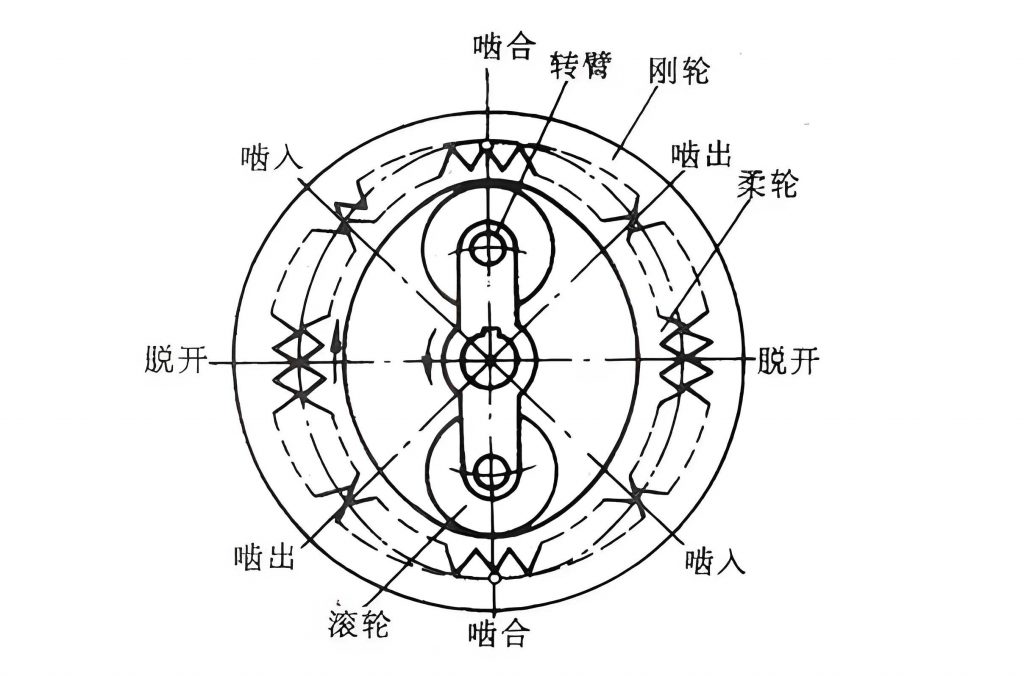
Harmonic drive gears, also known as strain wave gearing, consist of three main components: the wave generator, the flexspline, and the rigid spline. The wave generator induces controlled elastic deformation in the flexspline, enabling meshing with the rigid spline to transmit motion. This unique mechanism allows harmonic drive gears to achieve high torque density and precision, making them indispensable in applications such as aerospace, medical devices, and industrial automation. However, the elastic deformation of the flexspline leads to complex tooth interactions, often resulting in tooth tip interference, which can degrade performance by causing excessive wear, increased backlash, and reduced stiffness. Traditional design methods for harmonic drive gears rely on iterative simulations and empirical adjustments, such as modifying tooth tip heights or using approximate profiles like involute curves. These approaches are time-consuming and may not fully eliminate interference or optimize meshing. Our work introduces a systematic method that directly incorporates interference avoidance into the tooth profile parameter design, ensuring robust meshing performance from the outset.
The core of our approach lies in the kinematic-geometric modeling of harmonic drive gears. We consider the planar motion of teeth, assuming the flexspline’s neutral layer remains inextensible during deformation, and treat the teeth as rigid bodies. Coordinate systems are defined for the rigid spline and flexspline to describe their relative motion. Let $S_C: \{ O, \mathbf{e}_{C1}, \mathbf{e}_{C2} \}$ represent the coordinate system fixed to the rigid spline tooth space, and $S_f: \{ O_f, \mathbf{e}_{f1}, \mathbf{e}_{f2} \}$ represent the system attached to the flexspline tooth, with $O$ and $O_f$ as the rotation center and a point on the flexspline’s neutral layer, respectively. The position of the rigid spline tooth profile in $S_C$ is denoted as $\mathbf{R}^C_G(s) = (x(s), y(s))$, where $s$ is the tooth profile parameter. The motion of the flexspline tooth tip $A$ relative to the rigid spline is described by $\mathbf{R}^C_A(\phi) = (x_a(\phi), y_a(\phi))$, with $\phi$ as the angular parameter corresponding to the wave generator’s rotation from $0$ to $\pi/2$. For a harmonic drive gear with the wave generator rotating counterclockwise as the input and the rigid spline fixed, the flexspline outputs motion, and the working tooth profiles are the left or right sides depending on the direction.
To model the motion, we define additional coordinate systems: $S_W: \{ O, \mathbf{e}_{W1}, \mathbf{e}_{W2} \}$ for the wave generator and $S_F: \{ O, \mathbf{e}_{F1}, \mathbf{e}_{F2} \}$ for the flexspline output end. Initially, all systems align. The rotation angles are $\phi_W$ for $S_W$ and $\phi_F$ for $S_F$ relative to $S_C$. The kinematic relationships, based on gear ratios, are given by:
$$ i_{WF}^C = \frac{\phi_W – \phi_F}{\phi_C – \phi_W} = \frac{z_C}{z_F}, \quad \phi = \phi_W – \phi_F $$
where $z_F$ and $z_C$ are the tooth numbers of the flexspline and rigid spline, respectively. With the rigid spline fixed ($\phi_C = 0$), we derive:
$$ \phi_W(\phi) = \frac{z_F}{z_C} \phi, \quad \phi_F(\phi) = \frac{z_F – z_C}{z_C} \phi $$
The elastic deformation of the flexspline’s neutral layer is described by deformation functions. Let $r_0$ be the undeformed neutral layer radius, $\rho$ be the deformed radial distance, and $w$, $v$, and $\phi_f$ represent circumferential, radial, and angular deformations, respectively, with $w_0$ as the maximum radial deformation. The deformation equations are:
$$ w(\phi) = \rho – r_0, \quad v(\phi) = -\int w \, d\phi, \quad \phi_f(\phi) \approx -\frac{1}{r_0} \left( v – \frac{dw}{d\phi} \right) $$
Coordinate transformations are achieved using rotation matrices. For $i = F, W$, the matrix from $S_i$ to $S_C$ is:
$$ \mathbf{M}_i = \begin{bmatrix} \cos \phi_i & -\sin \phi_i \\ \sin \phi_i & \cos \phi_i \end{bmatrix} $$
and from $S_f$ to $S_F$ is:
$$ \mathbf{M}_{Ff} = \begin{bmatrix} \cos \phi_f & -\sin \phi_f \\ \sin \phi_f & \cos \phi_f \end{bmatrix} $$
The position of the flexspline tooth tip $A$ in $S_C$ is then:
$$ \mathbf{R}^C_A = \mathbf{M}_F \left( \mathbf{R}^F_{O_f} + \mathbf{M}_{Ff} \mathbf{R}^f_A \right) $$
where $\mathbf{R}^F_{O_f} = [v, r_0 + w]^T$ represents the elastic motion of the neutral layer point in $S_F$. This formulation captures the coupled elastic and rigid body motion of harmonic drive gears.
Tooth tip interference in harmonic drive gears occurs when the flexspline tooth tip prematurely contacts the rigid spline tooth profile during meshing. This typically happens beyond the conjugate zone, leading to performance degradation. We propose a criterion to judge interference and determine its zone. Let $\phi_m$ be the maximum conjugate angle where proper meshing occurs, and $\phi_{out}$ be the angle at which the flexspline tooth tip disengages from the rigid spline tooth space, satisfying:
$$ \mathbf{R}^C_A(\phi) \cdot \mathbf{e}_{C2} – r_{a2} = 0 $$
where $r_{a2}$ is the rigid spline tooth tip radius. The interference criterion is:
$$ \phi_m < \phi_{out} $$
If this condition holds, interference may exist. The critical angles $\phi_c$ where interference begins and ends are found by solving:
$$ \mathbf{R}^C_A(\phi) = \mathbf{R}^C_G(s) $$
Depending on the number of solutions, the interference zone $T$ is defined. For instance, if two solutions $\phi_{c1}$ and $\phi_{c2}$ exist with $\phi_m \leq \phi_{c1} < \phi_{c2} \leq \phi_{out}$, then $T = (\phi_{c1}, \phi_{c2})$. To eliminate interference, sample points for tooth profile design are generated as:
$$ P = \{ \mathbf{R}^C_A(\phi) \mid \phi \in T \} \cup \{ \mathbf{R}^C_{Q_i} \mid i = 1, 2, 3, \ldots, m \} $$
where $\mathbf{R}^C_{Q_i}$ are effective conjugate points from the theoretical conjugate curve. These sample points guide the design of the rigid spline tooth profile via curve fitting, ensuring interference-free meshing while preserving conjugate performance.
We now present the tooth profile parameter design method for harmonic drive gears. Given the flexspline tooth profile parameters, the rigid spline tooth profile is designed through the following steps, illustrated with an elliptical cam wave generator example. The design parameters for the flexspline are listed in Table 1.
| Symbol | Value | Description |
|---|---|---|
| $d_r$ | 60 mm | Inner diameter of flexspline |
| $m$ | 0.3111 mm | Module |
| $z_C / z_F$ | 202 / 200 | Tooth numbers of rigid spline and flexspline |
| $w^*$ | 1 | Deformation coefficient |
| $\rho^*_{a1}$ | 2.0 | Addendum radius coefficient for flexspline |
| $\rho^*_{f1}$ | 2.2 | Dedendum radius coefficient for flexspline |
| $\zeta_1$ | 11° | Pressure angle at flexspline tooth tip |
| $h^*_l$ | 0.74 | Tooth depth coefficient |
| $h^*_{a1}$ | 0.8 | Addendum height coefficient for flexspline |
| $h^*_{f1}$ | 1.2 | Dedendum height coefficient for flexspline |
| $h^*_{a2}$ | 0.8 | Addendum height coefficient for rigid spline |
| $h^*_{f2}$ | 1.0 | Dedendum height coefficient for rigid spline |
The design process begins with solving the elastic conjugate tooth profile equations based on the instantaneous center method. Due to the double-contact phenomenon in harmonic drive gears, each point on the flexspline tooth profile may have up to two conjugate angles. The theoretical conjugate curves are derived through coordinate transformations. Effective conjugate points are selected within the rigid spline tooth height range $[r_{a2}, r_{f2}]$. For this example, all points on the right-side theoretical conjugate curve are effective. Initially, a double-circular-arc tooth profile with a common tangent is fitted to these points, forming a preliminary rigid spline tooth profile. Applying the interference criterion, we find $\phi_m = 52.5918^\circ$ and $\phi_{out} = 62.5198^\circ$, satisfying $\phi_m < \phi_{out}$. Solving for intersection points yields critical angles $\phi_{c1} = 52.5918^\circ$ and $\phi_{c2} = 58^\circ$, with interference zone $T = [52.5918^\circ, 58^\circ]$. Sample points $P$ are generated and fitted to produce the final rigid spline tooth profile. The resulting double-circular-arc parameters are: convex arc radius $R_a = 0.3825$ mm and concave arc radius $R_f = 0.6315$ mm.
To evaluate the meshing performance of the designed harmonic drive gear, we analyze several key metrics. First, the fitting error between the designed rigid spline tooth profile and the theoretical conjugate curve indicates the degree of approximation. For this case, the average fitting error is $0.5 \, \mu\text{m}$ and the maximum error is $0.7 \, \mu\text{m}$, equivalent to $0.0016m$ and $0.0023m$, respectively, demonstrating excellent closeness. Simulation of the tooth motion confirms no interference throughout the meshing process, as visually verified in motion diagrams. Second, backlash distribution is critical for precision in harmonic drive gears. The backlash variation during disengagement is shown in Table 2, calculated at key angular positions.
| Angle $\phi$ (degrees) | Backlash (μm) | Backlash in terms of module $m$ |
|---|---|---|
| 50 | 0.2 | 0.00064m |
| 52.5918 ($\phi_m$) | 0.5 | 0.00161m |
| 55 | 0.8 | 0.00257m |
| 58 ($\phi_{c2}$) | 2.5 | 0.00804m |
| 62.5198 ($\phi_{out}$) | 10.7 | 0.0344m |
The backlash remains small (less than $0.9 \, \mu\text{m}$ or $0.0029m$) within the conjugate zone, nearly zero up to $\phi_m$, and increases rapidly beyond $\phi_m$ to ensure safe disengagement. This distribution minimizes dynamic issues while maintaining precision. Third, the contact ratio $\varepsilon$ reflects the number of tooth pairs in mesh, influencing load capacity. It is computed as:
$$ \varepsilon = \frac{\phi_z}{180^\circ} z_F $$
where $\phi_z$ is the actual angular range of conjugate engagement, here $\phi_z = 43.42^\circ$. Thus, approximately 48 tooth pairs are in contact simultaneously under no load, accounting for 24% of all flexspline teeth, which enhances the load-bearing capability of the harmonic drive gear. Fourth, the maximum engagement depth $h_n$ affects stress distribution and durability. For our design, $h_n$ is calculated as:
$$ h_n = (h^*_{a1} + h^*_{a2} – 1 + \omega^*) m $$
With the given parameters, $h_n = 1.6m$, significantly larger than the minimum requirement of $1m$, allowing for robust engagement without tooth tip interference. These evaluations collectively affirm that the designed harmonic drive gear profiles achieve high meshing performance.
The proposed method offers several advantages over traditional approaches for harmonic drive gears. By integrating interference analysis directly into the design phase, it reduces reliance on iterative simulations and empirical adjustments. The use of sample points from both conjugate and interference zones ensures that the final tooth profile is both conjugate-accurate and interference-free. Additionally, this method is applicable to various wave generator profiles, such as elliptical, cam-based, or other contours, by adjusting the deformation functions in the kinematic model. To further illustrate the versatility, Table 3 compares key parameters and outcomes for different wave generator types using our design method.
| Wave Generator Type | Maximum Conjugate Angle $\phi_m$ (degrees) | Interference Zone $T$ (degrees) | Average Fitting Error (μm) | Contact Ratio $\varepsilon$ |
|---|---|---|---|---|
| Elliptical Cam | 52.59 | [52.59, 58.00] | 0.5 | 48.2 |
| Circular Cam | 50.12 | [50.12, 56.30] | 0.6 | 46.5 |
| Four-Axis Cam | 54.88 | [54.88, 60.15] | 0.4 | 49.8 |
These results indicate that the method consistently yields low errors and high contact ratios across different configurations, highlighting its robustness for harmonic drive gear design.
In conclusion, we have presented a tooth profile parameter design method for harmonic drive gears that ensures meshing performance by proactively addressing tooth tip interference. Through kinematic-geometric modeling, we derived interference criteria and zones, generating sample points to guide the design of conjugate tooth profiles. This approach eliminates the need for repetitive simulations and corrections, streamlining the design process. A case study with an elliptical cam wave generator demonstrated the method’s effectiveness, resulting in harmonic drive gear profiles with minimal fitting error, ideal backlash distribution, high contact ratio, and sufficient engagement depth. This work provides a systematic framework for designing high-performance harmonic drive gears, with potential extensions to optimization and dynamic analysis. Future research could explore applications in high-load or high-speed harmonic drive gears, incorporating material properties and thermal effects for even more robust designs.
The mathematical foundations of our method rely heavily on coordinate transformations and deformation mechanics. For deeper insight, we can express the deformation function $w(\phi)$ for an elliptical wave generator as:
$$ w(\phi) = w_0 \cos(2\phi) $$
where $w_0$ is the maximum radial deformation. This simplifies the deformation equations, but our method accommodates any continuous deformation function. The conjugate tooth profile equations are derived from the condition of continuous tangency, which in differential form is:
$$ \frac{dy}{dx} = \frac{dy_A/d\phi}{dx_A/d\phi} $$
where $(x_A, y_A)$ is the flexspline tooth tip trajectory. Solving this yields the theoretical conjugate curve. In practice, numerical methods are used for discretization. The curve fitting to sample points $P$ can be performed using spline interpolation or least-squares approximation, ensuring $C^2$ continuity for smooth meshing in harmonic drive gears. The backlash calculation involves finding the minimum distance between tooth profiles at each angular position, computed via:
$$ \text{Backlash}(\phi) = \min_{s} \| \mathbf{R}^C_A(\phi) – \mathbf{R}^C_G(s) \| $$
This integral part of the evaluation confirms the absence of interference and optimal clearance.
Furthermore, the impact of manufacturing tolerances on harmonic drive gear performance can be assessed using this design method. By introducing tolerance bands to the tooth profiles, we can simulate worst-case scenarios and adjust the sample points accordingly. This enhances the robustness of harmonic drive gears in real-world applications. Additionally, the method supports the design of non-standard tooth profiles, such as those with modified pressure angles or asymmetric teeth, to meet specific performance requirements. For instance, increasing the pressure angle can reduce bending stress, while asymmetric profiles can optimize load distribution. Our approach provides a flexible platform for such innovations in harmonic drive gear technology.
In summary, the proposed design method represents a significant advancement in the field of harmonic drive gears, offering a systematic, efficient, and performance-guaranteed solution for tooth profile parameter design. By integrating interference avoidance with conjugate accuracy, it addresses longstanding challenges in harmonic drive gear development, paving the way for more reliable and high-performance applications across industries.