
The pursuit of highly mobile, robust, and adaptive legged machines has led to significant interest in hydraulically actuated bionic robots. These systems, exemplified by platforms like BigDog, offer superior power-to-weight ratios, high force output, and fast dynamic response, making them suitable for challenging terrains and heavy payload applications. The core of such a bionic robot’s agility and strength lies in its joint-level actuation system, typically a compact servo valve-controlled asymmetric or symmetric cylinder assembly, known as a Hydraulic Drive Unit (HDU). The dynamic performance of each HDU directly governs the overall locomotion quality, stability, and adaptability of the quadruped bionic robot.
Accurate trajectory tracking is paramount for stable gait generation in a bionic robot. However, the HDU is characterized by numerous parameters—both structural (e.g., piston area, valve coefficients, fluid compliance) and operational/control-related (e.g., controller gains, load mass). These parameters can exhibit variability due to manufacturing tolerances, temperature changes, wear, or shifting operational conditions. This inherent multi-parameter, time-varying nature can degrade the robustness of a fixed control strategy, adversely affecting the overall motion planning and control of the bionic robot. Therefore, quantitatively understanding the influence of each parameter on the HDU’s dynamic response is a critical step toward robust controller design and mechanical optimization.
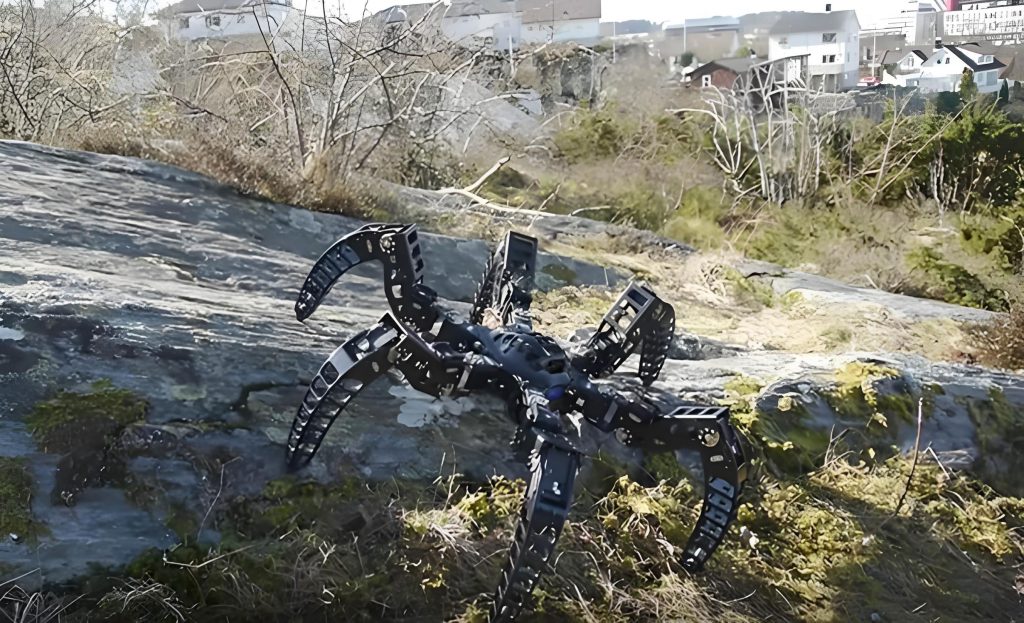
Sensitivity analysis provides a powerful mathematical framework to assess how variations in system parameters affect its output performance. Among various methods, trajectory sensitivity analysis is particularly suited for studying the temporal evolution of a system’s state due to parameter perturbations. This paper establishes a comprehensive model for an HDU used in a quadruped bionic robot, derives its trajectory sensitivity equations, and quantifies the impact of key structural and control parameters on its step response. The aim is to identify the dominant parameters influencing both the transient and steady-state behavior, thereby laying a theoretical foundation for prioritized design refinement and adaptive control strategies for the bionic robot’s actuation system.
Mathematical Modeling of the Hydraulic Drive Unit
The HDU for a bionic robot joint is essentially a high-performance servo valve-controlled cylinder system. For modeling, the servo valve is represented as a second-order oscillatory element due to its bandwidth being comparable to the hydraulic natural frequency. The system considers a PID controller for closed-loop position control. The following equations describe the dynamics in the frequency domain.
The servo valve flow equation and the cylinder output displacement are given by:
$$
\left\{
\begin{aligned}
&\left( K_w U – (K_w K_P + \frac{K_w K_I}{s} + K_w K_D s) Y \right) K_a – \frac{K_{sv}}{ \frac{s^2}{\omega_{sv}^2} + \frac{2\xi_{sv}}{\omega_{sv}}s + 1} Q = 0 \\
&\frac{Q}{A} – \frac{K_{ce}}{A^2} \left(1 + \frac{V_t}{4\beta_e K_{ce}} s \right) F = \left( \frac{V_t m_t}{4\beta_e A^2} s^3 + \frac{K_{ce} m_t}{A^2} s^2 + s \right) Y
\end{aligned}
\right.
$$
where the total flow-pressure coefficient \(K_{ce} = K_c + C_{tp}\). The hydraulic natural frequency \(\omega_h\) and damping ratio \(\xi_h\) are:
$$
\omega_h = \sqrt{\frac{4 \beta_e A^2}{V_t m_t}}, \quad \xi_h = \frac{K_{ce}}{A} \sqrt{\frac{\beta_e m_t}{V_t}} + \frac{B_p}{4A} \sqrt{\frac{V_t}{\beta_e m_t}}
$$
For time-domain analysis and subsequent sensitivity derivation, the system is transformed. Assuming a step input for position and a constant external load force, and neglecting cylinder viscous damping (\(B_p \approx 0\)), the inverse Laplace transform of the system equations yields the following time-domain model:
$$
\left\{
\begin{aligned}
&I u – I K_w y – P K_w \dot{y} – D K_w \ddot{y} – K_a K_{sv} \omega_{sv}^2 q = \ddot{q} + 2\xi_{sv}\omega_{sv} \dot{q} + \omega_{sv}^2 q \\
&\frac{K_{ce}}{A^2} F + \frac{4\beta_e K_{ce}}{V_t A} \dot{y} + \frac{4\beta_e A}{V_t} y = \frac{m_t}{A} \dddot{y} + \frac{4\beta_e m_t}{V_t} \ddot{y} + \dot{q}
\end{aligned}
\right.
$$
Where \(q\) is the integrated valve flow (a state variable), and \(y\) is the piston displacement.
Theory of Trajectory Sensitivity
Trajectory sensitivity analysis investigates how a system’s state trajectory changes due to small variations in its parameters. Consider a system described by the state-space equation:
$$
\dot{\mathbf{x}} = \mathbf{f}(\mathbf{x}, \mathbf{u}, \boldsymbol{\alpha}, t)
$$
where \(\mathbf{x} \in \mathbb{R}^n\) is the state vector, \(\mathbf{u} \in \mathbb{R}^r\) is the input vector (independent of parameters), \(\boldsymbol{\alpha} \in \mathbb{R}^p\) is the parameter vector, and \(t\) is time.
The first-order trajectory sensitivity function of the state vector \(\mathbf{x}\) with respect to a parameter \(\alpha_i\) is defined as:
$$
\boldsymbol{\lambda}_i(t) = \frac{\partial \mathbf{x}(t, \boldsymbol{\alpha})}{\partial \alpha_i}, \quad i=1,2,\dots,p
$$
Differentiating the state equation with respect to \(\alpha_i\) yields the trajectory sensitivity equation:
$$
\dot{\boldsymbol{\lambda}}_i = \frac{\partial \mathbf{f}}{\partial \mathbf{x}} \boldsymbol{\lambda}_i + \frac{\partial \mathbf{f}}{\partial \alpha_i}
$$
where \(\frac{\partial \mathbf{f}}{\partial \mathbf{x}}\) is the Jacobian matrix of \(\mathbf{f}\) with respect to \(\mathbf{x}\), and \(\frac{\partial \mathbf{f}}{\partial \alpha_i}\) is the partial derivative of \(\mathbf{f}\) with respect to the parameter \(\alpha_i\). This equation is a linear time-varying differential equation that can be solved simultaneously with the original state equation.
Trajectory Sensitivity Model for the Bionic Robot’s HDU
To apply this theory to the bionic robot’s HDU, the time-domain model is first expressed in state-space form \(\dot{\mathbf{x}} = \mathbf{f}(\mathbf{x}, \mathbf{u}, \boldsymbol{\alpha})\). The state, input, and parameter vectors are defined as follows:
State Vector \(\mathbf{x}\): \(\mathbf{x} = [x_1, x_2, x_3, x_4, x_5, x_6]^\top = [q, \dot{q}, \ddot{q}, y, \dot{y}, \ddot{y}]^\top\)
Input Vector \(\mathbf{u}\): \(\mathbf{u} = [u_1, u_2]^\top = [U, F]^\top\)
Parameter Vector \(\boldsymbol{\alpha}\): This vector includes 14 key parameters of the bionic robot’s drive system.
| Symbol | Parameter | Vector Index \(\alpha_i\) |
|---|---|---|
| \(K_{sv}\) | Servo Valve Flow Gain | \(\alpha_1\) |
| \(\omega_{sv}\) | Servo Valve Natural Frequency | \(\alpha_2\) |
| \(\xi_{sv}\) | Servo Valve Damping Ratio | \(\alpha_3\) |
| \(A\) | Piston Effective Area | \(\alpha_4\) |
| \(K_c\) | Flow-Pressure Coefficient | \(\alpha_5\) |
| \(C_{tp}\) | Total Leakage Coefficient | \(\alpha_6\) |
| \(m_t\) | Total Mass (Piston + Load) | \(\alpha_7\) |
| \(\beta_e\) | Effective Bulk Modulus | \(\alpha_8\) |
| \(V_t\) | Total Volume | \(\alpha_9\) |
| \(K_w\) | Displacement Sensor Gain | \(\alpha_{10}\) |
| \(K_a\) | Servo Amplifier Gain | \(\alpha_{11}\) |
| \(K_P\) | PID Proportional Gain | \(\alpha_{12}\) |
| \(K_I\) | PID Integral Gain | \(\alpha_{13}\) |
| \(K_D\) | PID Derivative Gain | \(\alpha_{14}\) |
The state equation \(\mathbf{f}(\mathbf{x}, \mathbf{u}, \boldsymbol{\alpha})\) is constructed from the time-domain model. The \(6 \times 6\) Jacobian matrix \(\frac{\partial \mathbf{f}}{\partial \mathbf{x}}\) and the \(6 \times 14\) parameter derivative matrix \(\frac{\partial \mathbf{f}}{\partial \alpha_i}\) are then derived analytically. These matrices are essential for forming the 84 coupled trajectory sensitivity equations (6 states \(\times\) 14 parameters) according to \(\dot{\boldsymbol{\lambda}}_i = \frac{\partial \mathbf{f}}{\partial \mathbf{x}} \boldsymbol{\lambda}_i + \frac{\partial \mathbf{f}}{\partial \alpha_i}\).
Sensitivity Analysis and Discussion
The analysis was performed by numerically solving the state and sensitivity equations using a variable-step Runge-Kutta algorithm in MATLAB. The nominal parameter values used for the bionic robot’s HDU are listed in the table below.
| Parameter | Nominal Value | Unit |
|---|---|---|
| \(K_{sv}\) | 0.0135 | m³/(s·A) |
| \(\omega_{sv}\) | 628 | rad/s |
| \(\xi_{sv}\) | 0.7 | – |
| \(A\) | 3.37e-4 | m² |
| \(K_c\) | 9.5e-12 | m³/(s·Pa) |
| \(C_{tp}\) | 5.95e-13 | m³/(s·Pa) |
| \(m_t\) | 0.8 | kg |
| \(\beta_e\) | 7.0e+8 | Pa |
| \(V_t\) | 2.94e-5 | m³ |
| \(K_w\) | 200 | V/m |
| \(K_a\) | 1.5e-3 | A/V |
| \(K_P\) | 21 | – |
| \(K_I\) | 10 | s⁻¹ |
| \(K_D\) | 0.02 | s |
Model Validation
The HDU model’s accuracy was validated by comparing its simulated step response with experimental data from a physical prototype of the bionic robot’s leg joint actuator. Under identical conditions and PID gains, the maximum relative error between the simulation and experimental curves was less than 3%, confirming the model’s fidelity for the rising and steady-state phases, which are the primary focus of this sensitivity study.
Sensitivity Functions of Displacement
The primary output of interest is the piston displacement \(y\) (state \(x_4\)). The sensitivity functions \(\lambda_4^i(t) = \partial x_4 / \partial \alpha_i\) for all 14 parameters were computed. A key observation is the behavior of these functions as the system reaches steady-state (\(t \to \infty\)). The sensitivity functions for parameters \(\alpha_1, \alpha_2, \alpha_3, \alpha_7, \alpha_8, \alpha_9, \alpha_{11}, \alpha_{12}, \alpha_{14}\) (valve gains/frequencies, mass, bulk modulus, volume, amplifier gain, P and D gains) all converge to zero. This indicates that these parameters have negligible influence on the steady-state position accuracy of the bionic robot’s joint. In contrast, the sensitivity functions for parameters \(\alpha_4, \alpha_5, \alpha_6, \alpha_{10}, \alpha_{13}\) (piston area \(A\), leakage coefficients \(K_c\) and \(C_{tp}\), sensor gain \(K_w\), and integral gain \(K_I\)) do not converge to zero, signifying their critical role in determining the final steady-state position.
Quantitative Impact Assessment
To quantitatively compare the influence of each parameter on the dynamic trajectory, the percentage change in the step response displacement \(y\) due to a 1% change in each parameter \(\alpha_i\) is analyzed. Using the first-order approximation \(\Delta y \approx \lambda_4^i \Delta \alpha_i\), the percentage change relative to the step command magnitude \(y_{ss}\) is:
$$
\text{Percentage Change} = \frac{\Delta y}{y_{ss}} \times 100\% \approx \frac{\lambda_4^i \Delta \alpha_i}{y_{ss}} \times 100\%
$$
The maximum value of this percentage over the entire time horizon for each parameter serves as a metric for its overall impact on the dynamic response of the bionic robot’s actuator. The results are summarized below:
| Parameter \(\alpha_i\) | Description | Max. % Change in \(y\) (for +1% \(\Delta\alpha_i\)) | Primary Influence |
|---|---|---|---|
| \(\alpha_2: \omega_{sv}\) | Valve Natural Frequency | High | Transient Dynamics (Oscillation) |
| \(\alpha_3: \xi_{sv}\) | Valve Damping Ratio | High | Transient Dynamics (Overshoot/Settling) |
| \(\alpha_4: A\) | Piston Area | High | Both Transient & Steady-State |
| \(\alpha_1: K_{sv}\) | Valve Flow Gain | Medium | Transient Dynamics (Speed) |
| \(\alpha_{12}: K_P\) | Proportional Gain | Medium | Transient Dynamics (Stiffness) |
| \(\alpha_7: m_t\) | Load Mass | Medium | Transient Dynamics (Inertia) |
| \(\alpha_{13}: K_I\) | Integral Gain | Low-Medium | Steady-State Accuracy & Low-Freq. |
| \(\alpha_{10}: K_w\) | Sensor Gain | Low | Steady-State Accuracy (Scaling) |
| \(\alpha_5, \alpha_6: K_c, C_{tp}\) | Leakage Coefficients | Low | Steady-State Accuracy (Droop) |
The analysis clearly identifies the servo valve’s natural frequency (\(\omega_{sv}\)), damping ratio (\(\xi_{sv}\)), and the piston area (\(A\)) as the most influential parameters on the transient dynamic performance (overshoot, oscillation frequency, settling time) of the bionic robot’s hydraulic drive unit. Variations in these parameters, which can occur due to component variability or changes in the fluid’s effective bulk modulus affecting \(\omega_{sv}\), can significantly alter the leg’s swing dynamics. The integral gain \(K_I\), sensor gain \(K_w\), and leakage parameters are dominant for steady-state accuracy, but their effect on the high-speed transient response is comparatively smaller.
Conclusion
This study successfully applied trajectory sensitivity analysis to a hydraulic drive unit for a quadruped bionic robot. A dynamic model was established and validated, and a comprehensive set of sensitivity equations was derived. By solving these equations, the influence of 14 key structural and control parameters on the actuator’s step response was quantified.
The main conclusions are:
1. The steady-state position of the bionic robot’s joint is primarily sensitive to the piston area (\(A\)), total flow-pressure coefficient (combining \(K_c\) and \(C_{tp}\)), displacement sensor gain (\(K_w\)), and the integral control gain (\(K_I\)). Ensuring accuracy and stability in these parameters is crucial for the precise foot placement of the bionic robot.
2. The transient dynamic performance, critical for agile and stable locomotion of the bionic robot, is most significantly affected by the servo valve’s dynamic characteristics (natural frequency \(\omega_{sv}\) and damping ratio \(\xi_{sv}\)) and the piston area (\(A\)). The proportional gain \(K_P\) and the load mass \(m_t\) also have a substantial impact.
3. Parameters like the servo valve flow gain \(K_{sv}\), bulk modulus \(\beta_e\), and derivative gain \(K_D\) affect the transient response but show negligible effect on the final steady-state position.
These findings provide clear guidance for the design and control of a hydraulically actuated bionic robot. For mechanical design, tolerances and operating conditions affecting the valve dynamics and piston area should be tightly controlled. For control system design, adaptive or robust strategies should prioritize compensating for variations in valve frequency/damping and load mass to maintain consistent dynamic performance across the bionic robot’s operational envelope. Future work will involve incorporating non-linearities (e.g., valve flow characteristics, friction) into the sensitivity model for a complete analysis across the entire workspace of the bionic robot’s actuator.