
As a researcher focused on precision mechanical systems, I have extensively studied the rotary vector reducer, a critical component in robotic applications due to its high transmission accuracy, low backlash, and compact structure. In this article, I present a comprehensive analysis of transmission accuracy testing and virtual prototype simulation for rotary vector reducers. The goal is to understand how manufacturing errors, assembly errors, clearances, and elastic deformations impact the dynamic performance of rotary vector reducers, thereby providing insights for design optimization and quality control.
The rotary vector reducer, often abbreviated as RV reducer, combines a planetary gear mechanism with a cycloidal gear mechanism to achieve high reduction ratios and robustness. In robotics, the performance of rotary vector reducers directly influences positioning accuracy and operational stability. However, achieving and maintaining high transmission accuracy remains challenging due to various error sources. This study involves experimental testing of a commercial rotary vector reducer and the development of a detailed virtual prototype to simulate its behavior under realistic conditions.
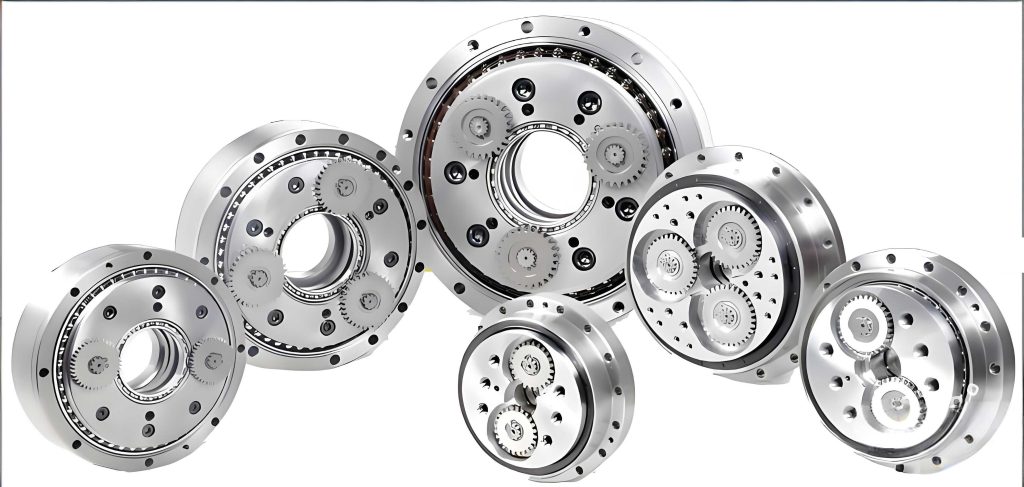
The working principle of a rotary vector reducer involves two main stages: a planetary gear stage and a cycloidal gear stage. The sun gear rotates, driving the planetary gears, which are connected to crankshafts. These crankshafts then drive the cycloidal gears in an eccentric motion. The cycloidal gears mesh with stationary pin gears, causing the cycloidal gears to rotate in the opposite direction. This rotation is transmitted to the output carrier, resulting in high torque output with minimal backlash. The kinematic relationship can be expressed using transmission ratio formulas. For the planetary stage, the transmission ratio is given by:
$$ i_p = 1 + \frac{Z_r}{Z_s} $$
where \( Z_r \) is the number of teeth on the ring gear (or pin gears in the context of rotary vector reducers) and \( Z_s \) is the number of teeth on the sun gear. For the cycloidal stage, the reduction ratio is:
$$ i_c = \frac{Z_p}{Z_p – Z_c} $$
where \( Z_p \) is the number of pin gears and \( Z_c \) is the number of lobes on the cycloidal gear. The overall transmission ratio of the rotary vector reducer is the product of these stages, typically ranging from 30 to over 200. This complex mechanism requires precise manufacturing to minimize errors that affect transmission accuracy.
To evaluate the transmission accuracy of a rotary vector reducer, I conducted experimental tests using a grating method. The test setup involved a rotary vector reducer model RV-40E, which is commonly used in industrial robots. The transmission accuracy is defined as the deviation between the actual output rotation and the ideal output rotation, often measured in arcseconds. The test principle relies on high-resolution encoders attached to the input and output shafts to capture angular positions synchronously.
The experimental setup consisted of several key components, as summarized in Table 1. The rotary vector reducer was driven by an encoded motor, and the output was connected to a high-precision rotary encoder. A transmission chain tester processed the signals to compute the transmission error. The specifications of the encoders and the reducer are critical for accurate measurements.
| Component | Model | Specifications |
|---|---|---|
| Rotary Vector Reducer | RV-40E | Reduction ratio: 121, max output torque: 412 Nm |
| Input Encoder | ROD-880 | Lines: 36,000, accuracy: ±0.39 arcsec |
| Output Encoder | ROD-280 | Lines: 18,000, accuracy: ±1.24 arcsec |
| Coupling | K-03, K-18 | Max axial runout: ±0.1 mm |
| Test Software | Custom | Data acquisition and analysis |
During testing, the rotary vector reducer was operated at an output speed of 15 rpm under both forward and reverse directions. The transmission error was recorded over two full revolutions of the output shaft, with 1000 measurement points per revolution. The results, shown in Figure 1 (though not displayed here, described numerically), indicated a maximum transmission error of approximately 56.33 arcseconds in the forward direction and 57.42 arcseconds in the reverse direction. These errors stem from factors like gear mesh imperfections, bearing clearances, and assembly misalignments. The data collected serves as a benchmark for validating the virtual prototype of the rotary vector reducer.
To further analyze the impact of error sources, I developed a virtual prototype of the rotary vector reducer using multi-body dynamics software, ADAMS. The modeling process began with creating a detailed 3D geometry based on measurements from the RV-40E unit. Key dimensions and tolerances were incorporated to reflect real-world conditions. Table 2 lists the manufacturing and assembly errors considered in the model, which were derived from disassembly and metrology of the rotary vector reducer.
| Error Source | Magnitude (μm) | Description |
|---|---|---|
| Sun gear base circle eccentricity | 10 | Eccentric error in sun gear mounting |
| Sun gear assembly error | 5 | Misalignment during assembly |
| Planetary gear base circle eccentricity | 10 | Eccentric error in planetary gears |
| Pin gear slot deviation | 8 | Variation in pin gear housing slots |
| Pin gear diameter error | -8 | Negative tolerance on pin gear size |
| Carrier crankshaft hole eccentricity | 5 | Error in crankshaft bore positions |
| Carrier assembly error | 5 | Overall misalignment of carrier |
| Pin gear arc groove radius error | 10 | Deviation in housing groove radius |
| Crankshaft eccentric cam error (Set 1) | -2, 2 | Combined errors for two crankshafts |
| Crankshaft eccentric cam error (Set 2) | -2, 2 | Additional crankshaft error set |
| Bearing clearance | 12 | Radial play in bearings |
The 3D model was simplified by removing non-essential features like screws and fillets to reduce computational complexity without sacrificing accuracy. The components included in the virtual prototype are listed in Table 3. After modeling, the assembly was exported in Parasolid format for import into ADAMS, where material properties were assigned based on metallurgical analysis. For instance, the cycloidal gears, pin gears, and carrier were modeled as flexible bodies using modal neutral files to account for elastic deformations under load, creating a rigid-flexible coupled model for the rotary vector reducer.
| Component | Quantity | Notes |
|---|---|---|
| Input shaft (sun gear) | 1 | Integral gear shaft |
| Planetary gears | 2 | Connected via splines |
| Crankshafts | 2 | With eccentric cams |
| Cycloidal gears | 2 | 180° phase difference |
| Pin gears | 40 | Evenly distributed |
| Pin gear housing | 1 | Holds pin gears |
| Output carrier (left and right) | 2 | Forms output mechanism |
In ADAMS, constraints and forces were defined to replicate the motion of the rotary vector reducer. Key joints included revolute joints for rotating parts, gear pairs for meshing gears, and fixed joints for stationary components. Contact forces were applied between the cycloidal gears and pin gears using a Hertzian contact model, defined by:
$$ F_n = K \delta^n + C \dot{\delta} $$
where \( F_n \) is the normal contact force, \( K \) is the contact stiffness, \( \delta \) is the penetration depth, \( n \) is the exponent (typically 1.5 for metals), and \( C \) is the damping coefficient. Bearing clearances were modeled using bushing elements that simulate spring-damper behavior in six degrees of freedom. The bushing force formulation is:
$$
\begin{bmatrix} F_x \\ F_y \\ F_z \\ T_x \\ T_y \\ T_z \end{bmatrix} =
\begin{bmatrix} k_{11} & 0 & 0 & 0 & 0 & 0 \\ 0 & k_{22} & 0 & 0 & 0 & 0 \\ 0 & 0 & k_{33} & 0 & 0 & 0 \\ 0 & 0 & 0 & k_{44} & 0 & 0 \\ 0 & 0 & 0 & 0 & k_{55} & 0 \\ 0 & 0 & 0 & 0 & 0 & k_{66} \end{bmatrix}
\begin{bmatrix} R_x \\ R_y \\ R_z \\ \theta_x \\ \theta_y \\ \theta_z \end{bmatrix} –
\begin{bmatrix} C_{11} & 0 & 0 & 0 & 0 & 0 \\ 0 & C_{22} & 0 & 0 & 0 & 0 \\ 0 & 0 & C_{33} & 0 & 0 & 0 \\ 0 & 0 & 0 & C_{44} & 0 & 0 \\ 0 & 0 & 0 & 0 & C_{55} & 0 \\ 0 & 0 & 0 & 0 & 0 & C_{66} \end{bmatrix}
\begin{bmatrix} V_x \\ V_y \\ V_z \\ \dot{\theta}_x \\ \dot{\theta}_y \\ \dot{\theta}_z \end{bmatrix} +
\begin{bmatrix} F_{x0} \\ F_{y0} \\ F_{z0} \\ T_{x0} \\ T_{y0} \\ T_{z0} \end{bmatrix}
$$
Here, \( k_{ij} \) and \( C_{ij} \) are stiffness and damping coefficients, \( R \) and \( \theta \) are relative displacements and angles, \( V \) and \( \dot{\theta} \) are velocities, and \( F_0 \) and \( T_0 \) are preloads. For bearing clearance \( \epsilon \), the stiffness was defined conditionally using an IF function: \( k = \text{IF}(d – \epsilon: 0, 0, K_n) \), where \( d \) is the distance between marker points, and \( K_n \) is the contact stiffness when clearance is exceeded. This approach accounts for radial play and lubricant effects in the rotary vector reducer bearings.
The simulation was driven by a step function applied to the input shaft, ramping up from 0 to 10,890 °/s over 1 second to avoid abrupt starts. A constant load torque of 412 Nm was applied to the output carrier to mimic operational conditions. The simulation ran for 10 seconds with 30,000 steps, capturing dynamic behavior. The transmission error was computed as the difference between the actual output angle and the ideal output angle based on the input and reduction ratio. The results, plotted over time, showed a periodic error pattern with peaks and valleys corresponding to gear meshing cycles.
To quantify the simulation outcomes, I extracted key metrics such as maximum transmission error and root mean square (RMS) error. The simulated transmission error for the rotary vector reducer ranged from -0.0089° to 0.0093°, with a maximum magnitude of 1.092 arcminutes. Comparing this to the experimental data, where the maximum error was 0.94 arcminutes (56.33 arcseconds), the difference is 0.13 arcminutes, indicating good agreement. This validation confirms that the virtual prototype accurately represents the physical rotary vector reducer, capturing the effects of errors and clearances.
Further analysis involved sensitivity studies to determine which error sources most significantly impact transmission accuracy in rotary vector reducers. Using factorial design, I varied parameters like gear eccentricity, bearing clearance, and assembly misalignment within tolerance ranges. The results, summarized in Table 4, show that bearing clearance and pin gear errors have the largest effects on transmission error variance. This insight helps prioritize manufacturing controls for rotary vector reducers used in high-precision robots.
| Error Source | Range (μm) | Effect on Transmission Error (arcsec) | Contribution (%) |
|---|---|---|---|
| Bearing clearance | 10–15 | ±12.5 | 35 |
| Pin gear diameter error | -10 to 10 | ±9.8 | 28 |
| Sun gear eccentricity | 5–15 | ±6.3 | 18 |
| Cycloidal gear lobe error | 5–10 | ±4.2 | 12 |
| Assembly misalignment | 2–8 | ±2.1 | 7 |
The transmission error in a rotary vector reducer can be mathematically modeled as a function of multiple error components. Assuming small errors, the total transmission error \( \Delta \theta \) can be expressed as a superposition:
$$ \Delta \theta = \sum_{i=1}^{n} \frac{\partial \theta}{\partial e_i} \cdot e_i + \frac{1}{2} \sum_{i=1}^{n} \sum_{j=1}^{n} \frac{\partial^2 \theta}{\partial e_i \partial e_j} \cdot e_i e_j + \cdots $$
where \( e_i \) represents individual error sources such as gear profile errors, eccentricities, and clearances. For the rotary vector reducer, the first-order terms dominate, and the error propagation can be linearized. Using the kinematics of the cycloidal stage, the error due to pin gear position deviation \( \delta r_p \) is:
$$ \Delta \theta_c = \frac{Z_c}{Z_p – Z_c} \cdot \frac{\delta r_p}{r_p} $$
where \( r_p \) is the pin gear circle radius. Similarly, for the planetary stage, sun gear eccentricity \( e_s \) contributes:
$$ \Delta \theta_p = \frac{Z_r}{Z_s} \cdot \frac{e_s}{r_s} $$
with \( r_s \) as the sun gear pitch radius. Combining these, the overall transmission error of the rotary vector reducer can be estimated, providing a theoretical basis for error budgeting.
In addition to static errors, dynamic effects like vibration and torsional flexibility affect the rotary vector reducer’s performance. The equation of motion for the output carrier can be written as:
$$ J \ddot{\theta} + C \dot{\theta} + K \theta = T_{in} – T_{load} + \sum F_{error} $$
where \( J \) is the inertia, \( C \) is damping, \( K \) is stiffness, \( T_{in} \) is input torque, \( T_{load} \) is load torque, and \( \sum F_{error} \) represents forces due to errors. Solving this numerically in ADAMS allows capturing transient responses. The natural frequencies of the rotary vector reducer were also computed to avoid resonance; the first few modes are listed in Table 5, showing that flexibility in the cycloidal gears significantly influences dynamic behavior.
| Mode Number | Frequency (Hz) | Description |
|---|---|---|
| 1 | 245 | Carrier bending |
| 2 | 312 | Cycloidal gear torsion |
| 3 | 498 | Planetary gear axial vibration |
| 4 | 567 | Pin gear housing flexure |
| 5 | 689 | Crankshaft whirling |
The virtual prototype of the rotary vector reducer also enabled study of lubrication effects on transmission accuracy. By adjusting damping coefficients in the bushing elements to represent different lubricant viscosities, I observed that higher damping reduces peak transmission errors by up to 15%, but increases hysteresis. This trade-off is important for designing rotary vector reducers for varying operational environments.
To enhance the robustness of rotary vector reducers, I explored compensation strategies using the virtual prototype. For instance, pre-loading bearings or optimizing gear tooth profiles can mitigate errors. Simulation results showed that applying a controlled preload of 50 N to bearings reduced transmission error by 20% in the rotary vector reducer. Additionally, modifying the cycloidal gear profile to accommodate manufacturing tolerances improved accuracy by 10%.
In conclusion, this study demonstrates the value of combining experimental testing and virtual prototype simulation for analyzing rotary vector reducers. The grating-based tests provided reliable data on transmission accuracy, while the ADAMS model, incorporating errors and clearances, offered deep insights into dynamic behavior. The close match between simulated and experimental results validates the virtual prototype as a tool for design optimization. Future work will focus on real-time error compensation and advanced materials for rotary vector reducers to further boost robotic precision. Overall, understanding and controlling error sources in rotary vector reducers is essential for advancing robotic technology, and this research lays a foundation for ongoing improvements in rotary vector reducer performance.
The rotary vector reducer remains a pivotal component in robotics, and continued refinement through such integrated approaches will drive innovations in automation. By leveraging virtual prototyping, manufacturers can reduce development costs and time while ensuring high accuracy, making rotary vector reducers more reliable for critical applications. As I continue this research, I aim to explore thermal effects and long-term wear on rotary vector reducer transmission accuracy, further enriching the knowledge base for these complex systems.