
In precision servo mechanisms, especially in robotics, harmonic drive gears are widely adopted due to their unique flexible component and multi-tooth engagement characteristics, which offer high transmission accuracy through error compensation. However, as applications demand increasingly stringent performance, further improvement in transmission accuracy requires a deep understanding of error sources. Transmission error, defined as the deviation between the actual output angle and the ideal angle, directly impacts control quality. Similarly, hysteresis error, often assessed through bidirectional transmission error, affects repeatability. In this study, I propose a method to analyze transmission error in harmonic drive gears by reconstructing it using main frequency cosine waves. This approach allows for identifying dominant error frequencies and their interactions, facilitating targeted design improvements.
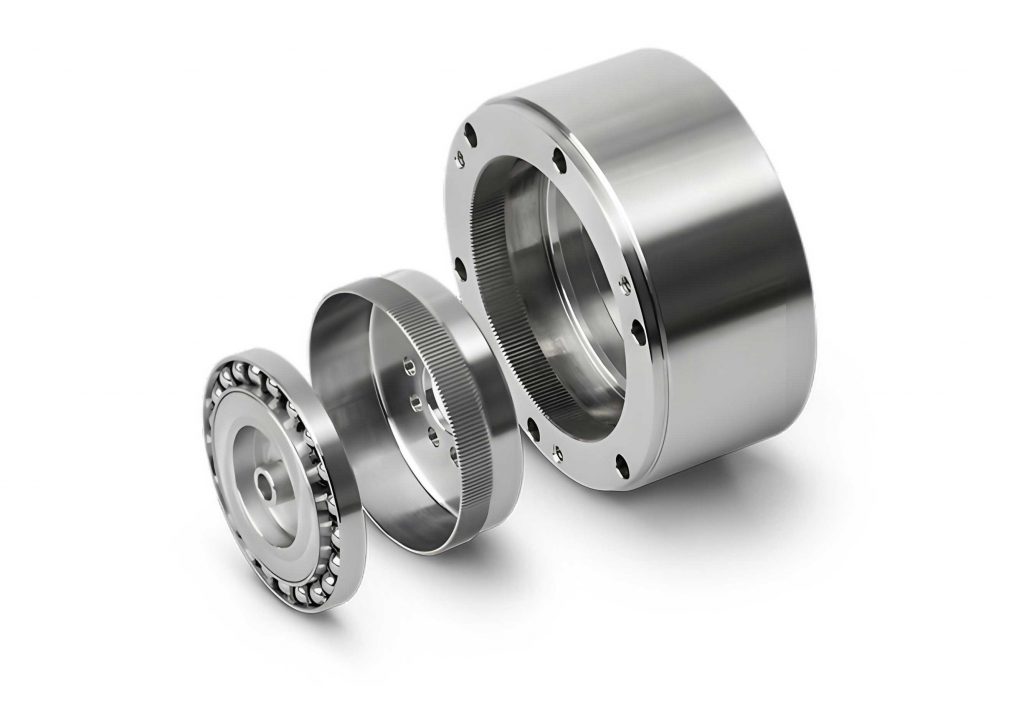
The transmission error in harmonic drive gears stems from various sources, primarily the wave generator, flexspline, and circular spline. Each component introduces deviations that manifest as specific frequency components in the error signal. For a harmonic drive gear with a fixed circular spline and wave generator input, the fundamental error frequencies can be derived based on kinematic relationships. Let the wave generator rotational frequency be denoted as \(f_{wg}\), with the flexspline and circular spline having tooth counts \(z_1\) and \(z_2\), respectively. The key theoretical main frequencies include:
- Flexspline rotation frequency: \(f_1 = 2f_{wg}/z_1\), arising from comprehensive deviations of the flexspline.
- Wave generator rotation frequency: \(f_2 = f_{wg}\), due to comprehensive eccentricities of the wave generator.
- Circular spline engagement frequency: \(f_3 = 2f_{wg}\), resulting from directional eccentricities of the wave generator and comprehensive deviations of the circular spline.
- Flexspline engagement frequency: \(f_4 = 2f_{wg} z_2 / z_1\), associated with comprehensive deviations of the flexspline.
These frequencies form the basis for analyzing transmission error in harmonic drive gears. High-frequency components like tooth profile errors or bearing ball errors are often negligible due to the multi-tooth engagement and small magnitudes.
To model the transmission error, I consider it as a superposition of cosine waves plus a constant offset. The general expression for a cosine wave is:
$$C = A \cos(2\pi f t + \phi)$$
where \(A\) is amplitude, \(f\) is frequency, and \(\phi\) is phase. Thus, the transmission error \(E(t)\) can be reconstructed as:
$$E(t) = E_0 + \sum_{q=1}^{Q} A_q \cos(2\pi f_q t + \phi_q)$$
Here, \(E_0\) is the constant component, and \(Q\) represents the number of significant cosine waves. This reconstruction enables the decomposition of complex error signals into interpretable components, focusing on main frequencies that dominate the error behavior in harmonic drive gears.
Analyzing the superposition characteristics of these basic main frequency cosine waves reveals intriguing patterns. For instance, when cosine waves with frequencies that are multiples or near-multiples combine, they produce beat frequency phenomena. Consider a harmonic drive gear with \(z_1 = 160\), \(z_2 = 162\), and \(f_{wg} = 0.5\) Hz. The basic frequencies are:
| Cosine Component | Frequency Name | Formula | Value (Hz) | Primary Source |
|---|---|---|---|---|
| C1 | Flexspline rotation frequency | \(f_1 = 2f_{wg}/z_1\) | 0.00625 | Flexspline comprehensive deviation |
| C2 | Wave generator rotation frequency | \(f_2 = f_{wg}\) | 0.5 | Wave generator comprehensive eccentricity |
| C3 | Circular spline engagement frequency | \(f_3 = 2f_{wg}\) | 1 | Wave generator directional eccentricity and circular spline deviation |
| C4 | Flexspline engagement frequency | \(f_4 = 2f_{wg} z_2 / z_1\) | 1.0125 | Flexspline comprehensive deviation |
Superimposing these components, with amplitudes set to 1 arcsecond and phases to \(\pi\) for illustration, shows distinct features. The combination of \(C_2\) and \(C_3\) (frequencies in a 1:2 ratio) yields a “large-small wave” pattern without beat frequency. In contrast, combining \(C_2\) and \(C_4\) (near-double frequencies) produces a wavy beat, while \(C_3\) and \(C_4\) (close frequencies) generate a spindle-shaped beat. When all three are superimposed, a complex beat pattern emerges, repeating twice per flexspline rotation cycle. These characteristics help link error morphology to specific component deviations in harmonic drive gears.
In practical measurements, transmission error is sampled as a discrete time series. To analyze it in the frequency domain, I employ Fourier transform techniques. Assuming the error signal \(E(t)\) is periodic with period \(T\), it can be expressed as a Fourier series:
$$E(t) = \frac{a_0}{2} + \sum_{n=1}^{N} \left[ a_n \cos\left( \frac{2\pi n}{T} t \right) + b_n \sin\left( \frac{2\pi n}{T} t \right) \right]$$
where coefficients are derived from integrals. For discrete sampling with \(N\) points at sampling frequency \(f_s\), the fast Fourier transform (FFT) computes complex coefficients \(F_n\) corresponding to frequencies \((n-1)f\), with \(f = f_s/N\). The amplitude and phase for each frequency component are:
$$A_{n-1} = \frac{2}{N} \sqrt{R_n^2 + I_n^2}, \quad \phi_{n-1} = \arg(F_n) = \tan^{-1}(I_n / R_n)$$
Here, \(R_n\) and \(I_n\) are real and imaginary parts of \(F_n\). This transformation separates the error signal into its frequency constituents, allowing identification of dominant responses at theoretical main frequencies for harmonic drive gears.
To validate the theoretical analysis, I conducted dynamic transmission error tests on a harmonic drive gear model ZSHF17-80-2SO. The setup used a ZRT-II robot reducer performance test system with high-precision circular gratings and NI data acquisition hardware. The harmonic drive gear had a fixed circular spline, wave generator input, and flexspline output, with \(z_1 = 160\), \(z_2 = 162\), and a theoretical reduction ratio of 80. Two wave generator configurations were compared: an integrated cam wave generator (Scheme I) and a slider-type cam wave generator (Scheme II). The slider design incorporates a cross-slider mechanism to mitigate eccentricities by allowing the cam to self-align, potentially reducing errors from wave generator deviations. Tests were performed at an input speed of 30 rpm (\(f_{wg} = 0.5\) Hz), with sampling at 10 Hz. Bidirectional transmission error was measured by rotating the output 370° forward and then reversing.
The results for Scheme I showed bidirectional error curves with similar shapes but offset in the spatial domain, yielding hysteresis error. Fourier analysis of the reverse error signal revealed significant amplitude responses at frequencies close to the theoretical main frequencies, as summarized below:
| Frequency (Hz) | Amplitude (arcseconds) | Phase (rad) | Correspondence |
|---|---|---|---|
| 0 | 13.98 | 0 | Constant error |
| 0.00622 | 2.29 | -2.8547 | Flexspline rotation frequency |
| 0.55935 | 2.37 | -0.2412 | Wave generator-related combined frequency |
| 1.00062 | 4.31 | -1.4923 | Circular spline engagement frequency |
| 1.01305 | 2.37 | -0.9727 | Flexspline engagement frequency |
| 2.00124 | 4.86 | -1.5289 | Second harmonic of circular spline engagement |
Reconstructing the error using these actual main frequency components closely matched the measured curve, confirming that dominant cosine waves can effectively represent transmission error in harmonic drive gears. For comparison, reconstruction with only theoretical basic frequencies captured overall beat trends but lacked amplitude and detail accuracy, highlighting the role of combined frequencies in shaping error morphology.
Scheme II, with the slider-type wave generator, exhibited altered error characteristics. The bidirectional error curves showed greater separation in the spatial domain, and hysteresis error increased. Frequency-domain analysis indicated reduced amplitudes at key frequencies compared to Scheme I, as shown in the amplitude comparison table:
| Frequency (Hz) | Amplitude Scheme I (arcseconds) | Amplitude Scheme II (arcseconds) | Difference (Scheme II – I) |
|---|---|---|---|
| 0 | 13.98 | 23.51 | 9.53 |
| 0.00622 | 2.29 | 1.16 | -1.13 |
| 0.55935 | 2.37 | 0 | -2.37 |
| 1.00062 | 4.31 | 3.16 | -1.15 |
| 1.01305 | 2.37 | 2.70 | 0.33 |
| 2.00124 | 4.86 | 3.38 | -1.48 |
The slider structure effectively eliminated wave generator-related eccentricities, reducing amplitudes at frequencies like \(f_{wg}\) and its harmonics. However, increased constant error in reverse motion due to slider间隙 contributed to larger hysteresis. This demonstrates that optimizing wave generator design, such as using slider mechanisms, can significantly improve transmission error in harmonic drive gears by mitigating specific deviation sources.
Further analysis of bidirectional frequency-domain results sheds light on hysteresis error generation. Comparing amplitude and phase spectra for forward and reverse errors in both schemes, phase variations emerged as a key factor. While amplitude changes were minor, phase differences at main frequencies were substantial. For example, in Scheme I, phase differences at 1.00062 Hz were around -1.8689 rad, altering the superposition outcome. The constant error component also varied between directions, especially in Scheme II due to间隙. These phase shifts, combined with constant error changes, cause morphological differences between bidirectional errors, leading to hysteresis. This insight suggests that controlling phase relationships among error components could further enhance precision in harmonic drive gears.
In conclusion, this study presents a main frequency cosine wave reconstruction method for analyzing transmission error in harmonic drive gears. By identifying fundamental error frequencies from wave generator, flexspline, and circular spline deviations, and examining their superposition effects, I have shown how beat frequency patterns relate to component imperfections. Experimental validation through bidirectional testing and Fourier analysis confirmed the dominance of theoretical main frequencies and their combinations. The comparison of integrated and slider-type wave generators highlighted the effectiveness of structural improvements in reducing error amplitudes. Moreover, phase variations in bidirectional errors were identified as a critical contributor to hysteresis. These findings provide a framework for error source diagnosis and precision enhancement in harmonic drive gears, emphasizing the importance of frequency-domain analysis and component optimization. Future work could explore phase manipulation strategies to minimize hysteresis and further refine transmission accuracy in harmonic drive gear systems.