
The pursuit of higher precision, greater torsional stiffness, and extended service life continuously drives innovation in the field of harmonic drive gears. As a core component in robotics and aerospace mechanisms, the performance of harmonic drive gears is intrinsically linked to their tooth profile design. This article delves into the design methodology and performance characteristics of a tri-arc tooth profile for the flexspline in harmonic drive gears, presenting a detailed analysis using conjugate theory, parametric studies, and comparative assessments.
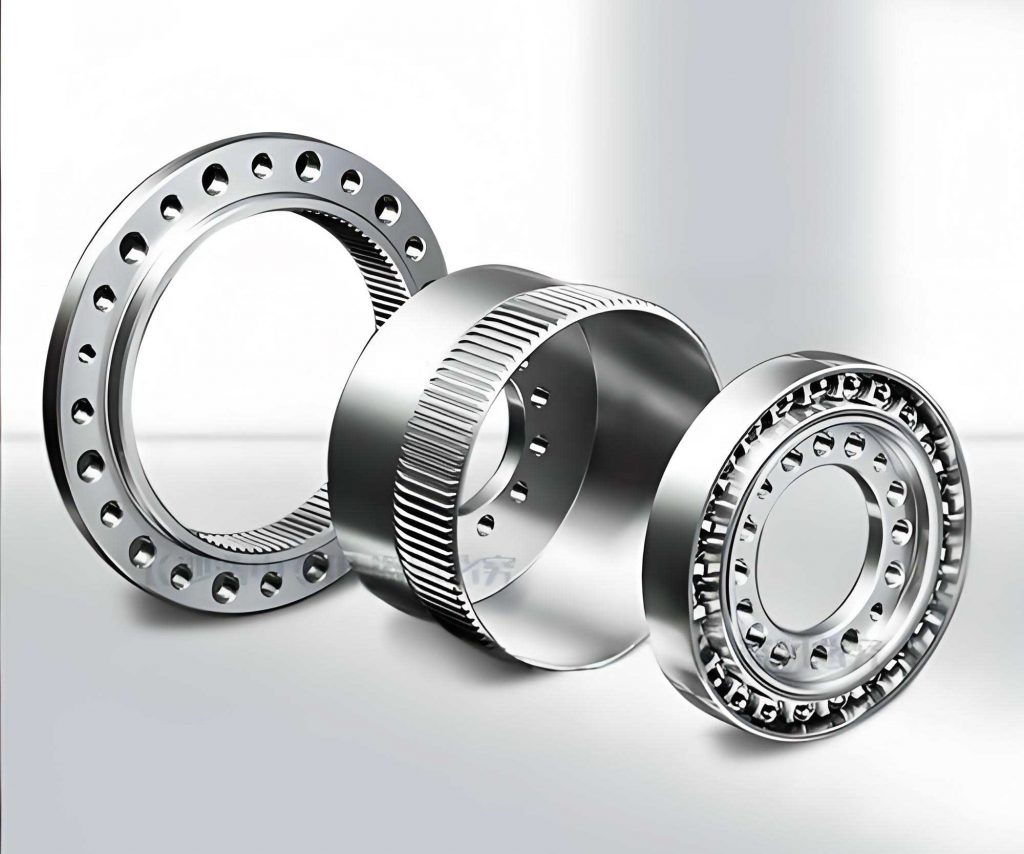
The fundamental operation of a harmonic drive gear relies on the controlled elastic deformation of a thin-walled flexspline by a wave generator, typically an elliptical cam. This deformation enables sequential meshing with a rigid circular spline, resulting in high reduction ratios within a compact package. The quality of this meshing action—characterized by factors like the number of tooth pairs in simultaneous contact, the nature of the contact (conjugate vs. point contact), and load distribution—is paramount. These factors are predominantly governed by the geometry of the flexspline tooth profile. While involute and double-circular-arc profiles are common, research indicates that circular-arc profiles can offer superior stress distribution and more uniform clearance. The tri-arc profile represents a further evolution, aiming to expand the conjugate meshing zone and enhance overall performance.
Geometric Modeling of the Tri-Arc Flexspline Tooth Profile
The proposed tri-arc profile for the harmonic drive gear’s flexspline consists of three distinct circular segments: a convex arc near the tooth tip, an intermediate arc, and a concave arc near the tooth root. The profile is defined in a local coordinate system attached to the flexspline tooth. Let the coordinate system \( S_1(O_1, X_1, Y_1) \) be fixed to the flexspline tooth, with the \( Y_1 \)-axis aligned with the tooth’s symmetry axis and the origin \( O_1 \) located at the intersection of this axis with the neutral curve of the flexspline. The \( X_1 \)-axis is tangent to the neutral curve at \( O_1 \).
The profile parameters are illustrated in the referenced figure and defined as follows:
- \( h, h_a, h_f \): Total tooth height, addendum height, and dedendum height.
- \( \rho_a, \rho_m, \rho_f \): Radii of the convex, intermediate, and concave arcs.
- \( \delta_1, \delta_2 \): Angles between the \( Y_1 \)-axis and the common tangents at the junction of the convex/intermediate arcs and intermediate/concave arcs, respectively.
- \( X_a, l_a \): Offset and shift distance for the center of the convex arc.
- \( X_f, l_f \): Offset and shift distance for the center of the concave arc.
- \( d \): Distance from the root circle to the neutral layer.
The tooth profile from the tip (point A) to the root (point D) is parameterized by the arc length \( s \). The position vector \( \mathbf{r} \) and unit normal vector \( \mathbf{n} \) for each segment in homogeneous coordinates are given below.
1. Convex Arc Segment AB (\( s \in (0, l_1) \)):
$$ \mathbf{r}_{ab}(s) = \begin{bmatrix} \rho_a \cos(\theta – s/\rho_a) + x_{oa} \\ \rho_a \sin(\theta – s/\rho_a) + y_{oa} \\ 1 \end{bmatrix}, \quad \mathbf{n}_{ab}(s) = \begin{bmatrix} \cos(\theta – s/\rho_a) \\ \sin(\theta – s/\rho_a) \\ 0 \end{bmatrix} $$
where \( \theta = \arcsin\left( (h_a + x_{oa}) / \rho_a \right) \), \( x_{oa} = -l_a \), \( y_{oa} = h – h_a + d – X_a \), and \( l_1 = \rho_a (\theta – \delta_1) \).
2. Intermediate Arc Segment BC (\( s \in (l_1, l_2) \)):
$$ \mathbf{r}_{bc}(s) = \begin{bmatrix} \rho_m \cos\left( \delta_1 – (s – l_1)/\rho_m \right) + x_{om} \\ \rho_m \sin\left( \delta_1 – (s – l_1)/\rho_m \right) + y_{om} \\ 1 \end{bmatrix}, \quad \mathbf{n}_{bc}(s) = \begin{bmatrix} \cos\left( \delta_1 – (s – l_1)/\rho_m \right) \\ \sin\left( \delta_1 – (s – l_1)/\rho_m \right) \\ 0 \end{bmatrix} $$
where \( x_{om} = \rho_a \cos \delta_1 + x_{oa} – \rho_m \cos \delta_1 \), \( y_{om} = \rho_a \sin \delta_1 + y_{oa} – \rho_m \sin \delta_1 \), and \( l_2 = l_1 + \rho_m (\delta_1 – \delta_2) \).
3. Concave Arc Segment CD (\( s \in (l_2, l_3) \)):
$$ \mathbf{r}_{cd}(s) = \begin{bmatrix} x_{of} – \rho_f \cos\left( \delta_2 + (s – l_2)/\rho_f \right) \\ y_{of} – \rho_f \sin\left( \delta_2 + (s – l_2)/\rho_f \right) \\ 1 \end{bmatrix}, \quad \mathbf{n}_{cd}(s) = \begin{bmatrix} \cos\left( \delta_2 + (s – l_2)/\rho_f \right) \\ \sin\left( \delta_2 + (s – l_2)/\rho_f \right) \\ 0 \end{bmatrix} $$
where \( x_{of} = \rho_m \cos \delta_2 + x_{om} + \rho_f \cos \delta_2 \), \( y_{of} = \rho_m \sin \delta_2 + y_{om} + \rho_f \sin \delta_2 \), and \( l_3 = l_2 + \rho_f \left\{ \arcsin\left( (y_{of} – d) / \rho_f \right) – \delta_2 \right\} \).
Kinematic Modeling and Conjugate Theory for Harmonic Drive Gears
To analyze the meshing behavior of the tri-arc harmonic drive gear, a precise kinematic model based on conjugate theory is employed. The analysis makes standard simplifying assumptions: the flexspline is perfectly compliant and wraps the wave generator without slip or middle-layer elongation, meshing is treated as planar, and individual tooth pairs are analyzed over one engagement cycle.
Three coordinate systems are established:
- \( S_2(O_2, X_2, Y_2) \): Fixed to the circular spline.
- \( S(O, X, Y) \): Fixed to the wave generator (elliptical cam).
- \( S_1(O_1, X_1, Y_1) \): Fixed to the flexspline tooth under analysis, as defined previously.
The wave generator’s long axis is aligned with the \( Y \)-axis. Initially, all \( Y \)-axes coincide. As the wave generator rotates by an angle \( \phi_2 \) (input), the flexspline’s non-deformed end rotates by \( \alpha \), its deformed end rotates by \( \gamma \) (output), and the local tooth coordinate system undergoes complex motion defined by angles \( \mu \) and \( \phi_1 \). Pure rolling is assumed between the circular spline’s pitch circle and the flexspline’s deformed neutral curve.
The transformation from the flexspline tooth coordinates \( S_1 \) to the fixed circular spline coordinates \( S_2 \) is crucial. The transformation matrix \( \mathbf{M}_{21} \) and the underlying vector transformation matrix \( \mathbf{W}_{21} \) are:
$$ \mathbf{M}_{21} = \begin{bmatrix} \cos \beta & \sin \beta & r \sin \gamma \\ -\sin \beta & \cos \beta & r \cos \gamma \\ 0 & 0 & 1 \end{bmatrix}, \quad \mathbf{W}_{21} = \begin{bmatrix} \cos \beta & \sin \beta & 0 \\ -\sin \beta & \cos \beta & 0 \\ 0 & 0 & 1 \end{bmatrix} $$
where \( r \) is the radial distance from the wave generator center \( O \) to the point \( O_1 \) on the flexspline neutral curve, and \( \beta \) is a compound angle relating the orientations of the coordinate systems.
The fundamental condition for conjugate contact is that the relative velocity at the contact point is orthogonal to the common normal vector. This can be expressed in any of the coordinate systems. Using system \( S_2 \), the condition is:
$$ \mathbf{n}_2 \cdot \mathbf{v}^{(12)}_2 = 0 $$
where \( \mathbf{n}_2 = \mathbf{W}_{21} \mathbf{n}_1 \) is the normal vector expressed in \( S_2 \), and \( \mathbf{v}^{(12)}_2 = \frac{d\mathbf{r}_2}{dt} = \frac{d\mathbf{M}_{21}}{dt} \mathbf{r}_1 \) is the relative velocity vector. Solving this equation for a given flexspline profile point (parameter \( s \)) yields the specific wave generator angle \( \phi_2 \) at which that point comes into conjugate contact. The set of all \( \phi_2 \) values for which solutions exist defines the conjugate zone. For harmonic drive gears, it is common for points on the convex flank to experience two separate conjugate engagements during a cycle, leading to two distinct conjugate zones separated by an interval of non-conjugate or point contact.
Parametric Study and Comparative Analysis
A numerical study was conducted to evaluate the tri-arc harmonic drive gear performance and compare it with a conventional double-circular-arc design. Common parameters were set as: module \( m = 0.32 \) mm, radial deformation coefficient \( w^*_0 = 1.0 \), total tooth height \( h = 1.5m \), addendum \( h_a = 0.6m \), dedendum \( h_f = 0.9m \), flexspline tooth number \( z_R = 160 \), and circular spline tooth number \( z_G = 162 \). The specific profile parameters for both designs are summarized below.
| Parameter | Double-Arc Design | Tri-Arc Design |
|---|---|---|
| Convex Arc Radius \( \rho_a \) (mm) | 0.620 | 0.620 |
| Concave Arc Radius \( \rho_f \) (mm) | 0.620 | 0.620 |
| Intermediate Arc Radius \( \rho_m \) (mm) | – | 2.700 |
| Angle \( \delta_1 \) (deg) | 11.8 | 12.5 |
| Angle \( \delta_2 \) (deg) | – | 10.7 |
| Convex Center Offset \( X_a \) (mm) | 0.1020 | 0.1020 |
| Convex Center Shift \( l_a \) (mm) | 0.4165 | 0.4165 |
| Neutral Layer Distance \( d \) (mm) | 0.4185 | 0.4185 |
Conjugate Zone Comparison
The conjugate zones calculated for both harmonic drive gear designs are as follows:
- Tri-Arc Harmonic Drive Gear:
- First Conjugate Zone: \( \phi_2 \in [2.90405, 10.34781] \) deg
- Second Conjugate Zone: \( \phi_2 \in [10.86511, 45.70194] \) deg
- Interval Between Zones: \( \Delta \phi_2 = 0.51730 \) deg
- Double-Arc Harmonic Drive Gear:
- First Conjugate Zone: \( \phi_2 \in [2.90405, 9.17592] \) deg
- Second Conjugate Zone: \( \phi_2 \in [14.25278, 45.70194] \) deg
- Interval Between Zones: \( \Delta \phi_2 = 5.07686 \) deg
The results clearly demonstrate the advantage of the tri-arc profile in harmonic drive gears. It exhibits a significantly wider first conjugate zone, a slightly wider second conjugate zone, and a dramatically smaller non-conjugate interval. A wider total conjugate zone implies more tooth pairs are in theoretically ideal contact simultaneously, which directly contributes to higher torsional stiffness and positional accuracy of the harmonic drive gear assembly.
Influence of Tri-Arc Profile Parameters
The sensitivity of the conjugate zone characteristics to variations in the tri-arc profile parameters was investigated systematically. The effects are summarized qualitatively and quantitatively in the table below.
| Parameter | Effect on First Conjugate Zone | Effect on Second Conjugate Zone | Effect on Interval Between Zones | Overall Impact on Total Conjugate Performance |
|---|---|---|---|---|
| Increase in Convex Radius \( \rho_a \) | Negligible change | Significant reduction | Minor reduction | Reduces total conjugate zone. Beneficial for widening the zone but detrimental for shrinking the interval. |
| Increase in Intermediate Radius \( \rho_m \) | Significant reduction | Significant reduction | Increase | Strongly reduces total conjugate zone and widens the interval. Reducing \( \rho_m \) is beneficial for both objectives. |
| Increase in Concave Radius \( \rho_f \) | No change for functional arcs* | No change for functional arcs* | No change | Negligible effect on the actual, functional conjugate zones of the harmonic drive gear. |
| Increase in Angle \( \delta_1 \) | Significant reduction | Significant reduction | Increase | Reduces total conjugate zone and widens the interval. Reducing \( \delta_1 \) is beneficial for both. |
| Increase in Angle \( \delta_2 \) | No change for convex arc segment | Reduction for intermediate arc segment | Increase | Reduces the conjugate contribution of the intermediate segment and widens the interval. Reducing \( \delta_2 \) is beneficial. |
*Note: The concave arc segment typically does not participate in functional conjugate contact in the final assembly due to interference with the second conjugate profile of the convex arc. Therefore, changes to \( \rho_f \) do not affect the operational conjugate zones.
The mathematical trends can be observed from the governing equations. For instance, a smaller \( \rho_m \) or smaller \( \delta_1 \) reduces the arc length of the intermediate segment \( l_2 – l_1 = \rho_m (\delta_1 – \delta_2) \). This geometric change allows the transition from the first to the second conjugate engagement of the convex flank to occur more rapidly as the wave generator rotates, thereby shrinking the non-conjugate interval. Simultaneously, it can alter the entry and exit points of conjugate contact on the profile.
Design Optimization and Implications for Harmonic Drive Gear Performance
The analysis provides clear guidelines for optimizing the tri-arc harmonic drive gear design. The primary objectives are to maximize the total conjugate zone and minimize the non-conjugate interval. To achieve this, the following design principles should be applied:
- Select a moderately small convex arc radius (\( \rho_a \)): While reducing \( \rho_a \) increases the second conjugate zone, an excessively small radius may lead to high contact stresses. A balanced value must be chosen.
- Minimize the intermediate arc radius (\( \rho_m \)) and angles (\( \delta_1, \delta_2 \)): This is the most effective strategy. Reducing these parameters directly shrinks the non-conjugate interval and can expand the conjugate zones. The lower limits are constrained by manufacturing capabilities and the need to maintain a smooth profile transition.
- The concave arc parameters (\( \rho_f \)) are non-critical for meshing: They can be chosen primarily based on root strength and fillet stress considerations, without significantly affecting the conjugate meshing performance of the harmonic drive gear.
The practical implication of a wider conjugate zone and a smaller interval is profound for harmonic drive gear performance. A larger conjugate zone means more teeth are engaged under ideal rolling/contact conditions at any given input angle, distributing the load more evenly. A smaller non-conjugate interval reduces the angular range where teeth are only in point contact or have increased clearance. Point contact leads to higher localized stress, greater wear, and lower torsional stiffness. Therefore, optimizing the tri-arc profile directly enhances the key metrics of transmission accuracy, rigidity, and longevity in harmonic drive gears.
Conclusion
This comprehensive analysis establishes the tri-arc tooth profile as a superior design candidate for high-performance harmonic drive gears. Through rigorous geometric and kinematic modeling, the conjugate meshing characteristics of the profile were elucidated. A direct comparison with a standard double-circular-arc profile confirmed that the tri-arc harmonic drive gear possesses a substantially expanded conjugate zone and a drastically reduced non-conjugate interval. A detailed parametric study revealed the influence of key design variables: reducing the intermediate arc radius \( \rho_m \) and the transition angles \( \delta_1 \) and \( \delta_2 \) is highly beneficial for achieving both design objectives, while the convex arc radius \( \rho_a \) presents a trade-off, and the concave arc radius \( \rho_f \) has minimal effect. By carefully selecting these parameters, designers can minimize detrimental point-contact phases and maximize the number of teeth in simultaneous conjugate contact. This optimization leads directly to measurable improvements in the critical operational characteristics of harmonic drive gears, namely their positional accuracy, torsional stiffness, and operational lifespan, meeting the escalating demands of advanced robotic and aerospace applications.