
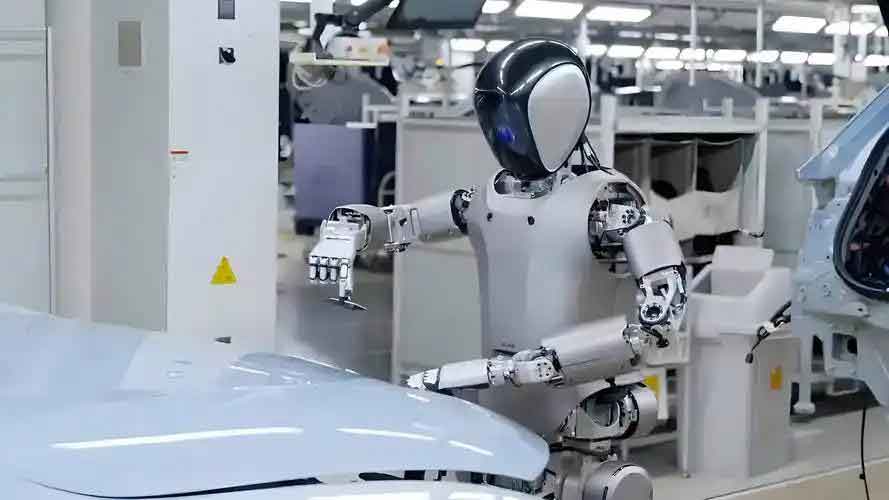
LIUZHOU, China, September 12, 2026 — UBTECH has begun production at its Liuzhou Industrial Humanoid Robot Super Smart Factory, a facility positioned as the world’s first intelligent manufacturing benchmark factory adapted to 10,000-unit-class capacity for industrial humanoid robots. The launch marks a significant step for the humanoid robot industry, moving from technology prototypes and small-batch production toward large-scale, standardized, and digital mass production.
The factory is located in Liuzhou, Guangxi, and is dedicated to the production of embodied intelligent industrial humanoid robots. Its core product lines include the Walker S series and the Cruzr series. According to the project design, the production takt time allows one industrial humanoid robot to roll off the line every 10 minutes, with an annual planned capacity of more than 10,000 humanoid robots.
The opening of the super smart factory represents more than a new production site. It is a practical demonstration of how the humanoid robot sector can combine advanced manufacturing, digital scheduling, and human-robot collaboration at scale. It also places Liuzhou at the center of a broader effort to build a more complete and resilient humanoid robot industrial ecosystem.
- A Humanoid Robot Factory Designed for Large-Scale Output
The Liuzhou Industrial Humanoid Robot Super Smart Factory covers an area of 14,000 square meters and has a building height of 13.8 meters. Its layout and production systems are designed around the requirements of industrial humanoid robot manufacturing, where precision, component coordination, and production rhythm are critical.
The factory’s planned annual capacity of more than 10,000 humanoid robots gives it a distinct position in the humanoid robot industry. Instead of focusing only on prototypes or limited pilot runs, the facility is structured to support continuous production of industrial humanoid robots at a scale that can serve real industrial scenarios.
The production of Walker S series and Cruzr series embodied intelligent industrial humanoid robots is central to the factory’s mission. These humanoid robots are intended for industrial environments and are designed to support intelligent manufacturing tasks. The factory therefore serves both as a producer of humanoid robots and as a proving ground for how humanoid robots can be integrated into production operations.
Key Metric Detail Facility UBTECH Liuzhou Industrial Humanoid Robot Super Smart Factory Location Liuzhou, Guangxi Production Start September 12, 2026 Positioning World’s first intelligent manufacturing benchmark factory adapted to 10,000-unit-class capacity for humanoid robots Floor Area 14,000 square meters Building Height 13.8 meters Main Products Walker S series and Cruzr series embodied intelligent industrial humanoid robots Production Takt One industrial humanoid robot every 10 minutes Annual Planned Capacity More than 10,000 humanoid robots Digital Manufacturing Foundation Developed with Siemens as a dedicated digital intelligent manufacturing base for humanoid robots Production Model Robots building robots and human-robot collaborative manufacturing The factory’s design reflects the reality that humanoid robot manufacturing is complex. A humanoid robot contains many components, requires frequent transfers across production stages, demands high assembly precision, and must accommodate rapid product iteration. These characteristics make traditional manufacturing approaches insufficient for large-scale humanoid robot output.
By combining industrial simulation system planning with a digital “smart brain” for full-domain scheduling, the Liuzhou factory seeks to address these challenges directly. The result is a humanoid robot production environment in which digital coordination supports physical assembly, and in which humanoid robots themselves become part of the manufacturing workforce.
- A Digital Backbone for Humanoid Robot Mass Production
UBTECH has partnered with Siemens to create a dedicated digital intelligent manufacturing foundation for humanoid robots. This foundation is tailored to the specific pain points of humanoid robot production, including the large number of parts, high transfer frequency, high assembly precision, and fast product iteration cycles.
These pain points are not minor technical details. They are central to whether the humanoid robot industry can move from limited production to reliable mass production. A humanoid robot must be assembled with consistency, tested with accuracy, and prepared for deployment in demanding industrial settings. Without a digital backbone, scaling such production can become expensive, slow, and difficult to standardize.
The digital manufacturing foundation developed with Siemens is intended to help the Liuzhou factory manage these complexities. Through full-domain digital system scheduling, the factory can coordinate production tasks, material flows, assembly processes, and humanoid robot deployment within the same intelligent manufacturing environment.
The project also demonstrates a deeper concept: using humanoid robots to build humanoid robots. UBTECH has integrated multiple self-developed embodied intelligent humanoid robots into production operations. These humanoid robots participate in production work and help create human-robot collaborative manufacturing scenarios.
This approach gives the factory a dual significance. It is a site for producing humanoid robots at scale, and it is also a site for testing and demonstrating how humanoid robots can work in industrial operations. The humanoid robot factory therefore becomes both a production asset and a live reference for future industrial humanoid robot deployment.
Humanoid Robot Production Pain Point Why It Matters Response at the Super Smart Factory Numerous components A humanoid robot requires coordinated assembly of many parts Dedicated digital manufacturing foundation and full-domain scheduling High transfer frequency Parts and subassemblies must move frequently across processes Industrial simulation system planning and digital “smart brain” coordination High assembly precision Humanoid robot performance depends on accurate assembly Digital intelligent manufacturing base designed for precision production Rapid product iteration Humanoid robot models and configurations evolve quickly Flexible digital scheduling and standardized manufacturing processes Integration of humanoid robots into work Humanoid robots must prove value in real production settings Self-developed embodied intelligent humanoid robots deployed in production operations The digital “smart brain” used by the factory is described as an all-domain scheduling system. Its role is to connect planning, simulation, production, and humanoid robot operations. This kind of coordination is essential for a humanoid robot factory because the production of a humanoid robot is not a single linear task. It involves multiple stages, many components, and strict quality requirements.
For the humanoid robot industry, this digital foundation can help establish repeatable processes. Repeatability is necessary for standardization, and standardization is necessary for large-scale adoption. The Liuzhou factory therefore contributes not only production capacity but also a model for how humanoid robot manufacturing can be organized.
- From First Unit to 1,000-Unit Mass Production to 10,000-Unit Capacity
In just over one year, UBTECH’s Liuzhou operation has moved from a first-unit breakthrough to 1,000-unit mass production and then to 10,000-unit capacity. This progression illustrates the speed at which the humanoid robot sector can advance when manufacturing capability, digital systems, and industrial collaboration are aligned.
The first-unit breakthrough represented the initial proof that humanoid robot production could be established in Liuzhou. The move to 1,000-unit mass production demonstrated that the process could be repeated beyond a single example. The new super smart factory now aims at a 10,000-unit capacity level, which represents a major step toward industrial-scale humanoid robot manufacturing.
This trajectory is significant for the humanoid robot industry because scale is one of the main barriers between laboratory innovation and widespread industrial use. A humanoid robot may be technically advanced, but its impact depends on whether it can be produced reliably, consistently, and in sufficient numbers. The Liuzhou factory is designed to address that requirement.
The factory’s annual planned capacity of more than 10,000 humanoid robots is intended to support the deployment of humanoid robots across more industrial scenarios. As production capacity increases, the humanoid robot ecosystem can expand from early adopters to broader industrial users.
The progress in Liuzhou also reflects a differentiated development path: research and development in Beijing, Shanghai, and Guangzhou; integration in Guangxi; and application in ASEAN. This approach connects advanced innovation centers with Guangxi’s integration capabilities and ASEAN’s application markets.
The humanoid robot factory is a concrete expression of that path. It brings together technology development, manufacturing integration, and regional application potential. It also strengthens Liuzhou’s position in the broader intelligent robot industry.
- Humanoid Robots Building Humanoid Robots
The phrase “robots building robots” captures the core manufacturing model of the Liuzhou super smart factory. UBTECH has integrated multiple self-developed embodied intelligent humanoid robots into production operations, creating human-robot collaborative manufacturing scenarios.
This model is important because it demonstrates that humanoid robots are not only products to be manufactured but also potential participants in manufacturing. In the Liuzhou factory, humanoid robots are deeply integrated into production work, helping to build the same class of intelligent machines that will eventually be deployed in industry.
The human-robot collaborative manufacturing environment is supported by the factory’s full-domain digital scheduling system. The system helps coordinate human workers, humanoid robots, and production equipment. This coordination is essential for maintaining production rhythm and quality in a complex humanoid robot manufacturing process.
The factory therefore serves as a practical example of new quality productive forces in intelligent manufacturing. It combines advanced robotics, digital planning, and industrial integration. It also shows how humanoid robot technology can be applied to the production of humanoid robots themselves.
For the humanoid robot industry, this is a notable milestone. It suggests that humanoid robots can be both the output and the operational tool of advanced factories. The Liuzhou factory is positioned to become a reference point for this dual role.
- A New Benchmark for Liuzhou’s Intelligent Manufacturing Strategy
The launch of the super smart factory is expected to help Liuzhou transform from a traditional industrial city into a new industrialization demonstration zone. It supports the city’s goal of building itself into a strong smart manufacturing city and injects new momentum into that effort.
Liuzhou has a strong industrial base, and the humanoid robot super smart factory connects that base with the emerging humanoid robot industry. By using UBTECH’s technology, brand, and ecosystem advantages, the project aims to promote the deployment of full-stack humanoid robot technology in more Liuzhou industrial scenarios.
This deployment can take place across multiple industrial settings. Humanoid robots may be used in manufacturing, assembly, inspection, logistics, and other tasks that require embodied intelligence. As the humanoid robot factory increases production, it can support broader experimentation and application within Liuzhou’s industrial ecosystem.
The project is also expected to attract upstream and downstream supporting enterprises. These enterprises can contribute components, subsystems, software, services, and integration capabilities. Together, they can help build a more complete and resilient humanoid robot supply chain.
The goal is to create an intelligent robot industry highland that is based in Guangxi, serves the whole country, and radiates toward ASEAN. The humanoid robot super smart factory is a central part of that vision.
- Liuzhou, Guangxi, and the ASEAN Application Path
The development path described as research and development in Beijing, Shanghai, and Guangzhou; integration in Guangxi; and application in ASEAN gives the Liuzhou humanoid robot project a regional and international dimension. It connects China’s advanced innovation resources with Guangxi’s role as an integration base and ASEAN’s growing application market.
For the humanoid robot industry, this path can help bridge innovation and deployment. Research and development centers can focus on core technologies, while Guangxi can support integration, testing, and manufacturing. ASEAN markets can then provide application scenarios for humanoid robots in industry, services, and other sectors.
The Liuzhou super smart factory fits this structure because it combines manufacturing scale with digital integration. It can produce industrial humanoid robots and support their deployment in real scenarios. It can also serve as a showcase for how humanoid robot technology can be integrated into regional industrial systems.
UBTECH’s collaboration with Liuzhou is described as a two-way engagement between advanced humanoid robot technology and Liuzhou’s manufacturing strengths. The factory is a visible result of that engagement and a new benchmark for the city’s artificial intelligence terminal and robot industry.
As the humanoid robot industry continues to evolve, regional ecosystems will become increasingly important. Liuzhou’s combination of manufacturing experience, digital infrastructure, and regional access may help it play a distinctive role in the humanoid robot supply chain.
- Why Humanoid Robot Mass Production Matters
The shift from small-batch humanoid robot production to large-scale, standardized, and digital mass production is a defining trend in the humanoid robot sector. The Liuzhou factory is designed to support that shift through its capacity, production design, and digital manufacturing systems.
Mass production matters because it can improve consistency. A humanoid robot that is produced through a standardized process is more likely to meet performance and reliability expectations. Consistency is especially important for industrial humanoid robots, which must operate in demanding environments and support repeatable tasks.
Mass production also matters because it can support ecosystem growth. When humanoid robots are produced at scale, suppliers can invest in dedicated components and subsystems. Software developers can build for a larger installed base. System integrators can develop repeatable deployment models. The entire humanoid robot value chain can mature.
The Liuzhou factory’s annual planned capacity of more than 10,000 humanoid robots is therefore not only a production number. It is a signal that the humanoid robot industry is preparing for broader industrial adoption. It also provides a foundation for standardization and digitalization across the humanoid robot manufacturing process.
At the same time, the factory demonstrates that humanoid robot manufacturing itself can be intelligent. By using industrial simulation, digital scheduling, and human-robot collaboration, the facility aims to make the production of humanoid robots more efficient, precise, and adaptable.
- Digital Planning and Full-Domain Scheduling
The super smart factory relies on an industrial simulation system for intelligent planning. This system helps design and optimize production flows before and during operations. It supports the arrangement of equipment, materials, human workers, and humanoid robots within the factory.
A digital “smart brain” provides full-domain scheduling. This scheduling role is critical because humanoid robot production involves many interdependent steps. Components must arrive at the right time, subassemblies must move efficiently, and assembly tasks must meet precision requirements. The digital brain helps coordinate these activities across the factory.
Full-domain scheduling also supports the integration of humanoid robots into production. When humanoid robots work alongside human workers and traditional equipment, their tasks must be synchronized with the overall production plan. The digital system helps make this synchronization possible.
This digital manufacturing model is a key part of the factory’s identity as a super smart factory. It is not simply a collection of machines. It is a connected production environment in which data, planning, and execution are linked.
For the humanoid robot industry, this model offers a path toward greater scalability. As humanoid robot designs evolve and production volumes increase, digital systems can help manage complexity and maintain quality.
- Human-Robot Collaboration in Industrial Production
The Liuzhou factory constructs human-robot collaborative manufacturing scenarios by deeply integrating multiple self-developed embodied intelligent humanoid robots into production operations. This is a practical example of how humanoid robots can work in industrial settings.
Human-robot collaboration can take different forms. Humanoid robots may perform repetitive tasks, assist with material handling, support assembly, or work in coordination with human workers. The exact tasks depend on the production process and the capabilities of the humanoid robots deployed.
The significance of this collaboration is that it tests humanoid robots in a real production environment. A factory is a demanding place, with time constraints, quality requirements, and safety considerations. When humanoid robots operate in such an environment, they generate experience that can inform future humanoid robot development.
The factory therefore contributes to a feedback loop. Humanoid robots are produced, deployed in production, and improved through operational experience. This loop can accelerate the maturity of industrial humanoid robots.
It also reinforces the factory’s role as a benchmark. Other manufacturers can observe how humanoid robots are integrated into production and how human-robot collaboration is organized. This can encourage broader adoption of humanoid robots in industry.
- Building a Complete and Resilient Humanoid Robot Supply Chain
The super smart factory is expected to drive the clustering of upstream and downstream supporting enterprises. These enterprises can provide key components, sensors, actuators, software, control systems, and integration services for humanoid robots.
A complete humanoid robot supply chain is important because humanoid robots depend on a wide range of technologies. No single company can easily develop and manufacture every component at the highest level. Collaboration across suppliers and technology providers is essential.
A resilient humanoid robot supply chain is also important for risk management. By building capabilities across multiple layers, the industry can better respond to changes in demand, technology, and global markets. The Liuzhou factory can serve as an anchor for such a supply chain.
The goal is to create an intelligent robot industry highland that is based in Guangxi, serves the entire country, and radiates toward ASEAN. This vision connects local manufacturing, national markets, and regional applications.
The humanoid robot factory is a central asset in this vision. It provides production capacity, digital manufacturing expertise, and a platform for humanoid robot deployment. It also signals that Liuzhou is serious about becoming a major player in the intelligent robot industry.
- Implications for Liuzhou’s Industrial Transformation
Liuzhou has historically been known as a traditional industrial city. The humanoid robot super smart factory supports its transition toward a new industrialization demonstration zone and a strong smart manufacturing city.
This transition is not only about replacing old industries with new ones. It is about integrating advanced technology into existing industrial strengths. Humanoid robots can support this integration by bringing embodied intelligence into manufacturing, logistics, and other operations.
The factory also helps attract talent, technology, and investment related to the humanoid robot industry. As more humanoid robot enterprises and supporting companies gather in Liuzhou, the local ecosystem can become more diverse and capable.
The project demonstrates that Liuzhou can host advanced manufacturing at the frontier of the humanoid robot sector. It can produce industrial humanoid robots at scale and deploy them in real production scenarios. This combination can strengthen the city’s reputation as an emerging hub for intelligent manufacturing.
For the humanoid robot industry, Liuzhou offers a model of how a traditional industrial base can become part of a new technology supply chain. This model may be relevant to other regions seeking to participate in the humanoid robot economy.
- A Benchmark for Standardized and Digital Humanoid Robot Production
The Liuzhou factory is described as a benchmark for humanoid robot intelligent manufacturing. Its importance lies in its combination of scale, standardization, and digitalization. These three elements are closely connected in the humanoid robot industry.
Scale provides the volume needed to serve industrial demand. Standardization provides the consistency needed for reliability and interoperability. Digitalization provides the coordination needed to manage complexity and support continuous improvement.
Together, these elements can help the humanoid robot industry move beyond one-off deployments. They can support repeatable production, repeatable integration, and repeatable service models. This is essential for humanoid robots to become a practical industrial technology.
The factory’s production design, with one industrial humanoid robot every 10 minutes and an annual planned capacity of more than 10,000 humanoid robots, illustrates the scale ambition. Its digital manufacturing foundation, developed with Siemens, illustrates the standardization and digitalization ambition.
The result is a humanoid robot factory that is intended to be both productive and instructive. It produces humanoid robots and also demonstrates how humanoid robot production can be organized in the digital age.
- Global and Regional Significance of the Liuzhou Humanoid Robot Factory
The Liuzhou Industrial Humanoid Robot Super Smart Factory is positioned as the world’s first intelligent manufacturing benchmark factory adapted to 10,000-unit-class capacity for humanoid robots. This positioning gives it global significance within the humanoid robot sector.
It shows that the humanoid robot industry is beginning to address manufacturing scale. For years, many humanoid robot developments focused on prototypes and demonstrations. The Liuzhou factory represents a shift toward production systems that can support larger volumes and broader deployment.
Regionally, the factory strengthens Guangxi’s role as an integration base. It connects research and development resources from Beijing, Shanghai, and Guangzhou with manufacturing and integration capabilities in Guangxi and application opportunities in ASEAN.
The humanoid robot factory can also serve as a platform for international cooperation. ASEAN markets may offer diverse industrial and service scenarios for humanoid robots. Guangxi’s location and integration capacity can support access to those markets.
By linking production, digital manufacturing, and regional application, the Liuzhou project helps build a more complete humanoid robot ecosystem. It supports the vision of an intelligent robot industry highland that serves China and radiates toward ASEAN.
- Looking Ahead: Humanoid Robot Capacity, Collaboration, and Ecosystem Growth
The launch of the super smart factory is a milestone, but it also marks the beginning of a new phase. The next phase will involve ramping up production, deepening human-robot collaboration, and expanding the use of humanoid robots in industrial scenarios.
As the factory produces more humanoid robots, it can support more deployments. Those deployments can generate operational data and experience, which can feed back into product development and manufacturing improvement. This cycle can help the humanoid robot industry mature.
The collaboration between UBTECH and Siemens provides a digital manufacturing foundation that can evolve with the humanoid robot product line. As humanoid robot designs change and production requirements grow, the digital backbone can be updated to support new needs.
The ecosystem around the factory can also grow. Upstream suppliers can invest in humanoid robot components. Downstream integrators can develop humanoid robot applications. Service providers can support maintenance, training, and deployment. Educational institutions can develop humanoid robot talent.
All of these elements can contribute to a more resilient and complete humanoid robot supply chain. The Liuzhou factory can act as an anchor for this development, bringing together production, technology, and application.
- Conclusion: A New Stage for the Humanoid Robot Industry
The UBTECH Liuzhou Industrial Humanoid Robot Super Smart Factory has begun production as a facility adapted to 10,000-unit-class capacity for industrial humanoid robots. It covers 14,000 square meters, stands 13.8 meters high, and is designed to produce Walker S series and Cruzr series embodied intelligent industrial humanoid robots.
With a production takt of one industrial humanoid robot every 10 minutes and an annual planned capacity of more than 10,000 humanoid robots, the factory represents a major step toward large-scale humanoid robot manufacturing. It also demonstrates a digital manufacturing model built with Siemens and designed to address the complexity of humanoid robot production.
The factory’s use of industrial simulation, digital “smart brain” scheduling, and human-robot collaboration shows how humanoid robots can be both produced and deployed in advanced manufacturing. It supports the concept of robots building robots and reinforces the humanoid robot industry’s move toward standardized, digital mass production.
For Liuzhou and Guangxi, the project supports industrial transformation and regional development. It aligns with the path of research and development in Beijing, Shanghai, and Guangzhou; integration in Guangxi; and application in ASEAN. It also aims to attract upstream and downstream enterprises and build a more complete humanoid robot supply chain.
The humanoid robot factory is therefore more than a production facility. It is a platform for innovation, collaboration, and ecosystem growth. It positions Liuzhou as a contributor to the humanoid robot industry and supports the vision of an intelligent robot industry highland based in Guangxi, serving the entire country, and radiating toward ASEAN.