
In my extensive experience with maintaining and repairing high-precision printing machinery, I have frequently encountered a unique and fascinating component central to achieving precise motion control: the strain wave gear, also commonly known as the harmonic drive. This encounter was not merely theoretical; it stemmed from a practical need to resolve a critical machine failure. The equipment, a sophisticated gravure press, exhibited unstable rear web tension, a fault that directly impacted print quality. After systematic troubleshooting, the root cause was traced back to the failure of a strain wave gear unit within the tension control system. Upon disassembly, I discovered a fractured flexspline. Replacing this component restored stability, but the incident ignited a deep, personal curiosity about the principles governing this remarkable device. This article is a synthesis of my subsequent exploration into the structure, operating principles, and distinctive characteristics of strain wave gear systems, augmented by technical analysis.
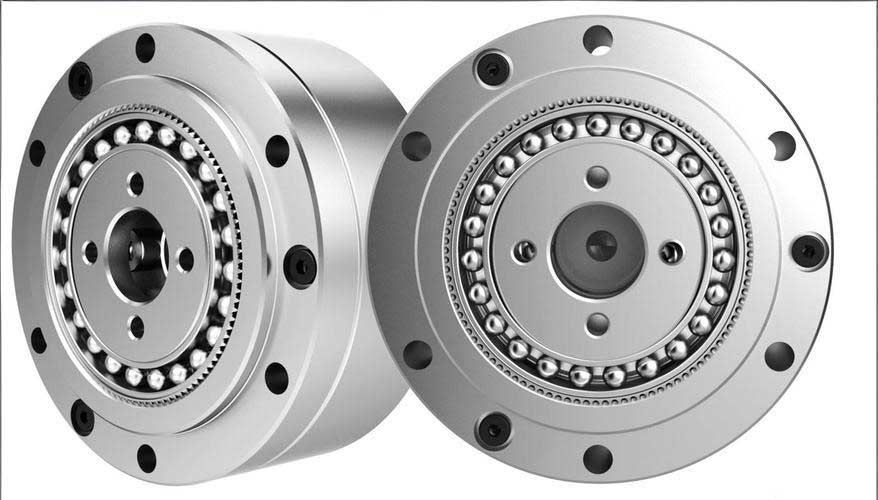
The fundamental architecture of a strain wave gear is elegantly simple, typically comprising three primary components working in concert. This configuration is what allows the strain wave gear to achieve its exceptional performance metrics.
| Component | Primary Function | Key Characteristics |
|---|---|---|
| Circular Spline (CS) | Static or slow-rotating rigid gear element. | A rigid ring with internal teeth. It is often the fixed element in the assembly. |
| Flexspline (FS) | Output element that undergoes controlled elastic deformation. | A thin-walled, flexible cup or ring with external teeth. Its tooth count is slightly less than that of the Circular Spline. |
| Wave Generator (WG) | Input element that induces the wave-like deformation. | An elliptical bearing or cam assembly inserted into the Flexspline, forcing it into an elliptical shape. |
The kinematic principle of the strain wave gear is where its genius lies. It does not rely on rigid-body kinematics alone but ingeniously utilizes controlled elastic deflection of the Flexspline to create motion. When the Wave Generator rotates, it propagates a rotating elliptical deflection wave through the Flexspline. At the major axis of this ellipse, the Flexspline’s teeth fully engage with the teeth of the Circular Spline. At the minor axis, the teeth are completely disengaged. In the quadrants between these axes, the teeth are in a state of partial engagement—either meshing in or meshing out.
This creates a phenomenon known as “differential tooth motion” or “conjugate motion.” If the Circular Spline is held stationary, each complete revolution of the Wave Generator causes the Flexspline to rotate slightly in the opposite direction. The magnitude of this rotation is determined by the tooth difference between the two splines. For a common two-wave generator (creating two major axis engagement zones 180° apart), one revolution of the Wave Generator results in the Flexspline rotating backward by a number of teeth equal to the difference in tooth count. This relationship yields a very high reduction ratio in a compact space.
| Motion Phase | Description |
|---|---|
| Meshing In | Teeth transition from disengaged to fully engaged as they approach the Wave Generator’s major axis. |
| Full Engagement | Maximum tooth contact occurs at the major axis lobes. |
| Meshing Out | Teeth transition from fully engaged to disengaged as they move away from the major axis. |
| Disengagement | Teeth are completely separated at the minor axis. |
Mathematical Foundation of Strain Wave Gearing
The operation of a strain wave gear can be described with precise mathematical models. The fundamental reduction ratio, \( i \), when the Circular Spline is fixed, the Wave Generator is the input, and the Flexspline is the output, is given by:
$$ i = -\frac{N_f}{N_f – N_c} $$
where:
\( N_f \) = Number of teeth on the Flexspline,
\( N_c \) = Number of teeth on the Circular Spline,
and \( N_f – N_c \) is typically 2 for a standard two-wave configuration (often denoted as \( \Delta Z \)).
The negative sign indicates the reversal of rotation direction between the Wave Generator input and the Flexspline output. For example, if \( N_f = 200 \) and \( N_c = 202 \), then:
$$ i = -\frac{200}{200 – 202} = -\frac{200}{-2} = 100 $$
This results in a reduction ratio of 100:1, with the output rotating opposite to the input. The kinematic relationship between the angular velocities of the three components can be expressed generally for a planetary configuration:
$$ \frac{\omega_c – \omega_{wg}}{ \omega_f – \omega_{wg} } = \frac{N_f}{N_c} $$
where \( \omega_c \), \( \omega_f \), and \( \omega_{wg} \) are the angular velocities of the Circular Spline, Flexspline, and Wave Generator, respectively. By setting one velocity to zero (fixing that component), the standard operating modes are derived.
The deformation of the Flexspline is not a perfect ellipse but can be modeled as a wave following a harmonic function. The radial displacement, \( w(\theta, t) \), of the Flexspline’s neutral line can be approximated as:
$$ w(\theta, t) = w_0 \cos[n(\theta – \omega_{wg} t)] $$
where \( w_0 \) is the amplitude of deformation (determined by the Wave Generator), \( n \) is the wave number (e.g., 2 for a two-wave generator), \( \theta \) is the angular coordinate, and \( t \) is time.
The stress within the Flexspline is critical for life calculation. The primary stress components are bending stress due to deflection and membrane stress. The maximum bending stress, \( \sigma_b \), is a key design parameter:
$$ \sigma_b \approx \frac{E \cdot h \cdot w_0}{R^2} $$
where \( E \) is the Young’s modulus of the Flexspline material, \( h \) is its wall thickness, and \( R \) is its nominal radius. The total stress state drives the fatigue life prediction of the strain wave gear component.
Core Advantages and Technical Characteristics
The unique operating principle of the strain wave gear confers a set of unparalleled advantages in motion control applications, which I have observed directly in their ability to restore precision to our machinery.
| Characteristic | Description | Beneficial Implication |
|---|---|---|
| High Reduction Ratio in Single Stage | Ratios from 30:1 to over 320:1 are achievable in a compact package. | Eliminates need for multi-stage conventional gearboxes, saving space and weight. |
| Zero Backlash & High Torsional Stiffness | Simultaneous tooth engagement across a wide arc (often 20-30% of teeth) pre-loads the gear mesh. | Essential for precision positioning, repeatability, and dynamic response. No lost motion on start-up or reversal. |
| High Positional Accuracy & Repeatability | Error averaging effect due to many teeth sharing the load. | Improves absolute accuracy and allows for very fine resolution in positioning systems. |
| Coaxial Input/Output Shafts | All three components share a common central axis. | Simplifies mechanical design and integration into compact assemblies like robotic joints. |
| High Torque-to-Weight/Volume Ratio | Load is distributed over a large number of teeth in contact. | Provides exceptional power density, crucial for aerospace and mobile robotics. |
The high positional accuracy stems from the kinematic averaging principle. If an individual tooth on the Flexspline has a profile error \( \epsilon_i \), the effective error transmitted to the output is dramatically reduced because many teeth (\( m \)) are engaged simultaneously. The effective positional error \( \epsilon_{eff} \) can be approximated by the average of the individual engaged tooth errors:
$$ \epsilon_{eff} \approx \frac{1}{m} \sum_{i=1}^{m} \epsilon_i $$
This averaging is a fundamental reason why a strain wave gear can achieve arc-minute or even arc-second level accuracy despite manufacturing tolerances on individual teeth.
Design Considerations and Material Science
The reliable operation of a strain wave gear is a testament to careful design and material selection. The Flexspline is the heart of the system and its most critically stressed component. It must possess a rare combination of properties: high fatigue strength, high yield strength, and sufficient toughness to endure millions of stress cycles without failure.
Common materials for the Flexspline include:
- Maraging Steel: Excellent high-strength and high-toughness properties, often used in demanding aerospace applications.
- Alloy Steels (e.g., AISI 4340, 300M): Heat treatable to high strength levels, offering a good balance of performance and cost.
- Precipitation-Hardening Stainless Steels (e.g., 17-4 PH): Used where corrosion resistance is required alongside good mechanical properties.
The life prediction for a strain wave gear, particularly the Flexspline, is based on high-cycle fatigue analysis using modified Goodman or S-N (stress-number of cycles) diagrams. The alternating stress \( \sigma_a \) is derived from the bending stress equation, while the mean stress \( \sigma_m \) is often non-zero due to preload from the Wave Generator. The safety factor is evaluated against the material’s endurance limit.
Lubrication is another critical design aspect. The strain wave gear requires a lubricant that can withstand high contact pressures in the elliptical engagement zones while also being compatible with the materials (including polymer seals on the Wave Generator bearing). Specialized greases with solid lubricants like molybdenum disulfide are commonly specified.
Application Spectrum and Configuration Variants
The application of strain wave gear technology extends far beyond the printing presses where I first encountered it. Its unique advantages make it the reducer of choice in fields where precision, compactness, and reliability are paramount.
- Robotics: Ubiquitous in robot joint actuators for industrial, collaborative, and humanoid robots due to compact size, zero backlash, and high torque density.
- Aerospace & Defense: Used in satellite antenna pointing mechanisms, missile guidance systems, and aircraft actuator controls for their reliability in extreme environments and high power density.
- Precision Machine Tools: Employed in rotary tables, indexers, and CNC axis drives where high accuracy and stiffness are required.
- Medical and Semiconductor Equipment: Critical in wafer handling robots, diagnostic instrument stages, and surgical robot arms where smooth, precise, and clean motion is essential.
The basic strain wave gear can be configured in several ways by designating different components as the fixed, input, and output elements. This provides flexibility in meeting specific application needs.
| Configuration | Fixed Element | Input Element | Output Element | Typical Use Case |
|---|---|---|---|---|
| Standard Reduction | Circular Spline | Wave Generator | Flexspline | Most common; provides high reduction, coaxial shafts. |
| Speed Increase | Flexspline | Wave Generator | Circular Spline | Less common; provides speed increase rather than reduction. |
| Differential (Compound) | None (All three rotate) | Two elements | Third element | Used for precise motion summing or splitting, e.g., in rotary vector drives. |
Furthermore, strain wave gears can be connected in tandem to create multi-stage reducers, achieving ultra-high reduction ratios (e.g., \( 10^6 \) or more) for specialized applications like telescope drives.
Efficiency, Thermal Management, and Failure Modes
While exceptionally capable, the strain wave gear is not a perfectly efficient device. Its efficiency \( \eta \) is influenced by several factors and typically ranges from 70% to 90% for a single stage under optimal load. The primary losses include:
- Hysteresis Losses: Energy lost due to the cyclic elastic deformation of the Flexspline, proportional to the area of the stress-strain hysteresis loop of the material.
- Sliding Friction Losses: From the tooth meshing action, which involves a combination of rolling and sliding contact.
- Wave Generator Bearing Losses: The elliptical bearing within the Wave Generator experiences high loads and contributes significantly to torque loss, especially at high speed.
- Churning Losses: From the lubricant being agitated within the gear housing.
An approximate model for no-load (spin) torque loss \( T_{loss} \) often shows a linear relationship with input speed \( \omega_{in} \):
$$ T_{loss} \approx C \cdot \omega_{in} $$
where \( C \) is a damping coefficient dependent on lubrication and bearing design. The efficiency under load can be modeled as:
$$ \eta \approx \frac{T_{out} / i}{T_{in}} $$
where \( T_{out} \) is output torque, \( T_{in} \) is input torque, and \( i \) is the reduction ratio.
These losses generate heat, making thermal management vital. In high-duty-cycle or high-torque applications, the housing of a strain wave gear reducer often acts as a heat sink. Forced air cooling or even liquid cooling jackets may be integrated for extreme performance demands.
Understanding failure modes is crucial for predictive maintenance. From my experience and industry data, common failure modes include:
- Flexspline Fatigue Fracture: The primary failure mode, initiating at stress concentrators (e.g., tooth root fillet, cup diaphragm junction) after exceeding the material’s fatigue life.
- Wave Generator Bearing Failure: Due to high cyclic loads, leading to brinelling, spalling, or seizure.
- Tooth Wear or Pitting: Surface fatigue due to high contact stresses, often accelerated by lubricant degradation or contamination.
- Loss of Preload/Increased Backlash: Wear in the Wave Generator bearing or tooth surfaces can reduce the preload, leading to a gradual increase in positional error.
In conclusion, the strain wave gear represents a pinnacle of elegant engineering, transforming the simple concept of elastic deformation into a robust, high-performance power transmission solution. Its principles of operation, grounded in wave mechanics and differential kinematics, enable a suite of characteristics—zero backlash, high reduction, compactness, and exceptional accuracy—that are difficult or impossible to achieve with conventional gearing. From resolving a tension fault on a printing press to enabling the precise movements of a Mars rover, the applications of strain wave gear technology are a testament to its versatility and reliability. My journey from troubleshooting a broken component to understanding the profound mathematics and mechanics behind it has only deepened my appreciation for this ingenious device. The ongoing development of new materials, advanced coatings, and integrated mechatronic designs promises to further expand the capabilities and applications of the strain wave gear in the future of precision engineering.