
My journey into the intricate world of high-precision gearboxes began with a fundamental question: what truly defines the operational essence of the rotary vector reducer? Widely recognized for its compactness, high stiffness, and exceptional positional accuracy, the rotary vector reducer has become the cornerstone of modern robotic joints. However, its underlying kinematic and dynamic principles, particularly its classification as a planetary closed differential system, often remain obscured by its complex structure. In this analysis, I will systematically dissect the rotary vector reducer, moving from basic planetary concepts to its unique architecture, and ultimately reveal its power flow characteristics through rigorous equivalent modeling.
The distinction between a simple planetary differential and a planetary closed differential is paramount. Let me first clarify this. A standard planetary differential mechanism possesses two or more degrees of freedom. It functions to split a single input motion into two outputs (or combine two inputs into one), where the output speeds depend on external load conditions. Common examples include the automotive differential and basic NGW-type planetary gear sets. Their operation is inherently unconstrained, allowing for speed differentiation.
In stark contrast, a planetary closed differential mechanism has only one degree of freedom. Here, the power and motion are forcibly split along distinct paths within a single, kinematically constrained system, only to be recombined later at the output. This enforced split and subsequent synthesis is the “closed” aspect, leading to a determinate motion relationship and fixed speed ratio. Mechanisms like certain wind turbine gearboxes exhibit this trait.
To solidify this understanding, I have compiled the mobility analysis of these systems. The number of degrees of freedom (F) is calculated using the Gruebler’s equation for planar mechanisms: $$F = 3n – 2P_L – P_H$$, where \(n\) is the number of moving links, \(P_L\) the number of lower pairs (revolute/sliding joints), and \(P_H\) the number of higher pairs (gear meshes).
| Mechanism Type | Moving Links (n) | Lower Pairs (PL) | Higher Pairs (PH) | Degrees of Freedom (F) |
|---|---|---|---|---|
| Automotive Differential | 5 | 5 | 3 | 2 |
| NGW Planetary Gear Set | 4 | 4 | 2 | 2 |
| Planetary Closed Differential (e.g., Wind Turbine Gearbox) | Varies (e.g., 8) | Varies (e.g., 8) | Varies (e.g., 7) | 1 |
| Rotary Vector Reducer | 4 | 4 | 3 | 1 |
This table conclusively shows that while classic differentials have F=2, the rotary vector reducer, with F=1, belongs firmly to the category of planetary closed differential mechanisms. This single degree of freedom is the first clue to its unique behavior.
To understand the modern rotary vector reducer, one must trace its lineage back to the single-tooth-difference cycloid drive. This simpler reducer consists of an eccentric input crank, a cycloidal disk (planetary gear) with \(z_3\) lobes, and a stationary ring of pins (internal gear) with \(z_4\) pins, where \(z_4 – z_3 = 1\). One revolution of the crank causes the cycloid disk to rotate backward by one lobe relative to the crank. The output is taken from a carrier connected to the cycloid disk via pins or rollers.
The evolutionary step to the rotary vector reducer is ingenious. The single eccentric crank is replaced by two or three cranks (planetary camshafts), phase-shifted for balance. These cranks are no longer directly driven. Instead, they are themselves driven as planetary gears by a central sun gear. This creates a two-stage system: a first-stage parallel/planetary gear train and a second-stage cycloidal drive, now with a “planetized” input crank.
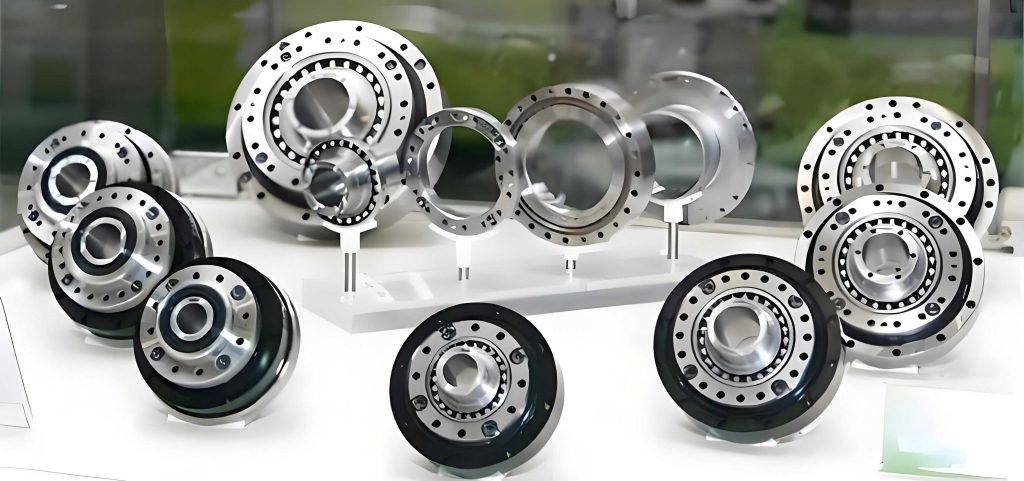
The key to analyzing this composite system lies in a powerful concept: equivalence. I propose treating the crank of the single-tooth-difference cycloid stage as a sun gear with a tooth count of \(z_5 = -1\). This conceptual leap allows us to apply standard planetary gear train equations. In an NGW train with fixed ring gear, input sun, and output carrier, the ratio is: $$i = \frac{z_{\text{sun}} + z_{\text{ring}}}{z_{\text{sun}}}$$. Applying this to the cycloid stage, with \(z_5 = -1\) and \(z_4\) as the ring (pin) count, we get the cycloid stage ratio from crank to carrier:
$$i_{\text{cycloid}} = \frac{z_5 + z_4}{z_5} = \frac{-1 + z_4}{-1} = -(z_4 – 1) = -z_3$$
This correctly indicates a large, negative reduction ratio (speed reversal).
Now, let’s construct the full kinematic model of the rotary vector reducer. Label the sun gear as gear 1 (\(z_1\)), the planet/ crank gear as gear 2 (\(z_2\)), the cycloid disk as gear 3 (\(z_3\)), and the pin ring as gear 4 (\(z_4\)). The carrier (output) is H. Gear 4 is fixed (\(n_4=0\)). Applying the relative motion formula for the first stage (sun 1, planet 2, carrier H) and the second stage (crank/sun \(5 \equiv 2\), cycloid 3, carrier H, ring 4), and carefully relating the motions, we derive the overall transmission ratio:
$$
\frac{n_1 – n_H}{0 – n_H} = \left( -\frac{z_2}{z_1} \right) \times \left( -\frac{z_3}{z_5} \right) \times \frac{z_4}{z_3}
$$
Since \(z_5 = -1\), this simplifies to the fundamental ratio formula for the rotary vector reducer:
$$
i_{\text{RV}} = \frac{n_1}{n_H} = \frac{z_2}{z_1} \times z_4 + 1
$$
This elegant formula, $$i_{\text{RV}} = \frac{z_2}{z_1} \times z_4 + 1$$, confirms that the ratio is determined by the first-stage gear ratio and the number of pins in the cycloid ring, offering a wide range of high reduction ratios.
The true nature of the rotary vector reducer as a planetary closed differential is revealed not just in kinematics, but in its power flow. The input power from the sun gear (1) is split at the planet gear (2). One path, the “direct” path, transmits torque directly through the crank arm to the output carrier (H). The other path, the “cycloidal” path, transmits torque through the gear mesh from planet (2) to the cycloid disk (3), which then drives the carrier (H) through its own action against the fixed pins (4). These two power streams must recombine at the single output carrier, satisfying the compatibility conditions of a one-degree-of-freedom system.
We can quantify this split using the principle of superposition from equivalent机构 modeling. The total reduction ratio \(i_{\text{RV}}\) can be expressed as the sum of the transmission ratios of two imaginary, independent power paths from input to output. Based on the derived kinematics:
1. Direct Path Ratio (\(i_1\)): This path considers the motion from sun (1) to carrier (H) if the cycloid disk were locked to the carrier. It’s simply the ratio of the first-stage planetary with carrier output: $$i_1 = \frac{z_2}{z_1} + 1$$.
2. Cycloidal Path Ratio (\(i_2\)): This path considers the motion through the planet gear (2) treated as a fixed-axis gear driving the cycloid stage. This is the product of the first-stage parallel gear ratio and the cycloid stage ratio: $$i_2 = \left( \frac{z_2}{z_1} \right) \times z_3$$.
According to the established theory for planetary closed differentials, the total ratio is the sum of these path ratios, and the proportion of total power flowing through each path is equal to that path’s ratio divided by the total ratio. Therefore:
$$
i_{\text{RV}} = i_1 + i_2 = \left( \frac{z_2}{z_1} + 1 \right) + \left( \frac{z_2}{z_1} \times z_3 \right) = \frac{z_2}{z_1} \times (z_3 + 1) + 1 = \frac{z_2}{z_1} \times z_4 + 1
$$
The power distribution fractions \(Q_1\) (direct path) and \(Q_2\) (cycloidal path) are:
$$
Q_1 = \frac{P_1}{P} = \frac{i_1}{i_{\text{RV}}} = \frac{\frac{z_2}{z_1} + 1}{\frac{z_2}{z_1} \times z_4 + 1}
$$
$$
Q_2 = \frac{P_2}{P} = \frac{i_2}{i_{\text{RV}}} = \frac{\frac{z_2}{z_1} \times z_3}{\frac{z_2}{z_1} \times z_4 + 1}
$$
And naturally, \(Q_1 + Q_2 = 1\).
Let’s validate this with a force-based analysis, which I find offers profound insight. Consider the forces on a planet gear. The input sun gear exerts a tangential force \(F_t\) on the planet gear. This force creates two reaction effects on the carrier (H):
1. A direct force \(F_t\) acting at the planet’s center (the crank bearing), producing a torque about the central axis.
2. A reaction torque on the planet gear itself, which must be balanced by the cycloid disk’s interaction with the pins. This generates an additional force on the carrier through the cycloid disk’s center.
The torque on the carrier from the direct force is \(T_1 = F_t \times (r_1 + r_2)\), where \(r_1\) and \(r_2\) are the pitch radii of the sun and planet. The power via this path is \(P_1 = T_1 \times \omega_H = F_t (r_1 + r_2) \omega_H\). The total input power is \(P = F_t \times r_1 \times \omega_1\). Knowing \(\omega_H = \omega_1 / i_{\text{RV}}\), the power fraction becomes:
$$
\frac{P_1}{P} = \frac{F_t (r_1 + r_2) (\omega_1 / i_{\text{RV}})}{F_t r_1 \omega_1} = \frac{r_1 + r_2}{r_1} \times \frac{1}{i_{\text{RV}}}
$$
Since the gear ratio \(z_2/z_1 = r_2/r_1\), this simplifies to:
$$
\frac{P_1}{P} = \frac{1 + \frac{z_2}{z_1}}{i_{\text{RV}}} = \frac{\frac{z_2}{z_1} + 1}{\frac{z_2}{z_1} \times z_4 + 1}
$$
This result matches exactly the power fraction \(Q_1\) derived from the equivalent机构 method, providing solid confirmation of the model’s correctness.
The implications for the design of a rotary vector reducer are significant. The power is not transmitted solely through the cycloid disk; a substantial portion flows directly from the cranks to the output. This analysis shatters the common oversimplification. We can now calculate precise power shares for any design configuration.
| Design Parameter Example | z1 | z2 | z4 (Pins) | Total Ratio (iRV) | Direct Path Power % (Q1) | Cycloid Path Power % (Q2) |
|---|---|---|---|---|---|---|
| High-Ratio Design | 20 | 80 | 40 | $$ \frac{80}{20} \times 40 + 1 = 161 $$ | $$ \frac{80/20 + 1}{161} \approx 3.1\% $$ | $$ \frac{(80/20) \times 39}{161} \approx 96.9\% $$ |
| Moderate-Ratio Design | 30 | 60 | 40 | $$ \frac{60}{30} \times 40 + 1 = 81 $$ | $$ \frac{60/30 + 1}{81} \approx 3.7\% $$ | $$ \frac{(60/30) \times 39}{81} \approx 96.3\% $$ |
| Low-Ratio, High Direct Power | 15 | 30 | 40 | $$ \frac{30}{15} \times 40 + 1 = 81 $$ | $$ \frac{30/15 + 1}{81} \approx 3.7\% $$ | $$ \frac{(30/15) \times 39}{81} \approx 96.3\% $$ |
| Emphasized Direct Path | 20 | 40 | 20 | $$ \frac{40}{20} \times 20 + 1 = 41 $$ | $$ \frac{40/20 + 1}{41} \approx 7.3\% $$ | $$ \frac{(40/20) \times 19}{41} \approx 92.7\% $$ |
This table reveals a critical insight: in a standard high-ratio rotary vector reducer, the vast majority of the power (often >95%) flows through the cycloid disk path. The direct path, while essential for kinematic closure and load sharing among cranks, typically carries a small percentage. However, this fraction is not negligible and increases as the ratio \(z_2/z_1\) increases relative to \(z_4\). This has direct consequences for efficiency calculations, heat generation, and component stress analysis. The cycloid disk and pins bear the brunt of the transmitted torque, justifying the focus on their material strength and contact fatigue life. The bearings on the cranks, however, are critically loaded by the force \(F_t\) from the split power, a force magnitude that is determined by the sun-planet mesh and is largely independent of the power path percentage.
In conclusion, my analysis affirms that the rotary vector reducer is a quintessential planetary closed differential mechanism. Its single degree of freedom belies a complex internal power split. By adopting the concept of the crank as a negative-tooth sun gear (\(z_5 = -1\)), we can seamlessly integrate its unique cycloidal stage into classical gear train analysis. The equivalent机构 model, yielding the power distribution formulas $$Q_1 = \frac{\frac{z_2}{z_1} + 1}{\frac{z_2}{z_1} \times z_4 + 1}$$ and $$Q_2 = \frac{\frac{z_2}{z_1} \times z_3}{\frac{z_2}{z_1} \times z_4 + 1}$$, provides the key to understanding its dynamic behavior. This theoretical framework is indispensable for the forward design of a rotary vector reducer, guiding optimal gear ratio selection, accurate load distribution analysis, and ultimately, the development of robust, high-performance reducers capable of meeting the demanding requirements of advanced robotics and precision machinery.