
The evolution of future spacecraft is decisively oriented towards large-scale, lightweight, high-precision, and high-stability platforms. Ensuring the stringent surface accuracy requirements for such space structures necessitates the rapid suppression of vibrations. Large space membrane structures, characterized by pronounced nonlinearities and high susceptibility to environmental disturbances, present a significant challenge. In scenarios where conventional passive and active vibration suppression methods fall short of achieving the desired performance, an alternative approach involving the use of space multi-arm robots emerges as a promising solution. This article investigates a method for suppressing vibrations in large flexible membrane antennas through direct, controlled contact using the end effectors of space multi-arm robots.
We begin by establishing the dynamics of a space multi-arm robotic system. The formulation employs a unidirectional recursive assembly method, which is computationally efficient for systems with multiple serial chains (arms) connected to a common base. This method is well-suited for the on-orbit robotic systems considered here.
The kinematics of the system are defined first. For a robot arm with \( n \) joints, the position and orientation of the \( i \)-th link’s coordinate frame with respect to the base frame can be expressed recursively. Let \( ^{i-1}\mathbf{T}_i \) denote the homogeneous transformation matrix from frame \( i-1 \) to frame \( i \), which is a function of the joint variable \( q_i \). The transformation to the end effector frame (frame \( n \)) is:
$$
^{0}\mathbf{T}_{n} = ^{0}\mathbf{T}_{1}(q_1) \cdot ^{1}\mathbf{T}_{2}(q_2) \cdot … \cdot ^{n-1}\mathbf{T}_{n}(q_n)
$$
The velocity propagation is given by the recursive Newton-Euler algorithm. The angular and linear velocities of link \( i \) are:
$$
\begin{aligned}
\boldsymbol{\omega}_i &= \boldsymbol{\omega}_{i-1} + \mathbf{z}_{i-1} \dot{q}_i \\
\mathbf{v}_i &= \mathbf{v}_{i-1} + \boldsymbol{\omega}_{i-1} \times \mathbf{r}_{i-1,i} + \mathbf{z}_{i-1} \dot{q}_i d_i \quad (\text{for prismatic})
\end{aligned}
$$
where \( \mathbf{z}_{i-1} \) is the unit vector along the joint axis, \( \mathbf{r}_{i-1,i} \) is the position vector from the origin of frame \( i-1 \) to frame \( i \), and \( d_i \) is the translational joint variable. For revolute joints, the linear velocity term simplifies. The acceleration propagation follows similarly, incorporating centripetal and Coriolis terms.
The dynamics are derived using the Lagrangian formulation or the principle of virtual work, resulting in the canonical equation of motion for the multi-arm system:
$$
\mathbf{M}(\mathbf{q}) \ddot{\mathbf{q}} + \mathbf{C}(\mathbf{q}, \dot{\mathbf{q}}) \dot{\mathbf{q}} + \mathbf{g}(\mathbf{q}) = \boldsymbol{\tau} + \mathbf{J}^T \mathbf{F}_{ext}
$$
where \( \mathbf{q} \in \mathbb{R}^{m} \) is the vector of generalized coordinates (joint angles/positions for all arms), \( \mathbf{M} \) is the mass matrix, \( \mathbf{C} \) represents Coriolis and centrifugal forces, \( \mathbf{g} \) is the gravity vector (negligible in space but included for completeness), \( \boldsymbol{\tau} \) is the vector of joint actuation torques/forces, \( \mathbf{J} \) is the Jacobian matrix mapping joint velocities to the end effector velocities, and \( \mathbf{F}_{ext} \) is the external force applied at the end effector. The validity of this derived model was confirmed by comparing simulation results with a benchmark model created in the multi-body dynamics software ADAMS, showing excellent agreement in joint trajectories and torques under identical test maneuvers.
Next, we model the dynamics of the large membrane antenna. Given its flexible, continuum nature, the Finite Element Method (FEM) is adopted. The membrane is discretized into a mesh of simple elements, such as constant-strain triangular (CST) elements. The displacement field \( \mathbf{u}(x,y,t) = [u, v]^T \) within an element is interpolated from the nodal displacements \( \mathbf{d}^e(t) \):
$$
\mathbf{u}(x,y,t) = \mathbf{N}(x,y) \mathbf{d}^e(t)
$$
where \( \mathbf{N} \) is the matrix of shape functions. Using the principle of minimum total potential energy or Hamilton’s principle, the equation of motion for the entire membrane structure is assembled:
$$
\mathbf{M}_f \ddot{\mathbf{d}} + \mathbf{K}_f \mathbf{d} = \mathbf{F}_{app}
$$
Here, \( \mathbf{M}_f \) and \( \mathbf{K}_f \) are the global mass and stiffness matrices of the membrane, \( \mathbf{d} \) is the global vector of nodal displacements, and \( \mathbf{F}_{app} \) is the vector of applied nodal forces. Damping is often added phenomenologically as a Rayleigh damping term \( \mathbf{D}_f = \alpha \mathbf{M}_f + \beta \mathbf{K}_f \). The accuracy of this FE model was verified against a modal analysis performed in the commercial software ABAQUS. The first several natural frequencies and mode shapes showed close correlation, as summarized in Table 1, validating the fidelity of our membrane model.
| Mode Number | ABAQUS Result | Proposed FEM Model | Relative Error |
|---|---|---|---|
| 1 | 0.152 | 0.148 | -2.6% |
| 2 | 0.158 | 0.155 | -1.9% |
| 3 | 0.231 | 0.225 | -2.6% |
| 4 | 0.240 | 0.235 | -2.1% |
| 5 | 0.312 | 0.305 | -2.2% |
The core of the proposed method lies in the interaction between the robotic end effector and the flexible membrane. A key challenge is modeling the contact dynamics accurately and efficiently. We model the end effector not as a rigid tool, but as a device with intrinsic viscoelastic properties—a “flexible damping end effector.” This design choice prevents high-impact forces and potential damage to the thin membrane. The interaction force \( \mathbf{F}_{contact} \) applied from the end effector to a contact point on the membrane is modeled as a spring-damper system in the direction normal to the membrane surface:
$$
F_n = -k_e \delta – c_e \dot{\delta}
$$
where \( \delta \) is the indentation depth (penetration) of the end effector into the membrane’s nominal plane, and \( k_e \) and \( c_e \) are the effective stiffness and damping coefficients of the end effector’s compliant tip. A contact detection algorithm continuously monitors the distance between the end effector’s tip position \( \mathbf{p}_{ee} \) and the membrane’s surface. When contact is established (\( \delta > 0 \)), the force from the above equation is applied to the corresponding node(s) of the membrane FE model (\( \mathbf{F}_{app} \)), and its reaction force is fed back into the robot’s dynamics as \( \mathbf{F}_{ext} \).
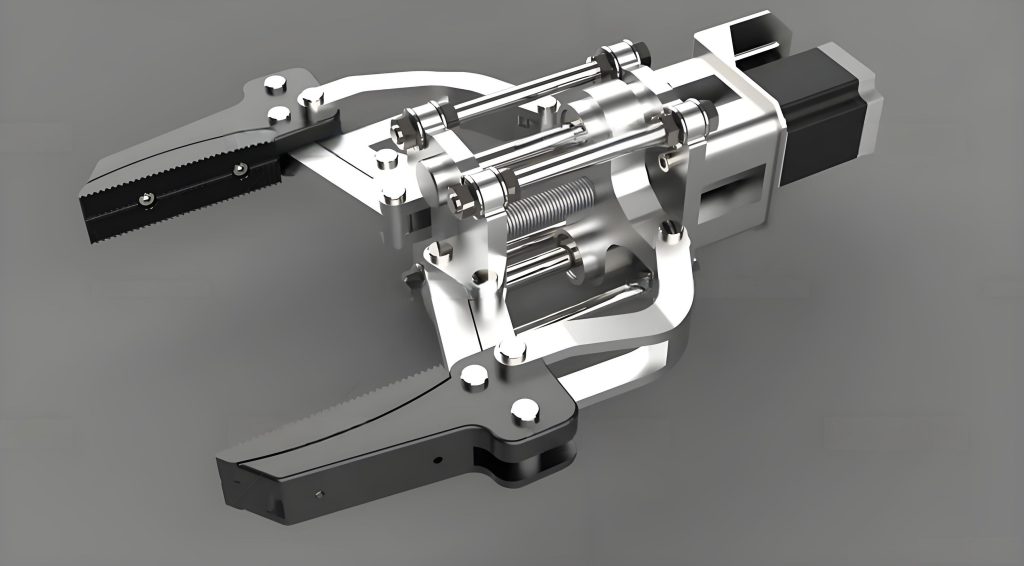
The coupled system dynamics are therefore governed by a combined set of differential-algebraic equations (DAEs): the rigid-flexible multi-body dynamics of the robot and the membrane, linked through the contact force constraint. The overall coupled dynamics can be conceptualized as:
$$
\begin{bmatrix}
\mathbf{M}(\mathbf{q}) & 0 \\
0 & \mathbf{M}_f
\end{bmatrix}
\begin{bmatrix}
\ddot{\mathbf{q}} \\
\ddot{\mathbf{d}}
\end{bmatrix}
+
\begin{bmatrix}
\mathbf{C}(\mathbf{q}, \dot{\mathbf{q}}) \dot{\mathbf{q}} \\
\mathbf{D}_f \dot{\mathbf{d}} + \mathbf{K}_f \mathbf{d}
\end{bmatrix}
=
\begin{bmatrix}
\boldsymbol{\tau} \\
0
\end{bmatrix}
+
\begin{bmatrix}
\mathbf{J}^T \\
-\mathbf{L}^T
\end{bmatrix}
\mathbf{F}_{contact}(\delta, \dot{\delta})
$$
where \( \mathbf{L} \) is a Boolean localization matrix that maps the contact force to the appropriate degrees of freedom in the membrane’s \( \mathbf{F}_{app} \). The control objective is to command the robot’s joint torques \( \boldsymbol{\tau} \) such that the motion of its end effector applies appropriate damping forces to the membrane to rapidly dissipate vibrational energy.
The control strategy operates in two phases: 1) Positioning Phase: The robot maneuvers its end effector to make contact with a pre-defined anti-node (point of maximum amplitude) of the dominant vibration mode on the membrane. This is achieved using inverse kinematics and standard joint trajectory tracking control. 2) Vibration Suppression Phase: Once contact is established, the primary control goal shifts from trajectory tracking to modulating the contact force to maximize energy dissipation. We implement an impedance control framework at the end effector. The desired dynamic behavior between the end effector’s motion and the contact force is specified. The target impedance model in the contact direction is:
$$
F_d = -M_d (\ddot{x}_c – \ddot{x}_d) – B_d (\dot{x}_c – \dot{x}_d) – K_d (x_c – x_d)
$$
where \( M_d, B_d, K_d \) are the desired inertia, damping, and stiffness parameters of the end effector, \( x_c \) is its actual position, \( x_d \) is its desired position (which could be static or slowly varying), and \( F_d \) is the desired force. For pure damping, \( K_d \) is set very low, and \( \ddot{x}_d = \dot{x}_d = 0 \), simplifying the law to \( F_d \approx -B_d \dot{x}_c \). The joint torque command is then computed using the inverse dynamics with force feedback:
$$
\boldsymbol{\tau} = \mathbf{M}(\mathbf{q}) \mathbf{J}^{-1} (\mathbf{a}_{cmd} – \dot{\mathbf{J}} \dot{\mathbf{q}}) + \mathbf{C}(\mathbf{q}, \dot{\mathbf{q}}) \dot{\mathbf{q}} + \mathbf{g}(\mathbf{q}) – \mathbf{J}^T \mathbf{F}_{contact}
$$
with \( \mathbf{a}_{cmd} \) being the acceleration command derived from the impedance control law to achieve \( F_d \). This formulation allows the robot’s end effector to behave like a programmable, mobile damper attached to the membrane.
To evaluate the proposed method, a high-fidelity numerical simulation was conducted. The system comprised a service spacecraft base, two 7-degree-of-freedom robotic arms, and a square membrane antenna (2m x 2m, thickness 50 μm, material properties akin to Kapton). An initial velocity field, simulating an impact or thruster firing disturbance, was applied to the membrane, exciting its first few low-frequency modes.
| Component | Parameter | Value |
|---|---|---|
| Membrane Antenna | Size | 2 m × 2 m |
| Thickness | 50 μm | |
| Density (ρ) | 1420 kg/m³ | |
| Robot Arm | Number of Arms | 2 |
| DOF per Arm | 7 | |
| Link Length (approx.) | 1.5 m total | |
| End Effector | Contact Stiffness (k_e) | 10 N/m |
| Contact Damping (c_e) | 5 N·s/m | |
| Impedance Control | Desired Damping (B_d) | 15 N·s/m |
| Desired Stiffness (K_d) | 1 N/m |
The simulation compared three scenarios: A) Membrane vibrating freely (no suppression). B) Suppression using one robotic end effector. C) Suppression using two robotic end effectors targeting two different anti-nodes simultaneously. The performance metric was the time for the total vibrational kinetic energy of the membrane to decay to 1% of its initial post-disturbance peak value.
The results were conclusive. The free vibration decayed very slowly due to the membrane’s inherently low material damping. The introduction of a single damping end effector significantly accelerated the energy dissipation process. The performance was further enhanced when a second robotic arm was deployed, applying coordinated damping at another strategic location. The end effector’s compliant contact ensured stable force application without causing local tearing or numerical instability. The key results are quantified in Table 3.
| Scenario | Description | Decay Time to 1% Energy (s) | Improvement vs. Free Vibration |
|---|---|---|---|
| A | Free Vibration (Baseline) | 285.3 | 0% |
| B | Single End Effector Damping | 45.7 | 84.0% reduction |
| C | Dual End Effector Damping | 22.1 | 92.3% reduction |
The interaction forces at the end effector were smooth and bounded, demonstrating the stability of the contact model and the impedance control scheme. The robotic joints successfully tracked the required compliant motion profiles while rejecting the disturbance forces from the membrane. The simulation confirmed that the end effector’s action directly removed energy from the targeted global modes of the membrane.
This study demonstrates a novel and effective paradigm for suppressing vibrations in large, ultra-flexible space structures. By leveraging the mobility and dexterity of space multi-arm robots, their end effectors can be transformed into active, targeted damping devices. The method is particularly advantageous for addressing low-frequency, large-amplitude vibrations where traditional distributed active damping (using piezoelectric patches or other embedded actuators) may be mass-inefficient or insufficient. The proposed approach offers several benefits: Adaptability: A single robotic system can suppress different modes by repositioning its end effector to different anti-nodes. Reusability: The same robot used for assembly, maintenance, or inspection can be repurposed for vibration control. No Permanent Modification: The membrane structure requires no embedded actuators or sensors, preserving its optimal structural and electromagnetic properties.
Future work will focus on several important extensions. First, optimizing the path planning and coordination of multiple end effectors for maximal energy dissipation rate. This could involve adaptive identification of dominant modes in real-time and optimal placement of the damping contact points. Second, refining the contact dynamics model to include friction and more complex viscoelastic material behavior for the end effector tip. Third, experimental validation using a ground-based testbed with a flexible membrane and robotic manipulators in a simulated microgravity environment (e.g., using air bearings or suspension systems). Finally, investigating robust control strategies to handle uncertainties in membrane properties, contact conditions, and robot dynamics.
In conclusion, the integration of space robotics with structural dynamics control opens a viable pathway for managing the vibrational integrity of next-generation large aperture systems. The concept of using a robotic end effector as a controllable damping interface provides a flexible and powerful tool for ensuring the high-precision surface stability required for advanced space missions. This research contributes a new思路 and a foundational reference for the in-orbit vibration suppression of large-scale spacecraft surfaces.