
The 2025 World Humanoid Robot Games, themed “Intelligent Competition for the Future,” officially commenced on August 14 at the National Speed Skating Oval, famously known as the “Ice Ribbon,” in Beijing. This groundbreaking event, recognized as the first global humanoid robot competition to integrate sports, art, and practical applications, serves as a pivotal platform for showcasing cutting-edge technological achievements and fostering international dialogue on future industries. With over 280 teams participating, the games highlight the rapid advancements in humanoid robot capabilities, from motion control to environmental perception, setting the stage for a transformative impact on robotics development worldwide.
- Grand Opening Ceremony: A Spectacular Fusion of Humanoid Robot Artistry and Human Collaboration
The opening ceremony of the World Humanoid Robot Games captivated audiences with a series of performances that seamlessly blended human creativity with humanoid robot precision. In the segment titled “Welcome to the World of Carbon-Based Life,” human dancers engaged in fluid interactions with humanoid robots, symbolizing a harmonious dialogue between carbon-based and silicon-based entities. Another standout performance, “Intelligent Harmony and Resonance,” featured the Panshi humanoid robot band and the Lingxin Qiaoshou humanoid robots delivering traditional Chinese melodies with remarkable accuracy. The Leju humanoid robots demonstrated Tai Chi movements, while Ubtech’s panda-inspired humanoid robots executed martial arts routines alongside young human practitioners. A humanoid robot adorned in the attire of the legendary Mu Guiying performed an excerpt from the classic opera “Mu Guiying Takes Command” with a child actor, emphasizing the cultural depth achievable through humanoid robot technology.
The fashion show segment, “Heavenly Craftsmanship and Radiance,” further illustrated the fusion of非遗技艺 (non-legacy techniques) and futuristic design. Humanoid robots from TianGong modeled garments featuring peony and herbaceous peony patterns, while those from Songyan Power embodied cultural elements reminiscent of tulou architecture. Another humanoid robot, with scale-like armor integrating feather motifs and modern aesthetics, showcased innovative apparel. The Leju humanoid robots wore outfits inspired by the Dunhuang Mogao Caves, with custom-made clothing combining 3D printing and handcrafted details. These humanoid robot models became moving exhibitions of cultural and technological integration, highlighting the potential for humanoid robots to transcend functional roles and embrace artistic expression.
Throughout the ceremony, the humanoid robot performances underscored the event’s theme of intelligent competition, with each act demonstrating the sophisticated programming and sensory capabilities of these humanoid robot systems. The collaboration between human performers and humanoid robots not only entertained but also illustrated the growing synergy between human ingenuity and humanoid robot automation, paving the way for future applications in entertainment, education, and beyond.
- Global Participation: Diverse Humanoid Robot Teams Showcasing International Talent
The World Humanoid Robot Games brought together 280 teams organized into three distinct contingents, each representing a different facet of the global humanoid robot community. The robot representative contingent featured humanoid robots like the Accelerated Evolution T1 model, which displayed exceptional coordination in a 5×5 formation, emphasizing the potential for swarm intelligence in humanoid robot systems. The Unitree G1 humanoid robots, previously deployed during the Beijing Winter Olympics, joined forces with Olympic champions in judo, swimming, and boxing, demonstrating the versatility of humanoid robots in cross-disciplinary collaborations. This contingent highlighted the practical applications of humanoid robots in real-world scenarios, from sports assistance to public services.
The international contingent included elite teams such as Germany’s HTWK Robotics and the Netherlands’ Tech United Eindhoven, both renowned for their achievements in RoboCup competitions. These teams brought advanced humanoid robot platforms that excel in dynamic environments, showcasing innovations in artificial intelligence and machine learning. The student contingent, comprising groups from institutions like Beijing National Day School, Tsinghua University, and Peking University, represented the next generation of humanoid robot developers. Notably, the Beijing National Day School team has secured the FIRST Robotics Global Challenge championship for three consecutive years, underscoring the growing expertise among young engineers in humanoid robot design and programming.
The parade of contingents was led by the games’ flag-bearer, the youngest participant “engineer” from Beijing No. 4 High School, accompanied by humanoid robot guard of honor members who were winners of the 2025 Beijing Yizhuang Half Marathon and Humanoid Robot Half Marathon. This included humanoid robots like TianGong Ultra, Songyan Power N2, and Zhuoyide Walker II, symbolizing the integration of human and humanoid robot achievements in endurance sports. The diverse backgrounds of these teams illustrate the global reach of humanoid robot technology, with each group contributing unique perspectives to the advancement of humanoid robot capabilities.
| Team Category | Representative Humanoid Robot Models | Key Features and Contributions |
|---|---|---|
| Robot Representative Contingent | Accelerated Evolution T1, Unitree G1 | Precise coordination in formations; experience in Olympic events; demonstrated fast combat moves and street dance. |
| International Contingent | Germany’s HTWK Robotics, Netherlands’ Tech United Eindhoven | RoboCup champions; advanced AI for dynamic tasks; highlighted global standards in humanoid robot football. |
| Student Contingent | Teams from Beijing National Day School, Tsinghua University, Peking University | Youth innovation in humanoid robot design; multiple competition wins; emphasis on educational applications of humanoid robots. |
This table summarizes the key participants in the humanoid robot games, emphasizing the diversity and specialization of humanoid robot teams. The humanoid robot models listed here represent the forefront of robotics engineering, with each team pushing the boundaries of what humanoid robots can achieve in competitive and collaborative settings.
- Technological Demonstrations: Humanoid Robot Competitions and Practical Applications
Following the opening ceremony, the FOP (Field of Play) demonstrations provided a platform for humanoid robots to showcase their athletic and functional prowess. In a thrilling 5v5 football match, teams from China and Germany engaged in a dynamic humanoid robot对抗 (confrontation), highlighting advancements in humanoid robot mobility, strategy, and real-time decision-making. The Unitree humanoid robots performed rapid combat sequences and street dance routines, displaying the agility and balance inherent in modern humanoid robot designs. A collaborative performance between nine “Terracotta Warrior”-themed humanoid robots from Hubei Optical Valley East Intelligence Technology Company and dancers from the Beijing Dance Academy demonstrated synchronized movements, underscoring the potential for humanoid robots in artistic and cultural presentations.
On the blue track, multiple humanoid robots participated in a 100-meter race, showcasing their ability to maintain stability and speed over distance. Humanoid robot athletes executed backflips and, in a group led by Songyan Power humanoid robots, performed a standardized gymnastics routine similar to radio calisthenics. These displays emphasized the integration of algorithmic “intelligence” and sensory “perception” in humanoid robots, allowing them to navigate complex physical challenges. The humanoid robot demonstrations extended to practical scenarios, such as hotel greeting and pharmaceutical sorting, where humanoid robots efficiently handled tasks that require precision and interaction, reinforcing the event’s focus on applied humanoid robot technology.
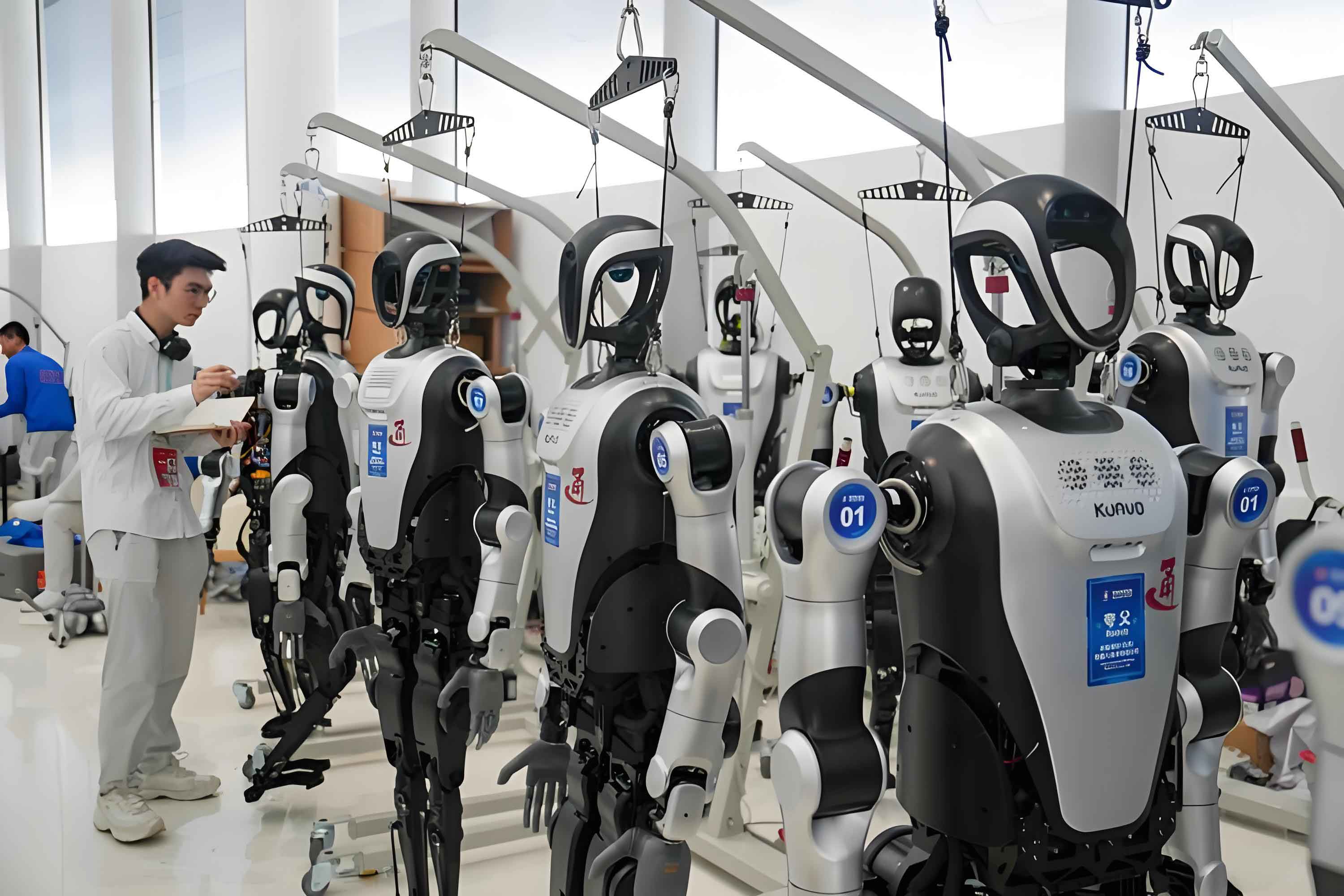
As humanoid robots continue to evolve, quality inspection processes become increasingly critical to ensure reliability and performance. The image above depicts a quality inspection of humanoid robots, highlighting the meticulous standards required in manufacturing and maintaining these advanced machines. At the games, the humanoid robot performances and competitions underscored the importance of such inspections, as each humanoid robot relied on precise engineering to execute complex tasks. The humanoid robot teams emphasized that rigorous testing and development are essential for achieving the levels of durability and functionality demonstrated in events like the humanoid robot football matches and races.
The technological showcases not only entertained but also provided valuable insights into the current state of humanoid robot innovation. From motion control in sports to environmental perception in practical applications, the humanoid robot games served as a live testing ground for breakthroughs that could redefine industries such as healthcare, logistics, and entertainment. The humanoid robot participants, through their diverse demonstrations, illustrated how humanoid robots are transitioning from experimental prototypes to integral components of modern society.
- Cultural and Artistic Integration: Humanoid Robots as Ambassadors of Innovation
The World Humanoid Robot Games extended beyond pure competition to embrace cultural and artistic expressions, positioning humanoid robots as bridges between tradition and technology. In the cultural creation segment “Intelligent Harmony and Resonance,” humanoid robot bands and performers delivered renditions of national-style melodies, with humanoid robots like those from Leju executing Tai Chi movements that mirrored human fluidity. The Ubtech panda humanoid robots, designed with cultural symbolism, engaged in martial arts displays that resonated with audiences, highlighting the potential for humanoid robots to preserve and promote cultural heritage. The humanoid robot dressed as Mu Guiying not only sang opera but also interacted with human actors, demonstrating how humanoid robots can enhance storytelling and artistic narration.
The fashion show “Heavenly Craftsmanship and Radiance” further exemplified this integration, with humanoid robots modeling attire that blended historical motifs with contemporary design. The TianGong humanoid robots, for instance, wore garments adorned with peony patterns, while others featured elements from architectural wonders like the tulou. These humanoid robot models, equipped with custom 3D-printed clothing, moved gracefully down the runway, illustrating the convergence of craft and technology. This segment emphasized that humanoid robots are not merely tools but can serve as dynamic mediums for cultural expression, inspiring new forms of art that leverage humanoid robot capabilities.
Throughout the games, the artistic performances reinforced the theme of intelligent competition, showing that humanoid robots can contribute to creative industries in meaningful ways. The collaboration between human artists and humanoid robots in dance, music, and fashion underscored a future where humanoid robots augment human creativity, rather than replace it. As humanoid robot technology advances, events like these suggest that humanoid robots will play an increasingly prominent role in cultural preservation and innovation, making them invaluable assets in global artistic communities.
- Future Implications: Driving Global Humanoid Robot Industry Forward
The 2025 World Humanoid Robot Games concluded with a resounding message about the future of humanoid robot technology and its impact on global industries. According to the games’ organizing committee, the competitions are designed to accelerate breakthroughs in core areas such as motion control, environmental perception, and AI integration for humanoid robots. By pitting humanoid robots against each other in demanding physical and cognitive challenges, the event fosters innovation that could lead to more robust and adaptable humanoid robot systems. The humanoid robot demonstrations in sports, art, and practical applications provided a comprehensive view of how humanoid robots are evolving to meet diverse human needs, from entertainment to essential services.
The participation of international teams highlighted the collaborative nature of humanoid robot development, with knowledge sharing and standardization efforts likely to benefit from such gatherings. For instance, the humanoid robot football matches between Chinese and German teams not only showcased competitive spirit but also facilitated exchanges on best practices in humanoid robot design and programming. The student contingents, with their fresh perspectives, emphasized the importance of education in nurturing the next wave of humanoid robot engineers, ensuring that the humanoid robot industry continues to grow with innovation and inclusivity.
As the games wrapped up with the performance of “Intelligent Competition for the Future,” the participating humanoid robots and their human counterparts delivered a powerful anthem for the smart era. The event demonstrated that humanoid robots are no longer confined to laboratories but are ready to integrate into everyday life, driven by advancements highlighted in the competitions. The humanoid robot games have set a precedent for future events, promising to inject new momentum into the global humanoid robot industry by inspiring further research, investment, and adoption of humanoid robot technologies across sectors.
In summary, the 2025 World Humanoid Robot Games served as a milestone in the evolution of humanoid robots, blending competition with culture to showcase the vast potential of these machines. From the opening ceremony’s artistic displays to the intense technological demonstrations, every aspect of the event reinforced the centrality of humanoid robots in shaping a smarter, more connected world. As humanoid robot capabilities continue to expand, the lessons learned from this games will undoubtedly influence the trajectory of robotics, making humanoid robots an indispensable part of our future.