
BEIJING, August 18, 2025 – The inaugural World Humanoid Robot Sports Games, a landmark global event exclusively for humanoid robots, wrapped up successfully on August 17 at the National Speed Skating Oval, known as the “Ice Ribbon,” in Beijing. Over three intense days, this pioneering competition brought together more than 500 humanoid robots from 280 teams across 16 nations, engaging in 487 matches across 26 events spanning athletics, football, dance, and scenario-based challenges. The games served as a comprehensive platform to evaluate and showcase the cutting-edge progress in intelligent decision-making, motion stability, and collaborative capabilities of humanoid robots, marking a significant milestone in the industry’s push toward practical, large-scale adoption. Event organizers confirmed that the second edition will be held in Beijing in August 2026, reinforcing the city’s role as a hub for humanoid robot innovation.
The competition was structured into core segments: athletic contests, performance displays, scenario-based tasks, and peripheral events, each designed to test specific facets of humanoid robot functionality. Athletic events, such as the 1500-meter run, 100-meter hurdles, and football matches, emphasized speed, endurance, and dynamic stability, while performance categories like group dance and martial arts highlighted coordination and artistic expression. Scenario-based events simulated real-world environments like factories, hospitals, and hotels, assessing the humanoid robot’s ability to perform tasks such as material handling and medication sorting. This multifaceted approach provided a holistic view of the current state of humanoid robot technology, drawing attention from investors, researchers, and industry leaders worldwide.
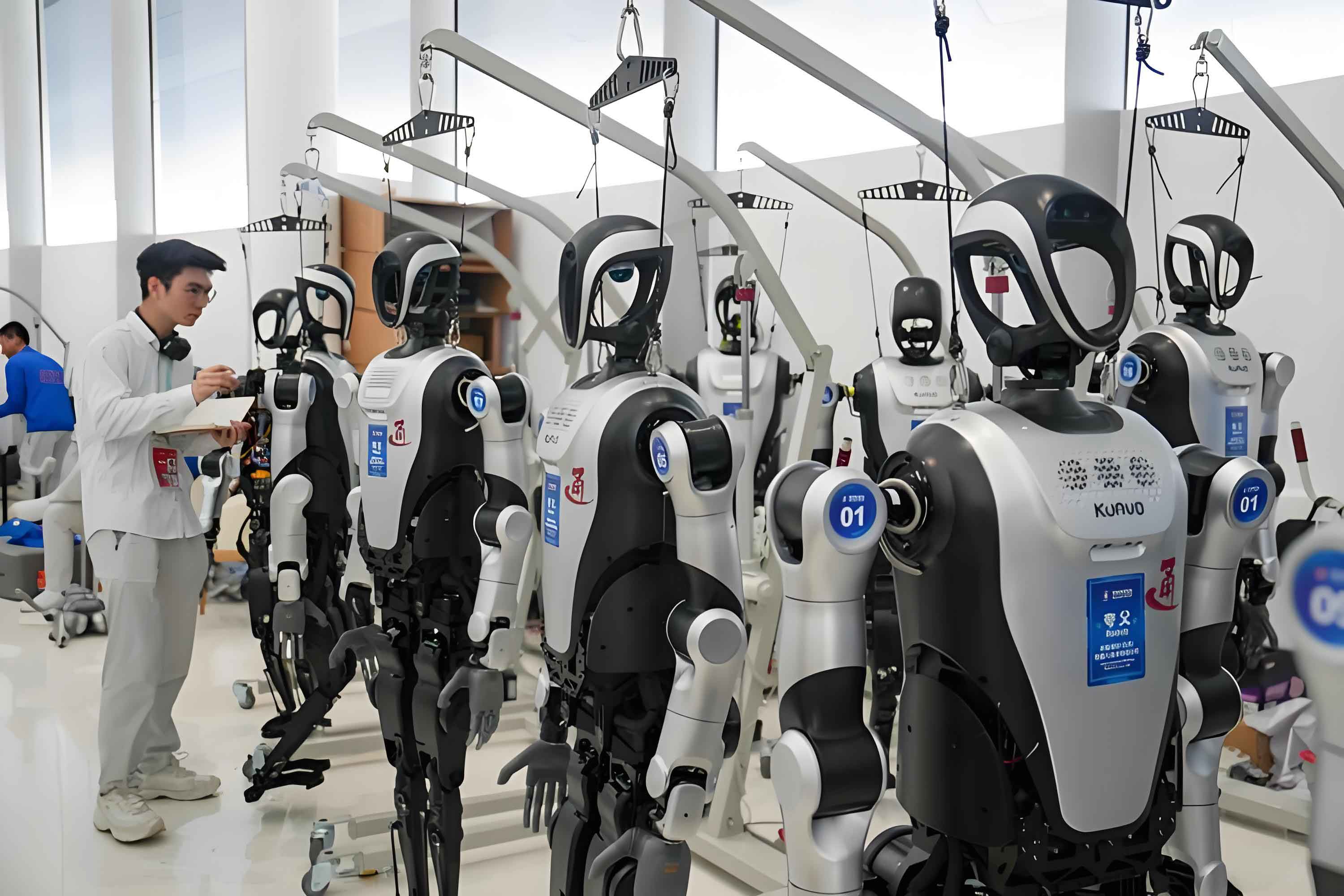
One of the most anticipated aspects of the games was the demonstration of enhanced motion capabilities in humanoid robots, with significant improvements noted compared to previous years. In the 1500-meter final, the H1 humanoid robot from宇树科技 (Yushu Technology) secured the first gold medal of the event, completing the race in 6 minutes and 34 seconds with an average speed of 3.8 meters per second and a peak speed of 5 meters per second. Yushu Technology CEO Wang Xingxing explained that the winning humanoid robot was an upgraded version of the model featured in the Spring Festival Gala, with refined algorithms for better velocity and efficiency. “This humanoid robot represents a leap in real-time motion processing, allowing it to maintain high performance over long distances,” he noted, underscoring the importance of software optimizations in achieving such feats.
Another standout participant was the “天工 Ultra” (Tiangang Ultra) humanoid robot from the Beijing Humanoid Robot Innovation Center, which distinguished itself as the only entrant capable of fully autonomous navigation without remote control. Chief Technology Officer Tang Jian elaborated that this humanoid robot advanced beyond the semi-autonomous systems used in earlier marathons by integrating multi-sensor fusion for real-time environmental understanding and independent motion planning in complex, dynamic settings. “This humanoid robot’s ability to navigate unpredictably crowded spaces without external guidance is a testament to the maturity of perception algorithms in humanoid robot development,” Tang said, highlighting how such innovations could translate to safer and more reliable operations in unstructured environments like public spaces or disaster zones.
Industry experts and investors pointed to the athletic events as a critical barometer for the progress of humanoid robot technology. A venture capitalist attending the games observed that the core determinants of a humanoid robot’s performance—such as speed, stability, and endurance—hinge on high-torque motor output, sophisticated joint design, and robust underlying control algorithms. “Watching these humanoid robots compete in races and jumps reveals how far we’ve come in mechanical engineering and AI integration,” the investor stated. “The humanoid robot’s ability to handle sudden changes in terrain or maintain balance during high-speed maneuvers is no longer just a theoretical goal; it’s becoming a reproducible reality.” This sentiment was echoed by multiple attendees, who noted that the games provided a transparent, competitive environment to benchmark different humanoid robot models against each other.
Beyond the track and field, the games featured performance events that showcased the artistic and expressive potential of humanoid robots. Group dance routines and martial arts demonstrations required precise synchronization and full-body coordination, with teams programming humanoid robots to execute complex sequences in unison. These displays not only entertained audiences but also illustrated advancements in swarm intelligence and real-time communication between multiple humanoid robots. “The emotional impact of seeing dozens of humanoid robots move in harmony was profound,” said Wang Qian, founder of自变量机器人 (Independent Variable Robotics). “From a technical standpoint, the motion performance issues have largely been resolved; the next frontier for humanoid robot development is enhancing reliability and emotional resonance to foster human-robot interaction.”
The scenario-based competitions were a focal point for exploring the practical applications of humanoid robots in everyday settings. In the factory scenario, humanoid robots were tasked with moving material boxes from shelves to carts within a time limit, testing their precision in logistics and supply chain operations. The hospital scenario involved humanoid robots dismantling and reassembling medication capsules into organized trays, evaluating their dexterity and accuracy in healthcare environments. Similarly, hotel and warehouse scenarios required humanoid robots to handle guest services and inventory management, demonstrating their versatility across service industries. A industry insider emphasized that “scene entry” is the prerequisite for规模化 application of humanoid robots; only after successful validation in real-world contexts can humanoid robot deployment scale effectively. “This event isn’t just a showcase—it’s a live testing ground that accelerates the feedback loop for humanoid robot developers,” the insider added.
The games also spurred international interest, with many foreign delegates expressing potential for cross-border collaborations and orders. According to a representative from the organizing committee, the concentrated, high-visibility nature of the sports event offered advantages over traditional expos or conferences. “We aimed to use this global platform to demonstrate that humanoid robots are already capable of delivering economic value in diverse scenarios,” the representative said. “The attendance of international guests could lead to partnerships that drive the humanoid robot industry forward, particularly in regions facing labor shortages or seeking automation solutions.”
Outside the main venue, the首程机器人科技体验店 (Shoucheng Robot Technology Experience Store) attracted large crowds, with visitors queuing to interact with over 200 robot and smart products from companies like Yushu Technology,星海图 (Xinghai Tu),银河通用 (Galaxy General), and松延动力 (Songyan Power). This nearly 200-square-meter space, one of the few in China dedicated to full-scene humanoid robot experiences, featured setups such as mahjong-playing humanoid robots, AI-guided tour humanoid robots, claw machine humanoid robots, and robotic arm delivery systems. Kang Yu, Board Office General Manager of Shoucheng Holdings, described the store as a microcosm of the humanoid robot’s expanding role. “Humanoid robots are at a critical inflection point, transitioning from technical validation to规模化落地 (large-scale landing),” Kang said. “This isn’t just about upgrading a single product category; it’s about redefining productivity across industries like manufacturing, services, healthcare, and homes, giving humanoid robots cross-cycle resilience and global expansion potential.”
Capital enthusiasm for the humanoid robot sector remains robust, reflecting confidence in its growth trajectory. Ye Qian, Co-President of Shoucheng Holdings, noted that investment continues to flow into the field, with data showing 96 financing rounds related to humanoid robots in China year-to-date, totaling 265.49 billion yuan—already surpassing the 210 billion yuan recorded for the entirety of 2024. This momentum is driving faster capital movements among startups; in June, Galaxy General announced a massive 11-billion-yuan funding round, the largest single investment in the embodied intelligence domain this year, followed by智元机器人 (Zhiyuan Robot)’s acquisition of A-listed company上纬新材 (Shangwei New Materials) in July, and Yushu Technology’s initiation of IPO辅导工作 (tutoring work) for a public listing.
The investment landscape is evolving, with a shift in focus from humanoid robot本体 (ontology) companies to upstream components and downstream applications. Zhu Fangwen, Managing Partner of Shoucheng Capital, explained that while last year’s investments centered on humanoid robot manufacturers, recent activities have expanded to include key parts like integrated joints, dexterous hands, and novel sensors, as well as vertical sectors such as consumer humanoid robots, companion humanoid robots, and specialized humanoid robots for specific tasks. “The humanoid robot ecosystem is maturing, and investors are looking beyond the hardware to the entire value chain,” Zhu said. “This diversification ensures that innovations in critical components will support the overall advancement and affordability of humanoid robots.”
Kang Yu analyzed that the surge in capital is underpinned by synergistic developments in technology, supply chain, and market demand. On the technology front,伺服系统 (servo systems),减速器 (reducers), high-performance motors, and multi-modal perception control algorithms have reached a stage where mass production is feasible. Supply chain improvements, through standardized and modular designs, have reduced costs, while leading companies’ in-house development of key components ensures delivery and pricing advantages. Demand-wise, growing needs from enterprises and institutions for labor substitution and intelligent solutions are pushing the “humanoid robot plus” scenario toward commercial scalability. “Humanoid robots are no longer a distant dream; they’re becoming integral to addressing real-world challenges, from aging populations to industrial efficiency,” Kang remarked.
Participants reported that the games directly facilitated technical iterations and industry exchanges. Jiang Zheyuan, founder of松延动力 (Songyan Power), shared that the marathon event earlier had already prompted upgrades to their N2 humanoid robot, and the sports games further pushed the hardware limits of their models. “We identified critical areas like motor torque and joint speed that need enhancement, and we’re already planning iterations based on these insights,” Jiang said. He revealed that松延动力 (Songyan Power) will launch a full-size humanoid robot next year to compete in the upcoming marathon and sports games, demonstrating the event’s role as a catalyst for innovation.
Looking ahead, the humanoid robot industry is poised for accelerated growth, with the World Humanoid Robot Sports Games set to become an annual benchmark for progress. The success of this inaugural edition has solidified the importance of such platforms in driving research, collaboration, and public engagement. As humanoid robots continue to evolve, their integration into daily life and various sectors is expected to deepen, potentially transforming how work is done in fields from logistics to elder care. The games have not only highlighted the current capabilities of humanoid robots but also ignited discussions on ethical standards, safety protocols, and the societal implications of widespread humanoid robot adoption.
In summary, the 2025 World Humanoid Robot Sports Games represented a pivotal moment for the humanoid robot community, blending competition with practical validation. By bringing together diverse stakeholders—from engineers and entrepreneurs to investors and end-users—the event underscored the collective effort required to advance humanoid robot technology. As preparations begin for the 2026 games, the industry is likely to see even more sophisticated humanoid robots capable of tackling complex tasks, further blurring the lines between human and machine capabilities. The journey of the humanoid robot from laboratory to real-world utility is well underway, and events like this are essential in steering that trajectory toward positive, impactful outcomes.