
- Introduction to the Milestone Event
In a groundbreaking demonstration of technological prowess, the Zhiyuan Expedition A2 humanoid robot successfully concluded a 24-hour continuous autonomous walk in an outdoor setting in Shanghai’s Pudong New Area, marking a global first for full-sized humanoid robots operating under high-temperature conditions. The event, which commenced at 8:20 AM, showcased the robot’s ability to navigate real-world environments without any remote human intervention, highlighting significant advancements in the field of humanoid robotics. This achievement not only underscores the growing capabilities of humanoid robots but also positions them closer to practical applications in everyday life, such as industrial inspection and commercial services. The live broadcast of this challenge attracted widespread attention, emphasizing the potential for humanoid robots to evolve from laboratory prototypes into reliable tools for various sectors.
- Detailed Account of the 24-Hour Challenge
The challenge took place in a diverse outdoor园区 environment, featuring uneven surfaces like brick and asphalt roads, obstacles such as traffic cones and speed bumps, and temperature extremes exceeding 35°C during the day, coupled with low-light conditions at night. Throughout the 24-hour period, the Expedition A2 humanoid robot maintained a steady pace, autonomously adjusting its gait to traverse uneven terrain, accurately identifying and overcoming barriers, and swiftly avoiding pedestrians. Its performance resembled that of a seasoned local, demonstrating robust environmental adaptability. The humanoid robot relied on advanced positioning and navigation technologies to determine its location and perceive obstacles in real-time, without experiencing gait disruptions or operational failures. This endurance test validated the humanoid robot’s stability and resilience, critical for future deployments in unpredictable settings.
Key aspects of the challenge included the robot’s response to varying ground materials and thermal stress. For instance, during peak daytime heat, when surfaces became烫 hot, the humanoid robot’s systems remained functional, thanks to integrated cooling mechanisms. At night, its vision systems adapted to weak lighting, ensuring continuous operation. The entire process was streamed live, providing transparent evidence of the humanoid robot’s capabilities and building confidence in its practical utility. This event represents a significant leap from mere “ability to walk” in controlled labs to ” proficient walking” in dynamic, real-world scenarios, pushing the boundaries of what humanoid robots can achieve.
- Technical Innovations and Hardware Specifications
The stability of the Expedition A2 humanoid robot stems from a harmonious integration of software and hardware components. As a multidisciplinary engineering feat, the humanoid robot’s mechanical structure, hardware, and embedded technologies form its physical foundation, with joint modules being a critical breakthrough. Early iterations of humanoid robots often faced joint failures leading to falls, but Zhiyuan has adopted a “self-developed + supplier co-development” model to enhance joint precision and reliability. This approach has boosted the localization rate of the robot’s body to 95%, reducing dependency on foreign components and strengthening the supply chain.
In terms of computational power, the Expedition A2 humanoid robot is equipped with a 270 TOPS controller, sufficient for core functions like autonomous walking, obstacle avoidance, and interaction. Why not use higher computing power controllers common in autonomous driving? As explained by Wang Chuang, General Manager of Zhiyuan Robot’s General Business Department, humanoid robots move at significantly slower speeds than vehicles, making the current configuration more suitable for battery life and thermal management. Excessive computing power could lead to rapid power drainage and overheating, undermining the humanoid robot’s endurance. This careful balance ensures that the humanoid robot operates efficiently within its physical constraints.
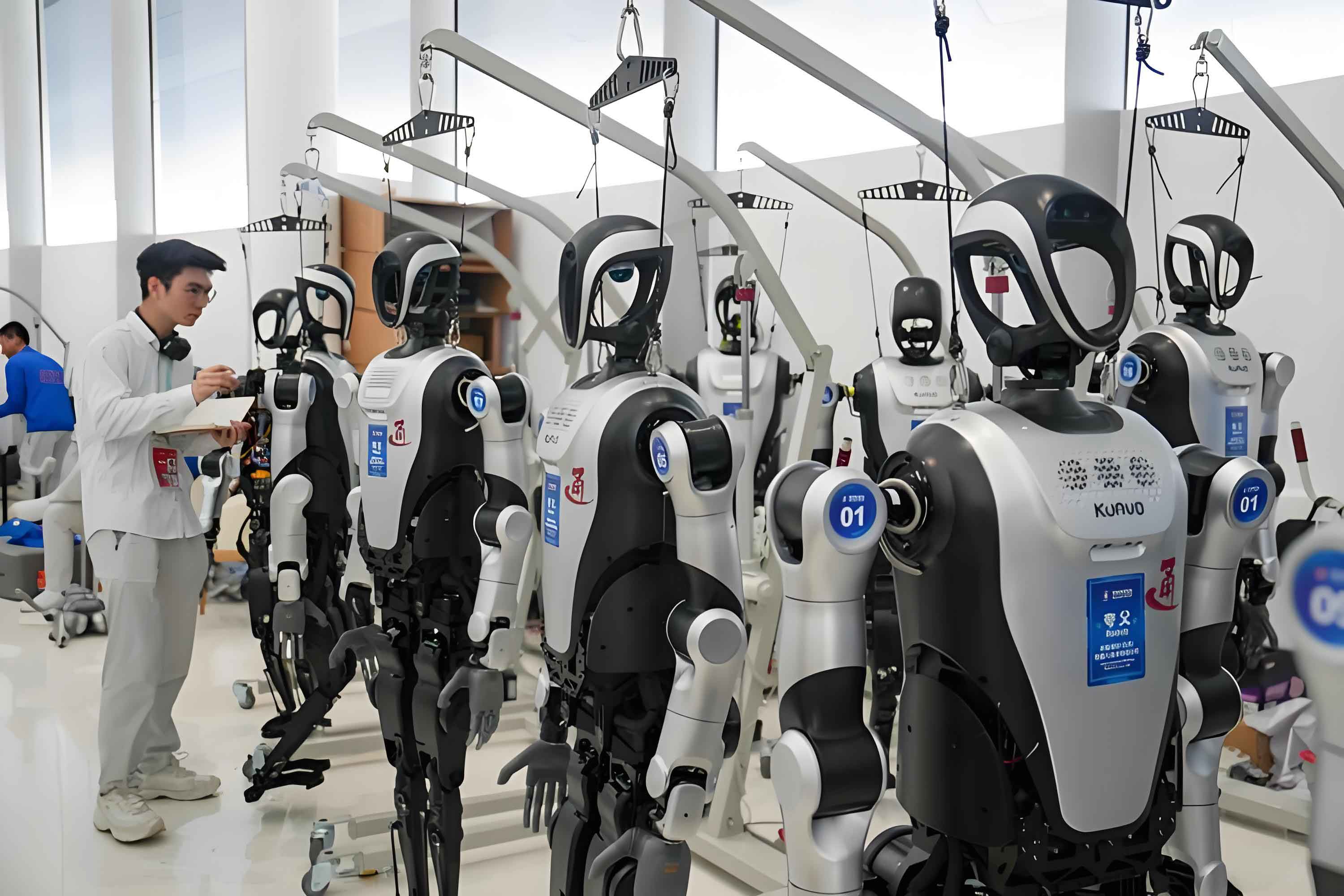
Another standout feature is the “hot-swappable battery” technology. According to Cao Xu, a representative from Zhiyuan’s R&D team, the humanoid robot can operate for approximately 2.5 hours on a single battery under continuous walking conditions. When power runs low, users can replace the battery without shutting down the system by connecting an external power source, a process that takes less than a minute and is designed for ease of use even by novices. This innovation addresses one of the major limitations in humanoid robot deployment—limited battery life—enabling extended operations without interruptions. Post-battery swap, the humanoid robot resumes walking immediately, reflecting its readiness for long-term tasks.
Moreover, the humanoid robot has undergone rigorous testing, with individual units accumulating over 3,000 hours of walking. Newly produced robots directly enter stress tests, including 60-hour and 360-hour continuous operations, with goals set for 720-hour benchmarks. This emphasis on durability and reliability highlights the progress in humanoid robot development, moving beyond theoretical models to practical, field-ready machines.
- Commercialization and Market Launch
Following the live challenge, Zhiyuan announced the commercial availability of its full product line, including the Expedition, Lingxi, and Jingling models, on the Zhiyuan Mall and JD.com platforms. This move signifies a major step toward comprehensive commercialization of humanoid robots. The Expedition A2 humanoid robot, previously priced in the millions of RMB, has seen a reduction to around 700,000 to 800,000 RMB, with expectations of further price drops as production scales up. This cost reduction is partly driven by the maturation of the domestic supply chain, where collaborations with joint and motor suppliers have enhanced economies of scale.
Wang Chuang revealed that some suppliers have experienced exponential growth in enterprise scale and market valuation due to increased orders from Zhiyuan. This ecosystem collaboration not only stabilizes the supply chain but also accelerates cost declines, making humanoid robots more accessible. The “drop eggs along the way” strategy—prioritizing commercially viable applications—guides Zhiyuan’s approach, allowing the humanoid robot to evolve through real-world use. Initial commercial focuses include emotional value and lightweight functions, such as exhibition hall guidance and entertainment performances, where the humanoid robot can greet visitors, explain products, or perform in synchronized groups, as demonstrated in the “Qin Yong Hun” dance at the World Humanoid Robot Games opening ceremony.
- Industry Challenges and Standardization Issues
Despite these advancements, the humanoid robot industry faces significant hurdles, primarily due to a lack of consensus on technical routes and unified standards. Wang Chuang pointed out that numerous non-consensus issues exist, such as debates over joint selection—whether to use lead screws or rotary joints—algorithm emphasis on rule-based versus data-driven approaches, and end-effector choices between high-degree-of-freedom dexterous hands or simple grippers. These unresolved questions require careful judgment from practitioners, as wrong choices could incur substantial costs.
More critically, the absence of industry-wide standards poses a barrier to collective progress. Zhong Junhao, Secretary-General of the Shanghai Artificial Intelligence Industry Association, stressed that standards should serve as entry thresholds rather than high benchmarks, but the industry has not yet reached a stage of broad agreement. The urgent need is for leading companies to outline clear directions and foster collaboration. Without unified “traffic rules,” the humanoid robot sector struggles to form synergistic development, even as individual players make strides. As domestic supply chains mature, the establishment of standards will be crucial for scaling applications and ensuring interoperability across different humanoid robot platforms.
- Future Development Directions
Looking ahead, the evolution of humanoid robots will concentrate on two main areas: deepening scene adaptation and enhancing autonomous decision-making. Wang Chuang likened current humanoid robots to “two-year-old children”—capable of stable walking and basic communication but not yet proficient in complex tasks. In factory settings, for example, humanoid robots currently achieve only 60-70% of human productivity per unit time. To bridge this gap, Zhiyuan adopts a gradual approach, starting with simpler commercial tasks to allow the humanoid robot to learn and improve in real environments.
In specific scenarios like elderly care, the initial focus is on fundamental functions such as companionship, medication reminders, and simple interactions, with plans to gradually introduce more complex capabilities like mobility assistance and emergency response. Similarly, in industrial contexts, the goal is to boost the humanoid robot’s “active” awareness, enabling it to independently identify tasks—for instance, recognizing when material boxes need moving in a warehouse without constant human commands. Ethan, a product expert at Zhiyuan, emphasized that enhancing this proactive intelligence will be key to expanding the humanoid robot’s utility beyond predefined routines.
Overall, the strategy involves leveraging technological iterations to build a solid foundation, using scene-based deployments to cultivate markets, and fostering industry cooperation to reduce costs. In the short term, the aim is not to replace humans hastily but to complement them, with the long-term vision of humanoid robots becoming new productivity tools that enhance efficiency in production and daily life. As the humanoid robot continues to advance, its integration into diverse sectors promises to transform how we work and live, driven by innovations like those demonstrated by the Expedition A2.
- Conclusion and Broader Implications
The successful 24-hour autonomous walk of the Zhiyuan Expedition A2 humanoid robot under high-temperature conditions marks a pivotal moment in robotics, showcasing the potential for humanoid robots to operate reliably in challenging environments. This achievement, coupled with ongoing commercial launches and supply chain developments, signals a shift toward practical adoption. However, overcoming industry fragmentation and standardizing practices will be essential for sustained growth. As humanoid robots like the Expedition A2 continue to evolve, they are poised to play an increasingly vital role in various fields, from industrial automation to personal services, ultimately contributing to a more efficient and innovative future. The journey of the humanoid robot from concept to reality is accelerating, with each milestone bringing us closer to a world where these machines are integral to everyday life.