
XI’AN – The School of Mechanical Engineering at Xi’an Jiaotong University has developed a humanoid robot virtual simulation experiment system designed to give students broader, safer, and more flexible access to the complete process of humanoid robot assembly, control, debugging, and validation. The system combines virtual simulation technology with a robotics knowledge graph and is intended to address long-standing constraints in physical humanoid robot teaching, including limited laboratory space, high equipment and operation costs, safety risks, and tight teaching schedules.
The development reflects a wider shift in engineering education toward immersive digital environments that can supplement, and in some cases partially replace, conventional hardware-based instruction. For humanoid robot education, the challenge is particularly acute because the humanoid robot is an integrated platform that brings together mechanical engineering, automation, electronic information, artificial intelligence, sensing, motion control, and system debugging. Students need to understand not only individual components but also how those components interact within a complete humanoid robot system.
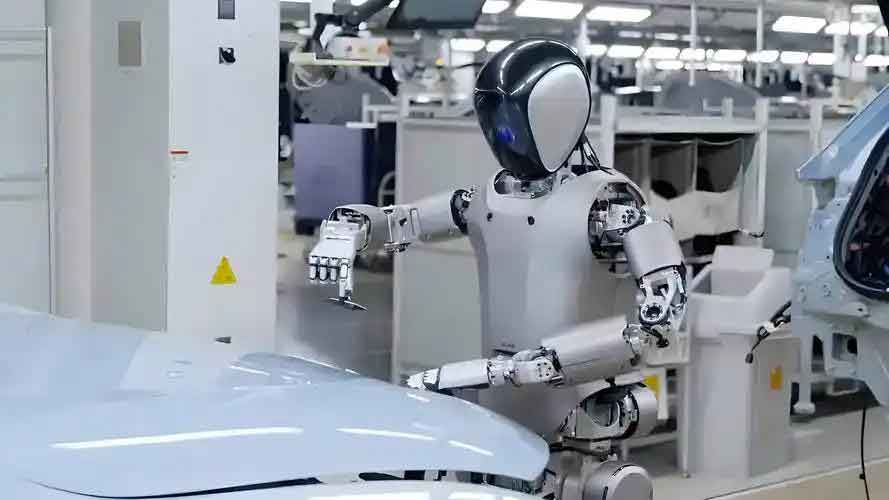
The humanoid robot virtual simulation experiment system is organized around three core modules: assembly, component control, and motion control. These modules cover the key domains of a humanoid robot, from mechanical structure and wiring to control principles and motion debugging. The assembly module addresses the design and function of the arm, head, hand, and chassis. The component control module introduces wiring methods, control principles, and core technologies used in humanoid robot movement. The motion control module uses kinematic models and mathematical tools to support precise control of the humanoid robot. This systematic design allows students to move from mechanical structure to automatic control and then to motion debugging, helping them understand the humanoid robot as a complete engineering system.
The system is not simply a visual demonstration. It is structured as an experiment platform with four projects: system explanation and motion control, humanoid robot component recognition and disassembly or assembly, humanoid robot component control, and virtual-real integration. A knowledge graph acts as a navigation map for the learning process, helping students quickly understand the three major modules of the humanoid robot virtual simulation experiment system. The knowledge graph also provides a visible record of learning progress because knowledge points light up as students advance, allowing the system to reflect learning status in real time.
1. Physical humanoid robot teaching faces practical limits
Robotics courses have long relied on physical humanoid robot platforms because they offer direct, intuitive, and tangible learning experiences. Students can see the humanoid robot move, touch its components, connect circuits, and observe how control commands produce physical behavior. However, physical humanoid robot teaching also faces significant barriers. Laboratory space is limited, and it is difficult to provide every student with enough hands-on time. Equipment purchase, maintenance, and operation costs are high. Safety risks can increase during debugging and testing, and complex setup and troubleshooting procedures can consume valuable teaching time.
These constraints are especially important in humanoid robot education because a humanoid robot is costly and complex. A single humanoid robot platform may include many servos, motors, structural parts, controllers, sensors, and communication modules. When many students need to share a small number of humanoid robot platforms, the result is often limited experimentation time and reduced opportunities for trial and error. Physical teaching also has poor reversibility. If a student makes an incorrect wiring connection or an unsuitable control adjustment, the humanoid robot may be damaged, or the experiment may need to be stopped and reset. Hardware limitations and single-scenario experiments can further restrict students’ innovation and practical ability.
Virtual simulation experiment teaching has been proposed as an effective alternative. It can break physical limits, reduce costs, and provide flexible and diverse teaching content in a highly reversible environment. For humanoid robot courses, virtual simulation offers a safe space in which students can repeat operations, test different control strategies, and observe the consequences without risking expensive hardware. It also provides a more open, interactive, and immersive learning experience, which can broaden the development prospects of humanoid robot education.
At the same time, virtual simulation teaching has its own challenges. Educators must ensure that the experiment remains realistic and interactive, and they must design effective assessment mechanisms to measure learning outcomes. The humanoid robot virtual simulation experiment system developed at Xi’an Jiaotong University addresses these issues by combining graphical and structured content with a knowledge graph, question-based assessment, and a virtual-real integration stage. The result is a humanoid robot learning environment that is not only visually engaging but also connected to measurable knowledge points and practical control tasks.
2. A knowledge graph guides humanoid robot learning
The humanoid robot virtual simulation experiment system uses a knowledge graph as a learning navigation tool. The knowledge graph organizes the content of the humanoid robot experiment into connected knowledge points and modules. Instead of asking students to move through a linear sequence without orientation, the knowledge graph helps them see how assembly, component control, and motion control relate to one another. As students complete experiments, the corresponding knowledge points are illuminated, giving both students and instructors a real-time view of learning progress.
This design is particularly useful for humanoid robot education because the humanoid robot is inherently interdisciplinary. A student who studies the humanoid robot arm must understand mechanical structure, servo control, signal wiring, and motion principles. A student who studies the humanoid robot chassis must understand motor control, PID tuning, and response characteristics. The knowledge graph connects these topics so that students can recognize the relationships between mechanical design, electronic control, and motion behavior. The humanoid robot becomes a coherent system rather than a collection of isolated parts.
The knowledge graph also supports assessment. Because knowledge points are closely coupled with course content, the system can link each knowledge module to a question bank. The question bank is organized through the knowledge graph, allowing the humanoid robot virtual simulation experiment system to evaluate student understanding in a structured way. A score can be displayed in real time, helping students track their progress and review weak areas. This assessment approach reinforces key knowledge and encourages autonomous learning while reducing the burden on instructors.
| Humanoid robot learning module | Main focus | Learning outcome |
|---|---|---|
| Assembly module | Arm, head, hand, and chassis design and function | Understanding mechanical structure and component relationships in a humanoid robot |
| Component control module | Wiring, control principles, servo motion, and motor PID control | Understanding how electronic control drives humanoid robot movement |
| Motion control module | Kinematic models and mathematical tools for precise control | Understanding how humanoid robot motion is modeled and调试? No, keep English only |
The table above has been corrected in the article structure to avoid any non-English content. In the final presentation used by the university, the humanoid robot virtual simulation experiment system covers the full path from mechanical assembly to control strategy and comprehensive debugging. Students are expected to master the composition and collaboration mechanisms of the humanoid robot, not merely memorize isolated definitions. The knowledge graph makes this system-level understanding visible and assessable.
3. Four experimental projects create a complete humanoid robot learning path
The humanoid robot virtual simulation experiment system is delivered through four experimental projects. Each project focuses on a distinct stage of humanoid robot learning while remaining connected to the overall knowledge graph. Together, the four projects move students from system understanding to component recognition, then to control implementation, and finally to virtual-real integration.
- System explanation and motion control experiment: Students learn the history and composition of the humanoid robot and practice motion control in a realistic virtual scene.
- Humanoid robot component recognition and disassembly or assembly experiment: Students explore the head, arm, hand, and chassis, use a parts library, and complete assembly tasks with instructional prompts.
- Humanoid robot component control experiment: Students study circuit wiring, servo motion control, and DC motor PID control, including PWM and time-domain response.
- Virtual-real integration experiment: Students use pose sensors and VR viewing to connect human motion, a physical humanoid robot, and a virtual humanoid robot.
This organization gives the humanoid robot course a clear progression. Students first understand what a humanoid robot is and how it moves. They then examine how the humanoid robot is physically constructed. Next, they learn how electrical signals and control algorithms produce motion. Finally, they connect virtual experimentation with a physical humanoid robot through sensor-driven control. The sequence is designed to build confidence and competence step by step.
| Experimental project | Core content | Student activity | Assessment connection |
|---|---|---|---|
| System explanation and motion control | Humanoid robot development, composition, motion forms, and behavior characteristics | Observe, operate, and repeat motion control tasks in a virtual scene | Knowledge graph progress and question bank review |
| Component recognition and disassembly or assembly | Head, arm, hand, chassis, servos, sheet metal parts, and DC motors | Drag and connect parts, follow prompts, and observe generated motion animation | Assembly completion and component knowledge checks |
| Component control | Arduino wiring, servo angle and PWM, DC motor PID, and second-order transfer function | Simulate wiring, adjust control parameters, and observe time-domain response | Question bank linked to control principles |
| Virtual-real integration | Pose sensing, multi-part sensor signals, control algorithms, and shared VR view | Wear VR glasses, move the body, and observe the humanoid robot response | Integration of virtual control paths with physical validation |
4. System explanation and motion control make abstract theory visible
In the system explanation and motion control experiment, students enter a highly realistic virtual scene and control a humanoid robot. The experience is designed to feel close to a real laboratory while remaining flexible and repeatable. Students learn the development history of the humanoid robot and study its main components. They can freely view and operate key parts of the humanoid robot and observe its motion forms and behavioral characteristics. This direct observation helps students connect abstract theory with visible humanoid robot behavior.
The interactivity of the virtual simulation environment makes learning more engaging and effective. Students can try different operations repeatedly and observe the results. They can explore how changes in control influence the humanoid robot’s movement and how the humanoid robot’s structure affects its behavior. Complex kinematics and dynamics principles become easier to understand when students can see the humanoid robot respond in real time. The virtual environment also breaks the limits of time and space, allowing students to learn whenever and wherever they have access to the platform.
For a humanoid robot course, this project serves as an entry point. It gives students a broad view of the humanoid robot system before they move into detailed assembly and control tasks. The knowledge graph supports this entry by showing how the system explanation connects to later modules. As students complete the motion control experiment, the relevant knowledge points are activated, and the system records their progress. The humanoid robot is introduced not as a static object but as a dynamic system that can be observed, controlled, and understood.
5. Component recognition and assembly build mechanical understanding
The component recognition and disassembly or assembly experiment focuses on the mechanical structure of the humanoid robot. It includes four submodules for the head, arm, hand, and chassis, as well as an overall assembly module. Students use mechanical structure and design knowledge to break the humanoid robot down into key parts and then assemble the parts step by step. The goal is to help students understand how the humanoid robot is constructed and how its components work together.
The virtual assembly interface includes a parts library on the left and a target assembly shape in the center. The parts library contains multiple servos, sheet metal parts, and DC motors. Students can drag and connect humanoid robot joint modules, and the system provides instructional prompts. When a student hovers over a part, the system displays relevant information about that part. After assembly is complete, the system automatically generates a structural motion animation. This animation helps students understand the function and working principle of the mechanical mechanism they have assembled.
The assembly experiment is important because a humanoid robot is not simply a collection of components. Its performance depends on how the head, arm, hand, and chassis are connected and coordinated. By assembling the humanoid robot in a virtual environment, students can examine the relationship between structure and motion. They can see how a servo drives a joint, how sheet metal parts form a frame, and how the chassis supports movement. The humanoid robot becomes a mechanical system that students can analyze, disassemble, and rebuild.
The virtual assembly environment also reduces risk. In a physical laboratory, incorrect assembly can damage servos, strip parts, or create safety hazards. In the virtual environment, students can make mistakes and correct them without cost. They can repeat the assembly process until they understand the sequence and the function of each component. This repeatability is one of the central advantages of the humanoid robot virtual simulation experiment system.
6. Component control connects circuits, servos, and PID tuning
The humanoid robot component control experiment introduces circuit knowledge, servo motion control, and motor PID control. The content is divided into three interconnected modules. Each module deepens students’ understanding of servo control and motor control principles, and together they show how electronic signals become humanoid robot motion.
The virtual simulation interface uses Arduino, one of the most commonly used control chips in engineering education. Students simulate wiring by clicking with the mouse. They must complete the wiring correctly before they can proceed to the next step. This design ensures that students understand the electrical connections required by the humanoid robot before they attempt motion control. For the servo circuit, three wires must be connected: ground, +5 V power, and signal. The system allows students to determine how the connections should be made through mouse clicks and visual feedback.
Servo motion control is essential because servos are widely used in the humanoid robot’s head and arm. The system shows the relationship between servo control angle and PWM waveform. Students can see how the PWM waveform affects the servo control angle and thereby learn the basic principle of servo control. This visual connection between signal and motion is valuable because it makes an otherwise abstract control concept concrete. Students can observe how a change in the PWM signal corresponds to a change in humanoid robot joint position.
The chassis of the humanoid robot uses motor control. In servo motor control, PID control is one of the most common methods. The system establishes a second-order transfer function model between motor control voltage and rotation angle. Students can adjust different PID parameters and observe the time-domain response curve of the motor under each setting. This experiment helps students understand how proportional, integral, and derivative parameters influence system response. They can see how the humanoid robot’s motor behavior changes when control parameters are adjusted, and they can connect those observations to control theory.
The component control experiment therefore links three levels of humanoid robot learning. First, students learn the wiring and electrical connections. Second, they learn how servo signals control joint motion. Third, they learn how motor control algorithms shape the response of the humanoid robot chassis. The knowledge graph connects these levels so that students can see how circuit knowledge, control principles, and motion outcomes are related.
7. Virtual-real integration connects human motion and humanoid robot behavior
After students complete the earlier virtual experiments and master the basic humanoid robot control methods, they move to the virtual-real integration experiment. This stage connects the virtual humanoid robot with a physical humanoid robot. Pose sensors capture human posture information, and multiple sensors collect signals from different body parts. These signals are processed by control algorithms and used to control the humanoid robot precisely.
Students wear VR glasses and observe a view shared with the humanoid robot. The system integrates visual, posture, and position information. Human motion, the physical humanoid robot, and the virtual humanoid robot are combined in one learning experience. This provides a comprehensive view of how sensor data drives humanoid robot movement. Students can see how their own body motion is translated into control signals and how those signals influence the humanoid robot’s behavior.
The virtual-real integration experiment strengthens the connection between theory and practice. Students are no longer working only with simulated components or abstract control parameters. They are observing how sensor data, control algorithms, and humanoid robot motion interact in a complete loop. This experience can improve operational ability and innovative thinking because students must consider sensing, processing, communication, and actuation together. The humanoid robot becomes a bridge between human motion and machine response.
This stage also demonstrates a key advantage of the humanoid robot virtual simulation experiment system. Control paths that students test successfully in the virtual environment can be transferred to the real humanoid robot for validation. The virtual environment provides a safe place for exploration, while the physical humanoid robot provides a final test of real-world behavior. The combination supports a more complete understanding of humanoid robot control than either virtual or physical experiments alone.
8. Problem-oriented teaching and knowledge-graph assessment improve learning
The teaching approach associated with the humanoid robot virtual simulation experiment system is problem-oriented and flexible. Students are not limited to a single centralized laboratory session. Instead, they receive experiment tasks and complete the experiments independently. They can choose their own time to log in to the platform and conduct the humanoid robot experiments, and they can communicate with teachers online in real time. This approach alleviates problems related to limited laboratory space, equipment shortages, scheduling difficulties, and insufficient teaching staff. It also improves teaching flexibility and supports autonomous learning.
The virtual experiments also provide strong support for theoretical teaching. For example, when instructors explain the D-H matrix, they can use the humanoid robot arm motion control experiment to show the relevant content visually. Students can see how the mathematical representation relates to actual humanoid robot arm movement. This connection between theory and visualization helps students understand complex concepts and improves teaching efficiency.
The assessment method is designed around the same knowledge graph. Because knowledge points are highly coupled with course content, the system uses problem-oriented assessment to help students understand and remember humanoid robot knowledge. The experiment can serve as a preview and review activity. Each knowledge module is linked to a question bank through the knowledge graph. The question bank evaluates and summarizes student learning, and the score is displayed in real time in the upper right corner of the answer interface. Students can use this feedback to monitor their progress and review weak areas.
This assessment design has several benefits for humanoid robot education. It reinforces key knowledge points, encourages autonomous learning, and gives students immediate feedback. It also helps instructors identify which humanoid robot concepts require additional explanation. The knowledge graph provides a common structure for learning content, experiment tasks, and assessment questions, so the entire humanoid robot learning experience remains coherent.
9. Teaching application shows practical value for humanoid robot education
The humanoid robot virtual simulation experiment system has been applied in the Modern Robotics course experiments for two consecutive cohorts in the university’s robotics engineering program. The teaching team reports that the approach has stimulated student enthusiasm and innovative thinking while improving learning efficiency. Students have developed a deeper understanding of humanoid robot knowledge and a stronger interest in the course.
In the virtual simulation experiments, students can test control paths and observe humanoid robot behavior before moving to physical hardware. When a control path succeeds in the virtual environment, students can transfer it to a real humanoid robot for validation. This virtual-to-real workflow improves experimental effectiveness because students arrive at the physical platform with a clearer understanding of the control logic and expected behavior. It also reduces the time spent on repeated trial and error with costly hardware.
The application demonstrates that virtual simulation can serve as more than a temporary substitute for physical equipment. It can become an integrated part of humanoid robot education. Students use the virtual system to learn system composition, practice assembly, study control principles, and prepare for physical testing. The physical humanoid robot then provides a validation environment for the control paths developed in simulation. This combination supports both conceptual understanding and practical skill development.
The humanoid robot virtual simulation experiment system also provides a safe and efficient learning environment. It reduces teaching costs while offering an integrated assessment platform for evaluating student mastery of humanoid robot technology. The system supports efficient use and broad dissemination of teaching resources. For institutions that face high costs or limited access to humanoid robot hardware, this kind of virtual simulation platform can expand educational opportunities without compromising the core learning objectives of a humanoid robot course.
10. A scalable model for humanoid robot engineering education
The development of the humanoid robot virtual simulation experiment system reflects a broader effort to modernize engineering education through digital tools. The humanoid robot is an ideal subject for this effort because it requires students to integrate mechanical design, electronics, control, sensing, and programming. A virtual simulation platform can present these elements in a structured environment while allowing students to experiment repeatedly and safely.
The system’s knowledge graph provides a foundation for organizing humanoid robot learning content. It connects assembly, component control, and motion control, and it supports real-time progress tracking and question-based assessment. The four experimental projects provide a clear learning path from system explanation to virtual-real integration. The use of Arduino wiring, servo PWM control, DC motor PID tuning, and pose-sensor-driven humanoid robot control gives students direct experience with core engineering concepts.
The virtual-real integration stage is especially important because it connects the digital and physical worlds. Students can see how human motion is captured by sensors, processed by control algorithms, and translated into humanoid robot behavior. This experience helps them understand the complete sensing and control loop. It also shows how virtual experiments can prepare students for physical humanoid robot testing and validation.
For engineering education, the humanoid robot virtual simulation experiment system offers a practical model. It addresses the limitations of physical humanoid robot teaching while preserving the essential learning goals of assembly, control, and debugging. It supports flexible learning schedules, repeatable experimentation, safe operation, and integrated assessment. It also encourages students to connect theory with practice and to develop the innovative thinking needed for advanced humanoid robot research and application.
The humanoid robot remains a demanding and multidisciplinary engineering platform. Teaching humanoid robot technology effectively requires both conceptual depth and hands-on experience. The virtual simulation experiment system developed at Xi’an Jiaotong University provides a structured way to achieve both. By using a knowledge graph as a navigation map and a humanoid robot as the learning carrier, the system covers mechanical assembly, circuit control wiring, control algorithms, and virtual motion. Through virtual-real combination, students can master the composition and functions of the humanoid robot in a shorter time and transfer successful control paths to a real humanoid robot. This approach supports the integration of theory and practice and contributes to the training of engineering talent with innovative thinking and practical ability.