
BEIJING—XPENG Group is advancing its humanoid robot IRON from a newly activated production line toward a staged mass-production and commercialization path, using resources developed in its automotive business to support manufacturing discipline, supply-chain coordination, and real-world deployment. After completing automated final assembly, the humanoid robot IRON walked off the new line under its own power, according to company disclosures. The core process automation rate on the line exceeds 80 percent, a figure that underscores how the company is trying to bring vehicle-level manufacturing logic into humanoid robot production.
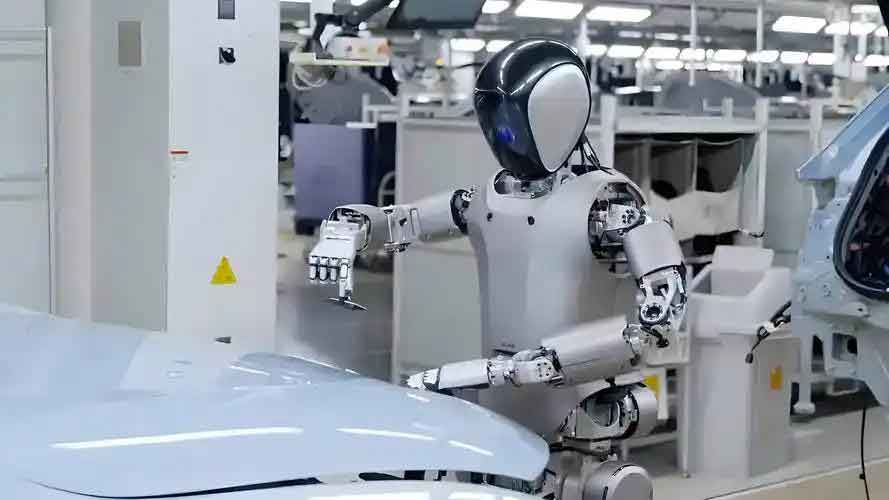
The company plans to enter the volume production stage at the end of 2026 and to officially launch and deliver the humanoid robot IRON in China and overseas markets in 2027. The first commercial applications are expected to begin in XPENG Group stores and campuses, a choice that reflects a controlled and repeatable operating environment for early humanoid robot deployment. XPENG Group said it will integrate supply-chain resources, automotive-grade manufacturing capabilities, and other assets accumulated through its automotive business to support humanoid robot mass production and commercialization. The company also plans to use real-world scenario data and human teaching data generated through subsequent applications to drive iterative training of its AI models.
- Humanoid Robot IRON and the New Production Line
The production line represents more than a manufacturing milestone for the humanoid robot IRON. XPENG Group described the approach as forward development aimed at scalable mass production, with the product and the production line designed simultaneously from the drawing board. That means the humanoid robot is not being treated as a laboratory prototype that later must be adapted to manufacturing; instead, the product definition and the production process are being developed together around the requirements of volume output, consistency, and future capacity expansion.
According to XPENG Group, the new line combines a vehicle-level quality system with precision manufacturing. The company is using automotive-grade consistency standards to establish a quality system for humanoid robot mass production. It also is pursuing automation in key processes and high-flexibility manufacturing to support assembly and production consistency. Those elements are intended to provide a foundation for subsequent scale production and rapid capacity expansion. For a humanoid robot program, such a foundation matters because the product combines mechanical structures, actuators, sensors, computing hardware, and software systems that must work together reliably across many units.
XPENG Group has also organized resources across the broader group to support the humanoid robot IRON. The company said it has introduced more than 12 years of accumulated software and hardware full-stack self-development experience into its humanoid robot business. Its automotive business provides supply-chain resources, automotive-grade manufacturing experience, and global layout resources. Its autonomous driving business provides support in areas including the Turing AI chip, AI infrastructure, and physical-world foundation models. According to the company, this ability to mobilize group resources can help the humanoid robot achieve mass production and commercialization faster.
He Xiaopeng, chairman and CEO of XPENG Group, said the company will continue to explore faster production takt and larger-scale humanoid robot manufacturing capacity. The emphasis on takt, or production rhythm, is significant because humanoid robot mass production is not only about whether a line can assemble a unit; it is also about whether the line can do so repeatedly, predictably, and at a cost structure that can support commercial deployment. The disclosed automation rate of more than 80 percent on core processes provides one indicator of manufacturing readiness, but experts cautioned that automation alone does not define mature humanoid robot mass production.
Before the production line was activated, XPENG Group’s humanoid robot business completed its first round of equity financing on August 24. The financing amount exceeded USD 900 million, and the post-money valuation exceeded USD 6.3 billion. Those disclosed figures place the humanoid robot IRON program within a broader effort to combine capital, manufacturing resources, AI infrastructure, and application scenarios. The company’s plan links production capacity with commercialization: the factory line is intended to support volume production, while stores and campuses are intended to provide initial deployment environments from which data can be collected and models can be improved.
- Automotive-Grade Quality and Humanoid Robot-Specific Validation
The question of how an automotive quality system should be adapted to a humanoid robot product has become a central issue in the IRON program. Zhu Keli, founding president of the Guoyan New Economy Research Institute and chief expert in intelligent economy, said in an interview that mature quality systems from carmakers have important reference value for humanoid robot manufacturing. However, he also said that the evaluation of humanoid robot mass production must extend to actual use. In his view, the ultimate standard for mature humanoid robot mass production is controllable failure rates after large-scale delivery, stable operations, and affordable operation and maintenance.
That standard goes beyond a factory acceptance test. A humanoid robot that performs well on a production line but experiences frequent failures in daily work would not meet the requirements of commercial deployment. The humanoid robot IRON therefore must be evaluated not only by assembly quality and automation rate but also by reliability in real environments, maintainability, and the cost of keeping the fleet operational. The company’s decision to start with stores and campuses appears designed to create a controlled setting in which those operational questions can be studied before the humanoid robot moves into more complex environments.
Zhang Xinyuan, a senior expert in enterprise strategy and technology innovation management and head of Kefangde Consulting, said in an interview that the product form, process route, and industry standards for humanoid robots are still changing. In that context, enterprises should transform vehicle-level quality methods into a validation system specifically designed for humanoid robots. Such a system should cover key component admission, whole-machine durability testing, small-batch trial production, and small-scope field operation validation. The logic is to adapt proven automotive discipline without assuming that automotive standards can be transferred unchanged to a humanoid robot.
Zhang also recommended that whole-machine yield be further decomposed into key components such as joints and dexterous hands. Batch product reliability should be evaluated by combining batch consistency and joint life performance. Testing and after-sales spare-parts spending should be included in cost evaluation. In his view, only when yield, takt, consistency, reliability, and cost improve simultaneously does the automation rate have real meaning for mass production. That statement places the humanoid robot IRON program within a broader manufacturing equation: automation is valuable only when it contributes to a reliable, repeatable, and economically sustainable production system.
Zhu Keli suggested that attention should be paid to flexible production takt and the fatigue reliability of core components. He noted that the joints, perception systems, and control algorithms of humanoid robots are still evolving rapidly, so the manufacturing system must retain the ability to adapt to hardware changes. Cost accounting should cover research and development, depreciation, and operation and maintenance allocation, rather than being limited to the assembly stage. For the humanoid robot IRON, this means the production strategy must balance current automation with future product iterations. A line that is highly optimized for one hardware configuration may become less useful if joint designs, sensors, or computing modules change quickly.
In Zhang Xinyuan’s evaluation framework, manufacturing yield and takt also must connect with post-delivery performance. Field failure intervals, average repair time, and software upgrade stability should all be included in the evaluation. Those metrics are especially relevant for a humanoid robot because software and hardware are tightly coupled. A humanoid robot may require over-the-air updates, diagnostic tools, spare-parts planning, and service procedures that differ from those of conventional machinery. The IRON program’s commercial success will therefore depend on whether manufacturing quality can be translated into operational uptime and serviceability.
- Stores and Campuses as the First Humanoid Robot Commercialization Ground
XPENG Group’s decision to begin commercial applications in its own stores and campuses is a deliberate first step. Zhang Xinyuan said stores and campuses are a reasonable starting point because the environment is relatively controllable, tasks are repeatable, and people can provide supervision and fallback. For a humanoid robot, early deployment in such settings can generate operational experience without exposing the system to the full complexity of public spaces or unstructured industrial environments. The humanoid robot IRON can be observed, maintained, and updated within a managed environment while the company collects data on task performance, failure modes, and human interaction.
Zhang also outlined several criteria for scenario selection. The company should consider whether a task is high-frequency, whether it truly requires a biped or humanoid structure, whether a human can conveniently take over after a failure, and whether revenue can be calculated by work hours or service results. These criteria are practical for a humanoid robot program because they connect technical capability with commercial logic. A task that is infrequent, highly variable, or difficult to supervise may not be suitable for early humanoid robot deployment. In contrast, a repeatable task in a controlled store or campus environment may provide a clearer path to measurable value.
XPENG Group has equipped the humanoid robot IRON with on-device AI capabilities. According to company disclosures, IRON carries 3 Turing AI chips, with effective compute of 2,250 TOPS, and its physical AI model has been deployed on the device. The company said the humanoid robot can autonomously complete complex work tasks without teleoperation while balancing inference latency and data security. On-device AI is relevant to commercial deployment because it can reduce dependence on remote operation and can support faster responses in local environments. For a humanoid robot working in a store or campus, the ability to process sensor data and make decisions locally may also address data-security and latency concerns.
In terms of hardware and scenario adaptation, XPENG Group said a highly humanoid robot platform can help use human daily behavior data and adapt to environments designed for people. According to the company, the humanoid robot IRON has 76 degrees of freedom in total, with 21 degrees of freedom in each hand. Those disclosed specifications indicate a platform designed for dexterity and human-scale interaction. The humanoid form factor may allow the humanoid robot to operate in spaces, use tools, and perform tasks that were originally designed around human bodies, although experts emphasized that task selection still must be justified by actual demand and reliability.
Zhu Keli recommended using scenario-driven demand to reverse-engineer product definition. He said companies should prioritize task necessity, controllable risk, calculable cost, and a replicable model. For the humanoid robot IRON, that approach could mean building standardized task packages around basic operations such as inspection, duty, and handling. The company could then explore paid operations in lower-complexity scenarios before gradually expanding the application scope. This staged approach aligns with the disclosed plan to begin in stores and campuses, where tasks can be standardized and human supervision can be maintained.
Zhang Xinyuan further proposed that commercialization evaluation be conducted at the level of a single humanoid robot. The key questions include how many work hours the humanoid robot can bear, how much risk it can reduce, how much revenue it can increase, and how much deployment cost is required to replicate the application in the next store or campus. He suggested starting with tasks such as inspection, handling, guidance, and simple retail assistance, accumulating operational data, and then gradually increasing operational complexity. Such a per-unit evaluation framework helps connect humanoid robot performance with business value rather than relying only on technical demonstrations.
- The Data-Model-Application Loop for Humanoid Robot IRON
XPENG Group’s application plan also includes using data collected from deployment to improve its models. In its interview response, the company said that as the humanoid robot IRON enters mass-production applications, it will obtain real-world scenario data and human teaching data that can be used to accelerate AI model training. The company said continuously improving model capabilities will in turn support the humanoid robot in entering more scenarios and generating more high-quality data. The goal is to form a continuous data-model-application iteration process that allows the humanoid robot to improve its capabilities in the real world.
That loop is central to the commercial logic of the humanoid robot IRON. Early deployments in stores and campuses can generate operational data that would be difficult to obtain in a laboratory. The humanoid robot can encounter variations in lighting, layout, human traffic, object placement, and task execution that may not be fully captured in simulation. At the same time, human teaching data can provide examples of how tasks are performed and how exceptions are handled. The company’s challenge is to convert that data into model improvements that are reliable enough to support broader deployment.
Zhu Keli said simulation can handle basic training, but real scenarios still require real-machine validation because of subtle disturbances, non-standard interactions, and complex working conditions. The accumulation of high-quality on-duty operation data and the ability to handle low-frequency complex tasks are important elements in advancing scaled commercial use. He recommended classifying operation, failure, and safety data and combining simulation pretraining with real-machine testing to reduce trial-and-error costs. In model evaluation, long-term stability, failure recovery capability, and scenario generalization should be emphasized, and a human fallback mechanism should be established for tasks beyond the humanoid robot’s capability.
Zhang Xinyuan noted that real-world scenario data has characteristics such as high labeling costs, noise, and limited task coverage. Human demonstration actions also cannot all be directly reused for a humanoid robot. Therefore, enterprises need to unify collection standards for task labels, environmental parameters, and operation results. Privacy masking, permission management, and on-site safety measures should be incorporated into the application process. In his view, only when data is comparable, models are evaluable, and scenarios are replicable can data accumulation be transformed into humanoid robot capability improvement and expanded application scope.
For XPENG Group, those data-governance requirements are likely to become part of the humanoid robot IRON commercialization system. A store or campus deployment is not only an operational test but also a data-collection environment. The humanoid robot must be able to record what it did, what failed, how a human intervened, and what environmental conditions affected performance. If those records are inconsistent across sites or tasks, they will be less useful for model training and reliability evaluation. The company’s ability to standardize data collection may therefore influence how quickly the humanoid robot IRON can move from initial applications to broader commercial use.
- Manufacturing, Cost, and Reliability Must Advance Together
The IRON program illustrates a broader challenge facing humanoid robot industrialization. A high automation rate on a production line can demonstrate manufacturing capability, but it does not by itself prove that a humanoid robot is ready for large-scale commercial deployment. The humanoid robot must be produced with consistent quality, maintained at reasonable cost, and supported by software updates and service infrastructure. The company’s use of automotive-grade manufacturing resources provides a foundation, but experts emphasized that humanoid robot-specific validation and cost accounting remain necessary.
Zhang Xinyuan’s proposed evaluation framework links manufacturing and operation. Whole-machine yield should be broken down into key components, batch consistency should be tracked, joint life should be tested, and after-sales spare-parts spending should be included in cost evaluation. Manufacturing yield and takt should be connected with field failure intervals, average repair time, and software upgrade stability. This framework treats the humanoid robot as a product that must perform reliably over time, not merely as a machine that can be assembled and demonstrated.
Zhu Keli’s emphasis on flexible production takt and fatigue reliability reflects the pace of change in humanoid robot technology. Joints, perception systems, and control algorithms are still iterating, so the manufacturing system must be able to adapt. Cost accounting should include research and development, depreciation, and operation and maintenance allocation. For the humanoid robot IRON, this suggests that the production line must be efficient enough for volume output while remaining flexible enough to accommodate design changes. The balance between standardization and adaptability will be an important factor in the program’s long-term manufacturing strategy.
The disclosed financing and valuation figures also indicate the scale of resources being directed toward the humanoid robot business. The first equity financing round exceeded USD 900 million, with a post-money valuation above USD 6.3 billion. Those resources can support production capacity, AI infrastructure, and commercialization efforts, but they do not remove the need for disciplined validation. The humanoid robot IRON must still demonstrate that it can operate reliably in real scenarios, that its data loop can improve performance, and that its deployment cost can be recovered through service value or operational savings.
- Disclosed Humanoid Robot IRON Production and Commercialization Markers
| Marker | Disclosed information |
|---|---|
| Production line status | The humanoid robot IRON completed automated final assembly and walked off the newly activated production line under its own power. |
| Core process automation rate | More than 80 percent. |
| Volume production target | End of 2026. |
| Market launch and delivery | 2027, in China and overseas markets. |
| Initial commercial applications | XPENG Group stores and campuses. |
| Manufacturing approach | Vehicle-level quality system combined with precision manufacturing and automotive-grade consistency standards for humanoid robot mass production. |
| Resource integration | Automotive business supplies supply-chain, automotive-grade manufacturing, and global layout resources; autonomous driving business supplies Turing AI chip, AI infrastructure, and physical-world foundation model support. |
| Software and hardware experience | More than 12 years of software and hardware full-stack self-development accumulation introduced into the humanoid robot business. |
| On-device AI | 3 Turing AI chips; effective compute of 2,250 TOPS; physical AI model deployed on the device. |
| Degrees of freedom | 76 degrees of freedom in total; 21 degrees of freedom in each hand. |
| First equity financing | Completed on August 24; more than USD 900 million raised. |
| Post-money valuation | More than USD 6.3 billion. |
| Data strategy | Use real-world scenario data and human teaching data to accelerate AI model training and support a data-model-application iteration loop. |
- Commercialization Discipline for the Humanoid Robot
The humanoid robot IRON program is being positioned at the intersection of automotive manufacturing discipline, AI model development, and service-scenario deployment. XPENG Group’s decision to start in stores and campuses reflects a practical understanding that early humanoid robot applications need controlled conditions, repeatable tasks, and human fallback. The company’s disclosed production plans, including the end-of-2026 volume production target and the 2027 launch and delivery plan, provide a timeline for moving from manufacturing preparation to market deployment. The humanoid robot’s on-device AI capabilities, including the 3 Turing AI chips and 2,250 TOPS of effective compute, are intended to support autonomous task execution while balancing latency and data security.
At the same time, the expert commentary points to several conditions that must be met before humanoid robot mass production can be considered mature. A controllable failure rate after large-scale delivery, stable operations, and affordable operation and maintenance are essential. Automotive-grade quality methods must be translated into humanoid robot-specific validation covering key components, whole-machine durability, small-batch trial production, and field operation. Yield, takt, consistency, reliability, and cost must improve together. Manufacturing metrics must connect with post-delivery performance, including field failure intervals, average repair time, and software upgrade stability.
The humanoid robot IRON’s data-model-application loop will also require disciplined data governance. Real-world data can be noisy, costly to label, and limited in task coverage. Human teaching data cannot be reused wholesale. Task labels, environmental parameters, and operation results need unified standards. Privacy protection, permission management, and on-site safety measures must be part of the application process. If those conditions are met, data from stores and campuses can become a useful asset for improving the humanoid robot’s capabilities and expanding its application scope.
For XPENG Group, the humanoid robot IRON is therefore more than a single product launch. It is a test of whether automotive-grade manufacturing, AI infrastructure, and a staged commercialization strategy can be combined into a repeatable model for humanoid robot deployment. The company’s production line, financing, chip and model capabilities, and initial store-and-campus applications provide the main elements of that model. The next phase will depend on whether the humanoid robot can demonstrate reliable operation, manageable service costs, and measurable value in real tasks. Those outcomes will determine how quickly the humanoid robot IRON can move from controlled early applications to broader commercial adoption.
- Outlook: From Controlled Deployment to Scalable Humanoid Robot Operations
The outlook for the humanoid robot IRON will be shaped by the interaction between manufacturing capability and operational evidence. XPENG Group has disclosed a production line with core process automation above 80 percent, a volume production target at the end of 2026, and a 2027 launch and delivery plan. It has also disclosed initial commercial applications in stores and campuses, on-device AI with 3 Turing AI chips and 2,250 TOPS of effective compute, and a humanoid robot platform with 76 degrees of freedom and 21 degrees of freedom per hand. Those elements provide a technical and industrial foundation, but the commercial outcome will depend on reliability, serviceability, and cost.
Experts highlighted that humanoid robot mass production should be judged by what happens after delivery. A humanoid robot that can be assembled at high automation rates but cannot maintain stable operations or affordable maintenance would not meet the standard for scaled commercial use. The humanoid robot IRON must therefore be evaluated through field failure intervals, average repair time, software upgrade stability, and the cost of spare parts and service. The company’s ability to collect and use operational data will influence how quickly those performance issues can be identified and addressed.
The store-and-campus starting point gives the humanoid robot IRON a controlled environment in which tasks can be repeated and human supervision can be maintained. That setting can support the development of standardized task packages for inspection, duty, handling, guidance, and simple retail assistance. As operational data accumulates, the humanoid robot can gradually take on more complex tasks. The data-model-application loop described by XPENG Group is intended to support that progression, but it will require consistent data standards, model evaluation, and safety mechanisms.
In the broader humanoid robot sector, the IRON program illustrates how automotive supply chains and quality systems may influence the path to industrialization. Carmakers have experience in large-scale manufacturing, supplier management, and quality control, but humanoid robots introduce new challenges in dexterity, perception, software updates, and human-robot interaction. The successful model is likely to be one that adapts automotive discipline to humanoid robot-specific requirements rather than simply transferring automotive methods unchanged. XPENG Group’s disclosed plan reflects that adaptation through simultaneous product and production-line design, automotive-grade consistency standards, flexible manufacturing, and staged commercial deployment.
As the humanoid robot IRON moves toward its planned volume production and market launch, the key indicators to watch will be production yield, takt, component reliability, field failure intervals, repair time, software upgrade stability, deployment cost, and task performance in stores and campuses. Those indicators will show whether the humanoid robot can convert manufacturing automation into operational value. The program’s progress will also provide a reference for how humanoid robot companies can combine AI models, on-device compute, real-world data, and service scenarios into a scalable commercial system.
The humanoid robot IRON program thus represents a staged effort to connect automotive-grade manufacturing with humanoid robot commercialization. XPENG Group has disclosed the main building blocks: a new production line, a volume production timeline, a 2027 launch and delivery plan, initial store-and-campus applications, on-device AI, a high-degree-of-freedom humanoid robot platform, and a data-driven model iteration strategy. The expert commentary adds a critical evaluation framework: humanoid robot mass production must be measured by reliability, maintainability, cost, and real-world task performance. Those factors will determine whether the humanoid robot IRON can move from controlled early deployment to scalable commercial operations.