
As I reflect on the rapid advancements in robotics, it is clear that the concept of an “intelligent robot” has evolved significantly. Based on standards that define intelligent robots as those with enhanced perception, learning capabilities, and autonomy to adapt to complex environments and tasks, the landscape is shifting from basic automation to sophisticated AI-driven systems. In my view, service robots, in particular, stand out due to their potential for close human interaction and vast market growth. They are categorized broadly into industrial, service, and special-purpose robots, with service robots—spanning personal, household, and public applications—showing the most urgent need for智能化升级. The market for these AI human robot systems is still nascent but growing rapidly, with applications expanding from finance and healthcare to hospitality and dining, though they remain limited to standardized scenarios for now.
In exploring the future of service robots, I often ponder: are they mere tools or true intelligent partners? The transition from “basic” to “intelligent” robots is underway, driven by AI and robotics technologies. During a recent forum, experts delved into this transformation, focusing on five critical questions that shape the path forward. This discussion highlighted how AI human robot integration is redefining intelligence, with potential breakthroughs in areas like cloud computing, model-driven AI, and humanoid designs. Below, I will address each question in detail, incorporating tables and formulas to summarize key insights, and emphasize the recurring theme of AI human robot evolution.
First, let me consider the classification of robots, which provides context for understanding their智能化 potential. Generally, robots are divided into three main types, as summarized in the table below. This categorization helps illustrate why service robots, with their diverse applications, are prime candidates for becoming true AI human robot systems.
| Type | Primary Functions | Examples |
|---|---|---|
| Industrial Robots | Handling, loading/unloading, welding, spraying, processing, assembly, cleaning | Automated arms in manufacturing |
| Service Robots | Household chores, education, entertainment, elderly care, assistance, public services like dining and guidance | Vacuum cleaners, educational companions |
| Special-Purpose Robots | Inspection, rescue, patrol, reconnaissance, bomb disposal, installation, mining, transport, surgery, rehabilitation | Search-and-rescue drones, surgical assistants |
From this, it is evident that service robots face unique challenges due to their interactive nature. In my analysis, the智能化 journey involves multiple levels of intelligence, which can be modeled mathematically. For instance, the progression from L0 (no intelligence) to L4 (super intelligence) can be described using a hierarchical function. Let me define the intelligence level $L$ as a function of autonomy $A$, learning capability $C$, and environmental complexity $E$:
$$L = f(A, C, E) = \sum_{i=0}^{4} \alpha_i \cdot A^i + \beta \cdot C + \gamma \cdot E$$
where $\alpha_i$, $\beta$, and $\gamma$ are coefficients representing the weight of each factor, and $i$ denotes the level. Currently, most service robots operate between L1 and L3, indicating partial autonomy with room for growth toward L4, where AI human robot systems could fully replace humans in complex tasks.
Now, addressing the first question: Is a cloud-based brain for service robots an ideal or a fantasy? In my opinion, relying solely on the cloud for robot intelligence poses significant risks. Experts have noted that real-time movements and environmental responses require local processing to avoid disruptions from network issues. For example, if a service robot navigates from point A to B, any latency or disconnection could compromise safety. This can be quantified using a reliability model. Let $R_{cloud}$ be the reliability of a cloud-based system, and $R_{local}$ for local intelligence. The overall reliability $R$ might be expressed as:
$$R = p \cdot R_{cloud} + (1-p) \cdot R_{local}$$
where $p$ is the probability of network stability. If $p$ is low due to intermittent connectivity, $R$ decreases, underscoring the need for hybrid approaches. The table below compares cloud and local intelligence for AI human robot systems, based on forum insights.
| Aspect | Cloud Intelligence | Local Intelligence |
|---|---|---|
| Computing Power | High, scalable | Limited but improving |
| Latency | Variable, dependent on network | Low, real-time |
| Reliability | Subject to outages | More stable |
| Cost | Ongoing subscription fees | Higher initial investment |
In summary, while the cloud offers immense computational resources, the consensus is that a balanced integration with local AI is essential for robust AI human robot deployments. As one expert implied, the trend toward distributed computing could eventually make cloud brains more viable, but for now, local capabilities are indispensable.
Moving to the second question: Which service robots will enter households in the next three years? I believe that cleaning robots currently lead in adoption, but the future lies in personalized companions. Specifically, AI playmates for children and elderly care robots are poised for mass adoption. For children, early education is critical, and AI human robot systems can serve as interactive partners that foster learning habits through data-driven insights. Similarly, for the elderly, robots assisting with cooking, monitoring, and rehabilitation address growing demographic needs. The potential market growth can be modeled using a logistic function for adoption rate $A(t)$:
$$A(t) = \frac{K}{1 + e^{-r(t – t_0)}}$$
where $K$ is the carrying capacity (maximum adoption), $r$ is the growth rate, $t$ is time, and $t_0$ is the inflection point. Given current trends, $r$ for service robots like AI companions could be high, leading to rapid expansion. The table below outlines key domains for near-term AI human robot integration.
| Application | Key Features | Expected Impact |
|---|---|---|
| Child Education | AI-driven play, habit formation, emotional support | Enhanced learning outcomes |
| Elderly Care | Companionship, health monitoring, daily assistance | Improved quality of life |
| Home Cleaning | Autonomous navigation, efficiency | Time savings for users |
In my assessment, these robots will become integral family members, driven by advancements in AI that enable more natural interactions. The emphasis on AI human robot systems here highlights their role in bridging emotional gaps, not just performing tasks.
The third question explores whether large models are catalysts for intelligent robots. I concur with predictions that model-driven AI human robot systems will emerge within three years, as seen in recent products. Large models, such as those based on Transformer architectures, have revolutionized natural language processing, enabling robots to understand and respond to complex commands. The evolution of these models can be traced through key milestones, as summarized in the table below, which also ties into the AI human robot theme by showing how intelligence is enhanced.
| Phase | Technologies | Impact on AI Human Robot |
|---|---|---|
| Early (1950-1990) | Expert systems | Limited, rule-based interactions |
| Machine Learning (1990-2010) | Shallow algorithms | Basic pattern recognition |
| Deep Learning (2010-2017) | Neural networks | Improved perception |
| Pre-trained Models (2018-2023) | BERT, GPT variants | Context-aware responses |
| Generative AI (2023-present) | ChatGPT, multimodal models | Human-like dialogue and adaptability |
Mathematically, the performance of a large model in an AI human robot can be represented by a loss function $L(\theta)$ that minimizes error in tasks like language understanding:
$$L(\theta) = -\sum_{i=1}^{N} \log P(y_i | x_i; \theta) + \lambda \|\theta\|^2$$
where $\theta$ are model parameters, $x_i$ and $y_i$ are input-output pairs, $N$ is the dataset size, and $\lambda$ is a regularization term. As models scale, parameters increase, leading to better performance but higher computational demands. Experts argue that for general AI human robot applications, large models are essential, but for specific tasks, smaller, optimized models suffice. This aligns with the trend of model democratization, where edge devices gain AI capabilities, making AI human robot systems more accessible.
Moreover, the shift from cloud to edge computing for AI inference is accelerating. By 2028, it is predicted that edge-side inference cards will surpass cloud training cards in sales, indicating that “branches” like specialized models and “leaves” like applications will flourish. In my view, this democratization will empower AI human robot systems to operate independently, enhancing their intelligence and reducing latency.
The fourth question delves into humanoid robots: are they the future or a relic? I observe that humanoid designs are gaining traction as embodiments of AI human robot ideals, with proponents arguing that they offer natural interaction through empathy and familiarity. However, alternative forms, such as spider-like robots, might excel in specific tasks like climbing. The decision to adopt humanoid forms can be analyzed using a utility function $U$ that balances efficiency $E_f$, interaction quality $Q_i$, and cost $C$:
$$U = w_1 \cdot E_f + w_2 \cdot Q_i – w_3 \cdot C$$
where $w_1$, $w_2$, and $w_3$ are weights. If $Q_i$ is prioritized for home environments, humanoid AI human robot systems may dominate, whereas $E_f$ might favor other designs in industrial settings. Recent advancements in large models have fueled this trend, as humanoid robots facilitate data collection from human perspectives, training AI to mimic human behaviors. For instance, digital twin training methods enable robots to learn movements virtually, making them more relatable.
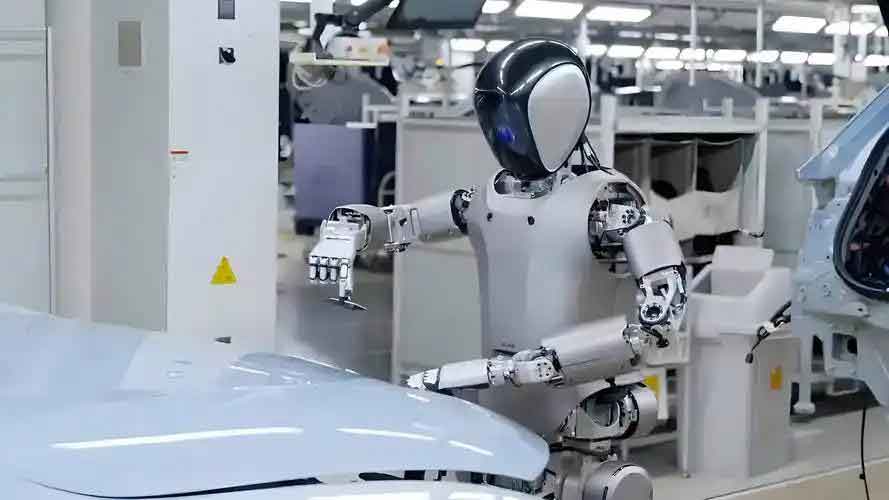
In this context, I believe that while humanoid AI human robot systems are not mandatory, their psychological appeal could drive adoption. The integration of large models allows these robots to process complex scenarios, moving them closer to L4 intelligence. As one expert noted, the synergy between AI and humanoid forms is accelerating, making them a focal point for innovation.
The fifth question concerns fiber optic communication and its role in enhancing robot responsiveness. I agree that as AI human robot systems incorporate more sensors and complex controls, traditional networks face limitations in bandwidth, latency, and interference. Fiber optics, with solutions like time-sensitive passive optical networks (TS-PON), offer a promising alternative. The advantages can be quantified using a performance metric $P$ that combines bandwidth $B$, latency $L_t$, and error rate $E_r$:
$$P = \frac{B}{L_t \cdot (1 + E_r)}$$
For fiber optics, $B$ is high (e.g., 10Gbps, scaling to 50Gbps), $L_t$ is low (microseconds), and $E_r$ is negligible due to immunity to electromagnetic interference, resulting in a high $P$. The table below compares fiber optics with traditional copper-based systems for AI human robot applications.
| Parameter | Fiber Optics | Traditional Copper |
|---|---|---|
| Bandwidth | Up to 50Gbps | Typically 1Gbps, upgrade challenges |
| Latency | Microsecond level | Higher, variable |
| Interference | None | Susceptible to EMI/EMC |
| Weight and Space | Lightweight, compact | Bulkier |
In practice, TS-PON solutions can integrate multiple protocols onto a single fiber, supporting up to 128 nodes with simplified wiring. This is crucial for AI human robot systems that require seamless coordination between sensors, processors, and actuators. For example, in humanoid robots with numerous joints, fiber optics ensure timely data transmission, enabling precise control. As one innovator highlighted, this technology has already been deployed in advanced robots, addressing bottlenecks like high latency and packet loss.
Furthermore, the development of system-on-chip (SoC) designs at 14nm and beyond will enhance these communications, integrating functions to boost performance and reduce costs. In my analysis, this progress is vital for overcoming “bottleneck” issues in high-end chips, fostering the growth of intelligent AI human robot ecosystems.
In conclusion, the journey from basic to intelligent service robots is marked by innovations in cloud-edge balance, model-driven AI, humanoid design, and advanced communication. As I see it, AI human robot systems are transitioning from simple tools to empathetic partners, capable of understanding and serving human needs. The integration of large models and fiber optics will accelerate this shift, bringing us closer to a future where robots are ubiquitous in daily life. Through continuous advancements, I am confident that service robots will not only perform tasks but also enrich human experiences, embodying the true essence of intelligence.
This evolution underscores the importance of collaborative efforts in AI and robotics. As we move forward, the focus should remain on developing adaptable, efficient, and humane AI human robot systems that can thrive in diverse environments. The potential is limitless, and I anticipate that these innovations will unlock new possibilities, making intelligent robots an integral part of our world.