
As a researcher in the field of robotics and artificial intelligence, I have witnessed the rapid evolution of humanoid robots, which are designed to mimic human appearance, movements, and behaviors. These AI human robot systems integrate multiple disciplines, including mechanics, electronics, materials science, computer science, sensors, control systems, and cognitive technologies, representing a significant marker of a nation’s technological advancement. Humanoid robots are capable of performing daily tasks, sensing environments, interacting with humans, and even displaying basic emotions and reactions. Despite their potential, the development of AI human robot platforms faces numerous challenges, spanning technical, ethical, social, economic, and legal domains. In this article, I will explore the current state, challenges, and future trends of humanoid robots, emphasizing the role of AI human robot integration in shaping our future society. The journey of AI human robot systems has been marked by decades of innovation, from early conceptualizations in science fiction to modern advancements driven by artificial intelligence and machine learning.
The historical development of humanoid robots can be traced back to the early 20th century, when ideas from science fiction and mechanical automata laid the groundwork. For instance, the term “robot” was first introduced in a play, inspiring future research. In the mid-20th century, foundational work in computer science and artificial intelligence, such as the Turing Test, provided criteria for machine intelligence, while the invention of the first industrial robot demonstrated practical applications. The introduction of robotics principles, including the famous three laws, helped frame ethical considerations. By the 1970s and 1980s, advancements in microprocessors enabled early humanoid robots with basic movements, and in the 21st century, breakthroughs from companies and institutions led to robots with enhanced mobility, perception, and interaction capabilities. Throughout this evolution, the integration of AI human robot technologies has been pivotal, driving progress from simple mechanical designs to complex systems capable of autonomous decision-making.
Currently, humanoid robots have achieved significant milestones in motion, perception, and application. For example, they can perform complex actions like running and jumping, interact naturally through voice and gesture recognition, and execute tasks in diverse fields such as healthcare, education, and service industries. The following table summarizes key aspects of the current state of AI human robot development:
| Aspect | Description | Examples |
|---|---|---|
| Motion Capabilities | Advanced control algorithms and sensors enable walking, running, and balancing on uneven terrain. | Humanoid robots performing dynamic movements |
| Perception and Interaction | Integration of vision, auditory, and tactile systems for natural human-robot communication. | Robots with emotion recognition and language processing |
| Autonomy and Task Execution | Ability to handle multiple tasks simultaneously through machine learning and real-time adaptation. | Autonomous navigation and object manipulation |
| Application Domains | Expansion into retail, elderly care, education, and rehabilitation, providing personalized services. | Use in homes, hospitals, and public spaces |
In terms of technical foundations, the motion control of AI human robot systems often relies on dynamic equations. For instance, the balance and stability can be modeled using the Lagrangian dynamics formula:
$$ L = T – V $$
where \( T \) represents the kinetic energy and \( V \) the potential energy of the system. The equations of motion are derived as:
$$ \frac{d}{dt} \left( \frac{\partial L}{\partial \dot{q}_i} \right) – \frac{\partial L}{\partial q_i} = Q_i $$
Here, \( q_i \) are the generalized coordinates, and \( Q_i \) are the generalized forces. This formulation helps in designing controllers for stable locomotion in AI human robot platforms, addressing challenges like uneven terrain and external disturbances.
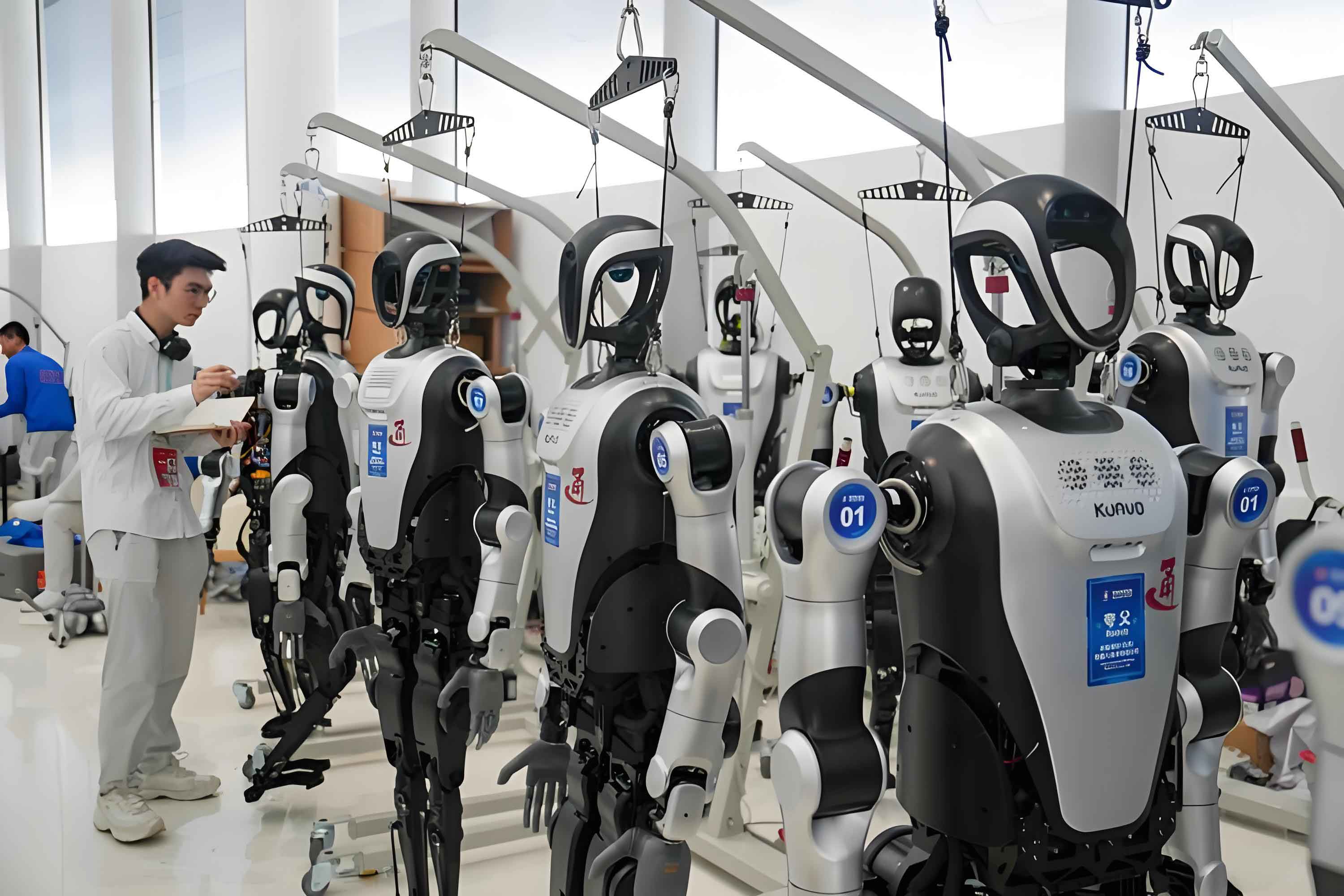
However, the development of AI human robot systems is fraught with challenges. Technically, achieving natural and stable movements remains difficult due to coordination and balance issues. The energy consumption for high-complexity actions often exceeds the capabilities of current battery technologies, leading to limited operational time. In perception, while sensors have improved, integrating multi-modal data (e.g., visual, auditory, tactile) for accurate environmental understanding requires substantial computational power. Natural language processing in AI human robot interfaces still struggles with context and emotional nuances, hindering seamless communication. Autonomy is another hurdle; although machine learning enables some decision-making, real-time adaptation in dynamic environments is not fully robust. The following table outlines the primary technical challenges in AI human robot development:
| Challenge Category | Specific Issues | Impact on AI Human Robot Systems |
|---|---|---|
| Motion and Stability | Poor coordination, balance on uneven surfaces, high energy demands | Reduced reliability in real-world applications |
| Perception and Understanding | Weak integration of sensory inputs, limited contextual awareness | Ineffective interaction and task execution |
| Natural Language Processing | Inaccurate comprehension and generation of speech, lack of emotional intelligence | Barriers to human-like communication |
| Autonomous Decision-Making | Mechanical responses, difficulty in multi-tasking and real-time planning | Limited adaptability in complex scenarios |
Ethically and socially, AI human robot systems raise concerns about privacy, emotional manipulation, and job displacement. The collection of personal data during interactions could lead to breaches or misuse, while the ability to mimic emotions might be exploited unethically. Societally, the widespread adoption of AI human robot technologies could automate many jobs, particularly in low-skill sectors, necessitating strategies to balance efficiency with employment. Public acceptance is also low due to fears of dependency and loss of human touch. From an economic perspective, the high costs of research, development, and maintenance limit commercialization and accessibility. Legally, issues of liability and safety standards are unresolved; for example, if an AI human robot causes harm, it is unclear who is responsible—the manufacturer, user, or the robot itself. Moreover, the共生 (coexistence) of humans and AI human robot systems requires designs that respect cultural diversity and human needs.
To quantify some of these challenges, we can use mathematical models. For instance, the energy efficiency of an AI human robot can be expressed as:
$$ \eta = \frac{P_{\text{output}}}{P_{\text{input}}} \times 100\% $$
where \( \eta \) is the efficiency, \( P_{\text{output}} \) is the useful power for tasks, and \( P_{\text{input}} \) is the total power consumed. Improving \( \eta \) is crucial for extending battery life. Similarly, in AI decision-making, a reinforcement learning model can be represented as:
$$ Q(s, a) = Q(s, a) + \alpha [r + \gamma \max_{a’} Q(s’, a’) – Q(s, a)] $$
Here, \( Q(s, a) \) is the value of taking action \( a \) in state \( s \), \( \alpha \) is the learning rate, \( r \) is the reward, and \( \gamma \) is the discount factor. This equation underpins how AI human robot systems learn from interactions, but current implementations often lack the robustness for complex, unpredictable environments.
Looking ahead, the future trends of AI human robot development are promising. Motion capabilities will advance towards more natural human-like movements, with enhanced self-balancing and recovery mechanisms. For example, future AI human robot models may incorporate adaptive control algorithms that use real-time sensor data to adjust gait and posture, reducing the risk of falls. Perception and interaction will see major improvements through computer vision, augmented reality, and affective computing, enabling AI human robot systems to understand and respond to human emotions more accurately. Autonomy will be boosted by advanced AI, allowing these robots to learn from experience and make intelligent decisions in varied contexts. Energy management will benefit from better batteries and energy harvesting techniques, such as solar power, leading to longer operational times. The following table summarizes key future trends for AI human robot systems:
| Trend Area | Expected Developments | Potential Impact on AI Human Robot Applications |
|---|---|---|
| Enhanced Motion and Balance | Imitation of complex human gestures, self-recovery from falls | Broader use in dynamic environments like disaster rescue |
| Advanced Perception and Interaction | Multi-modal communication, emotion recognition, AR integration | More personalized services in healthcare and education |
| Intelligent Autonomy | Self-learning, adaptive task execution, complex problem-solving | Autonomous operation in industrial and domestic settings |
| Improved Energy Management | High-capacity batteries, energy harvesting, extended续航 | Long-term deployments in remote or critical tasks |
| Commercialization and普及 | Cost reduction, widespread adoption in homes and public services | Increased accessibility and economic benefits |
| Human-Robot Collaboration | Seamless teamwork with humans, AR/VR enhancements | Enhanced productivity in manufacturing and caregiving |
| Ethical and Legal Resolution | Clearer guidelines on liability, privacy, and emotional boundaries | Safer and more trustworthy integration into society |
| Cultural Adaptation | Multilingual support, customization to local norms and values | Global applicability and acceptance of AI human robot technologies |
In terms of AI human robot intelligence, future systems may employ deep learning models for perception, such as convolutional neural networks (CNNs) for image recognition:
$$ y = f(W * x + b) $$
where \( x \) is the input image, \( W \) represents the weights, \( b \) is the bias, \( * \) denotes convolution, and \( f \) is an activation function. This allows AI human robot platforms to identify objects and faces accurately. For autonomous navigation, path planning can be optimized using algorithms like A* search, formulated as:
$$ f(n) = g(n) + h(n) $$
where \( f(n) \) is the total cost, \( g(n) \) is the cost from the start node to node \( n \), and \( h(n) \) is a heuristic estimate to the goal. Such mathematical approaches will enable AI human robot systems to operate efficiently in crowded or changing environments.
Commercialization of AI human robot technologies will expand into everyday life, with robots serving as household assistants, medical aides, and educational tools. For instance, in elderly care, AI human robot systems could provide companionship and monitor health, addressing issues of aging populations. In education, they might offer personalized tutoring, adapting to individual learning styles. Human-robot collaboration will become more prevalent, with AI human robot platforms working alongside humans in factories, hospitals, and offices, enhancing productivity through complementary skills. Ethically, as these systems evolve, society will need to address questions about emotional attachment and the legal status of AI human robot entities. Cultural adaptation will be key, requiring robots to understand and respect diverse languages and social customs to ensure global relevance.
In conclusion, the evolution of AI human robot systems represents a transformative shift in technology, with the potential to revolutionize various aspects of human life. While significant challenges remain in technical performance, ethical integration, and economic viability, ongoing advancements in AI, materials science, and energy systems are paving the way for more capable and accessible humanoid robots. As we move forward, it is essential to foster interdisciplinary collaboration and public dialogue to ensure that AI human robot development aligns with human values and needs. The future of AI human robot technology holds immense promise, but its success will depend on addressing these multifaceted issues to achieve harmonious coexistence between humans and machines.