
As I stepped into the bustling exhibition hall, I was immediately captivated by the vibrant display of AI human robots, each one embodying the cutting edge of technological innovation. The air was electric with excitement, as visitors from around the world gathered to witness these marvels of engineering. AI human robots have emerged as the stars of the show, showcasing abilities that once seemed confined to science fiction—walking, blinking, dancing, and even engaging in commerce. This experience solidified my belief that we are on the cusp of a transformative era, where AI human robots are not just novelties but integral components of our future society. In this article, I will delve into the intricacies of these machines, exploring their technical foundations, industrial impact, and the challenges they face, all while emphasizing the pivotal role of AI in shaping their evolution.
The proliferation of AI human robots at such events highlights their growing significance in global technological landscapes. I observed how these robots seamlessly integrate into various scenarios, from entertainment to industrial applications, demonstrating their versatility. For instance, one AI human robot performed elegant dance moves to melodious tunes, its movements fluid and natural, thanks to advanced motion control algorithms. Another engaged in intelligent conversations with attendees, displaying a range of subtle facial expressions that made interactions feel remarkably human-like. These experiences underscored how AI human robots are becoming more accessible and tangible, bridging the gap between virtual intelligence and physical presence. As I reflect on this, it is clear that the development of AI human robots is accelerating at an unprecedented pace, driven by innovations in artificial intelligence, robotics, and material science.
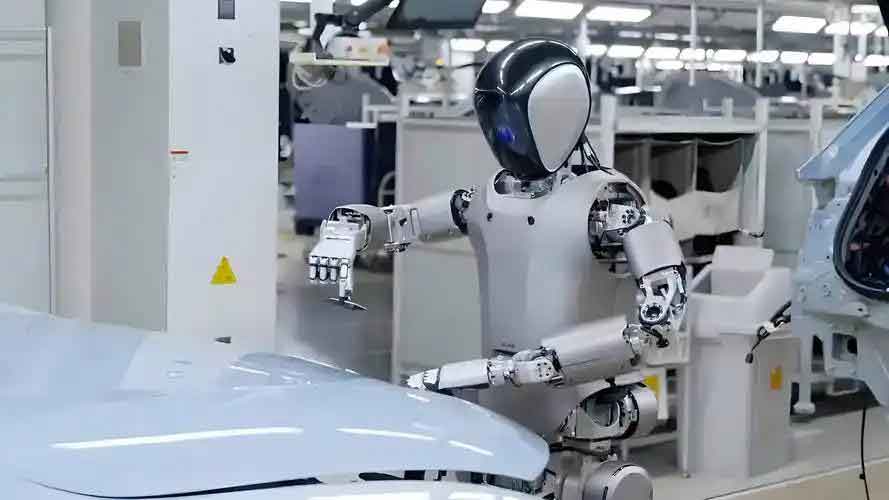
To better understand the capabilities of these AI human robots, I examined their core technologies, which often revolve around sophisticated AI systems. One key aspect is the motion control, which can be modeled using equations from robotics kinematics. For example, the inverse kinematics for a humanoid robot’s leg movement can be expressed as: $$ \theta = \text{IK}(x, y, z) $$ where $\theta$ represents the joint angles, and $(x, y, z)$ is the desired foot position in Cartesian space. This allows AI human robots to achieve stable walking and running gaits, with some models reaching speeds of up to 2 m/s. Additionally, the integration of reinforcement learning enables these robots to learn and adapt over time. A common formula used in such AI systems is the Q-learning update: $$ Q(s, a) \leftarrow Q(s, a) + \alpha \left[ r + \gamma \max_{a’} Q(s’, a’) – Q(s, a) \right] $$ where $Q(s, a)$ is the value of taking action $a$ in state $s$, $r$ is the reward, $\alpha$ is the learning rate, and $\gamma$ is the discount factor. This empowers AI human robots to master complex tasks like climbing stairs or dancing through iterative learning, making them more autonomous and efficient.
The industrial landscape for AI human robots is rapidly expanding, as evidenced by the diverse companies showcasing their products. I compiled data from various sources to illustrate this growth, highlighting how regions are competing to lead in this futuristic sector. Below is a table summarizing the estimated market size and key players in the AI human robot industry as of recent years:
| Region | Estimated Market Size (Billions USD) | Number of AI Human Robot Companies | Key Application Areas |
|---|---|---|---|
| North America | 5.2 | Over 30 | Healthcare, Logistics |
| Europe | 3.8 | Around 25 | Manufacturing, Education |
| Asia-Pacific | 7.5 | Over 100 | Entertainment, Industrial Automation |
| Other Regions | 1.5 | Approximately 15 | Research and Development |
This table reveals that the Asia-Pacific region, in particular, is a hotspot for AI human robot innovation, with a concentration of companies driving advancements. During my observations, I noted that many of these firms focus on integrating AI to enhance human-robot interactions, which is crucial for widespread adoption. For example, some AI human robots utilize natural language processing models, such as: $$ P(w_1, w_2, \dots, w_n) = \prod_{i=1}^n P(w_i \mid w_{i-1}, \dots, w_1) $$ where $P$ represents the probability of a word sequence, enabling more coherent dialogues. Moreover, the hardware components, like flexible joint actuators, are designed using principles from mechanics: $$ \tau = I \alpha $$ where $\tau$ is the torque, $I$ is the moment of inertia, and $\alpha$ is the angular acceleration. This allows AI human robots to perform delicate tasks, such as picking up objects with precision, mimicking human dexterity.
As I explored further, I encountered specialized components that form the backbone of AI human robots. One standout was the development of dexterous hands, which are essential for tasks requiring fine motor skills. These hands often incorporate tendon-driven mechanisms, modeled by equations like: $$ F = k \Delta x $$ where $F$ is the force applied by the tendon, $k$ is the stiffness constant, and $\Delta x$ is the displacement. This enables AI human robots to execute gestures like “OK” or “thumbs up” with remarkable accuracy. In fact, I witnessed a demonstration where an AI human robot used such a hand to handle fragile items in a simulated medical setting, showcasing its potential in healthcare. The integration of AI here is critical; for instance, computer vision algorithms help the robot identify objects using convolutional neural networks (CNNs), which can be represented as: $$ y = f(W * x + b) $$ where $y$ is the output, $x$ is the input image, $W$ is the weight matrix, $b$ is the bias, and $f$ is the activation function. This synergy between hardware and AI is what makes AI human robots so versatile and capable of operating in diverse environments.
The economic impact of AI human robots cannot be overstated, and I analyzed various reports to gauge their growth trajectory. Below is a table projecting the global market for AI human robots over the next decade, emphasizing key sectors and anticipated advancements:
| Year | Projected Global Market Size (Billions USD) | Expected Number of AI Human Robots Deployed | Primary Industries Adopting AI Human Robots |
|---|---|---|---|
| 2025 | 15.0 | 50,000 | Logistics, Retail |
| 2027 | 25.0 | 200,000 | Healthcare, Construction |
| 2030 | 50.0 | 1,000,000 | Education, Domestic Services |
| 2035 | 100.0 | 5,000,000 | Space Exploration, Advanced Manufacturing |
This projection indicates a exponential growth curve, fueled by investments in AI research and development. During my time at the expo, I learned that many companies are prioritizing the scalability of AI human robots, aiming to reduce costs while enhancing performance. For example, some are exploring modular designs where components can be easily replaced or upgraded, governed by reliability equations like: $$ R(t) = e^{-\lambda t} $$ where $R(t)$ is the reliability over time $t$, and $\lambda$ is the failure rate. This ensures that AI human robots can operate efficiently in demanding settings, such as disaster response or manufacturing assembly lines. Additionally, the use of cloud-based AI allows for continuous learning, with models updated in real-time using stochastic gradient descent: $$ \theta \leftarrow \theta – \eta \nabla_\theta J(\theta) $$ where $\theta$ represents the model parameters, $\eta$ is the learning rate, and $J(\theta)$ is the loss function. This means that every interaction with an AI human robot contributes to its improvement, making it smarter and more adaptive.
However, the journey of AI human robots is not without challenges. I engaged in discussions with experts who highlighted issues like the “uncanny valley” effect, where robots that appear almost human can evoke discomfort. This psychological phenomenon can be described probabilistically: if a robot’s human-likeness exceeds a certain threshold but falls short of perfection, the aversion probability $P_a$ increases, modeled as: $$ P_a = \frac{1}{1 + e^{-k(h – h_0)}} $$ where $h$ is the human-likeness level, $h_0$ is the threshold, and $k$ is a sensitivity constant. To mitigate this, many developers focus on enhancing interactivity and practicality rather than mere resemblance. For instance, some AI human robots are designed with expressive faces that convey emotions through micro-expressions, using AI-driven animation systems. Another major hurdle is the efficiency of underlying AI; if an AI human robot cannot perform tasks faster or more accurately than humans, its commercial viability is limited. This is often quantified using metrics like the task completion rate $C$, defined as: $$ C = \frac{\text{Number of successful tasks}}{\text{Total tasks attempted}} $$ which must surpass human benchmarks for widespread adoption. Through my observations, I saw that breakthroughs in deep learning, such as transformer architectures, are addressing this by enabling more robust decision-making: $$ \text{Attention}(Q, K, V) = \text{softmax}\left(\frac{QK^T}{\sqrt{d_k}}\right)V $$ where $Q$, $K$, and $V$ are query, key, and value matrices, and $d_k$ is the dimensionality. This allows AI human robots to handle complex, unstructured environments more effectively.
Looking ahead, the future of AI human robots appears bright, with potential applications spanning every aspect of life. I envision a world where these robots serve as companions, assistants, and even collaborators in creative endeavors. The integration of AI human robots into the Internet of Things (IoT) could lead to smarter cities, where they communicate seamlessly with other devices. For example, an AI human robot might coordinate with autonomous vehicles using optimization algorithms: $$ \min \sum_{i=1}^n c_i x_i \quad \text{subject to} \quad Ax \leq b $$ where $c_i$ represents costs, $x_i$ are decision variables, and $A$ and $b$ define constraints. This would enhance efficiency in urban logistics and emergency services. Moreover, as AI human robots become more affordable, they could democratize access to advanced technology, particularly in education and healthcare. I recall a demonstration where an AI human robot assisted in a simulated classroom, adapting its teaching style based on student responses using reinforcement learning. This personalization is key to making AI human robots truly beneficial, and it relies on continuous data analysis, often involving Bayesian inference: $$ P(H|E) = \frac{P(E|H) P(H)}{P(E)} $$ where $P(H|E)$ is the posterior probability of hypothesis $H$ given evidence $E$. Such advancements will undoubtedly reshape industries and daily life, fostering a more connected and intelligent world.
In conclusion, my immersion in the world of AI human robots has left me profoundly optimistic about their role in our future. From their technical prowess to their economic potential, these machines represent a leap forward in how we interact with technology. The repeated emphasis on AI in their development cannot be understated; it is the driving force behind their evolution. As we navigate challenges like ethical concerns and technical bottlenecks, I am confident that collaboration across disciplines will lead to breakthroughs. The era of AI human robots is not just coming—it is already here, and I am excited to witness and contribute to this transformative journey. Through continued innovation and a focus on human-centric design, AI human robots will undoubtedly become indispensable partners in building a smarter, more sustainable future.