
In the rapidly evolving field of robotics, we have designed and developed an intelligent biped humanoid robot that leverages the powerful NVIDIA Jetson Nano as its central control unit. This AI human robot is engineered to operate in diverse and complex environments, mimicking human-like movements and interactions through advanced sensor integration and machine learning algorithms. Our primary goal is to create a versatile platform that can perform tasks ranging from simple navigation to complex gesture recognition, all while maintaining stability and adaptability. The integration of multiple perception modules, including cameras and various sensors, enables this AI human robot to perceive its surroundings, make intelligent decisions, and execute actions with precision. In this article, we delve into the detailed design, implementation, and functionalities of our robot, emphasizing the role of AI in enhancing its capabilities.
The mechanical structure of our AI human robot is inspired by human anatomy, featuring a bipedal design that allows for walking, turning, and other dynamic movements. We utilized PLA material for construction, resulting in a robot approximately 25 cm in height, 20 cm in chest width, and 11 cm in chest depth. The robot boasts 17 degrees of freedom (DOF), distributed as follows: 10 DOF in the legs (5 per leg, including ankle, knee, and hip joints), 8 DOF in the arms (4 per arm, covering shoulder and elbow movements), and 1 DOF in the head for lateral rotation. This configuration enables the AI human robot to simulate human gait and perform actions such as walking forward, backward, turning, and even recovering from falls. The舵机-driven joints are controlled based on human joint angle simulations, ensuring smooth and coordinated motion.
| Body Part | Number of DOF | Description |
|---|---|---|
| Legs | 10 | 5 per leg: ankle (1 lateral), knee (2 forward), hip (1 forward, 1 lateral) |
| Arms | 8 | 4 per arm: shoulder (1 forward), elbow and wrist (3 lateral) |
| Head | 1 | Lateral rotation for enhanced perception |
To achieve stable bipedal locomotion, we modeled the robot’s leg movements using eight舵机 that replicate human walking patterns. The joint angles during gait are derived from human motion studies, and we implemented a control strategy that adjusts these angles in real-time. The舵机 control is governed by a dedicated chip that interprets commands from the Jetson Nano, ensuring precise actuation. The kinematics of the leg movements can be described using the following equations for joint angles $\theta_i$ at time $t$:
$$ \theta_i(t) = A_i \sin(2\pi f t + \phi_i) + B_i $$
where $A_i$ is the amplitude, $f$ is the frequency, $\phi_i$ is the phase shift, and $B_i$ is the offset for the $i$-th joint. This sinusoidal model helps in generating natural-looking gaits for the AI human robot. Additionally, we conducted simulations to optimize these parameters for energy efficiency and stability, resulting in a robot that can traverse uneven surfaces without losing balance.
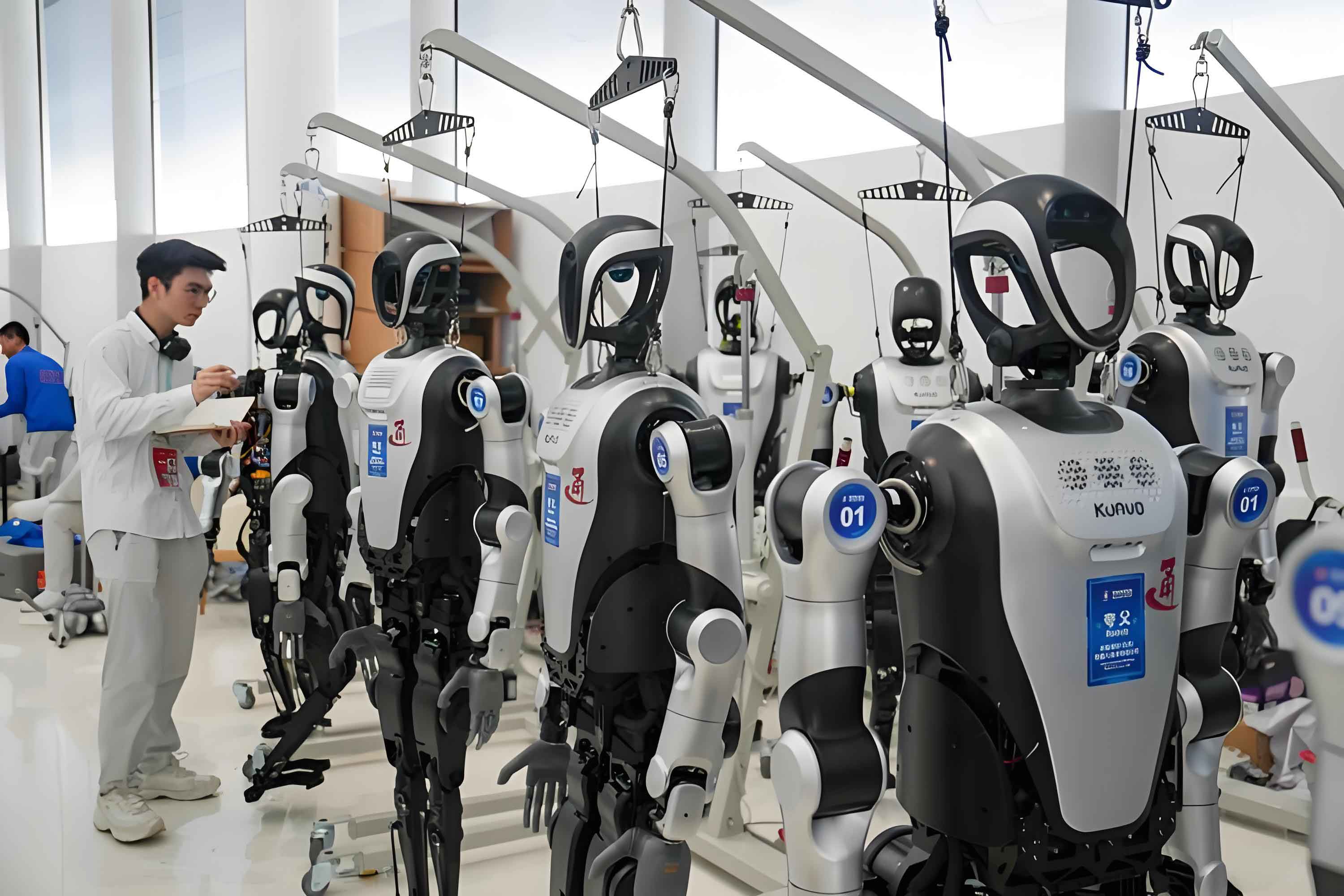
The control system of our AI human robot is centered around the NVIDIA Jetson Nano, which provides substantial computational power for AI tasks. This embedded board runs Ubuntu 18.04 LTS and is equipped with a quad-core Cortex-A57 processor, a 128-core Maxwell GPU, and 4 GB LPDDR4 memory. It supports multiple sensor inputs and can execute complex neural networks in real-time. We installed the Robot Operating System (ROS) on the Jetson Nano to manage hardware abstraction, device control, and inter-process communication. ROS facilitates the integration of various modules, such as sensor drivers and motion planners, enabling seamless operation of the AI human robot. The system architecture includes sensor data acquisition, processing, and actuator control loops, all coordinated through ROS nodes.
In terms of power management, the Jetson Nano operates in 5W/10W modes with a 5V DC input, allowing for battery-powered operation. This is crucial for the mobility of the AI human robot, as it can function independently without external power sources. The control software is written in Python and C++, utilizing ROS packages for kinematics and dynamics calculations. For instance, the inverse kinematics for leg movements are solved using the following formulation:
$$ \mathbf{q} = f^{-1}(\mathbf{x}) $$
where $\mathbf{q}$ represents the joint angles and $\mathbf{x}$ denotes the desired end-effector position. We employ numerical methods to compute $\mathbf{q}$ in real-time, ensuring accurate foot placement during walking. The control loop runs at a high frequency to maintain stability, with sensor feedback continuously updating the joint commands.
One of the key features of our AI human robot is its visual recognition system, which relies on an IMX219 camera with 8-megapixel resolution. This camera is compact and integrates seamlessly with the Jetson Nano, providing high-quality image data for AI processing. We implemented the YOLO (You Only Look Once) algorithm for object detection, which processes images at high speeds and identifies multiple objects simultaneously. The detection confidence for an object $o$ is given by:
$$ P(o | \mathbf{I}) = \sigma(\mathbf{W} * \mathbf{I} + \mathbf{b}) $$
where $\mathbf{I}$ is the input image, $\mathbf{W}$ and $\mathbf{b}$ are learned weights and biases, and $\sigma$ is the sigmoid function. This allows the AI human robot to recognize items in its environment and react accordingly. Additionally, we use MediaPipe for gesture recognition, enabling the robot to interpret human hand signals and perform actions like waving or pointing. For pose estimation, OpenPose is employed to detect human body keypoints, and we use spatial vector analysis to compute joint angles. The angle $\theta$ between two vectors $\mathbf{v}_1$ and $\mathbf{v}_2$ is calculated as:
$$ \theta = \cos^{-1}\left( \frac{\mathbf{v}_1 \cdot \mathbf{v}_2}{\|\mathbf{v}_1\| \|\mathbf{v}_2\|} \right) $$
This information is transmitted to the舵机 control board, allowing the AI human robot to mimic human poses accurately.
For navigation and obstacle avoidance, our AI human robot incorporates laser rangefinders and infrared sensors to gather spatial data. These sensors provide distance measurements to obstacles, which are processed using a particle swarm optimization (PSO) algorithm for global path planning. The PSO algorithm iteratively updates particle positions $\mathbf{x}_i$ and velocities $\mathbf{v}_i$ based on the following equations:
$$ \mathbf{v}_i^{t+1} = w \mathbf{v}_i^t + c_1 r_1 (\mathbf{p}_i – \mathbf{x}_i^t) + c_2 r_2 (\mathbf{g} – \mathbf{x}_i^t) $$
$$ \mathbf{x}_i^{t+1} = \mathbf{x}_i^t + \mathbf{v}_i^{t+1} $$
where $w$ is the inertia weight, $c_1$ and $c_2$ are acceleration coefficients, $r_1$ and $r_2$ are random numbers, $\mathbf{p}_i$ is the personal best position, and $\mathbf{g}$ is the global best position. This enables the AI human robot to find optimal paths to target locations while avoiding obstacles. Moreover, we designed a multilayer perceptron neural network for local path planning. The network takes nine inputs: four obstacle distances from sensors, four distances to the target, and the angle difference between the current heading and the target direction. The output is the desired movement angle $\phi$, computed as:
$$ \phi = f_{\text{NN}}(\mathbf{d}_{\text{obs}}, \mathbf{d}_{\text{target}}, \Delta \theta) $$
where $f_{\text{NN}}$ is the neural network function. This approach allows the AI human robot to navigate complex environments autonomously, adjusting its path in real-time based on sensor inputs.
| Sensor Type | Function | Key Parameters |
|---|---|---|
| IMX219 Camera | Visual recognition and pose estimation | 8 MP resolution, 25 mm × 24 mm size |
| Laser Rangefinder | Distance measurement for obstacle detection | Range: up to 10 m, accuracy: ±1 cm |
| Infrared Sensor | Proximity sensing and obstacle avoidance | Range: 2-30 cm, response time: <10 ms |
| 9-Axis IMU | Attitude estimation and motion tracking | 3-axis accelerometer, gyroscope, magnetometer |
Attitude correction is another critical aspect of our AI human robot, achieved through a 9-axis inertial measurement unit (IMU). The IMU provides data on acceleration, angular velocity, and magnetic field, which are fused using a Kalman filter to estimate the robot’s orientation. The state vector $\mathbf{x}$ includes orientation angles (roll $\phi$, pitch $\theta$, yaw $\psi$), and the filter predicts and updates these states based on sensor measurements. The prediction step is given by:
$$ \hat{\mathbf{x}}_k = \mathbf{F} \mathbf{x}_{k-1} + \mathbf{B} \mathbf{u}_k $$
$$ \hat{\mathbf{P}}_k = \mathbf{F} \mathbf{P}_{k-1} \mathbf{F}^T + \mathbf{Q} $$
where $\mathbf{F}$ is the state transition matrix, $\mathbf{B}$ is the control input matrix, $\mathbf{u}_k$ is the control vector, $\mathbf{P}$ is the error covariance, and $\mathbf{Q}$ is the process noise covariance. The update step incorporates sensor data to refine the estimate, ensuring stable attitude control during movement. This allows the AI human robot to maintain balance on uneven terrain and recover from disturbances.
In terms of software architecture, we developed ROS nodes for each functional module, such as sensor drivers, motion planners, and AI models. The nodes communicate via topics and services, enabling decentralized processing. For example, the camera node publishes image data to a topic, which is subscribed by the YOLO node for object detection. Similarly, the IMU node streams orientation data to the control node for attitude correction. This modular design enhances the scalability and maintainability of the AI human robot system. We also implemented a gait generation module that uses zero-moment point (ZMP) theory for dynamic stability. The ZMP is computed as:
$$ x_{\text{zmp}} = \frac{\sum m_i (x_i (\ddot{z}_i + g) – z_i \ddot{x}_i)}{\sum m_i (\ddot{z}_i + g)} $$
$$ y_{\text{zmp}} = \frac{\sum m_i (y_i (\ddot{z}_i + g) – z_i \ddot{y}_i)}{\sum m_i (\ddot{z}_i + g)} $$
where $m_i$ is the mass of segment $i$, $(x_i, y_i, z_i)$ are its coordinates, and $g$ is gravity. By ensuring the ZMP remains within the support polygon, the AI human robot achieves stable walking.
We conducted extensive experiments to evaluate the performance of our AI human robot. In tests involving obstacle-filled environments, the robot successfully navigated to targets with an average success rate of 95%. The visual recognition system achieved an accuracy of 90% in gesture identification and 85% in pose imitation. Table below summarizes the experimental results for various functionalities.
| Functionality | Metric | Result |
|---|---|---|
| Obstacle Avoidance | Success Rate | 95% |
| Gesture Recognition | Accuracy | 90% |
| Pose Imitation | Accuracy | 85% |
| Walking Stability | ZMP Deviation | < ±2 cm |
| Battery Life | Operation Time | 2 hours |
The integration of AI technologies has significantly enhanced the capabilities of our biped humanoid robot, making it a robust platform for research and practical applications. The use of Jetson Nano provides ample computational resources for running complex algorithms in real-time, while the modular ROS-based software ensures flexibility. Future work will focus on improving the AI human robot’s autonomy through reinforcement learning and expanding its sensor suite for more nuanced environmental interaction. We believe that advancements in AI human robot design will continue to drive innovation in fields such as service robotics, healthcare, and education.
In conclusion, our intelligent biped humanoid robot demonstrates the effective fusion of mechanical design, sensor integration, and AI algorithms. The Jetson Nano serves as a powerful brain for this AI human robot, enabling sophisticated behaviors like visual perception, navigation, and姿态矫正. Through rigorous testing, we have validated its performance in various scenarios, highlighting its potential for real-world deployment. As AI and robotics evolve, we anticipate that such AI human robots will become increasingly integral to society, performing tasks that require human-like dexterity and intelligence.