
In the field of dynamic force measurement, the six-axis force sensor plays a critical role by simultaneously detecting three orthogonal forces (Fx, Fy, Fz) and three orthogonal moments (Mx, My, Mz) in spatial force systems. Piezoelectric six-axis force sensors, as non-elastic electrical sensors, are particularly suited for dynamic applications due to their high sensitivity and fast response. However, structural and error-induced coupling significantly impair their accuracy, leading to challenges in high-precision domains such as robotics, heavy-duty manufacturing, and aerospace. This paper addresses these issues by proposing a decoupling algorithm based on a Radial Basis Function (RBF) neural network. The algorithm aims to mitigate inter-dimensional coupling errors and improve linearity, thereby enhancing the overall performance of the sensor.
The measurement principle of the six-axis force sensor relies on the strategic arrangement of piezoelectric quartz crystal groups. Forces and moments are derived from the outputs at four support points, where orthogonal forces are obtained by summing algebraic outputs and moments are calculated based on force distributions and positional relationships. The sensor’s performance is evaluated using Class I and Class II errors. Class I error refers to the deviation in the output when a single force component is applied, while Class II error represents the coupling effect where applying one force component induces outputs in other dimensions. The static coupling rate matrix Eβ|α is defined as:
$$ E_{\beta|\alpha} = \frac{\beta_{\text{output}}}{\beta_{\text{full-scale}}} \times 100\% $$
where βoutput is the output in dimension β when force α is applied, and βfull-scale is the full-scale value of β. Minimizing these errors is essential for achieving high accuracy in six-axis force sensor applications.
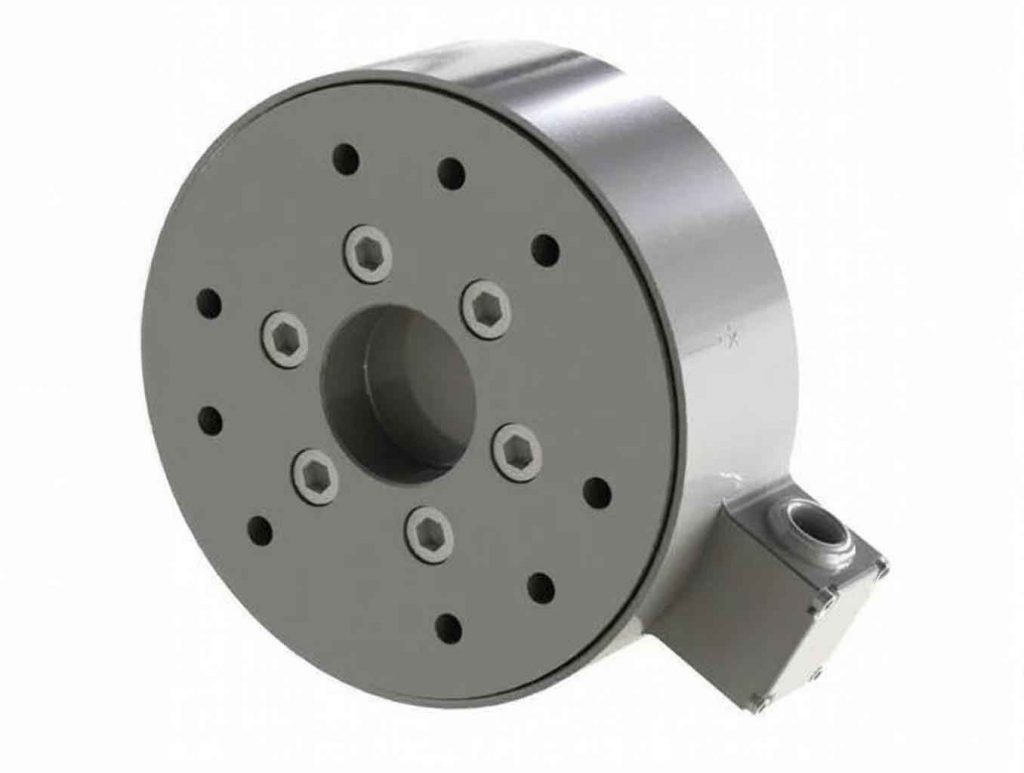
Coupling in six-axis force sensors arises from two primary sources: structural coupling, due to the mechanical design, and error-induced coupling, resulting from manufacturing and environmental factors. In this study, error-induced coupling is the focus, as it can be compensated through algorithmic approaches. The input force vector F = [Fx, Fy, Fz, Mx, My, Mz]T and output signal vector U = [UFx, UFy, UFz, UMx, UMy, UMz]T are used to analyze the coupling. Pre-decoupling tests show significant deviations and inter-dimensional influences, as illustrated in performance curves where applying a single force component results in non-zero outputs in other dimensions. For instance, when Fx is applied, outputs in My and other dimensions are observed, indicating strong coupling. This nonlinear behavior necessitates a robust decoupling method to map the complex relationship between F and U accurately.
The RBF neural network is employed for nonlinear decoupling due to its ability to approximate complex mappings. The network consists of three layers: input, hidden, and output. The input layer has six neurons corresponding to the output vector U, the hidden layer uses Gaussian radial basis functions, and the output layer has six neurons representing the force vector F. The activation function for the hidden layer is the radbas function, and the output layer uses a purelin function. The network model can be represented as:
$$ A_1 = \text{radbas}(R_1 \cdot U + B_1) $$
$$ F = \text{purelin}(R_2 \cdot A_1 + B_2) $$
where R1 and R2 are weight matrices, B1 and B2 are bias vectors, and A1 is the hidden layer output. The Gaussian function for the hidden layer is defined as:
$$ \phi_i(U) = \exp\left(-\frac{\|U – c_i\|^2}{2\sigma_i^2}\right) $$
where ci is the center vector and σi is the width parameter for the i-th neuron. The network is trained using calibration data to minimize the error between the predicted and actual force vectors. The training involves adjusting the weights and biases through iterative processes, with the goal of reducing the mean squared error below a threshold of 10−5. In this case, the hidden layer neurons are optimized to 23, achieving the desired accuracy after 23 training epochs.
Calibration experiments are conducted to collect data for decoupling. The six-axis force sensor is subjected to known force vectors, and the corresponding outputs are recorded. The data is preprocessed to normalize and remove noise, ensuring reliable training. The RBF network is then applied to learn the input-output mapping, effectively decoupling the sensor outputs. Post-decoupling, the performance curves show significantly improved linearity and reduced coupling, as the outputs align closely with the expected values. For example, when Fx is applied, the outputs in other dimensions are minimized, demonstrating the algorithm’s effectiveness.
The decoupling performance is quantified using error matrices. The force application matrix F and output matrix U from validation data are:
$$ F = \begin{bmatrix}
3000 & 0 & 0 & 0 & 0 & 0 \\
0 & 3000 & 0 & 0 & 0 & 0 \\
0 & 0 & 20000 & 0 & 0 & 0 \\
0 & 0 & 0 & 480 & 0 & 0 \\
0 & 0 & 0 & 0 & 480 & 0 \\
0 & 0 & 0 & 0 & 0 & 150
\end{bmatrix} $$
$$ U = \begin{bmatrix}
6825.3 & 8.1 & -22 & 303.33 & 4150.33 & -443.33 \\
-222.9 & 5936.4 & 67 & -2923 & -403.67 & 747.33 \\
-704.1 & -715.2 & 7790 & 410 & -819.33 & -29 \\
54.6 & -616.5 & 12 & 654.31 & 54.20 & -0.78 \\
599.4 & -24.9 & -8 & 42 & 642.00 & -0.02 \\
-12.9 & -13.5 & -14 & -5.1 & -51.84 & -453.21
\end{bmatrix} $$
After applying the RBF decoupling algorithm, the decoupled output F′RBF is:
$$ F’_{\text{RBF}} = \begin{bmatrix}
2995.83 & -0.04 & 0.77 & 2.01 & 3.06 & -1.53 \\
-0.51 & 2999.87 & 0.05 & 0.58 & -3.20 & 0.70 \\
0.54 & 0.33 & 19997.72 & -4.27 & 0.15 & -1.81 \\
0.07 & 0.03 & 0.06 & 480.00 & -0.70 & 0.19 \\
0.07 & -0.01 & -0.09 & 0.04 & 479.67 & 0.02 \\
-0.03 & 0.02 & 0.09 & -0.06 & -0.09 & 149.91
\end{bmatrix} $$
The percentage coupling error matrix ERBF is calculated as:
$$ E_{\text{RBF}} = \begin{bmatrix}
0.9223 & 0.4215 & 0.2891 & 0.0213 & 1.1026 & 0.0805 \\
0.1525 & 0.0929 & 0.0151 & 0.0405 & 0.0399 & 0.2353 \\
0.0251 & 0.1651 & 0.0261 & 0.1707 & 0.0086 & 0.1142 \\
0.1997 & 0.1694 & 0.0011 & 0.3419 & 0.0206 & 0.1016 \\
1.5576 & 0.4071 & 0.2978 & 0.0912 & 1.2924 & 0.1200 \\
0.0315 & 0.6649 & 0.4263 & 1.0885 & 0.0499 & 0.0828
\end{bmatrix} $$
From this matrix, the Class I and Class II errors are derived. The maximum Class I error is 1.29% for My, and the maximum Class II error is 1.56% when Fx couples into My. These results indicate that the RBF-based decoupling algorithm successfully reduces errors below the 2% threshold, meeting the requirements for high-precision applications.
To further illustrate the performance, the following table summarizes the errors after decoupling for each force component:
| Force Component | Class I Error (%) | Class II Error (%) |
|---|---|---|
| Fx | 0.92 | 1.10 |
| Fy | 0.09 | 0.24 |
| Fz | 0.03 | 0.17 |
| Mx | 0.34 | 0.20 |
| My | 1.29 | 1.56 |
| Mz | 0.08 | 1.09 |
The effectiveness of the RBF neural network in decoupling the six-axis force sensor is evident from the significant reduction in both error types. The algorithm’s nonlinear approach allows it to model the complex relationships accurately, overcoming the limitations of linear methods. In comparison to average-based decoupling algorithms, which often fail to address nonlinearities, the RBF method provides superior performance, as shown by the low errors and improved linearity in post-decoupling curves.
In conclusion, the RBF neural network-based decoupling algorithm effectively addresses the coupling issues in piezoelectric six-axis force sensors. By leveraging nonlinear modeling, the algorithm minimizes Class I and Class II errors, enhancing measurement accuracy and enabling applications in precision-critical fields. Future work could explore adaptive network structures or integration with real-time systems to further optimize performance. This approach underscores the importance of advanced algorithms in overcoming the challenges associated with multi-dimensional force sensing, paving the way for more reliable and accurate six-axis force sensor implementations.
The mathematical foundation of the RBF network involves optimizing the center vectors and widths in the hidden layer. The centers can be selected using clustering methods like k-means, and the widths are determined based on the spread of data. The output weights are computed using linear regression, ensuring efficient training. The overall cost function for training is:
$$ J = \sum_{k=1}^{N} \| F_k – \hat{F}_k \|^2 $$
where N is the number of training samples, Fk is the actual force vector, and �k is the predicted vector. Minimizing J through gradient descent or pseudoinverse methods yields the optimal parameters. This process highlights the robustness of the RBF network in handling the nonlinearities inherent in six-axis force sensor data.
Additionally, the decoupling algorithm’s performance can be analyzed in terms of sensitivity and specificity. Sensitivity refers to the ability to correctly detect applied forces, while specificity indicates the rejection of coupled signals. The RBF method achieves high sensitivity and specificity by accurately mapping the input-output relationship, as demonstrated by the error matrices. For instance, the low values in off-diagonal elements of ERBF show minimal cross-talk between dimensions.
In practical applications, the decoupled six-axis force sensor can be used in robotic manipulation, where precise force control is essential. The improved accuracy ensures reliable operation in tasks such as assembly, grinding, and haptic feedback. Moreover, the algorithm’s computational efficiency allows for real-time implementation, making it suitable for dynamic environments. The use of RBF neural networks thus represents a significant advancement in sensor technology, addressing long-standing challenges in multi-dimensional force measurement.
To summarize, this paper presents a comprehensive approach to decoupling piezoelectric six-axis force sensors using RBF neural networks. The method effectively reduces coupling errors, enhances linearity, and meets the stringent requirements for high-precision applications. Through detailed analysis and experimental validation, the algorithm proves to be a viable solution for improving the performance of six-axis force sensors, contributing to their broader adoption in advanced engineering systems.