
As an observer and participant in the field of robotics and artificial intelligence, I have witnessed firsthand the transformative power of embodied intelligence in reshaping industries, particularly logistics. Embodied intelligence, which emphasizes the integration of perception, action, and cognition through physical interaction with the environment, is no longer a theoretical concept but a driving force behind the digital transformation of logistics systems. In my analysis, the emergence of embodied robots represents a paradigm shift, moving beyond traditional automated guided vehicles (AGVs) to more adaptive, intelligent systems that can learn and evolve in real-time. This article delves into how embodied robots are redefining logistics robotics, drawing from recent global exhibitions and market dynamics to provide a comprehensive overview of technological hotspots, application realities, and future prospects.
The core of embodied intelligence lies in its ability to enable robots to perceive their surroundings, make decisions, and execute actions autonomously. For logistics, this means robots can handle complex tasks such as sorting, picking, loading, and unloading with minimal human intervention. I have seen that embodied robots are not just about replacing human labor; they are about enhancing efficiency, flexibility, and scalability in supply chains. The equation that often comes to mind when evaluating these systems is the overall efficiency gain: $$ E = \frac{T_a}{T_m} \times C_r $$ where \( E \) represents efficiency, \( T_a \) is the time taken by an embodied robot, \( T_m \) is the time taken by a human, and \( C_r \) is the cost reduction factor. This formula highlights how embodied robots can outperform humans in repetitive tasks, leading to significant operational improvements.
In recent exhibitions, such as the 2025 World Robot Conference, I noted a surge in innovations centered on embodied robots, particularly humanoid and composite forms. Humanoid robots, designed to mimic human morphology, have captured widespread attention due to their potential to integrate seamlessly into existing infrastructures. However, I have observed that they can be broadly categorized into wheeled and bipedal types, each with distinct advantages and challenges. The following table summarizes key characteristics of these embodied robots based on my observations:
| Type of Embodied Robot | Key Features | Typical Applications in Logistics | Current Adoption Level |
|---|---|---|---|
| Wheeled Humanoid Robots | Combines AMR base with humanoid upper body; high mobility on flat surfaces; often equipped with AI for tasks like grasping and sorting | Sorting, picking,搬运, assembly in warehouses | Early commercialization, with pilots in pharmaceuticals and manufacturing |
| Bipedal Humanoid Robots | Mimics human walking; adaptable to uneven terrain; requires advanced balance and coordination algorithms | Complex environments like outdoor logistics yards; tasks requiring human-like dexterity | Mostly experimental; limited to research and high-profile demonstrations |
| Composite Robots | Integrates mobile platforms with robotic arms; flexible and modular; lower cost compared to humanoids | Loading/unloading, material handling, and assembly lines | Growing adoption in sectors like semiconductors and electronics; more scalable |
From my perspective, wheeled humanoid embodied robots have gained traction due to their practicality in controlled environments. For instance, I have seen prototypes that utilize advanced AI models to perform泛化 operations, such as picking randomly placed items in a warehouse. These embodied robots often rely on multi-modal visual language models (VLA) to enhance their perception and decision-making capabilities. The learning process for such embodied robots can be modeled as: $$ L = \int_{0}^{t} D(e) \, de $$ where \( L \) is the cumulative learning, \( D(e) \) is the data efficiency as a function of environmental interactions, and \( t \) is time. This integral emphasizes that embodied robots improve through continuous exposure to real-world scenarios, though data scarcity remains a bottleneck.
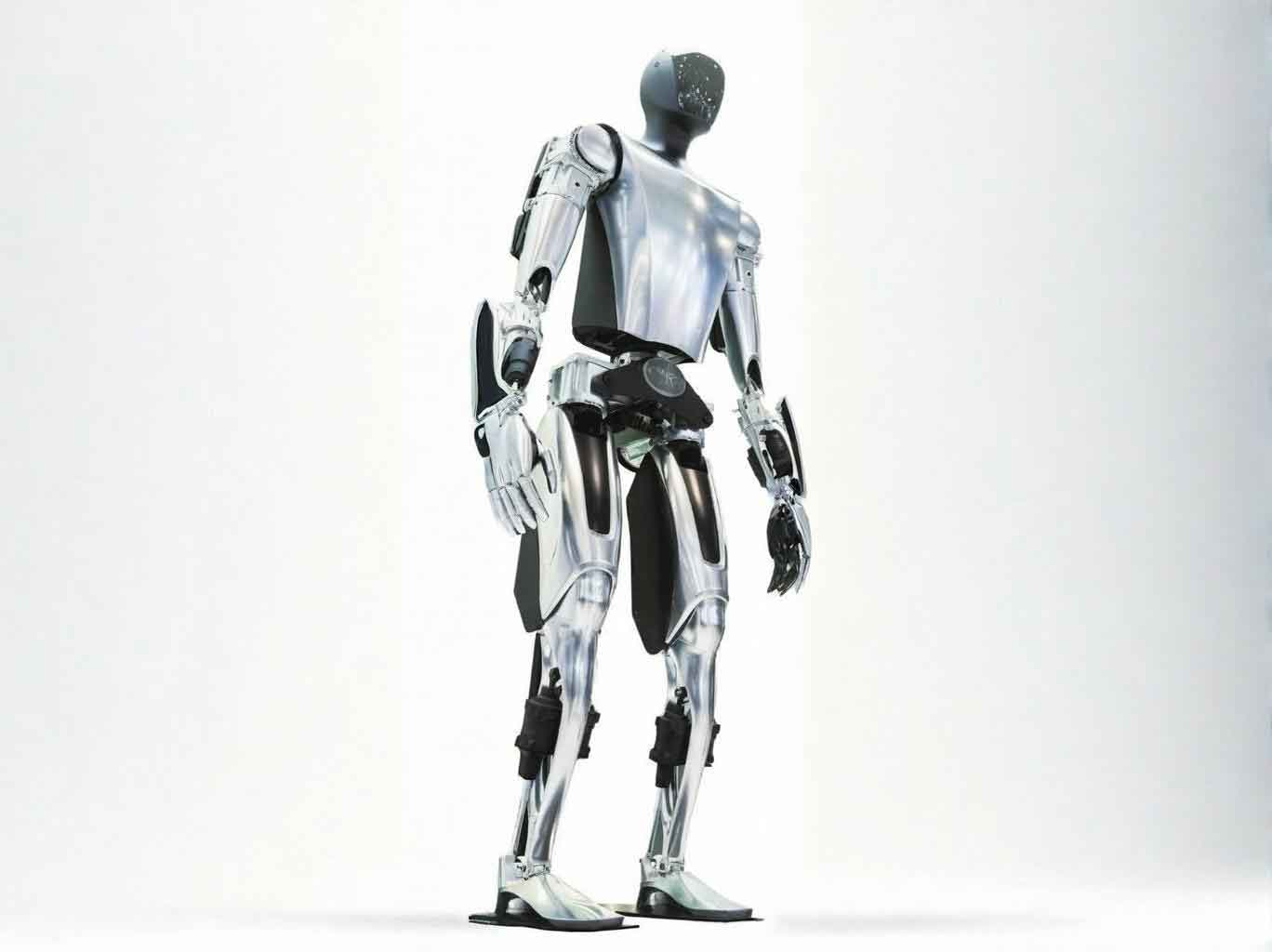
Bipedal humanoid embodied robots, while impressive in demonstrations, face significant hurdles in logistics applications. I have analyzed that their high development costs and complexity limit widespread deployment. In my view, the balance and stability required for bipedal locomotion in dynamic environments like distribution centers pose engineering challenges. However, advances in AI, such as reinforcement learning, are helping these embodied robots adapt. The cost-benefit analysis often involves equations like: $$ ROI = \frac{S – C}{C} \times 100\% $$ where \( ROI \) is return on investment, \( S \) is savings from reduced labor, and \( C \) is the total cost of the embodied robot system. Currently, for bipedal embodied robots, ROI is often negative or marginal, slowing down adoption.
In contrast, composite embodied robots offer a more immediate path to scalability. I have witnessed their deployment in loading and unloading tasks, where they combine mobility with precision manipulation. For example, autonomous unloading robots equipped with vision systems can handle varied package sizes and weights, reducing reliance on manual labor. The efficiency of these embodied robots can be quantified using metrics like throughput: $$ T = \frac{N}{t} $$ where \( T \) is throughput, \( N \) is the number of items handled, and \( t \) is time. In practice, I have seen composite embodied robots achieve throughput rates comparable to humans in structured settings, with the added benefit of 24/7 operation.
Another area where embodied robots are making strides is in mobile协作 robots, which blend AGV functionality with robotic arms. From my observations, these systems are particularly valuable in flexible manufacturing and logistics lines, where they can perform tasks like part feeding and inspection without extensive reconfiguration. The adaptability of such embodied robots is often enhanced by AI algorithms that enable path planning and obstacle avoidance. A key formula I use to assess their performance is the flexibility index: $$ F = \frac{A_d}{A_t} $$ where \( F \) is flexibility, \( A_d \) is the number of adaptable tasks, and \( A_t \) is the total tasks possible. Embodied robots with high \( F \) scores can quickly switch between roles, such as from picking to packing, in response to demand fluctuations.
The evolution of logistics robotics from AGVs to embodied robots marks a significant technological leap. I recall that early AGVs followed fixed paths, whereas modern embodied robots like AMRs use SLAM and computer vision for autonomous navigation. This shift is driven by the need for higher flexibility in e-commerce and omnichannel logistics. In my analysis, the integration of embodied intelligence allows these robots to learn from interactions, leading to continuous improvement. The learning rate can be expressed as: $$ LR = \frac{\Delta P}{\Delta E} $$ where \( LR \) is the learning rate, \( \Delta P \) is the change in performance, and \( \Delta E \) is the change in experience or data points. As embodied robots accumulate more operational data, their \( LR \) increases, making them more efficient over time.
Looking ahead, I believe that embodied robots will become ubiquitous in logistics, but several challenges must be addressed. Data privacy, interoperability standards, and initial investment costs are key concerns. From my experience, collaborative efforts between robotics firms and logistics providers are crucial to accelerating adoption. The future growth of embodied robots can be projected using logistic growth models: $$ G(t) = \frac{K}{1 + e^{-r(t-t_0)}} $$ where \( G(t) \) is the adoption level at time \( t \), \( K \) is the carrying capacity or maximum potential adoption, \( r \) is the growth rate, and \( t_0 \) is the inflection point. Based on current trends, I estimate that embodied robots will reach significant market penetration in logistics within the next decade, driven by advancements in AI and cost reductions.
In conclusion, as an advocate for innovation in logistics, I am excited by the potential of embodied robots to revolutionize the industry. These systems are not just incremental improvements but represent a fundamental rethinking of how robots interact with their environment. By leveraging embodied intelligence, logistics operations can achieve unprecedented levels of efficiency, resilience, and sustainability. The journey ahead will require continued research, investment, and collaboration, but the rewards—a smarter, more adaptive supply chain—are well worth the effort. Embodied robots are poised to become the backbone of future logistics, and I look forward to witnessing their ongoing evolution.