
As an observer deeply embedded in the industrial transformation, I have witnessed a remarkable shift: automotive components suppliers are increasingly pivoting toward the burgeoning field of humanoid robots. This movement is not merely a trend but a strategic necessity, driven by the saturation of traditional automotive markets and the quest for a second growth curve. Over the past year, the evolution of humanoid robots has accelerated exponentially, transitioning from clumsy prototypes to agile performers capable of complex tasks. In this article, I will explore how suppliers are leveraging their expertise in areas like powertrains, sensors, and autonomous driving to capitalize on the opportunities in humanoid robotics, supported by data, tables, and mathematical models to illustrate key points.
The rapid advancement of humanoid robots is nothing short of revolutionary. Just a year ago, these machines struggled with basic locomotion; today, they participate in coordinated activities that mimic human athleticism, showcasing improvements in hardware, control algorithms, and artificial intelligence. This progress positions countries like China at the forefront of the global supply chain, with undeniable advantages in integration and innovation. For instance, public demonstrations have highlighted the seamless coordination of humanoid robots in group performances, underscoring their potential for mass adoption. The commercialization of humanoid robots is accelerating, with 2025 poised to be a landmark year for initial mass production, fueled by substantial investments from major tech conglomerates. The market for humanoid robots is projected to expand from a modest base in 2024 to a multi-billion-dollar industry by 2030, reflecting a compound annual growth rate that underscores its viability as a growth vector.
In the automotive sector, however, the landscape is increasingly challenging. Developed markets face saturation, while even thriving regions like China’s新能源汽车 sector are approaching overcapacity. Data indicates a significant rise in inventory levels, with turnover periods exceeding healthy benchmarks, compounded by relentless price wars that erode profitability across the supply chain. This environment forces suppliers to seek diversification, and humanoid robots present a compelling avenue. The technological synergies between automotive components and humanoid robotics are profound; for example, robotic joints share similarities with electric drives in vehicles, both relying on battery power and sophisticated control systems. Moreover, the perception-planning-action loop in humanoid robots mirrors that of advanced driver-assistance systems (ADAS), allowing suppliers to repurpose existing capabilities. As one industry insider, I believe that this convergence is not just opportunistic but essential for sustaining growth in an era of disruption.
To quantify the market potential, consider the following table summarizing the projected growth in the humanoid robot industry. This data highlights key metrics that suppliers are monitoring to guide their strategic investments.
| Year | Global Market Size (in billion USD) | Annual Growth Rate (%) | Key Drivers |
|---|---|---|---|
| 2024 | ~3.8 | — | Initial commercialization, R&D investments |
| 2025 | ~5.5 | 44.7 | Mass production beginnings, tech advancements |
| 2026 | ~8.2 | 49.1 | Expansion into industrial and service sectors |
| 2027 | ~12.1 | 47.6 | Improved AI integration, cost reductions |
| 2028 | ~17.5 | 44.6 | Scalability in manufacturing, regulatory support |
| 2029 | ~24.8 | 41.7 | Adoption in healthcare and logistics |
| 2030 | ~35.0 | 41.1 | Market maturation, diverse applications |
The mathematical underpinnings of humanoid robot dynamics further illustrate why automotive suppliers are well-suited for this transition. For instance, the motion control of humanoid robots can be modeled using Lagrangian mechanics, where the generalized forces relate to the system’s kinetic and potential energy. A common formulation for robotic joint control is given by:
$$ \tau = M(q)\ddot{q} + C(q, \dot{q})\dot{q} + g(q) $$
Here, \( \tau \) represents the torque vector applied to the joints, \( M(q) \) is the inertia matrix, \( C(q, \dot{q}) \) accounts for Coriolis and centrifugal forces, and \( g(q) \) denotes gravitational effects. This equation is analogous to the dynamics in electric vehicle drivetrains, where suppliers have honed their skills in optimizing efficiency and stability. Additionally, the energy management in humanoid robots relies on battery systems similar to those in electric vehicles, with capacity and discharge rates critical for prolonged operation. The state of charge (SOC) can be expressed as:
$$ \text{SOC}(t) = \text{SOC}_0 – \int_0^t \frac{I(\tau)}{C} \, d\tau $$
where \( I(\tau) \) is the current and \( C \) is the battery capacity. Such formulas are familiar terrain for suppliers experienced in automotive electrification, enabling them to adapt quickly to the demands of humanoid robots.
In terms of technological overlap, the perception systems of humanoid robots heavily depend on sensors like lidar and cameras, which are staples in autonomous driving. The data fusion from multiple sensors can be modeled using Bayesian filtering techniques, such as the Kalman filter, which estimates the state of a system from noisy observations. For a humanoid robot navigating an environment, the state prediction and update steps are:
$$ \hat{x}_{k|k-1} = F_k \hat{x}_{k-1|k-1} + B_k u_k $$
$$ P_{k|k-1} = F_k P_{k-1|k-1} F_k^T + Q_k $$
$$ K_k = P_{k|k-1} H_k^T (H_k P_{k|k-1} H_k^T + R_k)^{-1} $$
$$ \hat{x}_{k|k} = \hat{x}_{k|k-1} + K_k (z_k – H_k \hat{x}_{k|k-1}) $$
$$ P_{k|k} = (I – K_k H_k) P_{k|k-1} $$
where \( \hat{x} \) is the state estimate, \( P \) is the error covariance, \( F \) and \( B \) are system matrices, \( u \) is control input, \( H \) is observation matrix, \( z \) is measurement, and \( K \) is the Kalman gain. This mathematical framework is integral to both autonomous vehicles and humanoid robots, allowing suppliers to transfer algorithms and hardware designs seamlessly. For example, a leading lidar supplier reported a dramatic surge in revenue from robotics applications, despite declines in automotive segments, highlighting how diversification into humanoid robots can offset market volatilities.
Another critical area is the development of integrated control systems for humanoid robots. Suppliers are innovating in “brain-like” controllers that combine computation, power management, and thermal regulation into compact units. This addresses common bottlenecks in humanoid robot design, such as limited space and insufficient processing power. The heat dissipation in these systems can be analyzed using Fourier’s law of heat conduction:
$$ q = -k \nabla T $$
where \( q \) is the heat flux, \( k \) is thermal conductivity, and \( \nabla T \) is the temperature gradient. By integrating cooling solutions directly into the controller, suppliers enhance the reliability and performance of humanoid robots, much like they do in automotive electronic control units (ECUs).
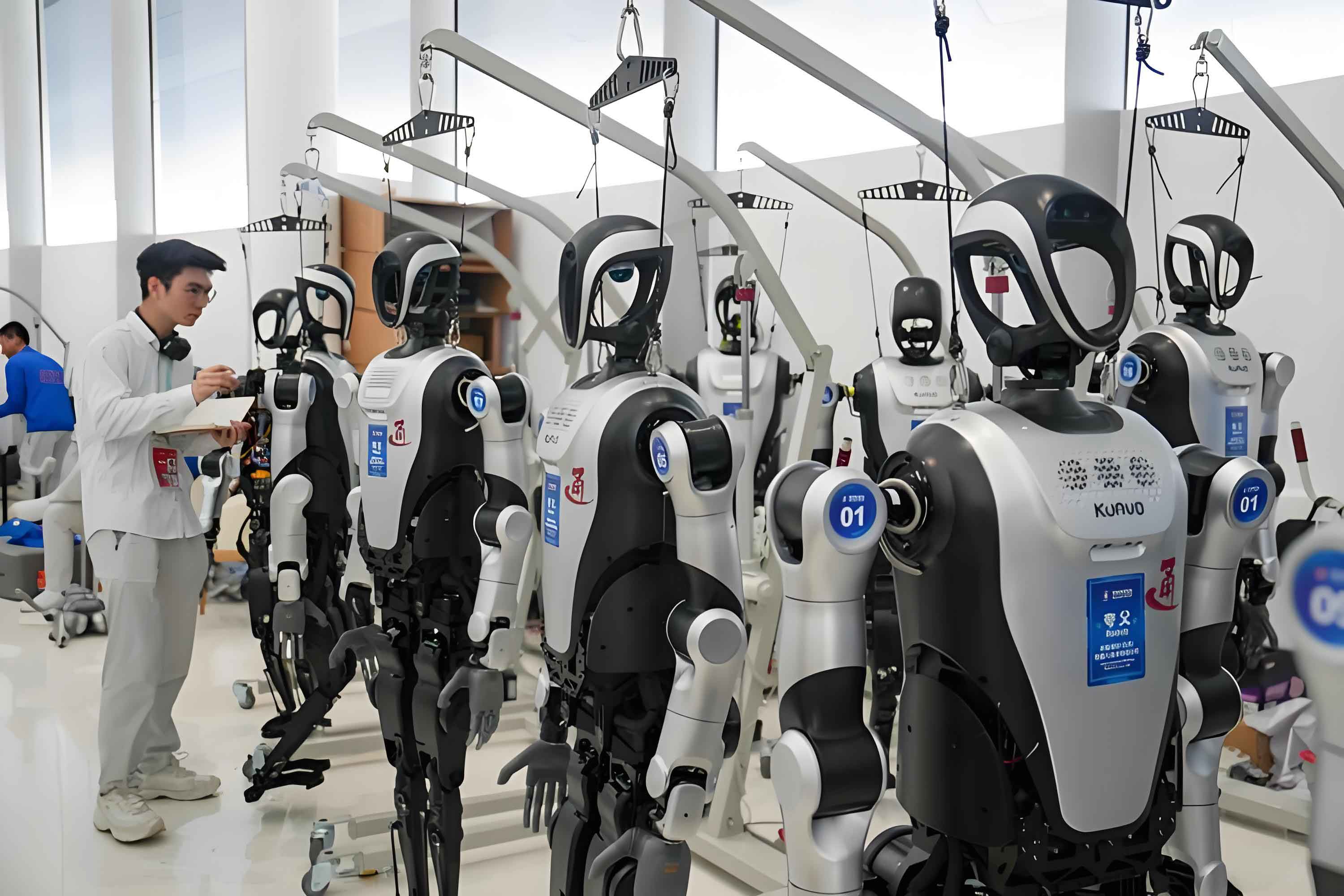
Quality inspection is paramount in the manufacturing of humanoid robots, as depicted in the image above. This process leverages automated vision systems and sensor networks to ensure precision and durability—areas where automotive suppliers excel due to their experience in mass production and quality control. Statistical process control methods, such as control charts, are employed to monitor production metrics. For instance, the mean and range of critical dimensions can be tracked using:
$$ \bar{X} = \frac{\sum_{i=1}^n X_i}{n} $$
$$ R = \max(X_i) – \min(X_i) $$
where \( \bar{X} \) is the sample mean and \( R \) is the range. These techniques help maintain consistency in the assembly of humanoid robots, reducing defects and enhancing scalability.
The following table compares key technological components between automotive systems and humanoid robots, illustrating the transferable expertise that suppliers bring to this new domain.
| Technology Component | Automotive Application | Humanoid Robot Application | Synergies |
|---|---|---|---|
| Electric Drives | Propulsion systems in EVs | Joint actuators for locomotion | High torque density, efficiency optimization |
| Battery Systems | Energy storage for vehicles | Power source for autonomous operation | BMS integration, fast-charging capabilities |
| Sensors (Lidar, Cameras) | ADAS for obstacle detection | Environmental perception and navigation | Data fusion algorithms, real-time processing |
| Control Algorithms | Vehicle stability control | Balance and gait control | PID controllers, adaptive learning |
| Thermal Management | Engine and battery cooling | Heat dissipation in compact enclosures | Active and passive cooling solutions |
| Materials Science | Lightweight composites for fuel efficiency | Durable, lightweight frames for agility | Advanced alloys and polymers |
From my perspective, the integration of humanoid robots into various sectors—such as industrial manufacturing, healthcare, and logistics—is inevitable. Suppliers are already developing specialized components like planetary roller screws for precise joint movements and compact bearings for enhanced mobility. The kinematics of humanoid robot arms, for example, can be described using Denavit-Hartenberg parameters, which define the relationship between consecutive links:
$$ A_i = \begin{pmatrix} \cos\theta_i & -\sin\theta_i \cos\alpha_i & \sin\theta_i \sin\alpha_i & a_i \cos\theta_i \\ \sin\theta_i & \cos\theta_i \cos\alpha_i & -\cos\theta_i \sin\alpha_i & a_i \sin\theta_i \\ 0 & \sin\alpha_i & \cos\alpha_i & d_i \\ 0 & 0 & 0 & 1 \end{pmatrix} $$
where \( \theta_i \), \( d_i \), \( a_i \), and \( \alpha_i \) are joint angle, link offset, link length, and twist angle, respectively. This matrix facilitates the calculation of end-effector positions, a concept familiar from robotic welding in automotive assembly lines.
Moreover, the economic impact of this shift is substantial. As suppliers allocate more resources to humanoid robots, we observe a rebalancing of revenue streams. For instance, one company reported that robotics-related sales now constitute over a third of total revenue, up from a negligible share just a year ago. This trend is likely to accelerate as humanoid robots achieve greater autonomy through advancements in AI. The learning process in humanoid robots often involves reinforcement learning, where an agent maximizes cumulative reward:
$$ J(\pi) = \mathbb{E} \left[ \sum_{t=0}^\infty \gamma^t R(s_t, a_t) \right] $$
Here, \( \pi \) is the policy, \( \gamma \) is the discount factor, and \( R \) is the reward function. Collaborations between suppliers and AI firms are focusing on embedding such models into humanoid robots, enabling them to adapt to dynamic environments—a capability crucial for applications like elderly care or disaster response.
In conclusion, the pursuit of a second growth curve through humanoid robots is a strategic imperative for automotive components suppliers. The alignment of technologies, coupled with market forces, creates a fertile ground for innovation. As we move toward mass production, challenges such as cost reduction and interoperability will persist, but the foundational expertise of suppliers positions them to lead this transformation. The future of humanoid robots is not just about mimicking humans but about enhancing human capabilities, and I am confident that this synergy will redefine industries in the decades to come.
To further illustrate the financial aspects, consider the following table on investment trends in humanoid robotics, which reflects the growing confidence in this sector.
| Year | Total Funding (in million USD) | Number of Major Deals | Notable Investor Types |
|---|---|---|---|
| 2023 | ~450 | 15 | Venture capital, tech giants |
| 2024 | ~1,200 | 28 | Automotive suppliers, private equity |
| 2025 | ~2,500 | 42 | Cross-industry conglomerates |
This influx of capital underscores the long-term potential of humanoid robots, and as suppliers continue to innovate, we can expect breakthroughs that make these machines integral to everyday life. The journey has just begun, and I am excited to be part of this evolution, where the boundaries between automotive and robotics blur, creating new horizons for growth and collaboration.