
The 2025 World Humanoid Robot Games, held from August 14 to 17 at the National Speed Skating Oval in Beijing, marked a historic milestone as the world’s first comprehensive sports event exclusively featuring humanoid robots as participants. This grand gathering brought together 280 teams from 16 countries, competing across 26 categories including athletic contests, performance demonstrations, scenario-based challenges, and peripheral events, totaling 487 matches. The games vividly displayed the cutting-edge advancements in intelligent decision-making, motion coordination, and collaborative capabilities of humanoid robots, underscoring their growing role in the global technology landscape.
The opening ceremony captivated audiences with a series of spectacular performances by humanoid robots, including street dancing, traditional opera singing, and fashion shows, highlighting the seamless fusion of technology and human culture. A defining moment was the parade of 25 Booster T1 humanoid robots, developed by Beijing Acceleration Evolution Technology Co., Ltd., which marched in a precise 5×5 formation—the first time in history that humanoid robots have participated in such a ceremonial procession. This display not only showcased the robots’ physical dexterity but also symbolized the rapid progress in humanoid robot development.
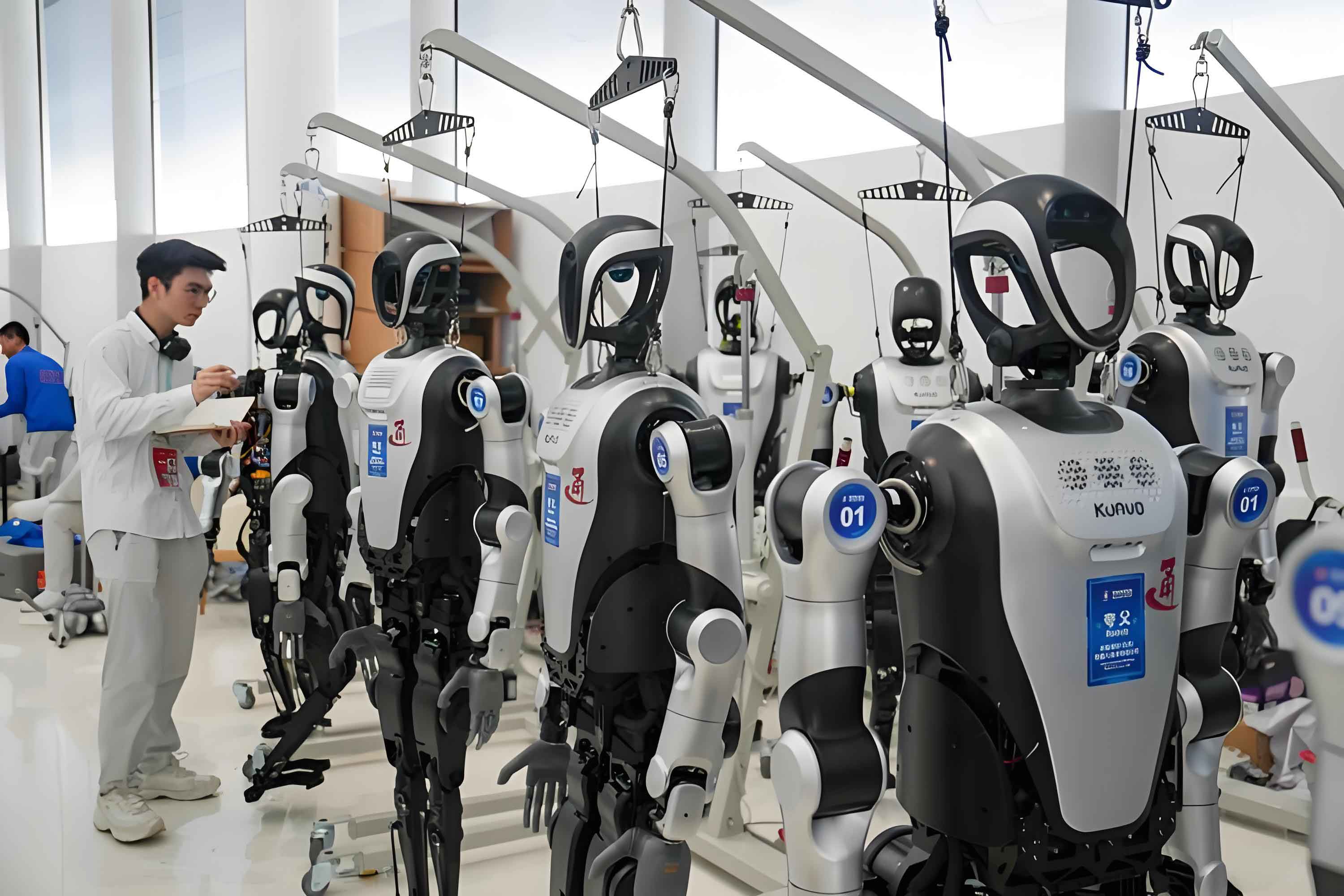
In an interview, Zhao Weichen, Vice President of Acceleration Evolution, emphasized the company’s role as a “developer ecosystem builder” rather than just a hardware provider. “We open-sourced the 3v3 brain decision-making algorithm for the games and offered a suite of development tools and training courses, enabling even high school teams with no prior experience to create competitive programs within two weeks,” he said. This approach highlights how the humanoid robot industry is fostering collaboration and accelerating innovation through shared resources.
The games featured a diverse range of competitions, putting humanoid robots to the test in events like track and field, soccer, and combat sports. On August 15, the 400-meter race saw four humanoid robots sprinting from the starting line with remarkable stability and speed. One standout was the humanoid robot developed by Guangzhou Gaoqing Electromechanical Technology Co., Ltd., which attracted significant attention for its advanced motor technology. Ren Haidong, the company’s Business Director, explained that their humanoid robot utilized self-developed high-performance modular motors capable of sustained operation for up to two hours without overheating. “Addressing heat dissipation during high-speed motion is critical for humanoid robot running, and autonomous navigation based on visual obstacle recognition is currently the most effective method,” he noted, pointing to the importance of robust sensory systems in humanoid robot design.
In the 3v3 soccer matches, teams demonstrated the strategic programming behind humanoid robot movements. Zhang Peihao, a member of the “Chiwen” team from Beijing University of Civil Engineering and Architecture, shared insights into their preparation. “Once the robots are activated on the field, they must operate independently—identifying teammates for passes, competing for the ball against opponents, and executing maneuvers like dribbling. Our focus was on enhancing programming to enable effective obstacle avoidance and coordination among humanoid robots,” he said. This underscores the complexity of developing humanoid robots that can perform in dynamic, real-world environments.
The event served as a vital platform for learning and exchange among global experts in humanoid robot research and application. Xue Qingheng, Deputy General Manager and Head of the Humanoid Robot Business Unit at City Between (Beijing) Technology Co., Ltd., whose company participated in events like the 1500-meter and 100-meter races and a freestyle dance competition, described a poignant moment during the opening ceremony. “When all the humanoid robots turned to face the Chinese national flag and paid respects during the anthem, it felt as if these machines had been imbued with a spiritual core. It symbolized China’s humanoid robot technology advancing confidently onto the world stage,” he reflected. Xue added that the games allowed them to test their self-developed algorithms for speed and coordination while fostering international dialogue to drive humanoid robot technology toward more intelligent and practical applications.
For student participants like Zhang Peihao, the games were an eye-opening experience. “Interacting with high school tech prodigies, postgraduate researchers, and industry professionals broadened my perspective. Their expertise and innovative thinking revealed areas for improvement and ignited my determination to excel in the humanoid robot field,” he said. This collaborative spirit is essential for nurturing the next generation of humanoid robot developers.
The significance of hosting such humanoid robot competitions extends beyond mere spectacle. Xue Qingheng views them as a multi-faceted engine for industry growth: “These events are a practical testing ground for technological iteration, a resource integrator for the industry ecosystem, an empirical reference for standards, and an incubation platform for commercialization and IP value.” Similarly, Li Yuhui, General Manager of Zhikan Shenjian (Beijing) Technology Co., Ltd., emphasized that humanoid robot games expose product weaknesses in high-intensity environments, accelerating technical refinement. “This competition-driven training model fosters technical exchange and continuous improvement in the humanoid robot sector,” she stated.
Wang Yifan, Deputy General Manager of Beijing Yizhuang Robot Technology Industrial Development Co., Ltd., highlighted the broader implications for the humanoid robot industry. “With many B2B and consumer scenarios still underdeveloped, these games provide a high-tech, globalized testing ground. By promoting research through competition, aggregating supply chains, and cultivating talent, we can transform scattered innovations into cohesive industry growth. This is a crucial step in moving humanoid robots from laboratory prototypes to market-ready products,” he explained.
Looking ahead, the future of humanoid robots is poised for transformative growth. Xue Qinghen predicts trends such as “technological upgrades, deeper scenario integration, ecosystem maturation, and standardized regulations.” He elaborated that advancements in general-purpose spatial intelligence models and enhanced multimodal perception fusion will be key drivers. Li Yuhui concurred, noting that commercialization will require time and expanded application scenarios to spur iterative technological progress. “The development of humanoid robots must focus on breakthroughs in areas like universal spatial AI models and robust multi-modal perception systems. As we explore more use cases, humanoid robot technology will evolve rapidly,” she said.
Wang Yifan expressed optimism about the prospects for humanoid robots, citing diversified technological development, gradual expansion into practical applications, and the establishment of industrial governance frameworks. “As industry standards, safety protocols, certification systems, and ethical guidelines take shape, humanoid robots will accelerate their transition from experimental technologies to large-scale deployment, becoming a powerful force in industrial transformation,” he affirmed.
The 2025 World Humanoid Robot Games not only celebrated the current capabilities of humanoid robots but also laid the groundwork for future innovations. By bringing together diverse stakeholders—from students to corporate leaders—the event reinforced the importance of collaboration in advancing humanoid robot technology. As the industry continues to evolve, such gatherings will play a pivotal role in shaping a future where humanoid robots seamlessly integrate into everyday life, driving progress across sectors like manufacturing, healthcare, and entertainment. The games demonstrated that humanoid robots are not just tools but partners in redefining human-machine interaction, with the potential to address global challenges and enhance quality of life worldwide.
In summary, the humanoid robot games served as a catalyst for technological exchange and industry synergy. The participation of teams from various backgrounds underscored the universal appeal and applicability of humanoid robot solutions. As research intensifies and investment flows into this sector, we can expect humanoid robots to become more adaptive, efficient, and accessible. The event’s legacy will likely inspire similar initiatives globally, fostering a competitive yet cooperative environment that accelerates the maturation of humanoid robot ecosystems. Ultimately, the 2025 games highlighted that the journey of humanoid robot development is a collective endeavor, one that promises to reshape our world in the decades to come.