
In the context of increasing demands for power system equipment maintenance, traditional high-altitude wiring methods have revealed significant inefficiencies, high costs, and safety risks. As researchers in this field, we have focused on developing an automatic wiring robot dog, specifically a quadruped robot, to address these challenges in high-voltage transformer equipment. This article explores the impact of wiring modes on the action paths of the robot dog, detailing system composition, control software, and the design of multi-type bushing connectors. Through experimental studies, we compare manual and automatic wiring modes, analyze the robot dog’s movement paths and wiring processes, and propose technical methods to optimize action accuracy, flexibility, and safety. Our findings demonstrate that the optimized robot dog significantly enhances operational efficiency, safety, and adaptability, providing robust support for intelligent maintenance of power equipment.
The power industry faces persistent issues with manual wiring, such as prolonged downtime and exposure to hazardous conditions. We initiated this project to leverage automation and intelligence in wiring processes. The robot dog, a quadruped robot designed for climbing and precision tasks, integrates advanced sensors and control systems to navigate complex environments. This research not only highlights the robot dog’s capabilities but also emphasizes how wiring modes influence its path planning and execution, leading to improved performance in real-world scenarios like substations.
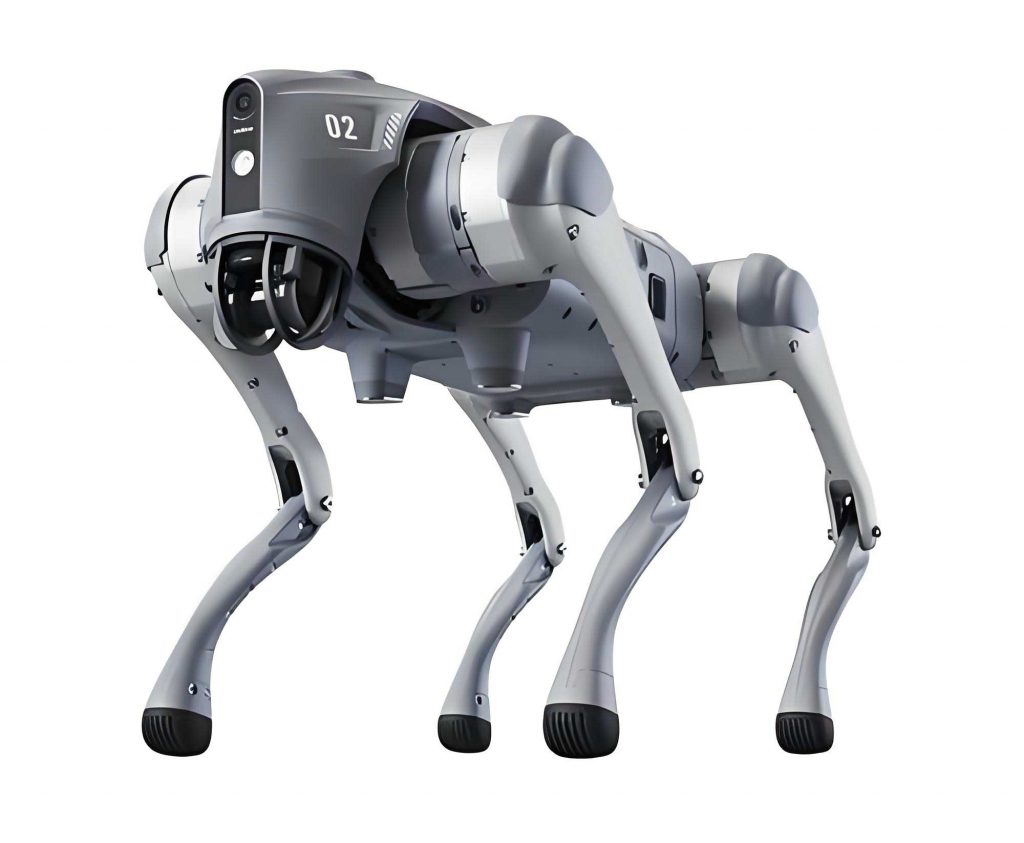
Our investigation begins with the system composition and structural design of the automatic wiring robot dog. This quadruped robot comprises three main modules: climbing, wiring, and control. The climbing module utilizes electric multi-joint arms and high-strength suction cups to ensure stable locomotion and minimize vibrations during ascent. We selected lightweight, high-strength materials to balance load capacity and self-weight, maintaining stability during high-altitude operations. The control module integrates visual feedback and a sensor network for precise scanning and path correction. The climbing speed is adjustable between 0.1 m/s and 0.5 m/s, allowing the robot dog to adapt to varied aerial wiring environments and ensure safety and efficiency. For instance, the robot dog’s design accounts for surface irregularities on transformers, enabling it to grip securely and adjust its posture in real-time.
In terms of experimental design, we conducted tests at a 500kV substation to compare manual and automatic wiring modes. The experiment involved initial debugging, wiring processes, and safety verification, with the robot dog autonomously climbing to complete wiring tasks. Data on climbing paths, wiring times, and environmental factors were recorded. Our 2024 project implementation showed that the robot dog substantially improved wiring efficiency, reduced human errors, and mitigated safety hazards. The equipment included the robot dog, wiring connectors, control modules, and high-voltage devices, tested across different heights and surface structures. The control system employs intelligent monitoring and feedback mechanisms, enabling remote real-time tracking of the robot dog’s progress. Operators can monitor statuses like wiring advancement and environmental changes via mobile devices or terminals, adjusting operations as needed. Comparative data analysis revealed that the automatic wiring mode outperforms manual methods in efficiency and equipment wear rates.
The research process delved into the technical specifications and implementation of the robot dog design. We adhered to strict technical standards to achieve precise climbing and wiring actions. The robot dog’s high-strength suction cups and sensors facilitate stable movement on diverse surfaces, with real-time adjustments to climbing routes. Field simulations validated its stability and speed on various materials. The wiring module features an automatic connector that adapts to multiple bushing specifications, using sensors to identify and adjust clamping force for stability and accuracy in high-voltage settings. The control system employs real-time feedback to optimize path planning and wiring operations, leveraging visual sensors to construct 3D models and generate shortest paths. Experimental data indicate that the robot dog can autonomously adapt its climbing strategies in complex environments, efficiently completing wiring tasks. This design prioritizes environmental adaptability and operational precision, contributing to enhanced maintenance efficiency and safety for power equipment.
A critical aspect of our study is how wiring modes affect the robot dog’s action paths. Through multiple field tests, we verified that the robot dog plans optimal climbing paths based on 3D structural models of transformer equipment. Sensors record trajectories, wiring positions, and operation times. In simple environments, the robot dog adopts the shortest path, while in complex scenarios, it automatically optimizes routes to avoid obstructions. During high-altitude operations, factors like equipment height, wiring point distribution, and wind speed necessitate rapid path adjustments to prevent deviations. We tested the robot dog’s climbing speed and path optimization under various conditions, demonstrating its ability to adapt to complexities and execute wiring tasks effectively. Thus, the robot dog’s advanced path planning and adjustment capabilities ensure efficient and safe task completion.
Field testing and data collection were conducted at a 500kV substation, where the robot dog performed actual wiring operations. Prior to experiments, our team completed site surveys and installed sensors, setting the robot dog to climb from ground level to a 10m high transformer wiring point. Using 3D visual scanning, the system generated models for automatic path planning. During wiring, the robot dog navigated autonomously and connected accurately, with researchers documenting wiring times, climbing paths, and environmental influences. Results showed that under ideal conditions, the robot dog completed wiring within 1 hour, reducing time by 75% compared to manual methods. Post-experiment assessments evaluated wiring quality, including contact resistance, device stability, and insulation performance. The robot dog maintained an average contact resistance below 0.05Ω, significantly lower than the 0.15Ω for manual wiring. In 100 trials, the success rate reached 98.5%, with a failure rate controlled below 0.5%. These findings underscore the robot dog’s practical benefits in enhancing wiring efficiency and quality for power equipment maintenance.
Safety and fault handling are paramount for the robot dog’s reliability in complex environments. We implemented multiple protections, such as real-time monitoring of temperature, current, and voltage, with automatic pauses and adjustments upon anomalies. Fault handling mechanisms simulate various failures, enabling the robot dog to quickly identify and respond via built-in algorithms, with an average response time of 2 seconds to resume operations. Experiments confirmed that these measures boost the robot dog’s safety and stability, minimizing interruptions during wiring tasks. For example, the current density during wiring must remain within safe limits, calculated as: $$ J = \frac{I}{A} $$ where \( J \) is the current density, \( I \) is the current, and \( A \) is the contact area of the wiring terminal. We ensure \( J \leq 10 \, \text{A/m}^2 \) to prevent hazards. Additionally, thermal sensors monitor temperature changes, and the system halts if the wiring point exceeds 80°C. Fault handling employs a fuzzy control theory, where the processing time \( T \) is given by: $$ T = \frac{R}{S} $$ with \( R \) as the fault impact range and \( S \) as the severity. This approach reduces response times, as evidenced by simulation results showing mechanical and electrical fault responses averaging 1.8s and 2s, respectively, with success rates of 98% and 99%.
In optimizing action accuracy and flexibility, we enhanced the robot dog’s performance for high-precision wiring in complex transformer settings. The robot dog, a quadruped robot, requires precise 3D mobility and multi-degree-of-freedom mechanical structures, with at least 6 degrees of freedom and joint angles adjustable from -90° to 90°. Improved sensor systems and control algorithms dynamically adjust paths and wiring positions. The key lies in the end-effector’s 3D positioning capability, where the position \( P(x, y, z) \) and sensor feedback error \( \Delta P \) lead to a correction: $$ P_{\text{new}} = P + K \times \Delta P $$ Here, \( K \) is a control gain coefficient tuned for environmental conditions. This allows the robot dog to maintain flexibility in confined spaces, with an end-effector angle error of ±0.5° and wiring precision of 0.1mm. Post-optimization, operational efficiency increased by 35%, and in 10 experiments, accuracy errors stayed within 0.05mm with a 98% success rate. Contact resistance assessments showed an average of 0.05Ω (±0.02Ω fluctuation) over 100 operations, outperforming manual wiring and ensuring reliable connections with reduced contact issues.
To summarize our results, we present data in tabular form for clarity. Table 1 compares manual and automatic wiring modes based on efficiency, success rates, and other metrics.
| Metric | Manual Wiring | Automatic Wiring (Robot Dog) |
|---|---|---|
| Average Wiring Time | 4 hours | 1 hour |
| Success Rate | 85% | 98.5% |
| Failure Rate | 5% | 0.5% |
| Contact Resistance | 0.15Ω | 0.05Ω |
| Fault Response Time | N/A (manual intervention) | 2 seconds |
Additionally, Table 2 details the robot dog’s performance under various environmental conditions, highlighting its adaptability as a quadruped robot.
| Environment | Climbing Speed (m/s) | Path Optimization Efficiency | Success Rate |
|---|---|---|---|
| Simple (flat surfaces) | 0.5 | High | 99% |
| Complex (irregular surfaces) | 0.1-0.3 | Moderate to High | 97% |
| High-altitude (with wind) | 0.2 | Moderate | 96% |
Further mathematical models support our findings. For action accuracy, the gain coefficient \( K \) is optimized using: $$ K = \frac{1}{1 + e^{-\alpha \cdot \Delta P}} $$ where \( \alpha \) is a damping factor that ensures stability in dynamic environments. This equation helps the robot dog, a versatile quadruped robot, maintain precision during rapid movements. In fault handling, the severity \( S \) is quantified on a scale of 1 to 10, and the impact range \( R \) is measured in meters, allowing for efficient resource allocation during repairs.
In conclusion, our research on the automatic wiring robot dog demonstrates its transformative potential in grid operation. By refining system design, control algorithms, and wiring modes, we have achieved significant improvements in accuracy, flexibility, and safety. The robot dog’s ability to autonomously navigate and wire in challenging environments, coupled with low failure rates and fast fault responses, positions it as a key tool for intelligent power system maintenance. As we continue to enhance this quadruped robot, future work will focus on scaling applications and integrating AI for predictive maintenance, further solidifying its role in advancing grid reliability and efficiency.