
In recent years, the rapid advancement of robotics technology has highlighted the potential of quadruped robots, often referred to as robot dogs, in various applications such as disaster response, exploration, and rescue missions. These quadruped robots exhibit remarkable environmental adaptability and mobility, but they face significant challenges in maintaining stability and efficiency in complex terrains. Traditional control methods often fall short in handling dynamic environmental changes and external disturbances, which limits their practical deployment. To address these issues, I propose an adaptive gait control strategy based on cooperative control for quadruped robots. This approach integrates multi-sensor data fusion, dynamic modeling, and intelligent control algorithms to enhance the robot dog’s ability to navigate uneven surfaces while conserving energy. In this article, I will detail the system modeling, control strategy design, and simulation results, emphasizing the use of formulas and tables to summarize key aspects. Throughout, I will frequently reference the terms “robot dog” and “quadruped robot” to maintain focus on these intelligent systems.
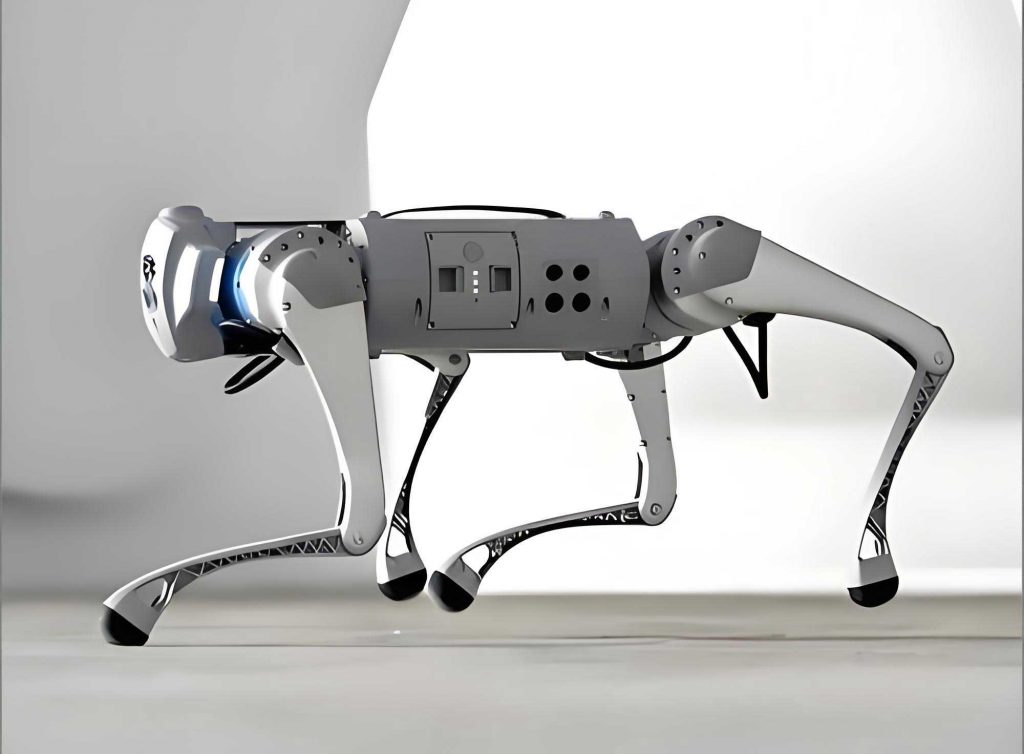
The foundation of this research lies in accurately modeling the quadruped robot’s structure and dynamics. A symmetric mechanical design is employed, consisting of a torso and four identical legs, each with three degrees of freedom. This includes hip joint drives for vertical axis swinging, thigh joint drives for forward-backward motion, and shank joint drives for flexion-extension movements. Such a design simplifies kinematic solutions and facilitates stable gait planning. The dynamic model is derived using Lagrangian mechanics, accounting for inertial properties, Coriolis forces, centrifugal effects, gravity, joint torques, and ground contact forces. This results in a hybrid dynamic model that alternates between support and swing phases, capturing the time-varying and nonlinear nature of the quadruped robot’s motion. The ground contact model incorporates data from sensors like IMUs, force sensors, and vision systems to estimate terrain interaction, which is crucial for adaptive control. For instance, the dynamics can be expressed as: $$M(q) \ddot{q} + C(q, \dot{q}) \dot{q} + G(q) = \tau + J^T(q) F$$ where \( M(q) \) is the inertia matrix, \( C(q, \dot{q}) \) represents Coriolis and centrifugal terms, \( G(q) \) is the gravity vector, \( \tau \) denotes joint torques, \( J(q) \) is the Jacobian matrix, and \( F \) is the contact force at the foot. This model enables precise control of the robot dog’s movements in real-time.
Building on the system model, the control strategy for the quadruped robot focuses on environment-aware gait planning and multi-leg coordination. Gait planning begins with determining the center of mass trajectory using equations of motion: $$m \ddot{x}_c + k x_c = F_x$$ $$m \ddot{y}_c + k y_c = F_y$$ $$m \ddot{z}_c + k z_c = F_z – m g$$ where \( m \) is the mass of the robot dog, \( (x_c, y_c, z_c) \) are the center of mass coordinates, \( k \) is the stiffness coefficient, and \( F_x, F_y, F_z \) are the resultant forces in each direction. Foot trajectories are planned using Bézier curves: $$P(t) = \sum_{i=0}^{n} C_n^i (1-t)^{n-i} t^i P_i$$ where \( n \) is the curve order, \( t \) is a parameter in [0,1], and \( P_i \) are control points. The duty cycle \( \beta \) is dynamically adjusted based on terrain complexity: $$\beta = \frac{T_{\text{support}}}{T_{\text{cycle}}}$$ with \( T_{\text{support}} \) as support phase duration and \( T_{\text{cycle}} \) as the full gait cycle. Stability is ensured by the zero moment point (ZMP) criterion: $$x_{\text{ZMP}} = \frac{\sum_{i=1}^{n} m_i (\ddot{x}_i z_i – \ddot{z}_i x_i + g x_i)}{\sum_{i=1}^{n} m_i (\ddot{z}_i + g)}$$ where \( m_i \) is the mass of each component, and \( (\ddot{x}_i, \ddot{z}_i) \) are acceleration components. This allows the quadruped robot to maintain balance by keeping the ZMP within the support polygon.
For multi-leg cooperative control, I design a framework that synchronizes the movements of all legs. The coupled dynamics equation is: $$M(q) \ddot{q} + C(q, \dot{q}) \dot{q} + G(q) = \tau + J^T(q) F$$ Force distribution among supporting legs ensures dynamic balance: $$\sum F_i = m g + m a$$ $$\sum (r_i \times F_i) = I_0 \dot{\omega} + \omega \times I_0 \omega$$ where \( F_i \) is the foot force of the i-th leg, \( r_i \) is the position vector from the center of mass, \( I_0 \) is the moment of inertia, and \( \omega \) is the angular velocity. This coordination minimizes energy consumption and enhances stability for the robot dog during locomotion. Adaptive control is implemented using Lyapunov-based laws to handle uncertainties and disturbances: $$\tau = K_p (q_d – q) + K_d (\dot{q}_d – \dot{q}) + \hat{\Theta} \phi(q, \dot{q}, \ddot{q}_d, \dot{q}_d)$$ $$\dot{\hat{\Theta}} = -\Gamma \phi(q, \dot{q}, \ddot{q}_d, \dot{q}_d) s^T$$ where \( K_p \) and \( K_d \) are gain matrices, \( \hat{\Theta} \) is the parameter estimate, \( \phi \) is the regression matrix, \( \Gamma \) is the adaptive gain, and \( s \) is the sliding surface. This adaptive strategy allows the quadruped robot to adjust parameters in real-time, maintaining stability under varying conditions.
To validate the proposed control strategy, I conduct simulations using MATLAB/Simulink, considering various scenarios such as flat terrain walking, slope climbing, and irregular surface navigation. The parameters for the quadruped robot are summarized in the table below, which includes key mechanical and control attributes. This robot dog is designed with a total mass of 32.5 kg, and the leg dimensions ensure optimal mobility. The simulation tests the robot’s ability to adapt to different environments while monitoring stability and energy efficiency.
| Parameter Name | Value |
|---|---|
| Total Mass (kg) | 32.5 |
| Torso Length (m) | 0.75 |
| Torso Width (m) | 0.45 |
| Thigh Length (m) | 0.32 |
| Shank Length (m) | 0.35 |
| Hip Joint Max Torque (N·m) | 80 |
| Knee Joint Max Torque (N·m) | 120 |
| Joint Max Speed (°/s) | 300 |
In flat terrain tests, the quadruped robot maintains a steady speed of 0.5 m/s, with center of mass oscillations within ±2 cm and a stability margin exceeding 8 cm. This demonstrates the effectiveness of the gait planning algorithm. For slope climbing at a 15° incline, the robot dog successfully adapts its foot force distribution, with contact force errors below 5%, confirming the accuracy of the force allocation method. On irregular terrain with height variations of ±10 cm, the robot adjusts foot trajectories and support phases seamlessly, ensuring continuous motion. The adaptive controller shows a rapid response with an average settling time of 0.3 s and overshoot under 15%, highlighting its robustness against disturbances. Energy analysis reveals that this cooperative control strategy reduces consumption by approximately 20% compared to traditional methods, thanks to optimized force distribution and parameter tuning. These results underscore the potential of this approach for real-world applications of quadruped robots.
In conclusion, the cooperative adaptive control strategy significantly improves the stability and adaptability of quadruped robots in complex environments. By integrating precise modeling, environment-aware planning, and multi-leg coordination, the robot dog achieves efficient and stable locomotion. Future work will focus on enhancing environmental perception algorithms and exploring deep learning techniques to further advance the intelligence of these systems. This research paves the way for broader deployment of quadruped robots in challenging scenarios, reinforcing their role as versatile robotic platforms.