
In recent years, the widespread application of radioactive sources in industrial, medical, energy, and environmental fields has heightened the need for efficient and safe radiation monitoring and source localization techniques. Accidental loss or illicit trafficking of radioactive materials poses significant risks to public safety and environmental health. Traditional methods for locating lost sources, such as handheld surveys or vehicle-mounted systems, often expose personnel to radiation hazards and are limited in efficiency and adaptability. To address these challenges, we have developed an innovative approach that combines a directional gamma-ray detector with a highly mobile quadruped robot, enabling autonomous or remote-controlled source searching in complex environments. This system leverages the stability and agility of the robot dog platform to navigate varied terrains, while the directional detector provides real-time spatial orientation data for rapid source localization. The integration of these technologies through the Robot Operating System (ROS) framework allows for seamless communication, control, and data processing, significantly reducing human intervention and exposure risks. In this article, we detail the design of the directional detector, the development of spatial orientation and localization algorithms, and experimental validation of the system’s performance in laboratory settings. Our results demonstrate that this approach achieves accurate source positioning with minimal measurement time, paving the way for enhanced nuclear security and emergency response capabilities.
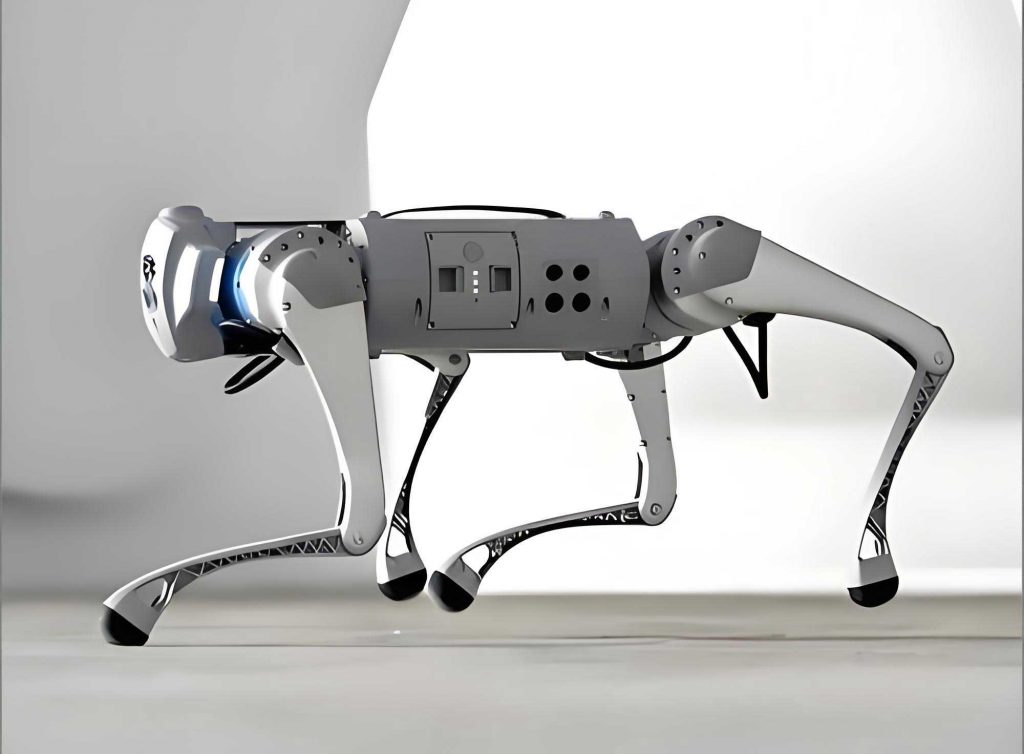
The core of our system is a 2×2 array detector composed of CsI(Na) scintillator crystals, each coupled with silicon photomultipliers (SiPMs) for efficient gamma-ray detection. This detector is mounted on a commercial quadruped robot, specifically the Unitree A1 model, known for its robust mobility and integration capabilities. The robot dog features an embedded computer, motion control boards, and camera modules, enabling autonomous navigation and real-time data transmission. We developed a PC-based software interface that facilitates system management, including robot motion control, detector configuration, and visualization of localization results. The entire system operates on ROS, ensuring modularity and scalability for various applications. Key functionalities include SLAM-based mapping, wireless communication, and automated source tracking, all designed to enhance the efficiency of radiation surveys. By combining the directional sensitivity of the detector array with the dynamic movement of the quadruped robot, our system can quickly triangulate the position of a gamma-ray source in three-dimensional space, as validated through experiments with milli-curie level cesium-137 sources.
The directional detector employs a cubic arrangement of four CsI(Na) crystals, each with dimensions of 24 mm × 24 mm × 48 mm, forming a 48 mm cube. This design exploits the mutual shielding between crystals to encode directional information of incident gamma rays. When a radioactive source is present, the count rates from each crystal vary based on the angle of incidence, allowing us to derive the source’s spatial orientation. The signals from the SiPMs are processed through custom electronics and transmitted to the PC for analysis. The quadruped robot serves as a mobile platform, carrying the detector and providing positional data via its onboard sensors, such as LiDAR and IMUs. The robot dog can traverse uneven surfaces, making it ideal for outdoor or unstructured environments where lost sources might be located. Our software integrates these components, offering a user-friendly interface for remote operation and real-time monitoring. This synergy between the detector and the quadruped robot enables rapid, safe, and accurate source localization, as demonstrated in our experiments.
To achieve spatial orientation of the gamma-ray source, we developed an algorithm based on the differential count rates of the detector array. In a spherical coordinate system, the incident direction of the source is defined by the azimuth angle φ and the polar angle θ. The response of each detector element is influenced by geometric occlusion, where crystals facing the source record higher counts than those shielded by others. We define four response ratios, R1 to R4, as functions of the counts from the four crystals (N1, N2, N3, N4):
$$ R_1 = \frac{N_1 + N_2}{N_1 + N_2 + N_3 + N_4} $$
$$ R_2 = \frac{N_2 + N_3}{N_1 + N_2 + N_3 + N_4} $$
$$ R_3 = \frac{N_3 + N_4}{N_1 + N_2 + N_3 + N_4} $$
$$ R_4 = \frac{N_4 + N_1}{N_1 + N_2 + N_3 + N_4} $$
These ratios form a response matrix that maps the count data to the incident angles. Using Geant4 simulations, we modeled the detector’s response to gamma rays from various directions, creating a 3D database of R values for different φ and θ. For a given measurement, the observed counts correspond to a plane in this matrix, and the intersection of multiple response curves yields the estimated angles. The symmetry of the detector array simplifies the computation, as pairs of responses (e.g., R1 and R3) are symmetric about R = 0.5. This algorithm allows us to determine the source direction with high efficiency, as confirmed by experimental tests.
The spatial localization of the source is achieved by combining the directional data from the detector with the positional information from the quadruped robot. We employ a triangulation method that requires only two measurement points, reducing the time and complexity of the search process. Let \( \mathbf{p}_{r,w} \) denote the position of the radioactive source in the world coordinate system, represented as a quaternion. At two measurement points, A and B, the detector provides the orientation angles (θa, φa) and (θb, φb), while the robot dog’s LiDAR and odometry systems give the detector’s position and orientation relative to the world frame: \( \mathbf{t}_{w,a} \), \( \mathbf{q}_{w,a} \) for point A and \( \mathbf{t}_{w,b} \), \( \mathbf{q}_{w,b} \) for point B. The source position in the detector coordinates at A and B, \( \mathbf{p}_{r,a} \) and \( \mathbf{p}_{r,b} \), can be related to the world coordinates through:
$$ \mathbf{p}_{r,w} = \mathbf{q}_{w,a} \mathbf{p}_{r,a} \mathbf{q}_{w,a}^{-1} + \mathbf{t}_{w,a} = \mathbf{q}_{w,b} \mathbf{p}_{r,b} \mathbf{q}_{w,b}^{-1} + \mathbf{t}_{w,b} $$
This leads to a system of linear equations in terms of the distances ra and rb from the detector to the source at points A and B:
$$ \begin{bmatrix} R_{a,(1,1)} \sin \theta_a \cos \phi_a \\ R_{a,(2,1)} \sin \theta_a \sin \phi_a \\ R_{a,(3,1)} \cos \theta_a \end{bmatrix} r_a + \begin{bmatrix} -R_{b,(1,1)} \sin \theta_b \cos \phi_b \\ -R_{b,(2,1)} \sin \theta_b \sin \phi_b \\ -R_{b,(3,1)} \cos \theta_b \end{bmatrix} r_b = \mathbf{t}_{w,b} – \mathbf{t}_{w,a} $$
Here, R represents the rotation matrix derived from the quaternion orientations. This system is typically overdetermined, so we solve it using the least squares method to obtain the optimal estimates of ra and rb, which are then used to compute \( \hat{\mathbf{p}}_{r,w} \). This approach minimizes the number of required measurements and leverages the mobility of the quadruped robot to quickly gather data from multiple vantage points.
We conducted experiments to validate the spatial orientation and localization capabilities of our system. The directional detector was tested using a cesium-137 source with an activity of approximately 4.3 mCi, placed at a fixed distance of 1.5 meters. The detector was mounted on a adjustable gimbal to simulate various incident angles, and measurements were taken for θ values of 30°, 45°, 60°, 75°, and 90°, and φ values from 90° to 180° in 15° increments. Each measurement lasted 60 seconds and was repeated 10 times to ensure statistical reliability. The results, summarized in Table 1, show the average absolute errors and standard deviations for θ and φ. The detector demonstrated consistent performance across the tested range, with mean errors of 4.9° for θ and 3.4° for φ, confirming its ability to accurately determine the source direction.
| Angle Type | Mean Absolute Error (°) | Standard Deviation (°) |
|---|---|---|
| θ (Polar) | 4.9 | 3.3 |
| φ (Azimuth) | 3.4 | 3.9 |
For spatial localization, we deployed the integrated system in a laboratory environment. The quadruped robot was programmed to move from a starting point O to four measurement positions (A, B, C, D), as illustrated in Figure 1. At each point, the robot dog paused for three 10-second measurements, and the average orientation angles and robot poses were recorded. Table 2 lists the measured parameters for each point, including the detector orientations and the robot’s position and orientation quaternions. Using pairs of these points, we computed the source position and compared it to the known location. The localization errors for all combinations are presented in Table 3, with all errors below 0.4 meters. This demonstrates the effectiveness of our triangulation algorithm and the synergy between the detector and the quadruped robot.
| Point | Orientation (θ, φ) | Robot Position (x, y, z) in meters | Robot Orientation (quaternion x, y, z, w) |
|---|---|---|---|
| A | 136.8°, 47.0° | 0.810, -0.369, -0.165 | 0.009, 0.006, 0.099, 0.995 |
| B | 164.8°, 52.8° | 1.762, -1.030, -0.207 | 0.007, 0.011, 0.211, 0.977 |
| C | 160.3°, 49.8° | 3.146, -1.142, -0.272 | 0.004, 0.010, 0.733, 0.681 |
| D | 132.3°, 45.8° | 3.662, -0.841, -0.238 | 0.012, 0.013, 0.936, 0.351 |
| Point Pair | Error (meters) |
|---|---|
| A, B | 0.381 |
| A, C | 0.271 |
| A, D | 0.317 |
| B, C | 0.358 |
| B, D | 0.334 |
| C, D | 0.210 |
The integration of the directional detector with the quadruped robot offers several advantages over traditional methods. The robot dog’s ability to navigate complex terrains allows it to access hazardous or hard-to-reach areas, while the detector provides real-time directional data without the need for heavy shielding or complex mechanics. Our software interface enables remote operation and visualization, further enhancing safety and efficiency. In experiments, the entire localization process, including robot movement and measurements, was completed within 90 seconds for a milli-curie level source, with errors under 0.4 meters. This performance highlights the potential of this system for practical applications in nuclear emergency response and radiation monitoring.
In conclusion, we have successfully developed and validated a system for gamma-ray source localization using a directional detector array integrated with a quadruped robot. The spatial orientation algorithm, based on response ratios from the detector array, accurately determines the source direction, while the triangulation method leverages robot mobility for efficient 3D localization. Experimental results confirm the system’s reliability and accuracy, with minimal measurement time and error. Future work will focus on enhancing autonomous navigation, obstacle avoidance, and multi-source detection capabilities. By reducing human exposure and improving search efficiency, this technology contributes significantly to radiation safety and security. The use of a robot dog platform ensures adaptability across various environments, making it a valuable tool for addressing the challenges of lost radioactive source recovery.
The development of this system underscores the importance of interdisciplinary approaches in radiation protection. Combining nuclear detection techniques with advanced robotics, such as the quadruped robot, opens new possibilities for automated and safe radiation surveys. Our research demonstrates that even with a simple detector array, sophisticated algorithms can achieve high precision in source localization. As robot dog technology continues to evolve, we anticipate further improvements in integration and performance, ultimately leading to widespread adoption in nuclear facilities, border security, and environmental monitoring. This work lays a foundation for future innovations in intelligent radiation detection systems.