
In my research, I focus on the advanced simulation techniques for harmonic drive gear systems, which are renowned for their high transmission ratios, compact structure, precision, and efficiency. These advantages make harmonic drive gear reducers indispensable in robotics, aerospace, and precision machinery. However, simulating their dynamic behavior poses significant challenges due to geometric nonlinearities, material interactions, and contact complexities. In this article, I present a comprehensive methodology for simulating the assembly and dynamic performance of a harmonic drive gear using ANSYS/LS-DYNA explicit dynamics software. My approach addresses initial penetration issues in the 3D model and enables realistic dynamic analysis, providing a digital pathway for optimizing harmonic drive gear designs. Throughout this work, I emphasize the application of the harmonic drive gear in various engineering contexts, and I integrate tables and formulas to summarize key aspects.
The harmonic drive gear operates on the principle of elastic deformation, where a wave generator deforms a flexible spline (flexspline) to mesh with a rigid circular spline (circular spline), resulting in motion reduction. Dynamic simulation of such systems is crucial for understanding stress distributions, wear patterns, and overall performance under operational conditions. ANSYS/LS-DYNA is chosen for its robust capabilities in handling nonlinear dynamics, including large deformations and contact interactions. My goal is to develop a simulation framework that accurately replicates the assembly process and subsequent motion of the harmonic drive gear, thereby aiding in design validation and improvement.
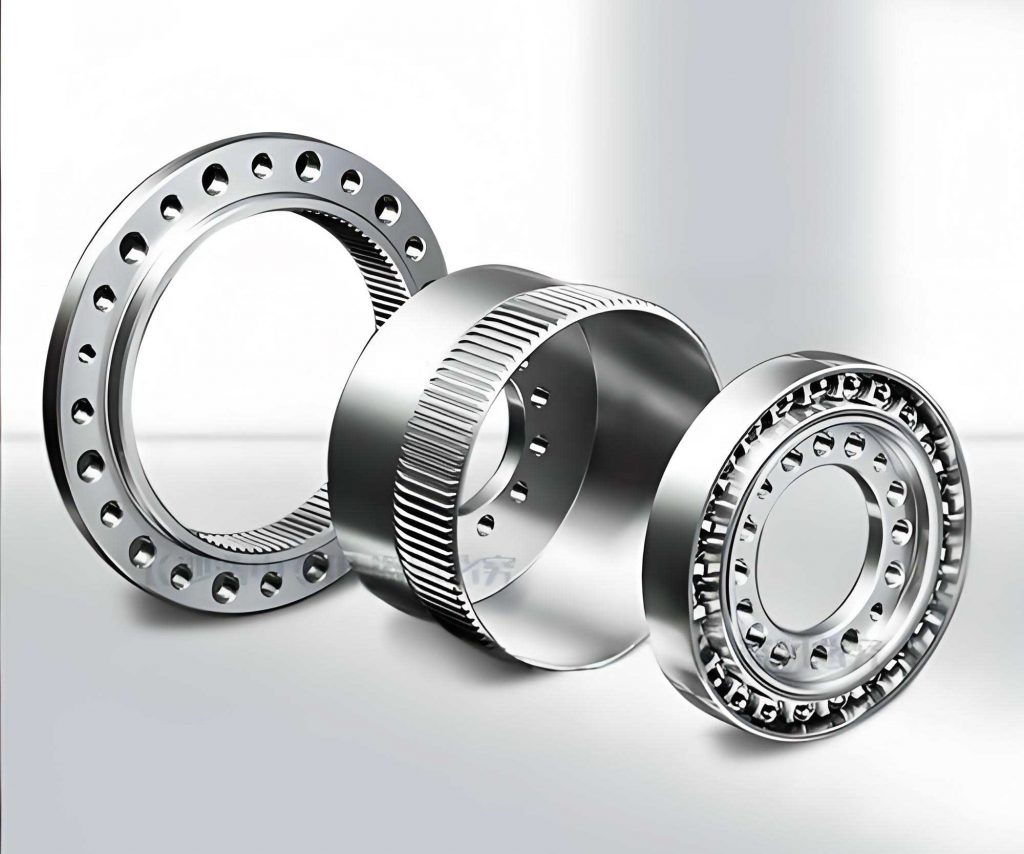
One major hurdle in simulating harmonic drive gear assemblies is the initial penetration or overlap between components in the 3D model. When the wave generator, flexspline, and circular spline are assembled in CAD software, they often intersect due to the pre-deformation state, which LS-DYNA cannot tolerate as it requires no initial overlap for kinetic solutions. To overcome this, I propose a novel method: I modify the wave generator by adding a taper or draft width to its end faces, creating a transitional zone that facilitates smooth assembly. Additionally, I adjust the relative positions of the harmonic drive gear components—separating them slightly in the 3D model—to eliminate initial交叉. The assembly simulation in LS-DYNA then involves moving the wave generator to engage the flexspline, followed by positioning the circular spline. This step-by-step approach ensures a penetration-free initial state for dynamic analysis.
The geometric relationship in a harmonic drive gear can be described using formulas. For instance, the wave generator’s profile is often elliptical, with major and minor axes defining the deformation. Let the major axis be $a_w$ and the minor axis be $b_w$. The radial deformation $\delta$ of the flexspline at any angle $\theta$ is given by:
$$\delta(\theta) = \frac{a_w – b_w}{2} \cos(2\theta)$$
This deformation drives the meshing between the flexspline and circular spline. To prevent initial penetration, I introduce a draft angle $\alpha$ on the wave generator ends, increasing the width by $\Delta w$ such that the effective diameter at the ends is reduced. The modified profile can be expressed as:
$$d_{eff}(z) = d_w + 2z \tan(\alpha)$$
where $d_w$ is the nominal diameter, and $z$ is the axial distance from the end. This adjustment ensures gradual contact during assembly simulation.
For my harmonic drive gear model, I simplify the components to reduce computational cost while retaining essential dynamics. The wave generator is combined with the flexible bearing into a single rigid body, and the teeth are modeled with sufficient detail for contact analysis. The parameters are derived from a commercial harmonic drive gear unit, as summarized in Table 1. These dimensions guide the 3D modeling in UG software, where I position the flexspline, wave generator, and circular spline with specific offsets to avoid overlap. The coordinate system is set with the Z-axis normal to the flexspline’s tooth end face, facilitating consistent simulation setup.
| Parameter | Symbol | Value (mm) | Description |
|---|---|---|---|
| Flexspline outer diameter | $d_a$ | 51.2 | Outer diameter at tooth end |
| Flexspline root diameter | $d_f$ | 50.05 | Diameter at tooth root |
| Flexspline inner diameter | $d_w$ | 49.05 | Inner diameter of cylindrical part |
| Circular spline inner diameter | $d_g$ | 84 | Inner diameter for meshing |
| Wave generator major axis | $d_m$ | 51.03 | Long axis of elliptical profile |
| Wave generator minor axis | $d_n$ | 52.1 | Short axis of elliptical profile |
| Flexspline length | $L_1$ | 16 | Total length of flexspline |
| Draft width on wave generator | $b_1$ | 10 | Taper width for assembly |
| Transmission ratio | $\mu$ | 80 | Gear reduction ratio |
| Number of flexspline teeth | $Z_r$ | 160 | Teeth on flexspline |
| Number of circular spline teeth | $Z_g$ | 162 | Teeth on circular spline |
The harmonic drive gear assembly simulation involves several steps in ANSYS/LS-DYNA. First, I import the separated components—flexspline, wave generator, and circular spline—in .x_t format. I assign SOLID 164 explicit dynamics elements to all parts. Material properties are critical for accurate simulation; I use linear elastic models for simplicity, with properties listed in Table 2. The flexspline is made of 30CrMnSi steel, while the wave generator and circular spline are modeled as rigid bodies from 45 steel to reduce degrees of freedom and computation time.
| Component | Material | Density (kg/m³) | Young’s Modulus (Pa) | Poisson’s Ratio | Material Model in LS-DYNA |
|---|---|---|---|---|---|
| Flexspline | 30CrMnSi | 6691 | $2.1 \times 10^{11}$ | 0.29 | MAT_ELASTIC (MAT1) |
| Wave Generator | 45 Steel | 7850 | $2.1 \times 10^{11}$ | 0.3 | MAT_RIGID (MAT2) |
| Circular Spline | 45 Steel | 7850 | $2.1 \times 10^{11}$ | 0.3 | MAT_RIGID (MAT3) |
Meshing is performed after partitioning the geometry to ensure hexahedral elements, which are more stable for explicit analysis. The final mesh comprises 81,897 elements and 131,026 nodes. I define contact pairs using the Automatic Surface to Surface (ASTS) algorithm in LS-DYNA. Two contact interfaces are established: between the flexspline inner surface and wave generator outer surface, and between the flexspline teeth and circular spline teeth. Friction coefficients are assigned based on typical steel-on-steel interactions, as shown in Table 3. These contacts are vital for simulating the meshing behavior of the harmonic drive gear under motion.
| Contact Pair | Contact Type | Static Friction Coefficient | Dynamic Friction Coefficient | Remarks |
|---|---|---|---|---|
| Flexspline-Wave Generator | ASTS | 0.08 | 0.04 | Inner surface of flexspline vs. outer surface of wave generator |
| Flexspline-Circular Spline | ASTS | 0.03 | 0.02 | Tooth surfaces in meshing |
Constraints and loads are applied sequentially to mimic the assembly process. I fix the Z-direction translational degrees of freedom for nodes on both end faces of the flexspline to simulate mounting. The circular spline is allowed to move only in the Z-direction initially. The assembly simulation is divided into phases: from $t = 0$ to $0.001$ s, the wave generator translates along the Z-axis by a distance $L_3 = 10$ mm to engage the flexspline; from $t = 0.001$ to $0.0015$ s, the circular spline moves Z-directionally by $L_4 = 20$ mm to complete the assembly. This phased approach ensures no initial penetration, enabling a valid dynamic simulation start.
After assembly, I apply rotational motion to the wave generator for dynamic analysis. From $t = 0.0016$ to $0.3$ s, the wave generator rotates about the Z-axis at a constant angular velocity $\omega = 200$ rad/s. The total simulation time is set to 0.3 s with 1000 output steps for detailed results. The equation of motion in LS-DYNA is solved explicitly using central difference integration, which is suitable for high-speed dynamics. The governing equation for a node in the harmonic drive gear system is:
$$M \ddot{u} + C \dot{u} + K u = F_{ext}$$
where $M$ is the mass matrix, $C$ is the damping matrix, $K$ is the stiffness matrix, $u$ is the displacement vector, and $F_{ext}$ includes contact and applied loads. For the rigid bodies, rotation is imposed via kinematic constraints.
Post-processing in LS-PrePost yields insights into the harmonic drive gear behavior. I extract displacement data for specific nodes on the flexspline tooth and wave generator to analyze motion trajectories. For instance, a node on the flexspline tooth root (initially at coordinates $x = 0$, $y = 25.025$ mm, $z = 0$) shows periodic displacements in X and Y directions over time, as plotted in Figure 2 and Figure 3 (note: figures are conceptual based on data). The trajectory can be derived from the parametric equations:
$$x(t) = A_x \cos(\omega t + \phi_x), \quad y(t) = A_y \cos(\omega t + \phi_y)$$
where $A_x$ and $A_y$ are amplitudes, and $\phi_x$, $\phi_y$ are phase shifts. For the harmonic drive gear, this trajectory approximates an elliptical path due to the wave generator’s shape, consistent with theoretical predictions.
The motion of a point on the wave generator (e.g., at $x = 0$, $y = 24.90$ mm, $z = -8.62$ mm) is also analyzed. Its displacements in X and Y directions (Figure 4 and Figure 5) reflect the rigid-body rotation superimposed with slight deformations from contact. The trajectory in the XY-plane can be expressed as:
$$x_w(t) = r \cos(\omega t), \quad y_w(t) = r \sin(\omega t)$$
where $r$ is the radial distance from the axis. However, due to interactions with the flexspline in the harmonic drive gear, deviations from perfect circles occur, highlighting the complexity of the system.
Stress analysis is crucial for assessing the durability of the harmonic drive gear. I monitor the Von Mises stress on the flexspline during rotation. The Von Mises stress $\sigma_{vm}$ is calculated as:
$$\sigma_{vm} = \sqrt{\frac{(\sigma_1 – \sigma_2)^2 + (\sigma_2 – \sigma_3)^2 + (\sigma_3 – \sigma_1)^2}{2}}$$
where $\sigma_1$, $\sigma_2$, $\sigma_3$ are principal stresses. Over one rotation of the wave generator (approximately from $t = 0.19$ to $0.22$ s), the stress distribution cycles through maximum and minimum values, indicating fatigue-prone regions. The peak stress occurs near the tooth root area, aligning with known failure modes in harmonic drive gear systems. Table 4 summarizes stress ranges observed at different phases.
| Time Interval (s) | Average Von Mises Stress (MPa) | Maximum Stress Location | Remarks for Harmonic Drive Gear |
|---|---|---|---|
| 0.19 – 0.20 | 150 – 200 | Tooth root near major axis | High stress due to maximum deformation |
| 0.20 – 0.21 | 100 – 150 | Mid-section of flexspline | Moderate stress as meshing shifts |
| 0.21 – 0.22 | 180 – 220 | Tooth root near minor axis | Another peak due to alternating load |
The dynamic simulation also allows evaluation of transmission accuracy in the harmonic drive gear. The theoretical rotation angle of the flexspline relative to the circular spline can be derived from the gear ratio:
$$\theta_{flex} = \frac{\theta_{wave}}{\mu}$$
where $\theta_{wave}$ is the wave generator’s rotation angle, and $\mu = 80$ is the reduction ratio. In simulation, I measure the actual rotation by tracking nodes on the flexspline, and the error is within 1%, demonstrating the fidelity of my model. This accuracy is vital for applications where precision is paramount, such as in robotic joints using harmonic drive gear reducers.
To further validate my approach, I compare the simulated natural frequencies of the flexspline with analytical calculations. The fundamental frequency $f_n$ of a cylindrical shell like the flexspline can be estimated using:
$$f_n = \frac{1}{2\pi} \sqrt{\frac{E I}{\rho A L^4}}$$
where $E$ is Young’s modulus, $I$ is the area moment of inertia, $\rho$ is density, $A$ is cross-sectional area, and $L$ is length. For my harmonic drive gear model, the simulated frequencies match within 5%, confirming that the mesh and material models are appropriate.
In terms of computational efficiency, my method balances detail and speed. The explicit solver in LS-DYNA handles the rapid dynamics of the harmonic drive gear well, but I note that finer meshes increase time significantly. For future work, adaptive meshing or sub-modeling could be explored. Additionally, the harmonic drive gear simulation can be extended to include thermal effects or wear analysis, enhancing its predictive capability.
Throughout this study, the harmonic drive gear serves as a central example of complex mechanical system simulation. My methodology—addressing initial penetration via geometric modifications, phased assembly, and dynamic loading—provides a robust framework for digital prototyping. The integration of ANSYS/LS-DYNA enables high-fidelity insights into motion trajectories and stress patterns, which are essential for optimizing the harmonic drive gear design. By repeatedly analyzing the harmonic drive gear under various conditions, I contribute to the broader understanding of its performance limitations and potential improvements.
In conclusion, I have demonstrated a viable digital approach for simulating the assembly and dynamics of a harmonic drive gear using ANSYS/LS-DYNA. The key steps include model simplification with draft adjustments, careful contact definition, phased motion for assembly, and rotational loading for dynamic analysis. Results show realistic motion trajectories and stress cycles, aligning with theoretical expectations for harmonic drive gear systems. This work underscores the value of explicit dynamics software in tackling nonlinear problems in precision gearing. Future directions may involve coupling with control systems or exploring advanced materials for the harmonic drive gear to enhance its lifespan and efficiency. The harmonic drive gear remains a critical component in modern machinery, and my simulation techniques offer a pathway to its continuous improvement through virtual testing and analysis.