
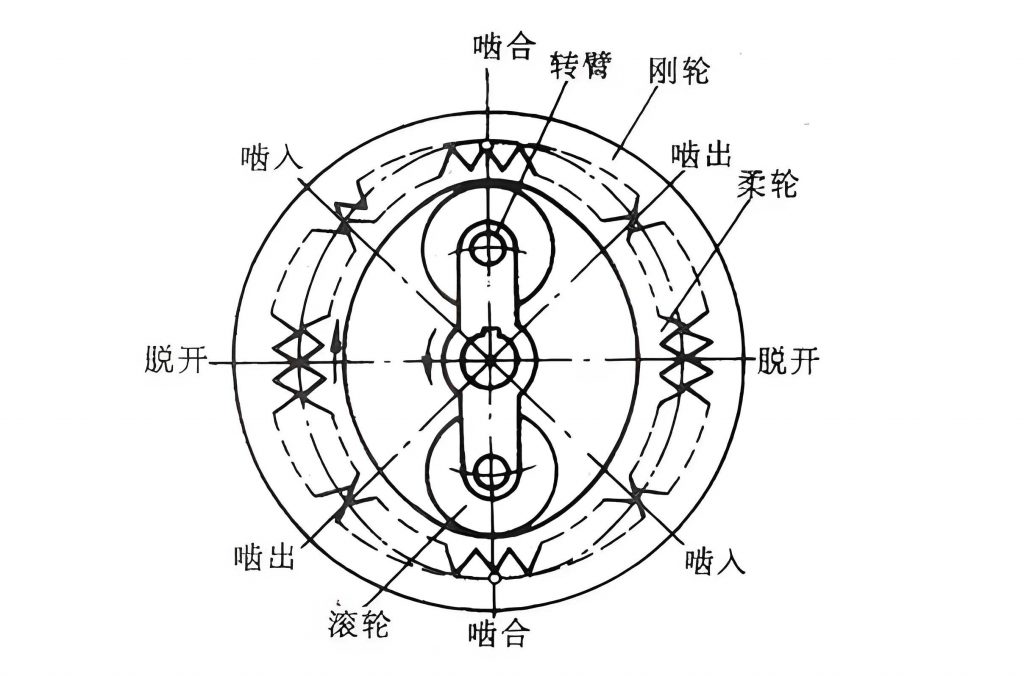
The unique operating principle of a harmonic drive gear, based on the controlled elastic deformation of a thin-walled flexspline, grants it exceptional characteristics including a high reduction ratio, superior load capacity, high positional accuracy, and minimal backlash. These advantages have cemented its role in critical applications such as space mechanisms and robotic joints. However, the commonly employed involute tooth profile is not optimal for this传动原理. Under load, issues like tooth interference and edge contact can arise, particularly near the major axis of the wave generator. This highlights the need for tooth profiles specifically engineered for the kinematics of harmonic drive gears.
This investigation focuses on the design and validation of a double-circular-arc tooth profile for harmonic drive gears, aimed at achieving continuous conjugate transmission across the entire engagement region. The goal is to maximize the number of simultaneously meshing tooth pairs, thereby enhancing the load-sharing capability, torsional stiffness, and operational stability of the harmonic drive gear.
Fundamentals of the Double-Circular-Arc Flexspline Tooth Profile
The proposed profile for the flexspline consists of two circular arcs connected by a common tangent, offering a geometrically robust shape. It is defined within a local coordinate system \( (x_f, y_f) \) attached to the tooth, where the \( x_f \)-axis is the tooth’s symmetry line. The profile is parameterized using dimensionless coefficients relative to the module \( m \), allowing for scalable design. The key parameters are summarized in the table below:
| Symbol | Definition |
|---|---|
| \( h_{a1}^* \) | Addendum coefficient of the flexspline |
| \( h_{f1}^* \) | Dedendum coefficient of the flexspline |
| \( h_{l1}^* \) | Coefficient for the tangent point location |
| \( s_1^* \) | Tooth thickness coefficient at the pitch circle |
| \( \rho_{a1}^* \) | Radius coefficient of the addendum arc |
| \( \rho_{f1}^* \) | Radius coefficient of the dedendum arc |
| \( \zeta_1 \) | Inclination angle of the common tangent |
| \( d_1, z_1 \) | Pitch diameter and number of teeth of the flexspline |
| \( z_2 \) | Number of teeth of the circular spline |
Due to its piecewise nature, the profile equation \( \mathbf{X}_f(s) = (x_f(s), y_f(s))^T \) is expressed as a function of the arc-length parameter \( s \) using Heaviside functions. The profile comprises three distinct segments:
1. Dedendum Arc Segment (HG):
$$ \mathbf{X}_f(s) = \mathbf{R}_{\theta} \cdot \mathbf{R}_{u} + \mathbf{T}_K, \quad s \in [0, l_1] $$
where \( l_1 = \rho_{f1} (\arctan(\frac{x_K – x_H}{y_K – y_H}) – \arctan(\frac{x_K – x_G}{y_K – y_G})) \), \( \rho_{f1} = \rho_{f1}^* \cdot m \), and \( \mathbf{R}_{\theta}, \mathbf{R}_{u}, \mathbf{T}_K \) are transformation and translation matrices defined by the arc geometry.
2. Common Tangent Segment (GF):
$$ \mathbf{X}_f(s) = \mathbf{R}_{\zeta_1} \cdot (s – l_1) + \mathbf{T}_G, \quad s \in [l_1, l_1 + l_2] $$
where \( l_2 = \sqrt{(x_F – x_G)^2 + (y_F – y_G)^2} \) and \( \mathbf{R}_{\zeta_1} \) defines the direction vector of the tangent.
3. Addendum Arc Segment (FE):
$$ \mathbf{X}_f(s) = \mathbf{R}_{\phi} \cdot \mathbf{R}_{v} + \mathbf{T}_A, \quad s \in [l_1 + l_2, l_1 + l_2 + l_3] $$
where \( l_3 = \rho_{a1} (\arctan(\frac{x_E – x_A}{y_E – y_A}) – \arctan(\frac{x_F – x_A}{y_F – y_A})) \), \( \rho_{a1} = \rho_{a1}^* \cdot m \), and \( \mathbf{R}_{\phi}, \mathbf{R}_{v}, \mathbf{T}_A \) are corresponding transformation matrices for this arc.
Precision Conjugate Theory for Harmonic Drive Gears
The conjugate tooth profile of the circular spline is generated by the envelope of the family of flexspline tooth profiles during assembly and motion. The core of the analysis is solving the meshing equation. A precise algorithm is essential for the double-circular-arc profile, as approximate methods for calculating rotational displacements can significantly affect the predicted conjugate engagement zone.
The wave generator deforms the neutral curve of the flexspline, inducing radial displacement \( u(\varphi) \) and circumferential displacement \( v(\varphi) \), where \( \varphi \) is the angular coordinate on the undeformed neutral circle of radius \( r_m \). The condition of an inextensible midline is enforced:
$$ \varphi_F = \int_0^{\varphi_f} \sqrt{(r_m + u)^2 + (r_m + u’)^2} \, d\varphi / r_m $$
where \( u’ = du/d\varphi \).
The critical angle \( \theta_{uz} \), which defines the orientation of the tooth’s symmetry axis relative to the radial vector after deformation, is calculated precisely as:
$$ \theta_{uz}(\varphi) = \arctan\left( -\frac{u’}{r_m + u} \right) $$
This precise calculation of \( \theta_{uz} \) is a key differentiator from older approximate methods and is crucial for accurately determining the envelope of the harmonic drive gear.
The family of surfaces for the flexspline tooth profile in the fixed coordinate system of the circular spline is given by:
$$ \mathbf{X}_c(\varphi, s) = \mathbf{M}(\varphi) \cdot \mathbf{X}_f(s) $$
where the transformation matrix \( \mathbf{M}(\varphi) \) accounts for the radial displacement \( \rho(\varphi) = r_m + u(\varphi) \), the rotation \( \theta_{uz}(\varphi) \), and the kinematic rotation of the flexspline \( \psi(\varphi) \).
The conjugate profile \( \mathbf{X}_c(s) \) must satisfy the meshing equation:
$$ \frac{\partial \mathbf{X}_c}{\partial s} \times \frac{\partial \mathbf{X}_c}{\partial \varphi} \cdot \mathbf{k} = 0 \quad \text{or} \quad \frac{\partial x_c}{\partial s} \frac{\partial y_c}{\partial \varphi} – \frac{\partial y_c}{\partial s} \frac{\partial x_c}{\partial \varphi} = 0 $$
For a given point \( s \) on the flexspline profile, solving this equation yields the conjugate angle \( \varphi(s) \). The range of \( s \) for which a real solution \( \varphi(s) \) exists defines the envelope existence domain. Substituting the pair \( (s, \varphi(s)) \) back into \( \mathbf{X}_c(\varphi, s) \) gives the corresponding point on the theoretical conjugate profile of the circular spline for the harmonic drive gear.
Analysis of Envelope Domains and the Double-Conjugate Phenomenon
Solving the meshing equation for a typical set of double-circular-arc parameters reveals a fundamental characteristic not prevalent in involute profiles for harmonic drive gears: the existence of two distinct envelope domains.
The results for an initial parameter set are visualized in the following graph of conjugate solutions \( \varphi(s) \):
[Note: A graph would be inserted here showing two curves: one (dashed) in a very narrow band near 0°, and another (solid) spanning from approximately 13.5° to 60.9°.]
1. The Engagement Zone Domain: This is a very narrow angular zone (e.g., \([-1.21°, 0.25°]\)) symmetrically located around the major axis of the wave generator (\( \varphi = 0° \)). Here, teeth are in full contact. Nearly the entire flexspline tooth profile (from dedendum to addendum arc) generates a conjugate curve in this zone.
2. The Ingression Zone Domain: This is a much wider angular zone (e.g., \([13.56°, 60.87°]\)) located between the major and minor axes. Here, teeth are entering the mesh. Only specific portions of the flexspline profile—primarily the addendum arc and the common tangent—generate conjugate curves in this zone. The piecewise nature of the \( \varphi(s) \) curve in this domain directly corresponds to the three segments of the original profile.
The presence of these two domains implies a double-conjugate phenomenon. The same flexspline addendum arc generates two different conjugate curves on the circular spline: one in the ingression zone (forming the tooth tip region of the circular spline) and another in the engagement zone (forming the tooth root region of the circular spline). The key design challenge is to make both conjugate curves usable and to ensure a smooth transition between them on the final circular spline tooth profile of the harmonic drive gear.
However, with initial parameters, a significant gap exists between these two domains (e.g., from \(0.25°\) to \(13.56°\)). This gap represents a region where no conjugate solution exists, limiting the number of teeth in simultaneous contact.
Parameter Optimization for Continuous Conjugate Engagement
The primary objective is to expand the envelope existence domains, particularly the ingression zone, and to bridge the gap between them, enabling continuous conjugate engagement around the entire harmonic drive gear. Sensitivity analysis shows that the following parameters have the most significant influence on the size and position of the envelope domains:
- Inclination angle of the common tangent, \( \zeta_1 \)
- Length of the common tangent segment, controlled by \( h_{l1}^* \)
- Radius coefficients of the addendum and dedendum arcs, \( \rho_{a1}^* \) and \( \rho_{f1}^* \)
By iteratively adjusting these parameters, the conjugate domains can be significantly widened and brought closer together. An optimized set of parameters yields the following improved results:
| Envelope Domain | Initial Angular Range | Optimized Angular Range | Improvement |
|---|---|---|---|
| Engagement Zone | \([-1.21°, 0.25°]\) | \([-1.26°, 3.59°]\) | +3.39° |
| Ingression Zone | \([13.56°, 60.87°]\) | \([6.26°, 66.95°]\) | +13.40° (Widened & Shifted) |
The optimization successfully bridges the previous gap. The ingression zone now starts at \(6.26°\), which is very close to the end of the expanded engagement zone at \(3.59°\). This creates a near-continuous zone of conjugate engagement from approximately \(-1.26°\) through to \(66.95°\), effectively enabling conjugate action for a much larger number of teeth in the harmonic drive gear. The majority of the improvement comes from expanding and shifting the ingression zone.
Kinematic Simulation and Profile Synthesis
To visually verify the conjugate action and the double-conjugate phenomenon, a kinematic simulation was performed. The precise algorithm is used to determine the position and orientation of multiple flexspline teeth around the deformed neutral curve. The trajectory of a single flexspline tooth profile relative to the circular spline tooth space is then plotted.
[Note: A figure would be inserted here showing the envelope of a moving flexspline tooth, clearly illustrating two distinct envelopes forming the addendum and dedendum of the circular spline tooth space.]
This graphical simulation confirms the theoretical findings. The envelope of the flexspline tooth’s motion clearly shows two distinct branches: one forming the tooth root (dedendum) of the circular spline and another forming the tooth tip (addendum). This is the visual proof of the double-conjugate action in the harmonic drive gear.
Based on this, the final circular spline tooth profile for the harmonic drive gear is synthesized by selecting the usable portions of the two conjugate curves:
1. The tooth root (dedendum) of the circular spline is formed by the conjugate curve generated by the flexspline addendum arc in the engagement zone.
2. The tooth tip (addendum) of the circular spline is formed by the conjugate curve generated by the flexspline addendum arc and common tangent in the ingression zone.
A critical design consideration is ensuring a smooth transition at the junction point between these two conjugate branches on the circular spline. Poor parameter selection can lead to a sharp corner or discontinuity at this junction, negatively impacting stress concentration and motion smoothness in the harmonic drive gear. Proper optimization of \( \zeta_1 \), \( h_{l1}^* \), and \( \rho_{a1}^* \) ensures this junction is a smooth, continuous point, as verified by the kinematic simulation plot.
Conclusion
This analysis establishes a comprehensive methodology for the design of double-circular-arc tooth profiles for harmonic drive gears. The key findings are:
- The double-circular-arc profile inherently produces two conjugate envelope domains: a narrow engagement zone and a wide ingression zone, leading to a double-conjugate phenomenon.
- Using a precise conjugate algorithm that accurately calculates the tooth orientation angle \( \theta_{uz} \) is critical for correctly predicting these domains, especially for the wide engagement ranges sought in harmonic drive gear optimization.
- The envelope existence domains, and consequently the number of teeth in simultaneous conjugate contact, are highly sensitive to specific profile parameters: the common tangent angle \( \zeta_1 \), its length parameter \( h_{l1}^* \), and the arc radius coefficients \( \rho_{a1}^*, \rho_{f1}^* \).
- Through systematic optimization of these parameters, the two envelope domains can be significantly expanded and brought into near-continuity. This enables conjugate action across almost the entire 180° arc from the major axis towards the minor axis of the harmonic drive gear.
- The final circular spline profile is successfully synthesized from the two usable conjugate branches, with the transition point being designed for smoothness to ensure stable and reliable operation of the harmonic drive gear.
Therefore, a properly designed double-circular-arc tooth profile can achieve continuous conjugate transmission in a harmonic drive gear. This maximizes the number of teeth sharing the load at any given time, which directly translates to higher torque capacity, greater torsional stiffness, and more stable transmission accuracy—addressing the very limitations observed in traditional involute profiles for harmonic drive applications. The methodology outlined provides a clear path for the design and verification of such high-performance harmonic drive gears.