
In the realm of precision motion control, harmonic drive gears are indispensable components, prized for their exceptional attributes such as high reduction ratios, compactness, zero-backlash design, and superior positional accuracy. These characteristics make the harmonic drive gear a cornerstone technology in fields ranging from aerospace robotics and satellite antenna pointing mechanisms to advanced industrial automation and surgical manipulators. The core of its operation involves a wave generator that deforms a flexible spline (or flexspline) to mesh with a rigid circular spline, enabling efficient torque transmission and high-ratio speed reduction within a minimal spatial envelope.
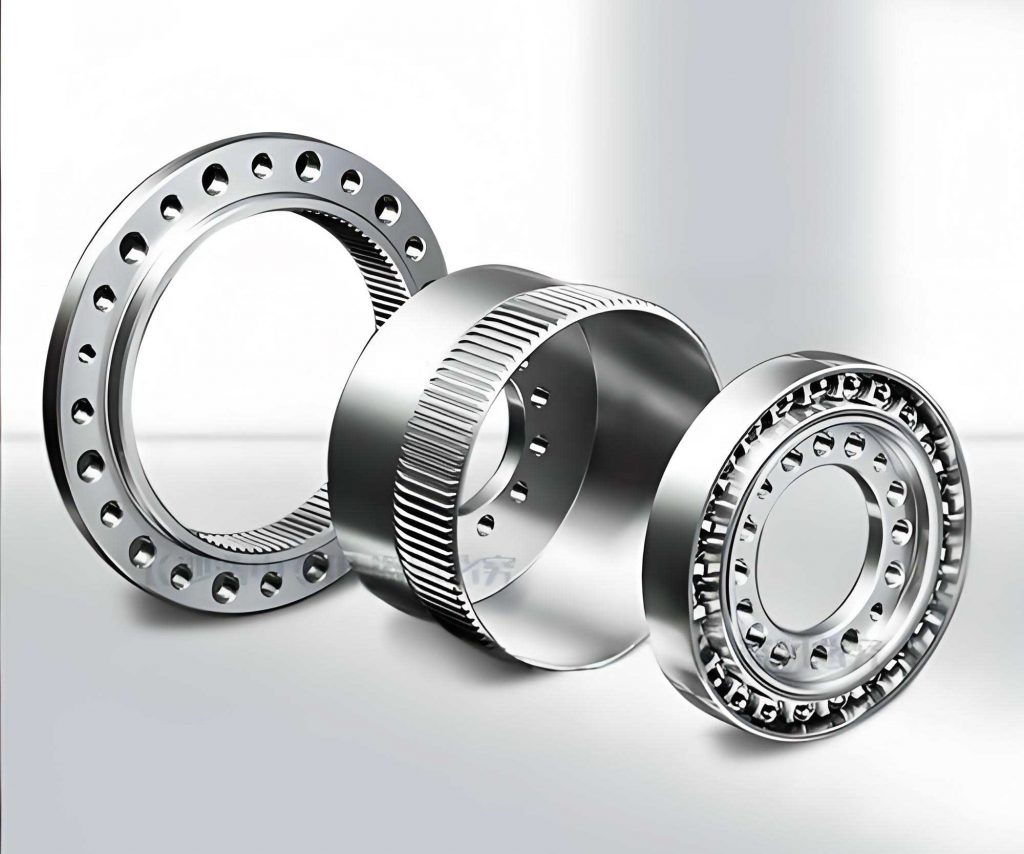
Despite their advantages, the dynamic performance of systems incorporating harmonic drive gears is fundamentally constrained by pronounced nonlinear behaviors, primarily stemming from friction, compliance, and most notably, hysteresis. This hysteretic characteristic manifests as a distinct loop in the relationship between transmitted torque (T) and the torsional deflection (θ) of the harmonic drive gear, where the path during loading differs from the path during unloading. This path-dependence introduces memory into the system, complicating control strategies that assume linear or simple nonlinear stiffness.
Traditionally, to simplify analysis, the stiffness of a harmonic drive gear in dynamic models is often approximated as constant or piecewise constant. Such simplifications, while computationally convenient, inevitably degrade model fidelity, leading to inaccuracies in predicting system response, limiting servo bandwidth, and hindering the achievement of ultra-high precision. Consequently, developing a high-fidelity model that accurately captures the intrinsic hysteresis of a harmonic drive gear is paramount for advancing model-based control techniques, improving dynamic simulation accuracy, and facilitating predictive maintenance.
This work introduces a novel phenomenological model for the hysteresis stiffness of harmonic drive gears, founded on the concept of genetic memory. The central tenet is that the instantaneous stiffness of the harmonic drive gear is not merely a function of the current state but is intrinsically linked to, or “genetically” influenced by, the entire history of states the system has traversed. We then employ a Particle Swarm Optimization (PSO) algorithm for robust parameter identification against experimental data, demonstrating a significant improvement in modeling accuracy compared to conventional approaches.
Nonlinear Hysteresis and Stiffness Definition in Harmonic Drive Gears
The torsional stiffness (K) of a harmonic drive gear is defined as the rate of change of transmitted torque with respect to the torsional deflection:
$$ K = \frac{dT}{d\theta} $$
For a harmonic drive gear system, the torsional deflection θ is calculated as the difference between the input rotation (adjusted by the gear ratio N) and the output rotation:
$$ \theta = \frac{\theta_{in}}{N} – \theta_{out} $$
where \( \theta_{in} \) is the angular displacement at the motor side, \( \theta_{out} \) is the angular displacement at the load side, and N is the reduction ratio of the harmonic drive gear.
The hysteresis phenomenon is observed when plotting T against θ. The curve does not retrace itself upon load reversal, forming a loop. This behavior arises from complex micro-slip friction in the multi-tooth meshing zones of the flexspline and circular spline, combined with the material compliance and energy dissipation within the flexspline itself. The stiffness, therefore, is not a single-valued function but depends on the direction of motion and the prior torque-deflection path.
A Genetic Memory-Based Hysteresis Stiffness Model
Our proposed model decomposes the total transmitted torque \( T(\theta) \) into two additive components: a nonlinear elastic foundation \( f(\theta) \) and a hysteresis correction term \( z(\theta) \) that encapsulates the genetic memory.
$$ T(\theta) = f(\theta) + z(\theta) $$
1. Nonlinear Elastic Foundation
The nonlinear stiffness \( f(\theta) \) represents the underlying, path-independent elastic response of the harmonic drive gear structure. We model it using an odd-powered polynomial to ensure symmetry and capture the progressive stiffening or softening behavior:
$$ f(\theta) = c_1 \theta + c_2 \theta^3 + c_3 \theta^5 $$
where \( c_1, c_2, c_3 \) are parameters to be identified.
2. Hysteresis Correction with Genetic Memory
The term \( z(\theta) \) is the core of our model, introducing history dependence. It is defined piecewise based on the direction of motion:
$$ z(\theta) = \begin{cases}
z^+(\theta), & \text{for positive unloading / negative loading} \\
z^-(\theta), & \text{for negative unloading / positive loading}
\end{cases} $$
The “genetic” influence is modeled using a memory factor \( \psi(u) \), which quantifies how the influence of a past state decays over time. We postulate an exponential decay:
$$ \psi(u) = \alpha e^{-\beta u} $$
where \( u \) is the elapsed time since that past state occurred, and \( \alpha, \beta \) are memory parameters. The total genetic influence at current time \( t \) is the integral (summation) of all past deflection rates \( \dot{\theta}(s) \), each weighted by its decaying memory factor:
$$ \int_0^t \psi(t-s) \dot{\theta}(s) \, ds = \int_0^t \alpha e^{-\beta (t-s)} \dot{\theta}(s) \, ds $$
To ensure the hysteresis loop converges to a stable, closed cycle under periodic excitation—a common test condition—we modulate this genetic memory integral with a term that guarantees continuity at motion reversal. For a periodic torsional deflection input \( \theta(t) = A \sin(\omega t) \), the hysteresis term is formulated as:
$$ z(t) = |\cos(\omega t)| \int_0^t \alpha e^{-\beta (t-s)} \dot{\theta}(s) \, ds $$
Solving this integral for the sinusoidal input yields an explicit time-domain expression:
$$ z(t) = A\alpha \cdot \frac{\omega e^{-\beta t} + \beta \sin(\omega t) – \omega \cos(\omega t)}{\beta^2 + \omega^2} \cdot |\cos(\omega t)| $$
The final model in the angular domain is obtained by finding the inverse relationship \( t^{\pm}(\theta) \) from \( \theta = A \sin(\omega t) \) for the two motion branches and substituting into \( z(t) \). The complete Genetic Memory Hysteresis Model (GMHM) for the harmonic drive gear is:
$$ T(\theta) = c_1 \theta + c_2 \theta^3 + c_3 \theta^5 + A\alpha \cdot \frac{\omega e^{-\beta t^{\pm}(\theta)} + \beta \sin(\omega t^{\pm}(\theta)) – \omega \cos(\omega t^{\pm}(\theta))}{\beta^2 + \omega^2} \cdot |\cos(\omega t^{\pm}(\theta))| $$
This model captures the essence of hysteresis in a harmonic drive gear: the stiffness depends on the current deflection, the direction of travel, and the weighted history of how that deflection was reached.
Parameter Identification via Particle Swarm Optimization
The proposed GMHM contains six parameters to identify: \( \mathbf{P} = [c_1, c_2, c_3, \alpha, \beta, \omega] \). The model’s structure makes it unsuitable for linear least-squares techniques. We employ Particle Swarm Optimization (PSO), a robust global search algorithm inspired by social behavior, known for effectively handling nonlinear, multi-parameter problems.
The fitness function for minimization is the Sum of Squared Errors (SSE) between the experimental torque data \( T_i \) and the model prediction \( T(\theta_i; \mathbf{P}) \):
$$ F(\mathbf{P}) = \sum_{i=1}^{n} \left[ T_i – T(\theta_i; \mathbf{P}) \right]^2 $$
where \( n \) is the number of experimental data points. The PSO algorithm seeks the parameter set \( \mathbf{P^*} \) that minimizes this fitness:
$$ \mathbf{P^*} = \arg \min_{\mathbf{P}} F(\mathbf{P}) $$
Experimental Validation and Results
A dedicated test platform was constructed to characterize the hysteresis of a harmonic drive gear. The system consists of a servo motor drive, the harmonic drive gear unit under test, a high-resolution torque sensor, precision optical encoders on both input and output shafts, and a magnetorheological brake for applying controlled load. The harmonic drive gear’s input was fixed after clearing the pre-load, and the output was subjected to a slow, quasi-static load-unload cycle from zero to positive rated torque, back to zero, then to negative rated torque, and finally back to zero again. Torque and angular position data were recorded synchronously.
A subset of the experimental data is presented in Table 1, illustrating the hysteresis loop data.
| Loading Phase | Torque T (Nm) | Deflection θ (10-3 rad) |
|---|---|---|
| Positive Loading | 0 | 0.143 |
| 2 | 0.264 | |
| … | … | |
| 28 | 1.120 | |
| 30 | 1.168 | |
| Positive Unloading | 30 | 1.168 |
| 28 | 1.147 | |
| … | … | |
| 2 | 0.245 | |
| 0 | 0.143 | |
| … (Negative Loading/Unloading data follows a similar symmetric pattern) | ||
The PSO algorithm was applied to the full dataset. The identified optimal parameters for the tested harmonic drive gear are:
| Parameter | Identified Value |
|---|---|
| c1 | 2.4737 × 10⁴ |
| c2 | 1.0000 × 10⁹ |
| c3 | -1.1774 × 10¹⁴ |
| α | 2.6532 × 10⁶ |
| β | -4.2268 × 10² |
| ω | -2.2631 × 10² |
The model’s output using these parameters shows excellent agreement with the experimental data points, accurately tracing both the loading and unloading branches of the hysteresis loop. More importantly, the decomposition of the model reveals the distinct contributions: the smooth polynomial curve \( f(\theta) \) representing the underlying nonlinear stiffness, and the loop-forming \( z(\theta) \) term that embodies the genetic memory effect. This clear separation provides valuable physical insight into the behavior of the harmonic drive gear.
Model Performance and Comparative Analysis
The accuracy of the proposed GMHM is quantitatively assessed using the Residual Sum of Squares (RSS). For comparison, a conventional piecewise linear stiffness model, which approximates the hysteresis loop with two straight lines (one for loading, one for unloading), is also fitted to the same dataset.
| Model | Residual Sum of Squares (RSS) [N²m²] | Relative Improvement |
|---|---|---|
| Piecewise Linear Model | 4521.5 | Base |
| Proposed Genetic Memory Model (GMHM) | 17.9 | ~252 times more accurate |
The results are striking. The proposed genetic memory-based model for the harmonic drive gear achieves an RSS that is approximately 252 times lower than that of the traditional piecewise linear model. This dramatic improvement in fidelity underscores the necessity of accounting for the history-dependent hysteretic nature of the harmonic drive gear in high-precision applications.
Discussion and Conclusion
We have developed and validated a novel hysteresis stiffness model for harmonic drive gears based on the principle of genetic memory. The model successfully captures the nonlinear and path-dependent stiffness characteristics that are intrinsic to this type of transmission. By incorporating a memory factor with exponential decay, the model elegantly represents how past states influence present stiffness, moving beyond simplistic static or piecewise representations.
The use of the Particle Swarm Optimization algorithm proved highly effective for identifying the model’s parameters from experimental data, overcoming the challenges posed by the model’s nonlinear structure and multiple parameters.
The validation on a commercial harmonic drive gear unit demonstrated exceptional accuracy, with a fit quality orders of magnitude superior to conventional piecewise linear models. This high-fidelity model is particularly valuable for:
- High-Precision Dynamic Simulation: Enabling more accurate prediction of system response in robotics and servo mechanisms.
- Advanced Control Design: Providing a foundation for model-based control strategies (e.g., inverse hysteresis compensation, adaptive control) to mitigate the deleterious effects of hysteresis and improve tracking performance.
- Performance Prediction and Diagnostics: Serving as a benchmark for assessing the health and performance degradation of harmonic drive gears over time.
While the model shows excellent performance under the quasi-static, full-range loading conditions tested, future work will focus on extending its validity. This includes testing under complex, non-periodic loading sequences and higher dynamic frequencies to ensure the genetic memory formulation remains robust. Furthermore, exploring the physical correlation between the identified phenomenological parameters (like α and β) and the actual material properties and geometric tolerances of the harmonic drive gear components could lead to even more insightful predictive models. Nonetheless, the proposed model establishes a significant step forward in the precise characterization and modeling of the complex hysteresis inherent in harmonic drive gears.