
The harmonic drive gear, a revolutionary transmission concept, relies on controlled elastic deformation of a flexible spline to transmit motion and torque. A critical performance metric for these precision systems is the no-load or kinematic backlash, which significantly impacts positioning accuracy, load distribution between simultaneously engaged teeth, torsional stiffness, and overall dynamic response. In double circular arc tooth profiles, the geometric parameters defining the flexspline tooth—namely the radii of the convex and concave arcs and the inclination of their common tangent—fundamentally govern the meshing behavior. This analysis investigates the influence of these flexspline tooth profile parameters on the conjugate meshing zone, the theoretically generated circular spline tooth form, and ultimately, the distribution of backlash. The objective is to establish guidelines for selecting parameters that yield a larger conjugate zone for increased load-sharing capacity and a minimal, uniformly distributed backlash for superior transmission performance.
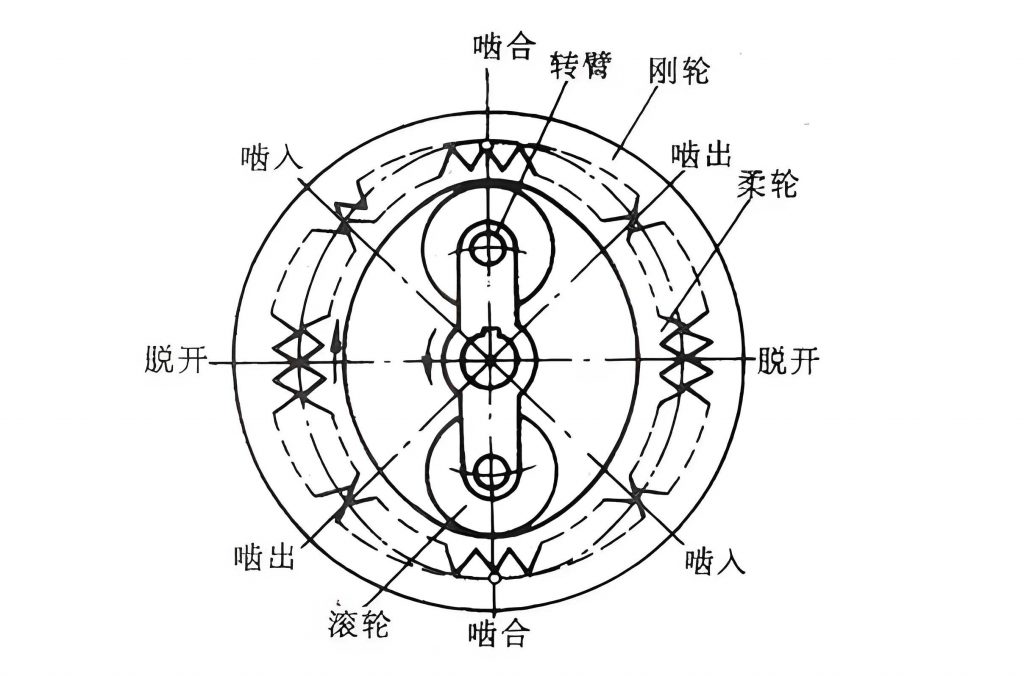
The fundamental operation of a harmonic drive gear involves a rigid circular spline, a flexible flexspline, and a wave generator. The wave generator, typically an elliptical cam or a set of opposing rollers, deforms the flexspline into a non-circular shape, engaging its teeth with those of the circular spline at two diametrically opposite regions. As the wave generator rotates, the points of engagement travel, resulting in a high reduction ratio determined by the difference in the number of teeth between the flexspline and circular spline. The double circular arc profile, consisting of a convex arc near the tooth tip, a concave arc near the root, and a straight-line tangent connecting them, is favored for its favorable contact stress distribution and improved bending strength compared to simpler involute designs. Precise kinematic modeling is essential to predict the true path of contact and the resulting clearance, or backlash, between the teeth under no-load conditions.
Mathematical Modeling of the Harmonic Drive Gear Mesh
To analyze the parametric influences accurately, a precise kinematic model of the harmonic drive gear is established. The analysis is based on the standard assumptions for ideal, no-load conditions: the flexspline is perfectly flexible in the radial direction but inextensible along its neutral curve, and it conforms perfectly to the wave generator’s profile. The complex spatial deformation is treated as a planar problem for each cross-section. Due to the periodicity and symmetry of the deformation, the analysis of the entire gear set can be simplified to studying a single tooth pair over one meshing cycle.
Flexspline Tooth Profile Definition
The double circular arc profile of the flexspline is defined in a local coordinate system \( S_1(O_1-x_1y_1) \), where the origin \( O_1 \) lies on the neutral curve of the undeformed flexspline, with the \( y_1 \)-axis aligned with the tooth’s symmetry line. The profile is parameterized by the arc length \( u \) from the tip (Point A). It comprises three segments:
1. Convex Arc Segment AB (\( u \in [0, l_1] \)):
The radius vector \( \mathbf{r}_1 \) and unit normal vector \( \mathbf{n}_1 \) are given by:
$$ \mathbf{r}_1(u) = \begin{bmatrix} \rho_a \cos(\theta – u/\rho_a) + x_{oa} \\ \rho_a \sin(\theta – u/\rho_a) + y_{oa} \\ 1 \end{bmatrix}, \quad \mathbf{n}_1(u) = \begin{bmatrix} \cos(\theta – u/\rho_a) \\ \sin(\theta – u/\rho_a) \\ 1 \end{bmatrix} $$
where \( \rho_a \) is the convex arc radius, \( \theta \) is its angular span, and \( (x_{oa}, y_{oa}) \) are the coordinates of its center.
2. Common Tangent Segment BC (\( u \in [l_1, l_2] \)):
$$ \mathbf{r}_2(u) = \begin{bmatrix} x_B + (u – l_1) \sin \gamma \\ y_B – (u – l_1) \cos \gamma \\ 1 \end{bmatrix}, \quad \mathbf{n}_2 = \begin{bmatrix} \cos \gamma \\ \sin \gamma \\ 1 \end{bmatrix} $$
Here, \( \gamma \) is the common tangent inclination angle, and \( (x_B, y_B) \) is the transition point from the convex arc.
3. Concave Arc Segment CD (\( u \in [l_2, l_3] \)):
$$ \mathbf{r}_3(u) = \begin{bmatrix} x_{of} – \rho_f \cos(\gamma + (u-l_2)/\rho_f) \\ y_{of} – \rho_f \sin(\gamma + (u-l_2)/\rho_f) \\ 1 \end{bmatrix}, \quad \mathbf{n}_3(u) = \begin{bmatrix} \cos(\gamma + (u-l_2)/\rho_f) \\ \sin(\gamma + (u-l_2)/\rho_f) \\ 1 \end{bmatrix} $$
where \( \rho_f \) is the concave arc radius, and \( (x_{of}, y_{of}) \) are the coordinates of its center. The lengths \( l_1, l_2, l_3 \) are determined by the profile geometry and basic tooth dimensions (module, addendum, dedendum).
Coordinate Systems and Kinematic Relationships
Three coordinate systems are defined for the kinematic analysis. \( S_2(O_2-x_2y_2) \) is fixed to the circular spline. \( S(O-xy) \) is attached to and rotates with the wave generator, with its y-axis along the major axis. \( S_1(O_1-x_1y_1) \) is attached to the flexspline tooth under study, with its origin on the deformed neutral curve. The wave generator profile is elliptical, defined by semi-major axis \(a\) and semi-minor axis \(b\). The radial distance from the wave generator center to a point on the deformed flexspline neutral curve is:
$$ r(\phi_1) = \frac{a}{\sqrt{1 + \epsilon^2 \sin^2 \phi_1}} $$
where \( \phi_1 \) is the angular parameter on the deformed ellipse (measured from the major axis) and \( \epsilon \) is the second eccentricity of the ellipse.
The core kinematic constraint is the inextensibility of the flexspline’s neutral curve. The arc length on the undeformed circular neutral curve (radius \(r_b\)) must equal the corresponding arc length on the deformed elliptical curve:
$$ r_b \phi = \int_{0}^{\phi_1} \sqrt{ r^2(\phi_1) + \left( \frac{dr(\phi_1)}{d\phi_1} \right)^2 } d\phi_1 $$
This establishes a precise, non-linear relationship \( \phi = \Phi(\phi_1) \) between the angular position on the undeformed circle (\( \phi \)) and on the deformed ellipse (\( \phi_1 \)), which can be expressed using elliptic integrals. All subsequent motion parameters are expressed as functions of the independent variable \( \phi_1 \).
Conjugate Tooth Profile Generation
The conjugate tooth profile for the circular spline is generated by enforcing the condition of continuous contact, which requires that the relative velocity at the contact point is orthogonal to the common surface normal. The coordinate transformation from the flexspline system \( S_1 \) to the circular spline system \( S_2 \) is given by the matrix \( \mathbf{M}_{21} \):
$$ \mathbf{M}_{21}(\phi_1) = \begin{bmatrix} \cos \beta & \sin \beta & r \sin \gamma \\ -\sin \beta & \cos \beta & r \cos \gamma \\ 0 & 0 & 1 \end{bmatrix} $$
where \( \beta \) and \( \gamma \) are functions of \( \phi_1 \) derived from the geometry. The conjugate condition can be formulated as:
$$ \mathbf{n}_1^T \cdot \mathbf{\Phi} \cdot \mathbf{r}_1 = 0 $$
with matrix \( \mathbf{\Phi} = \mathbf{W}_{21}^T \frac{d\mathbf{M}_{21}}{d\phi_1} \). Solving this equation numerically for each discrete point \( \mathbf{r}_1(u_j) \) on the flexspline profile yields the corresponding wave generator angle \( \phi_{1j} \) at which that point is in contact. The conjugate point on the circular spline profile is then obtained via transformation:
$$ \mathbf{r}_2^{(j)} = \mathbf{M}_{21}(\phi_{1j}) \cdot \mathbf{r}_1^{(j)} $$
By calculating this for all profile points, the full theoretical conjugate tooth form of the circular spline for the given harmonic drive gear parameters is generated.
Backlash Calculation
Kinematic backlash is defined as the shortest distance between non-contacting, conjugate tooth profiles when the gears are positioned in their theoretical meshing configuration. To compute this, both the flexspline and circular spline profiles are densely discretized into sets of points \( \{ \mathbf{p}_{f,i} \} \) and \( \{ \mathbf{p}_{c,k} \} \), respectively. For a given angular position of the wave generator (\( \phi_1 \)), the flexspline points are transformed into the fixed circular spline coordinate system \( S_2 \). For each transformed flexspline point, the nearest circular spline point is found. The minimum of all these shortest distances, adjusted by the local pressure angle, defines the backlash \( \delta \) at that meshing position:
$$ \delta(\phi_1) = \min_{i} \left( \frac{ \min_{k} || \mathbf{p}_{f,i}^{(2)}(\phi_1) – \mathbf{p}_{c,k} || }{ \cos(\eta_i + \xi_{i,k}) } \right) $$
A negative backlash value indicates tooth profile interference, which is undesirable.
Influence of Flexspline Profile Parameters
The following analysis is based on a harmonic drive gear with fixed fundamental parameters: module \( m = 0.32 \) mm, radial deformation coefficient \( w^*_0 = 1.0 \), gear teeth numbers \( Z_F = 160 \) (flexspline) and \( Z_C = 162 \) (circular spline). The base flexspline profile parameters are: convex radius \( \rho_a = 0.62 \) mm, concave radius \( \rho_f = 0.62 \) mm, and common tangent angle \( \gamma = 11.8^\circ \). Each parameter is varied independently to isolate its effect on the conjugate zone and backlash.
1. Influence on the Conjugate Meshing Zone
The conjugate zone refers to the range of flexspline profile arc length \( u \) for which a real solution to the conjugate condition exists for a given \( \phi_1 \). In double circular arc harmonic drive gears, a phenomenon of double conjugation is often observed, meaning two distinct wave generator angles \( \phi_{1j}^{(1)} \) and \( \phi_{1j}^{(2)} \) satisfy the conjugate condition for a single flexspline point. This leads to two separate conjugate zones (primary and secondary) which enhance torsional stiffness. The goal is to maximize the total conjugate zone and minimize any “dead zone” between them to ensure smooth load transfer.
Effect of Convex Arc Radius (\( \rho_a \)):
As shown in the analysis, reducing \( \rho_a \) significantly increases the arc length of the flexspline profile that participates in the conjugate meshing, particularly in the secondary zone. A smaller \( \rho_a \) makes the tooth tip sharper, allowing it to maintain contact over a wider range of wave generator motion. However, the blank (non-conjugate) zone between the primary and secondary zones remains largely unaffected by changes in \( \rho_a \).
Effect of Concave Arc Radius (\( \rho_f \)):
Variations in \( \rho_f \) have a negligible impact on the conjugate zone associated with the convex arc and the common tangent. The primary influence is a slight reduction in the secondary conjugate zone length on the concave arc itself as \( \rho_f \) increases. The blank zone is again largely insensitive to this parameter.
Effect of Common Tangent Angle (\( \gamma \)):
This parameter has the most pronounced effect on the conjugate zone structure. Increasing \( \gamma \) reduces the conjugate arc length on the convex segment, increases it on the concave segment, and critically, expands the blank zone between the primary and secondary zones. A large blank zone is detrimental as it reduces the number of teeth sharing the load at certain positions. Therefore, a smaller \( \gamma \) is generally preferred to maximize the continuous conjugate action in a harmonic drive gear.
The trends are summarized in the table below:
| Parameter Change | Effect on Conjugate Zone (Convex Arc) | Effect on Conjugate Zone (Concave Arc) | Effect on Blank Zone |
|---|---|---|---|
| Decrease \( \rho_a \) | Significant Increase | Minor Change | Negligible Change |
| Increase \( \rho_f \) | Negligible Change | Minor Decrease | Negligible Change |
| Increase \( \gamma \) | Decrease | Increase | Significant Increase |
2. Influence on the Theoretical Circular Spline Profile
The conjugate circular spline profile generated by the flexspline is not a perfect double circular arc. However, its shape can be approximated by best-fit circular arcs. The parameters of these fitted arcs (radii and center coordinates) are influenced by the original flexspline parameters.
| Flexspline Parameter Changed | Effect on Circular Spline Concave Arc | Effect on Circular Spline Convex Arc |
|---|---|---|
| Increase \( \rho_a \) | Radius increases significantly; center shifts. | Radius nearly constant; center shifts noticeably. |
| Increase \( \rho_f \) | Radius and center remain virtually constant. | Radius increases significantly; center shifts. |
| Increase \( \gamma \) | Radius and center show very minor changes. | Radius and center show very minor changes. |
The analysis reveals a complementary relationship: the flexspline’s convex arc primarily governs the circular spline’s concave arc parameters, and vice-versa. The common tangent angle \( \gamma \) has minimal direct effect on the geometry of the generated circular spline tooth form in the harmonic drive gear.
3. Influence on Kinematic Backlash
The distribution of backlash across the multiple simultaneously engaged tooth pairs is crucial for smooth operation. The following trends are observed for the harmonic drive gear under study:
Effect of Convex Arc Radius (\( \rho_a \)):
Increasing \( \rho_a \) leads to a reduction in the magnitude of backlash for tooth pairs away from the major axis of the wave generator. The backlash distribution becomes more uniform. However, there is a trade-off: as \( \rho_a \) increases beyond an optimal point (which depends on other parameters), the risk of tooth interference (negative backlash) increases, especially near the major axis. Conversely, a smaller \( \rho_a \) increases backlash but provides a larger safety margin against interference.
Effect of Concave Arc Radius (\( \rho_f \)):
Increasing \( \rho_f \) has a similar effect to increasing \( \rho_a \): it reduces backlash and improves uniformity in the distribution for tooth pairs not immediately adjacent to the wave generator’s major axis. Again, excessive increase can lead to interference.
Effect of Common Tangent Angle (\( \gamma \)):
This parameter has the most direct and global impact on backlash. Increasing \( \gamma \) causes a substantial increase in backlash across almost all engaged tooth pairs and makes the distribution less uniform. A smaller \( \gamma \) consistently yields lower and more evenly distributed backlash, which is highly desirable for precision harmonic drive gear applications.
The interplay between parameters for optimal backlash control is summarized below:
| Design Objective | Recommended Parameter Adjustment | Associated Trade-off / Risk |
|---|---|---|
| Reduce Backlash Magnitude | Increase \( \rho_a \) or \( \rho_f \); Decrease \( \gamma \). | Increased risk of interference (for \( \rho_a, \rho_f \)). Reduced conjugate zone on convex arc (for \( \gamma \)). |
| Improve Backlash Uniformity | Increase \( \rho_a \) or \( \rho_f \); Decrease \( \gamma \). | Same as above. |
| Maximize Conjugate Zone | Decrease \( \rho_a \); Decrease \( \gamma \). | Increased backlash magnitude. |
| Avoid Interference | Use moderately small \( \rho_a \) and \( \rho_f \). | May result in higher backlash. |
Discussion and Synthesis
The design of a double circular arc harmonic drive gear is a multi-objective optimization problem. The parameters \( \rho_a \), \( \rho_f \), and \( \gamma \) do not act in isolation but interact to define the meshing performance. A key finding is the distinct role of the common tangent angle \( \gamma \). It acts as a primary control for backlash: minimizing \( \gamma \) is the most effective way to reduce and homogenize backlash. Simultaneously, a smaller \( \gamma \) eliminates the undesirable blank zone in the conjugate meshing cycle, promoting continuous engagement and better load sharing among teeth. However, an excessively small \( \gamma \) might constrain the design of a strong tooth profile.
The arc radii \( \rho_a \) and \( \rho_f \) offer a more nuanced control. They significantly influence the conjugate zone size (particularly \( \rho_a \)) and the generated circular spline geometry. Their adjustment is the primary method for fine-tuning the tooth contact pattern and stress distribution after the backlash has been broadly set by \( \gamma \). Increasing them improves backlash but at the cost of a reduced conjugate zone for \( \rho_a \) and an increased risk of interference for both. Therefore, the selection of \( \rho_a \) and \( \rho_f \) must balance the desire for low backlash with the need for a robust, interference-free mesh and a wide load-bearing contact zone in the harmonic drive gear.
A practical design approach would involve:
- Setting the common tangent angle \( \gamma \) to a relatively low value (within manufacturing and strength limits) to establish a baseline of low, uniform backlash and a continuous conjugate zone.
- Selecting initial values for \( \rho_a \) and \( \rho_f \) based on geometric constraints (tooth height, clearance).
- Using the precise kinematic model to calculate the conjugate zones and backlash distribution.
- Iteratively adjusting \( \rho_a \) and \( \rho_f \) to eliminate any interference while pushing towards the smallest possible backlash that still maintains an acceptably large conjugate zone for the intended load.
This systematic parametric study enables the design of high-performance harmonic drive gears tailored for applications requiring exceptional positional accuracy and high torque capacity.
Conclusion
This investigation into the parametric influence on the kinematic behavior of double circular arc harmonic drive gears establishes clear relationships between flexspline tooth profile geometry and critical performance metrics. The convex arc radius \( \rho_a \), the concave arc radius \( \rho_f \), and the common tangent inclination angle \( \gamma \) are decisive factors.
1. The common tangent angle \( \gamma \) is the most significant parameter for controlling backlash. Reducing \( \gamma \) effectively minimizes backlash, improves its distribution uniformity, and expands the conjugate meshing zone by reducing the blank zone, thereby enhancing the load-sharing capability of the harmonic drive gear.
2. The convex arc radius \( \rho_a \) strongly influences the size of the conjugate zone; a smaller \( \rho_a \) increases it but tends to increase backlash. It primarily determines the geometry of the circular spline’s concave flank.
3. The concave arc radius \( \rho_f \) has a minor effect on the conjugate zone but a notable impact on backlash reduction and the geometry of the circular spline’s convex flank.
4. An optimal design requires a balanced compromise. A strategy favoring a relatively small \( \gamma \) for backlash and continuity control, combined with carefully optimized values of \( \rho_a \) and \( \rho_f \) to fine-tune the contact pattern and avoid interference, will yield a harmonic drive gear with superior transmission characteristics: high precision, high torsional stiffness, and smooth operation under load.